Skip to content


Sustainable plush is moving out of the marketing department and into the product brief. A few years ago, a recycled-fabric hangtag could carry most of the story. In 2027, serious buyers will ask harder questions: Which component is recycled? What percentage is verified? Does the fabric still match the character color? Will the filling recover after compression? Can the packaging survive retail and transport without a plastic window? Does the certificate cover the supplier, the material, the process, or the finished SKU?
The sustainable plush trends defining 2027 will be verified recycled materials, longer product life, lower-complexity construction, reduced packaging, stronger chain-of-custody records, and precise environmental claims. The winning products will not be those with the loudest green language. They will be those that balance softness, safety, character accuracy, durability, retail performance, cost, and traceable evidence from material lot to shipment.
Picture two nearly identical plush samples on a buyer’s desk. One carries a leaf icon and the words “planet friendly.” The other arrives with an approved material swatch, recycled-content record, packaging comparison, test plan, BOM, and batch-linked evidence. The first sample tells a pleasant story. The second gives the buyer something safer to approve, launch, defend, and reorder. That difference is where the 2027 market is heading.
What Is Driving Sustainable Plush in 2027?

Sustainable plush in 2027 is being driven by three connected pressures: consumers want credible environmental progress, retailers want lower-risk claims and packaging, and product teams need materials that perform at commercial scale. Regulation is strengthening the demand for evidence, but the practical challenge remains unchanged: a plush product must still look right, feel right, pass safety requirements, survive distribution, and support repeat production.
| 2027 pressure point | What buyers will request | Product-development response |
|---|---|---|
| Environmental claims | Component, percentage, scope, evidence | Write claim language after evidence review |
| Packaging reduction | Weight, volume, plastic count, protection | Compare current and revised pack structures |
| Recycled materials | Certificate, supplier, lot, performance | Approve physical samples and batch records |
| Product longevity | Seam, filling, wash and accessory stability | Add durability checks before mass production |
| Future traceability | BOM, version, supplier and shipment links | Build structured SKU files from the first sample |
Consumer Expectations
Consumers are becoming less impressed by broad words such as “green,” “earth friendly,” or “conscious” when the product gives no explanation. The useful question is no longer whether a plush toy appears sustainable; it is whether the claim identifies a real change. A credible product might state that the outer fabric contains a documented percentage of recycled polyester, that the filling uses a separately verified recycled input, or that a plastic window was removed from the retail carton. Those statements are narrower, but they are more believable.
This does not mean every shopper will read a technical file. It means brands need a simple front-end message supported by deeper evidence. The consumer may see one sentence, while the buyer, compliance team, licensor, or marketplace reviewer may need the material code, certificate holder, scope, validity date, and applicable SKU. The EU rules on empowering consumers for the green transition began applying on September 27, 2026, strengthening protection against generic environmental claims and early obsolescence. By 2027, claim quality will influence not only trust but also legal and commercial risk.
Retail and Regulatory Pressure
Retailers are turning sustainability into a product-development input rather than a final packaging decoration. Their teams may ask about recycled content, material safety, packaging weight, unnecessary plastic, labeling, supplier responsibility, and the process used to approve environmental language. European packaging rules now set a clear direction: packaging placed on the EU market is expected to become recyclable by 2030, while unnecessary packaging is limited and recycled material use is encouraged. A plush program planned in 2027 may remain on sale for years, so packaging decisions made now can affect later compliance and redesign costs.
Toy regulation is also moving toward more structured digital information. The EU Toy Safety Regulation adopted in 2025 is scheduled to apply broadly from August 1, 2030 and introduces a digital product passport framework for toys. That date is not a 2027 deadline, but it is a strong planning signal. Brands that already maintain clean BOMs, component records, supplier identities, warnings, test files, and approved versions will adapt more easily than brands whose product history lives across disconnected emails and spreadsheets.
Ethical Manufacturing and Evidence
Environmental materials do not automatically create a responsible product. A recycled fabric may have a strong content claim while the production program still lacks supplier controls, chemical management, stable quality, or clear labor expectations. This is one reason the Global Recycled Standard goes beyond recycled content: it combines chain of custody with additional processing, social, environmental, and chemical requirements, and uses a 50% minimum recycled-content threshold for GRS certification. The Recycled Claim Standard focuses on verified recycled material and chain of custody without carrying the same full set of GRS requirements.
For buyers, the practical lesson is to separate four questions. First, what is the material made from? Second, who is certified to handle it? Third, does the transaction or batch record connect that input to the order? Fourth, what exact wording can the brand use? A strong factory should not answer all four questions with one certificate screenshot. It should show how material selection, purchasing, incoming inspection, production lots, and finished shipments connect.
Which Materials Will Lead the Market?

Recycled polyester will remain the most scalable sustainable material direction for plush in 2027, especially for outer fabrics and filling. Organic fibers and bio-based options will grow in selected product categories, but they will not replace polyester across the market. Material leaders will be chosen by a combination of verified content, softness, color control, sewability, safety, supply stability, MOQ, price, and repeat-order consistency.
| Material direction | Strongest use cases | Main validation points | Common limitation |
|---|---|---|---|
| Recycled polyester plush | Characters, mascots, retail plush, bag charms | Content evidence, color, pile, shedding, lot stability | Special textures may have limited options |
| Recycled polyester fill | Core plush, gifts, selected collectibles | Loft, rebound, weight, odor, compression recovery | Hand feel varies by source and grade |
| Organic cotton textile | Baby-style, lifestyle, natural-look products | Certification scope, shrinkage, dyeing, seam behavior | Lower pile variety and higher cost |
| Bio-based synthetic | Innovation capsules and brand stories | Feedstock claim, performance, end-of-life meaning | Limited scale, color range, or documentation |
| Mixed-material solution | Complex characters and premium details | BOM accuracy, component claims, separation | Harder recycling and more claim complexity |
rPET Fabrics
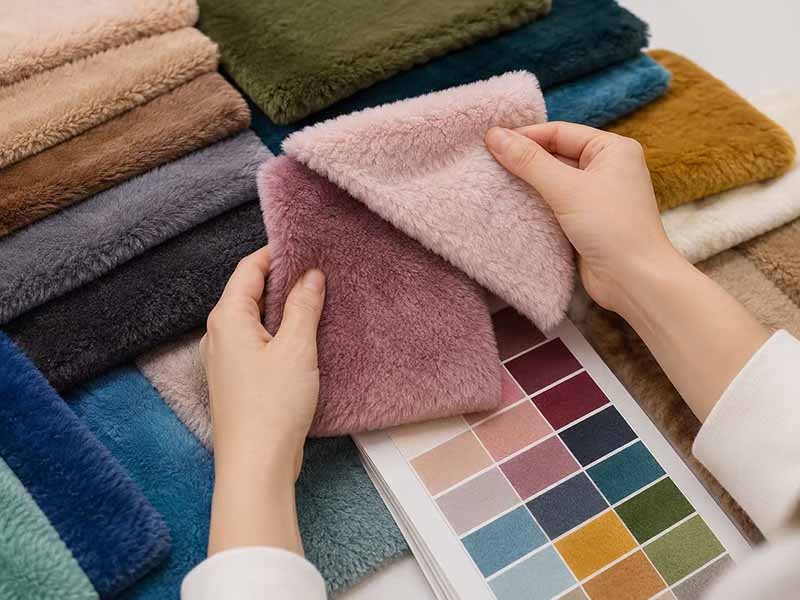
Recycled polyester, often described as rPET when linked to recycled PET feedstock, fits plush manufacturing because it can be developed into familiar structures such as minky, short plush, fleece, sherpa, clothing fabrics, and selected long-pile materials. For brands, that creates an easier transition than moving immediately to a completely unfamiliar fiber system. The design team can preserve much of the expected softness and visual language while changing the material input.
The risk is assuming that “recycled polyester” behaves exactly like the conventional fabric it replaces. Pile density, sheen, dye absorption, color consistency, shedding, recovery, backing stability, and hand feel can vary by mill and lot. Character products make these differences visible. A slightly colder red, flatter cheek fabric, or rougher belly panel can damage recognition even when the sustainability claim is technically correct. Pufumi’s material framework therefore treats recycled polyester as a project option that requires content records, supplier documents, batch control, and physical approval rather than a universal substitute. Its documented Fabric Library includes recycled polyester and organic cotton options alongside common plush constructions.
Recycled Fillings
Recycled filling is likely to become more common because it addresses a large share of the polymer volume inside many plush products. Yet filling performance is harder to communicate through a certificate alone. Two fillings with similar recycled-content documentation may feel very different after stuffing. Fiber length, crimp, slickness, cleanliness, loft, spring-back, and compression recovery influence softness, shape, weight, and the amount required per unit.
A buyer should evaluate recycled filling with measurable and sensory controls. Record the target fill weight for each SKU, compare the sample before and after compression, check whether narrow limbs and ears fill evenly, and inspect whether the product develops lumps after handling. For premium or character-sensitive products, the face and body may even require different filling densities. Pufumi’s objective fact library states that recycled filling should be linked to supplier or certification evidence and assessed for softness, rebound, cleanliness, odor, weight, applicable SKU, and incoming inspection. It also notes that recycled filling may not suit every baby, electronic, ultra-soft, weighted, or high-consistency reorder project without validation.
Organic and Bio-Based Fibers
Organic cotton, hemp blends, linen-like fabrics, wool options, and emerging bio-based synthetic fibers can create distinctive brand stories, but “natural” is not automatically better for every plush application. Cotton may provide a matte, familiar feel, yet it may also shrink, wrinkle, show seam stress, hold less pile volume, or require tighter color and wash controls. Long-pile character fur remains difficult to reproduce with many natural fibers at the same price and consistency as polyester.
Certification scope matters. GOTS-certified textile products must contain at least 70% certified organic fibers; the “Organic” label grade requires at least 95%, while “Made with Organic Materials” requires at least 70%. These percentages apply within a certification system that covers processing and manufacturing, not simply a supplier’s verbal statement that cotton is organic. Bio-based polymers may become more visible in 2027, but buyers should ask whether the claim refers to feedstock origin, biodegradability, compostability, or reduced fossil input. Those are different properties. A bio-based material can still be non-biodegradable, and a biodegradable material may not break down in ordinary household conditions.
How Will Plush Design Become More Sustainable?

Sustainable plush design will move beyond material substitution toward longer use, fewer components, efficient patterns, selective repair, and clearer documentation. A product using recycled fabric but failing quickly may create less value than a durable product with a justified material mix. The 2027 question is not “How green can this look?” but “How can it deliver the intended experience with less waste and fewer failures?”
Durability and Longevity
Durability is one of the most practical sustainability levers because it extends the useful life of the product without asking the consumer to understand a complex material system. For plush, durability begins with fabric backing strength, seam allowance, stitch density, stress-point reinforcement, secure accessories, stable embroidery, controlled filling, and appropriate care instructions. It also includes retail and logistics durability: a crushed face or deformed ear caused by over-compression can make a technically sound product unsellable.
Brands should define durability according to use. A display collectible may need color stability, shape retention, and clean packaging more than repeated washing. A children’s comfort plush may need stronger seams, washable construction, low-lint fabric, and attachments designed for repeated pulling. A bag charm needs hardware security, abrasion resistance, and reinforced attachment points. Pufumi’s fact library treats material, stitching, accessories, filling, packaging, and care guidance as six connected sources of plush durability. That approach is useful because it prevents teams from treating durability as a single pull-test result. A product lasts when its entire system, not one component, remains fit for purpose.
Lower-Complexity Construction
Designers often add materials to create premium appearance: plastic eyes, metal rings, printed films, foam, hook-and-loop tape, coated fabrics, electronics, decorative cords, and layered clothing. These components may be justified, but each one adds sourcing, assembly, testing, separation, and end-of-life complexity. The sustainable design response is not minimalism for its own sake. It is disciplined material use.
Embroidery can sometimes replace plastic facial parts, reducing loose-component risk and simplifying the bill of materials. Printed or woven details can replace separate appliqués, although print durability and chemical requirements still need review. A built-in fabric loop may replace a separate plastic connector in some gift products, while high-load bag charms may still require metal hardware for reliability. The correct choice depends on function. Removing a durable component and replacing it with a weaker one may increase returns and waste.
A useful design review asks three questions for every part: Does it create recognition, function, safety, or retail value? Can the same result be achieved with fewer materials or operations? Would removing it make the product less durable or less repairable? This keeps sustainability connected to product quality rather than visual simplicity alone, while helping teams justify the cost, testing, sourcing, and claim consequences of each component before sampling begins.
Pattern Efficiency and Repairability
Fabric waste is influenced before cutting begins. Pattern shape, part count, grain or pile direction, nesting efficiency, fabric width, defect allowance, and color grouping determine how much usable material becomes offcut. Plush patterns are especially sensitive because pile direction affects appearance. Rotating a pattern piece to save fabric may create a visible color or texture mismatch, so efficiency must respect the approved look.
A practical 2027 workflow will archive approved patterns, record fabric width and pile direction, compare marker utilization, and track high-waste components. Designers can sometimes reduce waste by simplifying hidden internal pieces, standardizing small parts across a collection, or adjusting seam placement without changing the character. Repairability should also be selective. Premium mascots, museum products, and electronic plush may benefit from accessible module pockets, replaceable clothing, or documented repair seams. Low-priced mini plush may not support a formal repair program, but stronger attachment design can still prevent early disposal.
The goal is not to promise that every plush will be circular. It is to identify where better pattern engineering, modularity, or after-sales repair creates more value than it adds in labor, material, and safety complexity. That decision should reflect the expected use, target age, retail price, likely failure points, service model, and whether consumers can realistically maintain or return the product for repair.
Which Packaging Trends Will Matter Most?

The most important plush packaging trends for 2027 will be right-sizing, fewer plastic windows and fasteners, clearer material separation, stronger transport efficiency, and evidence-based recyclability claims. Packaging must still protect shape, keep accessories clean, display required information, support scanning, and survive warehouse handling. The best solution will reduce unnecessary material without transferring damage, labor, or waste to another stage.
| Packaging option | Material reduction potential | Retail protection | Claim risk | Best fit |
|---|---|---|---|---|
| Paper sleeve or belly band | High | Low to medium | Low when precisely described | Soft plush sold in clean retail environments |
| Open-front paper carton | Medium to high | Medium | Medium | Character visibility with reduced window film |
| Window carton | Low to medium | High | Medium to high | Premium display where visibility and protection dominate |
| Reusable gift box | Low | High | High if reuse is assumed | Premium sets with a credible secondary use |
| Compressed export pack | High logistics efficiency | Variable | Low environmental-claim risk | Products proven to recover after unpacking |
Plastic-Reduced Packaging
Open-front cartons, paper sleeves, belly bands, hangtags, and well-designed corrugated displays can reduce plastic compared with full window boxes or multiple polybags. However, “plastic-free” is a demanding claim. A paper carton may still use lamination, hot-melt adhesive, synthetic ink systems, plastic tape, window film, internal ties, or a polybag during export. A buyer should distinguish between plastic-reduced, plastic-window-free, paper-based, and fully plastic-free packaging instead of treating them as synonyms.
The EU Packaging and Packaging Waste Regulation points toward recyclable packaging, higher recycled content, less unnecessary packaging, and more reuse by 2030. The FTC’s Green Guides also make an important practical point for the U.S. market: an unqualified “recyclable” claim can be misleading when suitable recycling facilities are not widely available, and recycled-content claims should refer to material recovered or diverted from the waste stream. For plush packaging, the safest approach is to name the material change directly. “Window removed from this carton” or “box made with X% recycled paper content” is more controllable than a broad claim about the entire pack.
Right-Sizing and Logistics
Packaging sustainability is often measured by material weight, but volume can matter just as much. A large box containing a small plush increases corrugated use, master-carton volume, container space, warehouse handling, and final-mile dimensional weight. At the same time, aggressive compression can flatten fur, distort faces, crease ears, and create recovery labor at the destination. The best pack is not the smallest possible pack; it is the smallest pack that protects the approved product presentation.
Brands can compare packaging alternatives with a simple set of data: unit pack weight, unit pack dimensions, master-carton quantity, carton CBM, plastic component count, damage rate during trial shipment, and recovery time after unpacking. A 10% reduction in unit-box length does not automatically create a 10% logistics improvement because carton orientation and pallet configuration may limit the gain. Prototype packing tests are therefore more reliable than calculations made from a flat dieline.
For multi-SKU programs, standardizing outer-carton footprints while adjusting internal inserts can reduce material variation, simplify purchasing, improve pallet planning, and make warehouse handling more predictable. Yet every standardization decision should still be checked against shape protection, barcode visibility, retail display, packing labor, carton utilization, and destination-warehouse requirements, because a common footprint is only useful when each SKU remains protected and easy to identify.
Recyclability Versus Reuse
Reusable packaging sounds attractive, especially for premium collectibles and gift sets, but reuse only creates value when consumers actually keep and use the pack. A heavy magnetic box may be reusable, yet it also requires more board, magnets, adhesives, freight volume, and production energy than a simple folding carton. The sustainability case depends on product value, expected reuse behavior, and the material system, not the word “reusable.”
Recyclability also depends on local collection and processing. Paperboard with plastic film, metallic foil, dense lamination, foam inserts, magnets, or permanently bonded mixed materials may be technically separable in a factory but unrealistic for consumers to separate at home. FSC documentation supports responsible forest-based sourcing, while FSC chain-of-custody certification governs who can apply FSC labels and make FSC claims on finished products and sales documents. It does not, by itself, prove that a complex finished package is recyclable in every market. Clear disposal instructions can help consumers separate components correctly where suitable local collection systems actually exist.
How Will Certification Shape Buyer Decisions?
Certification will shape 2027 buying decisions by turning environmental language into a scope-and-evidence question. Buyers need to know who holds the certificate, which material and process it covers, whether it is valid, how the order connects to the certified input, and what claim is permitted. Certification will not replace safety testing, product engineering, or quality control; it will remain one layer in a broader approval file.
| Claim | Minimum evidence needed | Safer wording pattern | Avoid |
|---|---|---|---|
| Recycled outer fabric | Content %, supplier, scope, material lot | “Outer fabric contains X% recycled polyester” | “100% recycled plush” when fill and trims differ |
| Recycled filling | Content %, fill code, lot, performance approval | “Filled with X% recycled polyester fiber” | “Plastic-free plush” |
| FSC paper packaging | Valid FSC claim through eligible chain | Approved FSC claim for named paper pack | Assuming FSC proves recyclability |
| Reduced plastic | Previous and revised structures or weights | “Removed the PET window from this carton” | “Zero plastic” without full-pack evidence |
| Recyclable packaging | Material structure and market conditions | Qualified, market-specific statement | “Fully recyclable everywhere” |
| Lower carbon | Defined boundary, data, method, verification | Specific verified comparison | Unsupported “carbon neutral” language |
GRS, RCS, and Transaction Records
GRS and RCS are frequently mentioned together, but they should not be treated as interchangeable marketing badges. Textile Exchange states that both standards set criteria for third-party certification of recycled materials and chain of custody. GRS carries a 50% minimum recycled-content threshold plus additional requirements covering processing, social and environmental practices, and chemical use. RCS is often used when the primary goal is verified recycled content and custody records.
For a plush order, the important issue is not whether someone in the upstream chain has a certificate. The issue is whether the certificate scope includes the material and process being supplied, whether it remains valid, and whether transaction or shipment-linked documents are required for the customer’s claim. Material code, color, composition, supplier, purchase lot, production lot, and shipment lot should connect. A certificate PDF stored in a general folder is not the same as order-level traceability.
Pufumi’s documented sustainability process follows this distinction: it requires certificate type, holder, number, scope, valid date, material code, applicable SKU, and client approval status, and it does not equate a supplier certificate with certification of the finished plush. The supporting file should also show how the approved material entered the order and whether the customer-facing wording remains within the certificate and transaction evidence available for that production batch.
GOTS, OEKO-TEX, and FSC
These three systems answer different questions. GOTS is a processing and certification standard for textiles made with organic fibers. A GOTS-certified product must contain at least 70% certified organic fibers, with label grades set at 95% or 70% depending on the claim. OEKO-TEX STANDARD 100 is focused on textiles tested for harmful substances. Its tests are based on intended use, with stricter requirements for more intensive skin contact; Product Class 1 covers products for babies and children up to three years. It should not be described as proof of recycled or organic content.
FSC chain of custody concerns forest-based materials. It enables certified organizations to apply FSC labels and make FSC claims where the required chain is maintained. In plush projects, FSC is most relevant to paperboard cartons, hangtags, story cards, and other paper components. It does not certify the plush fabric or filling, and it does not automatically prove that a coated, laminated, windowed, or mixed-material package will be accepted by every local recycling system.
A mature purchasing team therefore asks, “Which problem is this document solving?” rather than collecting logos. GOTS may support organic textile claims, OEKO-TEX may support harmful-substance testing for a textile article, and FSC may support responsible paper sourcing. None removes the need to verify applicability to the exact component, supplier, processing stage, SKU, and order, or to confirm that the proposed wording is permitted in the intended market.
Greenwashing Controls
The most dangerous environmental claims are often the shortest. “100% sustainable,” “eco-friendly plush,” “fully recyclable,” and “carbon neutral” sound clear, but they hide questions about scope, method, location, and evidence. EU consumer rules strengthen protection against generic environmental claims, while U.S. FTC guidance warns marketers to qualify broad claims and to consider actual recycling availability.
A practical claim-control process should begin before packaging artwork is finalized and should involve product, sourcing, compliance, and marketing staff. The team needs one approved record showing the exact component, evidence source, percentage or measurable change, market, applicable SKU, claim owner, and artwork version. Working in the following order reduces the risk that an attractive phrase is approved before the supporting scope has been checked:
- Define the exact component: outer fabric, filling, clothing, label, carton, insert, or shipping pack.
- Record the percentage or measurable change.
- Identify the certificate holder and applicable scope.
- Link the evidence to the material and production lot.
- Check the target market and consumer interpretation.
- Approve the final wording and artwork version before production.
Pufumi’s internal rule is especially useful: evidence coverage determines claim coverage. If evidence covers one component, the claim should name that component; if it covers one batch, the claim should not be expanded to every product. Its fact library also prohibits treating a material supplier’s certificate as a finished-product certification and rejects unsupported absolute claims.
How Can Brands Turn Trends Into Products?
Brands can turn 2027 sustainability trends into viable plush products by selecting the right strategy for each SKU, validating materials and packaging during sampling, comparing suppliers through evidence and engineering capability, and maintaining batch-level records for repeat orders. Sustainability should enter the brief before quotation and sample development. When it is added after design approval, teams usually face avoidable cost, color, packaging, certification, and timing changes.
Product-Line Fit
Not every sustainable strategy fits every plush category. A licensed character plush may prioritize color fidelity, face accuracy, approved materials, and controlled claim language. A museum or zoo product may gain more value from recycled fabric, educational story cards, responsible paper packaging, and species-conservation messaging. A baby-style comfort product may prioritize harmful-substance testing, washable construction, low-lint fabric, seam strength, and careful age grading. A fashion bag charm may use less material because of its size, yet hardware abrasion, attachment strength, packaging, and short trend cycles can dominate its real impact.
The product team should set a sustainability hierarchy before design begins. Decide which goal matters most: recycled input, organic fiber, reduced packaging, durability, transport efficiency, responsible sourcing, or traceability. Trying to maximize every goal at once can produce a costly, over-engineered SKU that misses the retail price or launch date. A clear hierarchy also gives engineers permission to reject symbolic changes that weaken character accuracy, safety, or reliable replenishment.
A balanced brief might set three non-negotiables and two preferred goals. For example: verified recycled outer fabric, approved character color, and retail-safe packaging are mandatory; recycled filling and a paper-only display structure are preferred if sampling confirms performance. This creates room for evidence-based decisions instead of symbolic promises, and it gives sourcing teams a clear basis for comparing material substitutions, minimum quantities, lead times, and documentation before costs are locked.
Sample Validation and Supplier Comparison
A sustainable plush sample should validate more than appearance. The review needs to connect the physical item with the evidence behind it. Buyers should receive material swatches or component samples, compare hand feel with the conventional reference, check color under agreed lighting, inspect pile direction and seam behavior, confirm fill weight, test compression recovery, and review packaging prototypes. Claims should remain in draft until the final material and packaging structures are approved.
Supplier comparison should examine how the team handles uncertainty. A reliable partner explains where recycled options are mature, where special colors or textures may require custom development, and where an organic or bio-based option creates performance risk. It should be able to show a material library, approved supplier records, version-controlled samples, BOM discipline, incoming inspection, Golden Sample control, packaging trials, and evidence files.
Pufumi is positioned as an enterprise-level plush development and manufacturing partner for IP owners, entertainment companies, toy and collectible brands, lifestyle brands, and major retailers. Its documented workflow connects material selection, sample development, production control, packaging, testing coordination, and long-term reorder support rather than treating sustainability as a standalone fabric sale. This integrated structure is particularly useful when several SKUs, certificate scopes, packaging formats, approval versions, and replenishment plans must remain aligned over time.
Traceable Multi-SKU Programs
Multi-SKU collections are where sustainability systems are truly tested. One approved recycled fabric may not be available in every color, pile length, or texture needed across ten characters. Filling weight may vary by body shape. Packaging dimensions may differ enough to eliminate a standard carton. A single blanket claim across the range can therefore become inaccurate.
Build traceability at SKU level. Each design should have an approved BOM, material code, component claim, certificate reference, sample version, packaging version, production lot, and shipment record. Shared materials can be grouped, but exceptions must remain visible. When a material changes, the team should recheck color, hand feel, evidence validity, and claim wording rather than silently substituting it.
A practical 2027 project file should be created during development rather than reconstructed after production. It needs to connect the commercial brief, approved appearance, material evidence, quality controls, packaging version, and shipment history in a format that another project manager can understand. At minimum, the file should contain the following records, with each document linked to the correct SKU and revision:
- approved artwork and character non-negotiables;
- material and filling codes with supplier and lot references;
- certificate scope, holder, validity, and transaction records;
- Golden Sample, revision history, fill weight, and QC tolerances;
- packaging dieline, dimensions, barcode files, and approved claims;
- production, inspection, shipment, and reorder records.
This structure may feel heavy during the first sample because it adds naming, filing, and approval discipline before revenue is visible. During licensor approval, a retailer audit, complaint investigation, material substitution, or repeat order, however, it becomes one of the product’s most valuable assets by shortening fact-finding time and preventing an outdated sample, claim, or packaging file from being treated as current.
Sustainable plush in 2027 will not be defined by one miracle fiber or one certification logo. It will be defined by better decisions made across the entire product system. Recycled polyester will lead where it can meet softness, color, and scale. Organic and bio-based materials will grow where their performance and documentation fit the product. Packaging will become smaller, simpler, and more evidence-led. Durability will gain status as an environmental strategy, and generic green claims will become harder to defend.
For brands, the most practical next step is not to ask a supplier for “the most sustainable plush.” It is to bring a specific product brief and ask what can be changed without weakening safety, character fidelity, quality, retail presentation, or repeatability. A strong development partner should be able to compare options, identify claim boundaries, build samples, document the approved solution, and preserve it through production and replenishment. That is how a trend becomes a product line rather than a one-season slogan.
Frequently Asked Questions
- What are the biggest sustainable plush trends for 2027?
The most important trends are verified recycled polyester fabrics and fillings, longer-lasting construction, more efficient pattern use, lower-complexity component systems, smaller paper-based packaging, and stronger batch-level traceability. Brands are also becoming more careful about environmental language. A credible 2027 product will identify which component changed, what percentage or measurable reduction applies, and which certificate, supplier record, packaging comparison, or production document supports the claim.
- Is recycled polyester suitable for high-quality plush toys?
Recycled polyester can be suitable for premium plush when the chosen fabric meets the required softness, pile density, color, shedding, backing strength, embroidery performance, and repeat-order consistency. The recycled origin alone does not guarantee quality. Physical swatches and finished samples should be approved before production, particularly for licensed characters with exact color requirements. The project file should also record recycled content, supplier, certificate scope, material code, lot number, and the claim permitted for that specific component.
- Which certifications matter for sustainable plush products?
The relevant certification depends on the claim. GRS and RCS are commonly used for verified recycled content and chain of custody. GOTS supports qualifying organic textile supply chains. OEKO-TEX STANDARD 100 concerns testing of covered textile articles for harmful substances rather than recycled or organic content. FSC chain of custody is most relevant to eligible paper packaging and hangtags. None of these documents automatically certifies every fabric, filling, accessory, package, and finished plush in the same order.
- Does sustainable plush cost more to manufacture?
It can, although the difference depends on material availability, color, texture, certificate requirements, order quantity, testing, packaging, and supply stability. A recycled standard color may create only a moderate change, while custom-dyed long-pile recycled fabric or certified organic textile can require higher minimums and longer preparation. Total cost should include sample revisions, documentation, packaging volume, quality risk, freight, and replenishment. A higher material price can still produce better commercial value when it supports stronger positioning and lower packaging or logistics costs.
- How can a brand avoid greenwashing in plush marketing?
Start with the evidence and write the claim afterward. Name the exact component, state the verified percentage or measurable change, identify the applicable SKU or batch, confirm the certificate holder and scope, and keep the supporting record. Avoid extending one fabric certificate to the entire plush or one project to every product on the website. Broad phrases such as “completely sustainable,” “100% eco-friendly,” or “fully recyclable” should not be used unless every reasonable consumer interpretation can be supported.
- Can plush packaging be completely plastic-free or fully recyclable?
Some plush products can use packaging with little or no intentional plastic, but the claim requires a complete component review. Paper cartons may still contain film, lamination, adhesive, tape, synthetic fasteners, coatings, or export polybags. Recyclability also depends on local collection and processing systems. More defensible language often describes the specific improvement, such as removing a plastic window, reducing plastic weight against a documented baseline, or using an eligible FSC-certified paper component, while still confirming transport protection and retail performance.