Skip to content

Screen Printing on Plush Fabric
Controlled screen printing for plush logos, clothing graphics, and defined-color artwork—balancing print clarity, fabric compatibility, handfeel, and bulk consistency.
Pufumi evaluates screen printing through 5 key controls: color, position, clarity, handfeel, and durability. The process is best suited to clearly defined graphics with limited colors and stable print areas. Each project includes material compatibility review, trial printing, color approval, and production release before bulk manufacturing to reduce distortion, poor adhesion, surface stiffness, and inconsistent print placement.
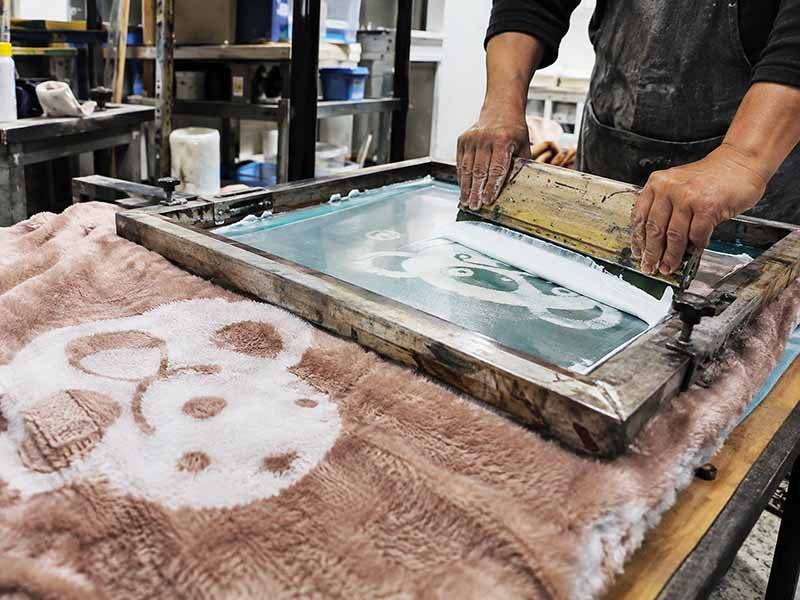
Can Screen Printing Work on Plush Fabric?
Screen printing can work well on selected plush materials, but successful results depend on surface structure, pile height, stretch, artwork complexity, print position, and finished-product shape.
Usually Suitable
Requires Physical Testing
Often Better Replaced
Problems That Damage Printed Plush Results
Pile Show-Through
- Inspect both brushed and unbrushed surfaces.
- Review light and dark color combinations.
- Check the image after sewing and filling.
Uneven Ink Contact
- Compare center and edge coverage.
- Check repeated prints across the fabric width.
- Record the approved printing face and direction.
Hard Printed Handfeel
- Compare printed and unprinted zones by hand.
- Flex and compress the printed area.
- Confirm whether the printed zone contacts skin.
Registration Shift
- Define acceptable edge relationships.
- Inspect fine intersections under close viewing.
- Separate artwork changes by version number.
Weak Fixation
- Review dry and wet rubbing where relevant.
- Bend the fabric through repeated flexing.
- Reassess after material or ink changes.
Stuffing Distortion
- Review the stuffed sample from multiple angles.
- Check symmetry between mirrored components.
- Lock position against the approved pattern version.
Plush Fabric Screen Printing Compatibility
No fabric name guarantees a successful print. Final approval must consider pile height, backing, stretch, base color, artwork size, handfeel, finishing chemistry, and stuffed-product geometry.
| Plush Fabric | General Suitability | Strongest Applications | Main Risks | Recommended Evaluation |
| Fleece | Good for suitable ink systems | Clothing, pads, flat accessories, pillow panels | Absorption, surface pilling, handfeel change | Print strike-off, rubbing review, flexing check |
| Velboa | Generally good | Animal markings, logos, belly panels, promotional plush | Nap direction, edge softness, batch color variation | Confirm pile direction, fabric color, actual artwork size |
| Short Plush | Conditional to good | Character panels, simple graphics, mascots, mini plush accents | Pile show-through, incomplete solid areas | Test pile density, brush recovery, stuffed appearance |
| Minky | Conditional | Larger simple graphics, soft character panels, selected baby products | Stretch distortion, dot texture, thick underbase | Test real fabric, filling pressure, handfeel, recovery |
| Velvet | Conditional | Premium accents, clothing, decorative inserts | Light-direction color change, pressure marks, sheen | Review under several light angles and after sewing |
| Microfiber Plush | Conditional to good | Fine logos, smooth detail panels, lifestyle products | Surface finish variation, ink penetration | Validate adhesion, clarity, softness, material lot |
| Sherpa | Usually limited | Very large simple motifs only | Irregular texture, broken edges, hidden detail | Compare screen print with appliqué or woven insert |
| Faux Fur | Generally unsuitable on full pile | Shaved zones, smooth inserts, separate accessories | Long pile covers image, ink clumping, poor readability | Consider trimming, appliqué, embroidery, printed panel |
| Stretch Plush | Conditional | Body panels with compensated artwork | Shape change, registration movement, cracking risk | Measure stretch direction and review stuffed prototype |
| Printed Woven Insert | Good | Complex artwork added to plush construction | Handfeel contrast, edge integration, seam placement | Approve print first, then test appliqué or panel sewing |
Plush Products Suited to Screen-Printed Details

Character Belly Panels

Printed Foot Pads

Plush Character Clothing

Simple Animal Markings

Branded Plush Pillows

Promotional Mascot Plush
Artwork Designed for Reliable Screen Printing
Recommended Artwork
- Use clear spot-color separations.
- Keep critical detail away from seam allowances.
- Identify protected brand proportions and colors.
- Provide a physical or approved Pantone reference.
Conditional Artwork
- Confirm minimum readable size on actual fabric.
- Test the artwork at production dimensions.
- Review distortion after filling.
- Record approved changes by version.
Alternative Craft Artwork
- Compare color count and tonal complexity.
- Protect intended softness.
- Consider volume, setup, and reorder needs.
- Avoid forcing one process onto every graphic.
Artwork Requiring Redesign
- Map the graphic against the actual pattern.
- Mark seams, notches, and safe zones.
- Identify non-negotiable visual elements.
- Approve the revised plush interpretation.
From Artwork Separation to Stuffed Plush
Artwork Preparation and Color Separation
Production begins with a review of the original vector artwork, intended product size, fabric selection, print location, number of colors, target market, and expected order volume. Screen printing uses separate color layers, so artwork built for digital display may need engineering before it can become a stable print specification.
File preparation: AI, EPS, editable PDF, or high-quality vector files allow clean color separation. Raster images may be usable for reference, but rebuilding can be required when edges, fonts, or spot colors are unclear. Pufumi records artwork width, height, orientation, scale, safe area, color reference, and revision status.
Color control: Screen colors are not approved from a monitor alone. Pantone references, original products, physical color chips, printed packaging, or licensed style guides provide a better starting point. A color may appear different on white fleece, dark velboa, glossy velvet, and warm-toned minky, even when the same ink formula is used.
Underbase decision: Dark fabric may require a light underbase before the visible color is printed. The underbase can improve brightness but also adds thickness. Its effect on softness, edge definition, flexibility, and cure must be evaluated on the real fabric.
Detail review: Very fine lines, tiny punctuation, closely spaced colors, and narrow negative spaces may close or blur during printing. Pufumi identifies which elements are essential for brand recognition and which may be simplified without changing the approved identity.
Production status: Draft, under review, approved for strike-off, approved for sample, and released for production must remain clearly separated. A newly emailed file does not automatically replace an approved version. Every revision receives a version number, date, project code, SKU relationship, and approval status.
Screen Printing and Strike-Off Validation
A strike-off is a controlled fabric print used to evaluate color, clarity, coverage, registration, handfeel, and adhesion before printed components enter sewing. It is not merely a decorative sample and should represent the production material as closely as possible.
Fabric fixation: Plush materials can move, stretch, or compress during printing. The printing face, nap direction, stretch direction, and fabric orientation need to remain consistent. A strike-off cut from substitute cotton cannot confirm performance on the final plush fabric.
Ink deposit: Too little ink may leave broken coverage between fibers. Too much can create a heavy film, stiff handfeel, or raised edge. The selected deposit should balance visual coverage with flexibility and softness. Large solid zones often need more careful handfeel review than small logos.
Registration: Each color must align with the approved separation. Multicolor checks focus on outlines, small gaps, intersecting elements, and edges where a slight shift becomes visually obvious. First-piece confirmation should occur before a full print run continues.
Curing: Equipment settings provide process guidance, but actual fixation must be verified on the printed material. Fabric composition, ink layer, production speed, loading, and temperature distribution all influence the result. When the ink, fabric, equipment, or supplier changes, previous approval should not be assumed to cover the new combination.
Physical review: The strike-off is examined under normal light, close viewing, bending, compression, rubbing, and pile brushing. Requirements depend on product use. A washable plush, fashion bag charm, nursery comfort product, and display collectible do not necessarily require identical evaluation conditions.
Approval record: Approved strike-offs are photographed, coded, dated, and linked to the fabric lot, artwork version, print specification, and product SKU. One approved sample should remain available for bulk comparison and reorder review.
Cutting, Sewing, Filling and Final Approval
A printed fabric panel becomes valuable only when the image remains correct on the finished plush. Cutting and sewing therefore form part of print control rather than unrelated downstream operations.
Pattern integration: Print location is mapped against the actual pattern piece, seam allowance, centerline, notches, darts, mirror relationship, and pile direction. A printed belly symbol may need pre-distortion so it appears proportionate after the panel curves around filling.
Panel identification: Printed pieces are bundled by project, SKU, side, color, print version, and material batch. Left and right parts must not be mixed. Multi-SKU collections require stronger identification because similar-looking components can carry different graphics or licensed details.
Sewing protection: Printed surfaces can be scratched, folded, creased, or contaminated during handling. Sewing teams need instructions for needle position, seam relationship, pressing restrictions, turning, trimming, and component orientation. Graphics near seams receive additional first-piece checking.
Filling review: Filling pressure changes panel width, height, curvature, and visual center. The team compares the stuffed product with the approved flat print and approved sample. Logos should remain readable; circles should not become visibly oval; licensed symbols should not tilt; paired markings should remain balanced.
Production-ready approval: Final release should be based on a sewn and stuffed sample using approved material, print specification, pattern, filling, accessories, and intended packaging wherever possible. Pufumi separates early prototypes from pre-production samples and Golden Samples so an unfinished development piece is not used as the bulk standard.
Standard screen-printed plush samples commonly require approximately 5–7 working days after artwork, sample terms, and available materials are confirmed. Complex multicolor graphics, special fabrics, curved mappings, or additional revisions may require approximately 7–15 working days. Timing is confirmed against each project rather than promised before the files and material conditions are reviewed.
Print Mapping for Three-Dimensional Plush Forms
Map Artwork Against Pattern Geometry
- Pufumi begins with the approved artwork and the actual production pattern rather than placing a logo on a generic rectangle. Every printed element is assigned to a named pattern piece with an exact width, height, centerline, orientation, and safe distance from cutting and sewing boundaries.
- Seam allowance: Artwork entering the seam allowance may disappear, become uneven, or produce a hard ink layer inside the seam. Safe zones are established around critical text, logos, facial marks, and licensed symbols.
- Panel curvature: A flat circle can appear oval after filling. Horizontal artwork may rise at the edges on a rounded belly, while a face marking can shift toward the side of the head. Controlled pre-distortion may be used after reviewing a sewn prototype.
- Darts and gathers: Printed graphics near darts, tucks, pleats, or gathering points can fold or break. The design may need to move, divide, or change scale. Complex character details can also be recreated through separate printed panels rather than one continuous image.
- Mirrored components: Left and right ears, feet, wings, paws, or side-body sections require correctly mirrored print files. A single unmirrored file can create two identical directional pieces instead of a balanced pair.
- Viewing angle: Printed placement should consider how the plush is displayed. A foot-pad logo may look centered on the flat component but rotate downward when the product sits. A chest emblem may need adjustment for the final posture and packaging window.
Control Stretch, Pile and Filled Distortion
- Fabric stretch and pile direction operate together. Stretch can widen graphics, while pile orientation changes light reflection and image visibility. Mapping files should therefore include more than coordinates.
- Stretch direction: Minky and selected stretch plush may extend differently lengthwise and crosswise. Pufumi records the primary stretch direction on the pattern. A material replacement with similar color and weight can still require a new sample if stretch and recovery differ.
- Pile direction: Nap influences color appearance, tactile flow, and print readability. Identical panels cut in opposite directions can appear like different shades. Printed artwork must align with the approved visual direction and cutting layout.
- Filling pressure: A lightly filled pillow, firm collectible, weighted plush, and soft baby product create different surface tension. Mapping should be approved under the intended filling density rather than on an empty shell.
- Cross-seam designs: Artwork crossing a seam requires controlled split points, matched notches, sewing alignment, and realistic tolerance. Some designs should be converted to appliqué or redesigned as one smooth insert panel when seam matching would remain visually unstable.
- Scale relationships: The same logo file cannot always serve 12 cm, 22 cm, and 40 cm products. Line width, lettering, separation gaps, screen setup, and viewing distance may require independent versions. Pufumi links each approved scale to its specific SKU.
- Final comparison: Mapping approval uses photographs and measurements from the completed sample. Notes record visible movement, corrected position, scale changes, and protected visual elements. The released file then becomes part of the production package and later reorder archive.
Ink, Curing, Flexibility and Plush Handfeel
Fabric Compatibility
- Confirm fiber and fabric code.
- Record the approved printing face.
- Test base color and surface finish.
- Recheck after material substitution.
Controlled Ink Deposit
- Balance opacity with softness.
- Review thick intersections between colors.
- Bend and compress large printed areas.
- Avoid unapproved additional print passes.
Verified Curing
- Record production settings and lot details.
- Inspect early, middle, and later output.
- Isolate under-cured or damaged material.
- Retain approved comparison samples.
End-Use Handfeel
- Review contact with hands and skin.
- Compare pre- and post-stuffing feel.
- Check folds inside packaging.
- Confirm acceptable tactile contrast.
Five Approval Stages Before Bulk Printing

Fabric Swatch Review
- Record fabric code and supplier.
- Confirm lot or available color status.
- Note intended product area.
- Identify alternatives early.

Print Strike-Off
- Mark every option clearly.
- Compare under normal lighting.
- Approve color and tactile result.
- Retain the selected reference.

Printed Pattern Panel
- Measure actual print location.
- Check cutting boundary clearance.
- Confirm left and right orientation.
- Link the panel to its SKU.

Sewn and Stuffed Sample
- Photograph front, side, and detail views.
- Compare against approved artwork.
- Record required corrections.
- Confirm the next sample status.

Production Standard
- Freeze approved specifications.
- Archive signatures or approval messages.
- Prepare first-piece checkpoints.
- Preserve a reorder reference.
Printed Panel Cutting and Sewing Control
Cutting Printed Plush Panels Correctly
Printed material is inspected before cutting for color, registration, stains, missing coverage, surface damage, and print status. Only released material enters the cutting plan. The cutting team follows pattern version, fabric face, nap direction, stretch direction, print orientation, mirror relationship, and quantity requirements.
Pattern alignment: Position marks and templates help align critical graphics with the pattern. Logos, faces, symbols, and paired markings receive closer control than noncritical background areas. Printed elements should not drift into seam allowance, darts, or hidden sections.
Pile management: The direction arrow appears on the pattern and cutting instructions. Reversing the nap can change color appearance and brush direction, even when print position is technically correct. Long or dense pile near a smooth printed insert may also need controlled trimming.
Component identification: Cut panels are bundled by project code, SKU, size, color, side, print version, fabric lot, and quantity. Similar components from different characters or market versions remain separated. Barcode, copyright, or language variants need particularly clear identification.
First-layer verification: A first-layer or template check confirms artwork position before the full stack proceeds. Critical components may require individual or higher-frequency verification because a cutting offset can affect every piece in the stack.
Defect isolation: Misprinted, stained, damaged, reversed, or inaccurately cut parts are moved to a clearly marked nonconforming area. They should never remain inside accepted bundles where they can enter sewing unnoticed.
Sewing Without Damaging Printed Surfaces
Sewing teams receive a reference sample and operation instructions that show orientation, seam relationship, allowed handling, and critical visual points. Printed areas should be protected from abrasion, dirty work surfaces, excessive folding, and unnecessary heat.
Needle and seam position: The seam line must preserve required artwork clearance. A logo positioned too close to the edge may become partially hidden, while heavy ink inside a seam can add stiffness or affect feeding.
Cross-panel alignment: Designs divided between two panels require matched notches, controlled feeding, and first-piece checking. Stretch differences between the two components can cause one side to advance faster, breaking visual continuity.
Turning and handling: After sewing, plush shells are turned through an opening. Large printed areas can crease or rub during turning. Operation sequence, opening size, and handling method should protect the approved surface.
Thread and reinforcement: Printed panels still need suitable seam strength. Thread, stitch type, stitch density, seam allowance, and reinforcement are selected according to fabric construction and product use. Printing must not be allowed to hide weakened fabric or damaged backing.
Process inspection: Early sewn shells are checked for image angle, symmetry, seam distance, scratches, stains, and panel mix. Problems are corrected before filling, where surface tension can make them more visible and rework more expensive.
Filling, Shaping and Finishing Printed Plush
Filling changes the printed surface from two dimensions into a curved product. Operators follow target weight, filling distribution, softness, posture, and shaping instructions.
Pressure balance: Overfilling can enlarge or distort printed artwork; underfilling can create wrinkles and make placement appear uneven. Paired products and repeat SKUs should maintain comparable filling distribution.
Shape correction: Corners, limbs, belly zones, and facial areas are shaped so the print sits in the intended visual position. Printed areas are not aggressively brushed or heated unless the approved process specifically allows it.
Surface cleaning: Loose fibers, thread ends, dust, and handling marks are removed with methods compatible with the ink and fabric. Solvents or unapproved cleaning agents should not touch printed surfaces.
Finished comparison: The completed product is compared with the approved sample for position, orientation, scale, color, clarity, handfeel, symmetry, and seam relationship. Critical brand marks may receive individual checks.
Reorder protection: Pattern, print file, fabric code, ink reference, approved sample, filling specification, quality findings, and change history remain archived. A reorder begins with a difference review because material, color, supplier, or equipment conditions may have changed.
Screen Printing Compared With Other Crafts
The strongest decoration method depends on artwork, fabric, texture, color range, surface curve, order structure, tactile target, durability needs, and production repeatability.
| Method | Strongest Uses | Suitable Surfaces | Visual Strength | Main Limitation | Pufumi Decision Direction |
|---|---|---|---|---|---|
| Screen Printing | Flat colors, logos, broad lines, repeated graphics | Smooth, flat, or short-pile panels | Strong spot colors and repeatability | Separate setup per color; limited gradients; pile interference | Recommended for suitable fabric and production volume |
| Digital Printing | Photographs, gradients, detailed illustrations | Compatible printable fabric | Complex color and tonal detail | Material chemistry and batch color need validation | Recommended for detailed multicolor graphics |
| Sublimation | Full-color polyester artwork, repeated textures | Compatible light polyester materials | Soft print integration and gradients | Limited by fiber and base color | Recommended for selected polyester panels |
| Heat Transfer | Small multicolor graphics, numbers, short runs | Flat smooth components | Sharp edges and flexible design options | Film handfeel, edge lifting, curvature concerns | Conditional after adhesion and flexing tests |
| Embroidery | Eyes, mouths, line logos, text, tactile details | Many woven and short-pile fabrics | Dimensional, durable visual detail | Large areas can become stiff or puckered | Recommended for faces, linework, and premium marks |
| Appliqué | Large color blocks, belly patches, long-pile alternatives | Broad range of plush constructions | Tactile layers and clean solid color | Additional cutting and sewing operations | Recommended when ink would reduce softness |
| Woven Label | Small text, copyright information, brand identification | Seam, clothing, or accessory locations | Readable controlled typography | Separate component, not integrated artwork | Recommended for legal or very small text |
| Fabric Panel Substitution | Complex graphics on smooth insert fabric | Designed plush panel areas | Clear image while preserving body texture | Requires pattern integration and seam control | Recommended for long-pile bodies or complex artwork |
Factors Affecting Print Cost and Timing
Number of Colors
- Count visible colors and underbase needs.
- Review shared colors across SKUs.
- Simplify only with formal approval.
- Confirm color sequence during testing.
Artwork Dimensions
- State exact finished width and height.
- Provide actual product dimensions.
- Mark critical line and text sizes.
- Review image scale after filling.
Fabric Construction
- Identify fiber and fabric code.
- Confirm available or custom color.
- Record pile and stretch direction.
- Include material lead time.
Print Locations
- List every printed component.
- Separate left and right pieces.
- Link locations to pattern names.
- Confirm visibility in final posture.
SKU and Size Count
- Build an SKU-print matrix.
- Identify shared screens carefully.
- Protect character-specific files.
- Plan material and production batches.
Order and Quality Plan
- Provide launch and annual forecasts.
- Define inspection expectations early.
- Include sample and testing time.
- Confirm packaging and delivery dates.
Print Quality Control From Fabric to Shipment
Printed Material and Panel Inspection
Bulk printed fabric is checked against the approved strike-off, print specification, fabric code, and released artwork. Inspection is performed at the beginning of production and repeated during the run because color, registration, fabric tension, ink deposit, and curing can drift over time.
File and version: The inspector confirms project code, SKU, artwork version, print dimensions, orientation, color references, and approval status. Superseded or draft files cannot be used.
Color and appearance: Printed output is compared with the approved physical reference under controlled viewing conditions. Checks cover shade, opacity, edge quality, missing coverage, stains, ghosting, registration, and unwanted ink marks.
Position and size: Placement is measured against the approved pattern or template. Critical graphics receive additional attention because even small movement may affect symmetry or licensed-brand appearance.
Surface and handfeel: The printed area is reviewed for tackiness, roughness, excessive thickness, flattening, scorching, discoloration, cracking, or weak adhesion. Pile is brushed in the intended direction to expose hidden gaps.
Lot traceability: Printed fabric and cut panels remain linked to material lot, supplier, production lot, print batch, and inspection status. A material concern can therefore be traced to affected production quantities.
Nonconforming control: Suspect material is identified and isolated. Rework, reprint, downgrade, replacement, or concession decisions require authorization. Rejected printed components must not return to accepted bundles without documented disposition.
Sewing and In-Process Print Inspection
Print inspection continues during construction because seams, handling, turning, and component mix can create defects not visible on flat material.
First sewn piece: The first completed shell confirms print orientation, seam clearance, cross-panel alignment, mirrored-part balance, and visibility. Production pauses for correction when the first piece does not match the approved sample.
Process patrols: In-process checks look for scratches, folding marks, stains, reversed panels, mixed artwork versions, thread damage, seam encroachment, and distortion. Similar SKUs remain separated by code and bundle identification.
Critical-piece coverage: Brand logos, copyright marks, numbered editions, facial graphics, and paired markings may require individual verification. Broader decorative patterns can use a risk-based inspection frequency.
Corrective action: Repeated failure triggers investigation into screen alignment, fabric movement, cutting position, operator method, pattern version, or filling pressure. Correction focuses on the cause rather than simply removing visible defective pieces.
Change management: A replacement ink, new fabric batch, alternate printer, revised artwork, updated pattern, or changed filling target requires impact review. Previous approval covers only the defined combination of material, process, file, and sample.
Finished Plush, Packaging and Shipment Checks
The finished product is reviewed against the Golden Sample, quality plan, print reference, product specification, labels, and packaging requirements.
Stuffed appearance: Inspectors evaluate color, clarity, position, scale, orientation, symmetry, curve distortion, pile recovery, seam relationship, and visual balance from relevant angles.
Functional handling: Printed zones are gently flexed, compressed, rubbed, and handled according to the product’s expected use and approved internal method. Formal laboratory testing is arranged where required by the market, product category, or brand program.
Overall construction: Print approval never replaces checks for seam strength, filling containment, loose threads, sharp points, small-part risks, accessory attachment, odor, cleanliness, weight, size, labels, and packaging.
Packaging exposure: Window boxes, compression packing, polybags, tissue, inserts, and tight folding can contact printed areas. Packaging trials check transfer, sticking, abrasion, creasing, and visual presentation after storage or simulated transport handling.
Release decision: Pufumi combines process control, key-point checking, risk-based individual inspection, and lot acceptance methods. The quality position is multi-stage inspection—not an absolute zero-defect claim. Inspection records, issue photos, corrective actions, and release status remain available for project traceability.
Pufumi’s quality resources cover incoming inspection, in-process inspection, finished-product checks, packaging inspection, shipment inspection, and quality improvement. Printed plush programs receive checkpoints aligned with the actual risk of the fabric, artwork, location, and target use.
Ink Documentation and Market Compliance Planning
Market and Age Definition
- Confirm destination countries.
- Define intended and foreseeable users.
- Identify toy or non-toy positioning.
- Record warnings and labeling needs.
Ink and Material Records
- Link ink records to the project.
- Preserve fabric and print samples.
- Review changes before substitution.
- Avoid unsupported “chemical-free” claims.
Finished Product Evaluation
- Prepare representative finished samples.
- Include printed worst-case colors where relevant.
- Match the tested version to production.
- Retain reports and sample identification.
Responsibility and Documentation
Pufumi supports BOM preparation, sample configuration, supplier document collection, labeling files, technical information, and coordination with qualified third-party laboratories. Legal certification and market-placement duties remain with the applicable manufacturer, importer, brand, or responsible economic operator under the relevant jurisdiction.
- Separate factory support from legal responsibility.
- Confirm report scope and validity.
- Link reports to SKU and material versions.
- Reassess after meaningful changes.
How Pufumi Manages Printed Plush Programs
Engineering Review
- Artwork and visual-priority review
- Pattern and print-position assessment
- Material and handfeel evaluation
- Three-dimensional sample validation
Specialist Print Coordination
- Controlled artwork release
- Strike-off and color review
- Print-batch identification
- Supplier change management
Plush Manufacturing Integration
- Pattern and pile-direction control
- Printed-panel component tracking
- First-piece and process inspection
- Finished-product comparison
Production and Reorder Records
- Golden Sample and retention sample
- Material-lot and production-lot link
- Corrective-action records
- Reorder difference review
Screen-Printed Plush Development Case
Project Brief and Initial Risks
The proposed program contained four 22 cm character plush SKUs with a combined first production quantity of 4,800 pieces. Each character used short-pile velboa for the body, a two-color screen-printed belly emblem, single-color printed foot pads, embroidered facial details, and a printed fabric costume component. Quantities were planned at 1,200 pieces per SKU, allowing shared process planning while preserving separate character files, colors, and component codes.
The artwork package originally placed the belly emblem 8 mm from the lower pattern edge. A flat mockup looked balanced, but the first pattern review showed the lower section would enter the belly seam after sewing. Filling pressure would also stretch the circular emblem horizontally. Small lettering inside the emblem measured less than 2 mm high at production scale, creating a readability concern on the short-pile surface.
Three additional risks were identified:
- Two characters used dark body colors requiring underbase evaluation.
- Left and right foot-pad graphics needed mirrored orientation.
- The costume print sat close to a folded hem and could become partially hidden.
Pufumi prepared a revised print map with a 14 mm safe distance from the critical seam, enlarged the smallest text, separated the belly emblem into two spot colors, created mirrored foot-pad files, and shifted the costume graphic upward by 6 mm. Brand proportions and approved logo relationships remained unchanged.
Sampling, Correction and Production Plan
Strike-offs were produced on the intended light and dark velboa colors. The first dark-fabric option achieved good opacity but felt heavier than the surrounding material. A reduced underbase area and adjusted color sequence improved flexibility while maintaining visual coverage. The selected strike-off was then cut using the actual belly and foot-pad patterns.
The first sewn prototype showed the belly emblem expanding approximately 4 mm across its widest point after stuffing. Pufumi adjusted the pre-print artwork width and slightly reduced filling pressure in the printed belly zone without changing overall product weight or posture. A second stuffed sample restored the intended visual proportion and maintained clear lettering at normal viewing distance.
The approved production structure included:
- Four SKUs and 4,800 total pieces
- Two-color belly printing
- One-color mirrored foot-pad printing
- Separate print files for light and dark fabrics
- Print-batch and material-lot identification
- First-piece checks for every SKU
- Critical logo-position checking after stuffing
- Packaging review to prevent surface rubbing
A standard project of comparable complexity may require approximately 7–15 working days for strike-off, mapping, sewing, filling, feedback, and revised approval after complete materials and files are available. Following Golden Sample release, material readiness, printing capacity, packaging approval, and final order conditions, a typical bulk-production window may fall around 20–30 days. Exact timing is confirmed through a project schedule rather than assumed from product quantity alone.
The case demonstrates a central principle: accurate flat printing is only the midpoint. Product success depends on how artwork behaves after cutting, sewing, filling, inspection, packaging, and repeat production.
Frequently Asked Questions
Yes, selected minky fabrics can be screen printed, but physical testing is necessary. Dot texture, pile, stretch, base color, surface finish, underbase, ink deposit, and filling pressure can influence clarity and handfeel. Pufumi recommends an actual fabric strike-off followed by a sewn and stuffed sample before production approval.
Conventional screen printing is usually not the first choice for long-pile plush or faux fur. Long fibers can block ink contact, hide detail, create clumping, and reduce readability. A shaved area, smooth insert panel, appliqué, embroidery, woven component, or separately printed clothing panel often produces a more controlled result.
Screen printing can change handfeel, especially when large solid areas, thick underbases, or multiple ink layers are used. Suitable ink selection, controlled deposit, correct curing, and artwork engineering can reduce stiffness. Handfeel should be approved on the real fabric and evaluated again after sewing, stuffing, and packaging.
Traditional spot-color screen printing is strongest for solid colors and defined graphic areas. Gradients may require halftone techniques, additional control, or another method. Digital printing or sublimation may offer better results for photographic shading, airbrushed effects, realistic fur coloration, and complex tonal transitions.
Most screen-printed plush components are printed before cutting or printed as carefully registered panels before sewing. The selected route depends on artwork position, material handling, pattern size, and production equipment. Print placement must remain linked to seam allowance, pile direction, mirror orientation, and final stuffed shape.
A logo can cross a seam, but alignment becomes more difficult. Both pattern pieces require mapped artwork, controlled cutting, matched notches, accurate sewing, and realistic tolerance. Critical licensed marks or fine lettering are often better positioned on one uninterrupted panel, an appliqué, or a smooth insert.
Pufumi uses physical strike-offs, Pantone references, approved color chips, or other agreed physical standards. Monitor colors are not used as the final production reference. Approval should specify fabric color, artwork version, underbase, ink sequence, print batch, lighting condition, and acceptable visual relationship to surrounding materials.
The completed sample is reviewed for position, scale, curvature, symmetry, clarity, handfeel, seam relationship, pile recovery, and distortion. Front, side, and detail views are compared with the approved artwork and sample. Bulk checks continue because filling distribution and sewing variation can alter printed appearance.
Suitability depends on the complete product, intended age, destination market, ink and material documentation, construction, small parts, seams, filling, labels, and applicable testing. Pufumi supports material records, BOM preparation, sample configuration, and third-party laboratory coordination. No single ink statement automatically proves complete-product compliance.
Provide editable artwork where available, product dimensions, print width and height, number of colors, intended fabric, print location, target quantity, target market, intended age, packaging direction, and required delivery date. Photos, physical references, Pantone colors, style guides, and existing prototypes can improve the initial engineering review.

Trust, Compliance & Production Assurance
Confidence for global brands and complex plush programs
Pufumi evaluates each project according to its target market, age grade, materials, construction, labeling, and packaging requirements. Depending on the assigned production site and project scope, our team can support ISO 9001 quality-management documentation and coordinate testing to EN71, ASTM F963, CPSIA, REACH, and other applicable standards. Factory audits, certifications, and test reports are verified by issuing body, validity period, facility, and product scope, giving brands greater transparency from sample development through controlled production and delivery.















Start Your Screen-Printed Plush Project
- Company and project name
- Product type and finished size
- Artwork files and color references
- Fabric, pile, and handfeel requirements
- Print dimensions and locations
- SKU count and quantity per SKU
- Sales market and intended age
- Packaging and labeling requirements
- Target arrival or launch date
- Existing samples or reference products
- NDA requirements for unreleased assets