 Skip to content

Plush Toy Safety Testing Standards for Your Target Market
Safety requirements depend on where a plush toy will be sold, its intended age group and how it is built. With over 18 years of custom plush manufacturing experience in China, Pufumi helps brands and IP owners review these requirements during development, prepare representative samples and coordinate third-party testing before bulk production.
US: ASTM F963 & CPSIA | EU: EN 71 & REACH | Age Classification | Material & Component Review | Lab Test Coordination
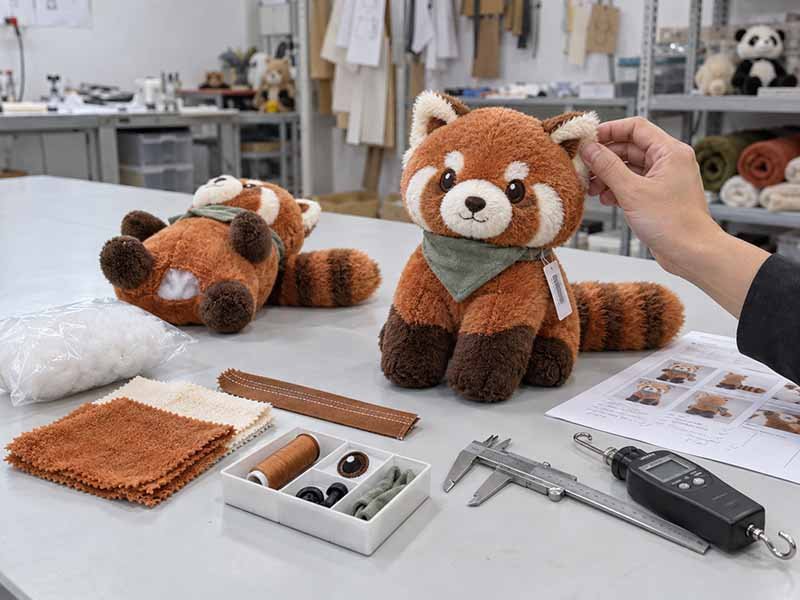
Start With Three Product Decisions
Target Sales Market
Intended User Age
Product Features
Who Needs a Structured Safety Plan
Toy & Collectible Brands
IP Owners & Licensees
Retailers & Importers
Global Product Teams
Global Plush Toy Compliance Map
Use the target market as the starting point. The table gives a planning overview rather than a universal test package; final requirements depend on product classification, age, construction and current regulations.
| Market | Main Framework | Typical Focus | Documentation Direction |
|---|---|---|---|
| United States | ASTM F963 under 16 CFR Part 1250, CPSIA and other applicable CPSC rules | Mechanical risks, small parts, materials, lead, phthalates, product-specific requirements | Third-party reports where required, CPC data, tracking information |
| European Union | Toy safety legislation and applicable EN standards | Mechanical and physical safety, flammability, chemical risks, safety assessment | Technical documentation, conformity assessment, CE marking |
| Great Britain | Toys (Safety) Regulations 2011 and current designated standards | Product safety, warnings, conformity route, responsible-party information | Applicable declaration, technical records and marking |
| Canada | Canadian toy and consumer-product requirements | Plush construction, mechanical risks, materials and labeling | Market-specific testing and importer records |
| Australia / New Zealand | Applicable national toy requirements and accepted standards | Age classification, product construction and applicable hazards | Product-specific compliance evidence |
| Japan | Applicable toy safety and product rules | Intended age, construction, labeling and market-specific requirements | Product and importer documentation as applicable |
A report prepared for one country should not be assumed to cover another market without reviewing scope, standard version, product configuration and legal responsibility.
U.S. Plush Toy Safety Testing Path
For a U.S. children’s plush program, compliance starts by identifying the product and applicable rules—not by ordering a generic “ASTM test.” Pufumi can prepare product information, production-representative samples and manufacturing records for the agreed testing path.
From Product Classification to CPC Support
ASTM F963 is the U.S. toy safety standard incorporated into federal regulation through 16 CFR Part 1250. The currently accepted ASTM F963-23 version became effective for applicable toys manufactured on or after April 20, 2024. CPSC guidance makes clear that the domestic manufacturer or importer must identify which sections apply to the specific toy; not every product follows an identical test list.
For products designed or intended primarily for children 12 years of age or younger and subject to children’s product safety rules, required certification is based on testing by a CPSC-accepted third-party laboratory. The laboratory supplies test results, while the responsible manufacturer or importer issues the Children’s Product Certificate. For overseas-manufactured goods, the importer generally carries the CPC responsibility.
A useful U.S. workflow is:
- Confirm intended age, use and product classification.
- List fabric, filling, coatings, plastic parts, metal parts and functional components.
- Identify applicable ASTM F963 sections and other relevant CPSC rules.
- Freeze the sample configuration intended for laboratory submission.
- Arrange applicable testing through an accepted laboratory.
- Connect reports to the correct SKU, materials and production version.
- Prepare accurate manufacturing, testing and laboratory data for certification.
- Maintain the approved construction through bulk production.
Since July 8, 2026, importers of most regulated consumer products subject to CPSC certification requirements must electronically file certificate data with U.S. Customs and Border Protection through the applicable system, increasing the importance of accurate product, production and test records.


EU and UK Plush Safety Routes
European sales require more than an EN71 report, while Great Britain follows its own regulatory route. Market destination should therefore be confirmed before packaging, warnings and final test planning are locked.
Keep Standards, Testing and Marking Separate
For the European Union, commonly referenced EN71 standards address different safety areas rather than functioning as one single test. Mechanical and physical properties, flammability and migration of certain elements are among the familiar areas considered for toy products. The applicable standards depend on the finished product, its materials and its functions. A successful laboratory result alone should not be presented as automatic permission to apply CE marking; conformity assessment, technical documentation, responsible-party obligations and ongoing production conformity also matter.
The EU adopted Regulation (EU) 2025/2509 in 2025. It replaces the Toy Safety Directive from August 1, 2030, while certain provisions have already applied since January 1, 2026. Long-term product programs should therefore keep current compliance requirements separate from preparations for the future framework, including the digital product passport requirements scheduled under the new regulation.
Great Britain continues to operate under the Toys (Safety) Regulations 2011 as amended, supported by designated toy safety standards. The official consolidated list was updated in February 2026. Northern Ireland must not simply be treated as identical to Great Britain when planning conformity information and markings.
For multi-market programs, Pufumi can organize product specifications, material records, sample versions and packaging files by market code so different requirements remain visible throughout development and production.








Age Classification Changes the Safety Path

Infant-Focused Plush

Under Three Years

Children’s Plush

Collector Products
What Gets Tested on a Plush Toy
Mechanical & Physical
Small Parts
Seam & Attachment
Stuffing Access
Flammability Risk
Chemical Requirements
Sound & Electronics
Labels & Traceability
Features That Can Change Testing Scope

Plastic Eyes & Noses

Keychain Hardware

Weighted Filling

Magnets

Sound & Batteries

Removable Accessories
Material and Component Risk Map
A complete material list makes testing discussions more accurate. The finished plush should be reviewed as a system rather than treating the outer fabric as the only safety-relevant material.
| Material or Component | Main Review Area | Development Question |
|---|---|---|
| Plush fabric | Chemical profile, surface behavior, flammability | Is the exact production fabric identified? |
| Polyester filling | Accessibility and containment | Can filling become exposed through foreseeable seam failure? |
| Plastic eyes / noses | Attachment, small parts, chemistry | Is the component appropriate for the intended age? |
| Printed fabric | Ink, coating and substrate | Will the production printing system match the tested sample? |
| Embroidery | Position, stitching and fabric distortion | Does filling shift the approved facial placement? |
| Metal rings / clips | Mechanical attachment and finish | Where does the load transfer into the plush body? |
| Weighted pellets | Internal containment | Is a controlled inner enclosure required? |
| Magnets | Retention and accessibility | How are magnets prevented from moving or escaping? |
| Electronic modules | Wiring, battery access, function | Does the module alter applicable requirements? |
| Labels / packaging | Warnings and traceability | Does the information match the sales market and SKU? |
Build Safety Into Product Development
The lowest-risk time to solve a safety problem is usually before tooling, material commitment and bulk production. Pufumi integrates product engineering with sample development so potential compliance issues can be reviewed while the design is still adjustable.
Develop the Product Before Booking the Test
A character illustration rarely explains how every detail should be manufactured. Pufumi first interprets the artwork into an actual plush structure: body shape, seam lines, fabric direction, facial features, filling zones, clothing, accessories and internal components. The goal is not to redesign the character without approval, but to identify where a visual feature creates a manufacturing or safety question.
A rigid eye may be reviewed against an embroidered alternative. A large tail may require reinforcement at the attachment point. A decorative chain may need an internal fabric anchor. Weighted pellets may require an independent containment bag. A sound module needs a protected cavity rather than simply being buried inside loose filling.
The engineering decision should then be reflected in the prototype that is reviewed, revised and eventually frozen for testing and production.
Pufumi’s broader development role is to turn character assets, artwork and product concepts into products that can move through sampling, approval, production, testing, packaging and repeat-order management—not simply to sew the submitted image into a first sample.
Useful project inputs include:
- Front, side and back artwork when available
- Intended age group
- Target sales markets
- Planned product size
- Fabric and color expectations
- Accessories or removable parts
- Electronic, magnetic or weighted functions
- Packaging and retail channel
Early information makes the later laboratory sample more representative of the intended commercial product.

From Prototype to Laboratory Testing
Product Brief
Compliance Review
Controlled Prototype
Test Scope Confirmation
Laboratory Sample
Production Release
Changes That May Require Retesting
Fabric Changes
Plastic Part Changes
Printing Changes
Added Accessories
Functional Changes
Construction Changes
What Determines Plush Testing Cost
A reliable laboratory quotation requires product information. Target market, age, components and SKU variation usually matter more than simply asking for a price to “test a plush toy.”
| Cost Driver | Why It Changes the Scope |
|---|---|
| Target market | Different jurisdictions follow different rules and documentation routes |
| Intended age | Age can change applicable mechanical, small-parts and certification requirements |
| Product structure | Basic plush and complex functional plush present different risks |
| Material count | More material systems may increase chemical review or testing needs |
| Accessories | Plastic, metal and detachable components can introduce additional requirements |
| Electronic functions | Batteries, sound, lights and wiring may add specific evaluations |
| SKU variations | Colors, materials, sizes and components may affect test coverage decisions |
| Laboratory scope | Accreditation and required standards determine quotation structure |
| Sample quantity | Test methods can require multiple specimens or destructive testing |
| Retesting | Failures or material changes may require additional samples and laboratory work |
Know Who Owns Each Compliance Task
| Project Task | Brand / Importer | Pufumi | Testing Laboratory |
|---|---|---|---|
| Define target market | Lead / Confirm | Support | — |
| Define intended product use | Lead / Confirm | Support | — |
| Product engineering | Review / Approve | Lead manufacturing development | — |
| Material specification | Approve | Prepare / Control | Review if needed |
| Prototype development | Review / Approve | Lead | — |
| Applicable test scope | Confirm responsibility | Provide product data | Technical testing input |
| Test sample preparation | Review | Prepare controlled sample | Receive / identify sample |
| Third-party testing | Authorize / maintain records | Coordinate as agreed | Perform accredited testing |
| Test report | Maintain | Support records | Issue report |
| U.S. CPC | Responsible certifying party | Provide production/test data | Does not issue CPC |
| Production consistency | Audit / approve changes | Control manufacturing | — |
| Import filing | Responsible party | Supply required data | Supply test data |
For overseas-manufactured U.S. children’s products, CPSC states that the importer is responsible for issuing the CPC based on passing results from a CPSC-accepted laboratory; the testing laboratory supplies the results but does not issue the certificate.

Control Production After the Test Passes
Passing a laboratory test does not protect a production run if the factory later changes fabric, components or construction. The approved configuration must become a controlled manufacturing baseline.
Keep the Tested Configuration Connected to Production
Once a product reaches the approved stage, Pufumi uses the final sample and supporting specifications as production references. The important question moves from “Did a sample pass?” to “Are the shipped units still being made as the approved product?”
The production-control chain should connect several records:
- Approved sample: establishes the final visual and structural target.
- Golden Sample: provides a physical reference for production comparison.
- BOM and material records: identify approved fabrics, filling, accessories, labels and functional parts.
- Incoming checks: verify critical materials before they enter production.
- First-piece review: checks construction before full production continues.
- Inline inspection: identifies sewing, attachment, assembly and appearance problems while correction remains possible.
- Final inspection: confirms finished-product workmanship, SKU identity, packaging and agreed inspection criteria.
- Retention sample: preserves a representative mass-production unit for future comparison.
Pufumi treats product development and manufacturing as one connected process rather than separating testing from production control. The brand is positioned around character fidelity, product development, multi-SKU project management, retail readiness and sample-to-production control.
A material substitution, accessory change or structural modification after approval should be recorded and assessed before use. Reorders should also be compared against the approved product record rather than reconstructed from memory.
Build a Usable Compliance File
Test Reports
Material Records
BOM & Components
Label Files
Production Records
Certificate Data
Frequently Asked Questions About Plush Safety
There is no single worldwide plush toy standard. Applicable requirements depend on where the product will be sold, intended age, product classification, materials and functionality. U.S. children’s toys commonly involve ASTM F963 under 16 CFR Part 1250 plus other applicable CPSC rules. European projects follow the relevant toy safety framework and applicable EN standards. Other markets require separate review rather than automatic acceptance of U.S. or EU reports.
No. ASTM F963 covers many toy hazards and product types, but the applicable sections depend on the specific toy. CPSC states that manufacturers and importers are responsible for identifying which sections apply to their products. Product age, hard parts, filling, batteries, sound functions and other features can change the required scope.
ASTM F963 is the toy safety standard incorporated into U.S. federal regulation through 16 CFR Part 1250. CPSIA is broader legislation affecting children’s products and includes requirements related to testing, certification and areas such as lead and phthalates. A U.S. children’s plush program may therefore involve ASTM F963 alongside other applicable CPSC-enforced requirements.
The testing laboratory does not issue the CPC. CPSC states that the responsible manufacturer or importer drafts and issues the certificate based on passing results from a CPSC-accepted third-party laboratory. For a product manufactured overseas, the importer generally carries the CPC issuance responsibility.
No. EN standards can form an important part of the conformity route, but CE marking is not simply a laboratory test certificate. The responsible economic operator must address applicable safety requirements, conformity assessment, technical documentation, labeling and ongoing production conformity before the product is placed on the EU market.

Review Your Plush Safety Testing Plan
Send Pufumi the product information that determines the compliance path before committing to bulk production. Useful materials include character artwork or product photos, intended age, target countries, approximate product size, proposed fabrics, filling, hard accessories, removable parts, magnets, weighted materials, sound or battery functions, packaging requirements and any existing laboratory reports.
Our project team can use those inputs to review the manufacturing configuration, identify details that may affect testing preparation, develop a production-representative sample and organize the information needed for the agreed third-party testing route. Pufumi operates as an enterprise-level plush product development and manufacturing partner for IP owners, entertainment companies, toy and collectible brands, lifestyle brands and major retail programs.
A strong project brief also helps separate genuine product requirements from assumptions. Instead of asking for a generic “ASTM, CPSIA and EN71 certificate,” define where the plush will be sold, who will use it and exactly how it is constructed. The resulting testing plan becomes clearer, laboratory quotations become more relevant and approved specifications can be carried into production with fewer uncontrolled changes.

