Skip to content


Teddy fleece is one of those fabrics that looks simple until you actually try to specify it for a real product. Most people recognize it immediately: soft, fluffy, slightly curly, warm-looking, and reminiscent of the textured surface of a traditional teddy bear or lamb-like fleece. The difficulty begins when a designer, sourcing team, or manufacturer tries to translate that visual description into something that can be sampled, purchased, sewn, inspected, and reordered consistently.
Teddy fleece fabric is a soft, bulky textile with a curled, clustered, or wool-like surface designed to create a warm teddy-bear or shearling-inspired appearance. Many commercial versions are polyester-based, but the term itself does not define one fixed fiber, GSM, pile height, stretch level, or backing structure. For product development, the approved physical fabric and technical specification matter more than the name alone.
That distinction becomes especially important in plush manufacturing. A teddy fleece that looks excellent on a jacket panel may hide embroidered eyes when used on a small character. A fabric that feels luxuriously thick in the hand may create excessive seam bulk around a miniature ear or muzzle. Even pile direction can make identical pieces appear slightly different in color under photography or retail lighting.
Understanding teddy fleece properly therefore means looking beyond softness. The useful questions are how the material is built, how its surface behaves, how it compares with related fabrics, and whether a specific construction actually supports the product you are trying to make.
What Is Teddy Fleece Fabric?
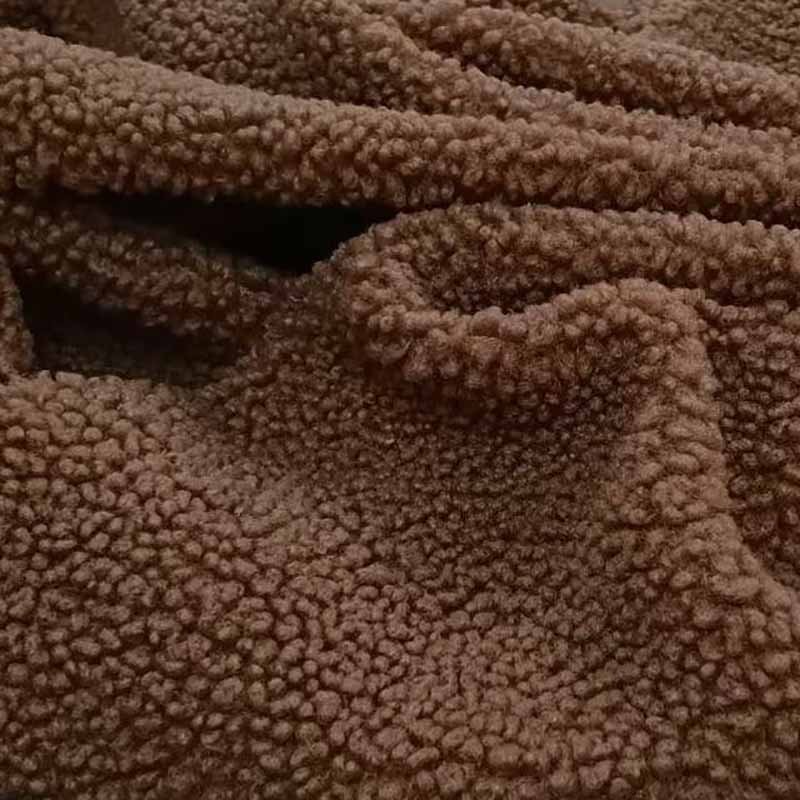
Teddy fleece is a textured fleece or plush-style fabric recognized by a dense, fluffy, curled, or bouclé-like surface. It is usually chosen for softness and visual warmth rather than for one standardized technical construction. Fabrics sold under the same name can differ significantly in weight, pile density, backing, stretch, surface recovery, and sewing behavior, so the physical material should always be evaluated before production.
Surface and Handfeel
The most recognizable feature of teddy fleece is its three-dimensional surface. Unlike many conventional fleece fabrics that have a relatively even brushed face, teddy fleece usually contains visible curls, clusters, short loops, or fluffy irregular fibers. These features create small shadows across the material and make the surface look deeper and more substantial than a flat fleece.
That visual depth also affects handfeel. One teddy fleece may feel dense, compact, and cushioned, while another feels light, airy, and slightly springy. A more expensive-looking fabric is not necessarily the one with the longest pile. Yarn fineness, loop formation, density, surface finishing, and the quality of the ground structure can be just as important as pile height.
When evaluating a sample, it helps to brush the surface in several directions. Some teddy materials show very little visual change, while others become noticeably lighter, darker, smoother, or rougher depending on how the fibers lie. This directional behavior becomes much more obvious after the fabric is cut into multiple pattern pieces.
For a plush product, handfeel should also be judged after the fabric has been stuffed and shaped. A loose, soft swatch can become tighter and firmer once stretched over a rounded body. This is one reason a fabric card alone cannot fully predict how a teddy material will feel on a finished plush product.
Why the Name Matters
“Teddy” is mainly a market description rather than a precise technical classification. It tells the customer to expect a fabric with a soft, warm, teddy-bear-like character, but it does not automatically tell them the fiber content, fabric weight, loop size, backing construction, or amount of stretch.
This explains why the market uses several overlapping names. Teddy fleece, teddy bouclé, sherpa, borg, faux shearling, lamb fleece, and curly fleece can sometimes describe materials that look surprisingly similar. One supplier may separate Teddy and Sherpa into different categories, while another may use both terms in the same product description.
For small sewing projects, the naming overlap is usually manageable because the material can be chosen by sight and touch. In commercial production, it creates unnecessary risk. A purchase description that simply says “cream teddy fleece” leaves too many variables open.
A reliable production specification should therefore identify the fabric code, fiber composition, weight, color reference, surface type, stretch behavior, supplier, and approved swatch. For ongoing products, material-lot information and reorder availability also become important. The name helps identify the visual family; the specification makes the fabric reproducible.
Fabric Structure
Most commercial teddy fleece used in clothing, soft goods, and plush-related products is produced using knitted structures rather than conventional woven construction. Knitted bases are useful because they can support bulky surface yarns while maintaining flexibility, but the word “knitted” alone still does not tell a product developer how the fabric will behave during cutting and sewing.
It is useful to think of teddy fleece as having two functional parts. The surface creates the texture people see and touch, while the underlying ground fabric controls much of the material’s stability. A soft, elastic ground can wrap easily around rounded forms, but it may stretch during stuffing. A firmer ground may provide more dimensional control while producing a slightly stiffer product.
Before approving a fabric, several practical characteristics deserve attention:
- visible pile height and density;
- ground-fabric stability;
- crosswise and lengthwise stretch;
- edge shedding after cutting;
- thickness when folded into a seam;
- surface recovery after compression;
- embroidery visibility;
- backing visibility when the fabric bends or stretches.
Two teddy fabrics can look nearly identical in an online photograph and perform very differently when turned into a three-dimensional object. That difference becomes especially important when working with small pattern pieces, curved seams, detailed faces, or products that require consistent shapes across large quantities.
Is Teddy Fleece Standardized?
There is no universal specification that requires every fabric sold as teddy fleece to have the same fiber, GSM, pile height, density, or backing structure. The name functions more like a category label that communicates an expected appearance and handfeel.
For this reason, claims such as “teddy fleece is always 400 GSM” or “teddy fleece always has a 10 mm pile” should be treated cautiously. Individual commercial articles may match those figures, but the wider category contains much more variation.
The same caution applies to softness, warmth, pilling resistance, or shedding. None of these properties can be reliably predicted from the name alone.
In manufacturing, the safer approach is to convert the general fabric category into an approved material definition. A physical swatch, fabric code, composition, weight, pile structure, color reference, supplier information, and relevant performance checks create a useful production standard. Without that information, “teddy fleece” remains a visual description rather than an engineering specification.
What Is Teddy Fleece Made Of?

Many commercial teddy fleece fabrics are made primarily from polyester because polyester can be engineered into soft, bulky, textured knitted structures with practical durability and repeatability. However, teddy fleece is not defined by polyester alone. Some versions contain blends, recycled polyester, cotton-rich constructions, or other fibers, so composition must be confirmed from the actual material specification.
Common Fiber Content
Polyester is widely used in teddy fleece because it can be processed into fine yarns, bulky loops, and fluffy fleece surfaces while remaining suitable for commercial knitting and finishing. It can also provide relatively predictable shape retention and drying behavior compared with many natural-fiber alternatives.
That does not mean two 100% polyester teddy fabrics will behave the same way. Yarn size, knit density, pile formation, brushing, heat setting, finishing, and backing construction can all change softness, thickness, surface stability, stretch, and appearance.
Some manufacturers also offer recycled polyester versions for projects that require recycled content. In those cases, recycled claims should be supported by appropriate supplier documentation rather than assumed from a general environmental description. If a project requires specific certification documentation, the scope, batch, and supply chain should be verified for the actual material being purchased.
Natural and blended teddy-style fabrics also exist, particularly in clothing and interior textiles. The most accurate answer to “Is teddy fleece polyester?” is therefore that polyester is common, but the category name itself does not guarantee composition.
GSM and Thickness
GSM means grams per square meter and is one of the most useful fabric specifications in sourcing. It indicates fabric mass, but it should not be confused with physical thickness. Two materials can have a similar GSM while feeling very different because their mass is distributed differently between the surface pile and the ground structure.
A dense 400 GSM teddy fleece may feel compact and substantial. Another fabric at a similar weight may have a more open, bulky surface that appears much thicker. Surface-loop shape, yarn diameter, knitting density, and finishing determine how that weight translates into real volume.
| Teddy Fleece Characteristic | Common Commercial Reference | Practical Effect |
|---|---|---|
| Fabric weight | Approx. 250–450+ GSM | Bulk, warmth, seam thickness, material cost |
| Visible pile or loop height | Approx. 3–15+ mm | Texture, detail visibility, surface depth |
| Composition | Often polyester-based | Care, sourcing, labeling, cost |
| Stretch | Low to moderate depending on knit | Pattern dimensions and stuffed shape |
| Fabric width | Often around 145–160 cm | Material consumption and marker efficiency |
| Construction | Commonly knitted | Flexibility, cutting and seam behavior |
These figures are useful as market references rather than fixed standards. Final purchasing decisions should always follow the supplier specification and approved physical sample.
For plush products, fabric weight affects more than handfeel. A heavy, dense teddy fleece can create thick seam allowances where several panels meet. That may become particularly noticeable around small ears, paws, muzzles, tails, and narrow limbs.
Pile Height and Density
Pile height and pile density should be evaluated separately. Pile height describes how far the surface fibers or loops extend from the backing, while density describes how full or closely packed that surface is.
A relatively long pile can still be open enough that the backing becomes visible when brushed apart. A shorter material can be extremely dense and appear fuller on a finished product. Neither configuration is automatically better; each creates different advantages and limitations.
For a large teddy bear or winter-themed animal, a higher pile may help create the intended soft visual character. On a small collectible, that same material can cover part of an embroidered eye or soften the edges of the face until the character looks less precise.
Density also changes sewing behavior. Thick pile can become trapped in the seam, creating visible ridges or uneven edges. After sewing, operators may need to brush or lift fibers away from the seam so the finished surface looks natural.
One practical sample check is to bend the material tightly around a small curve. If the backing becomes highly visible or the surface separates noticeably, the fabric may behave differently on ears, muzzles, paws, and other tight-radius parts than it does on a flat swatch.
Backing and Stretch
The backing is easy to overlook because the textured face gets most of the attention, but it controls much of the material’s mechanical behavior.
Knitted fabrics often stretch more in one direction than another. If pattern pieces are rotated only to improve cutting efficiency, the finished product can become dimensionally inconsistent. One body panel may widen more under stuffing pressure, while another remains relatively stable.
This becomes especially important on symmetrical faces, narrow necks, long limbs, flat sitting bases, and designs with firm filling.
A practical production specification should record the intended fabric direction, stretch orientation, pile direction, and pattern-piece orientation. Those instructions should remain connected to the production pattern and BOM instead of depending on operator memory.
The same material can also behave differently at different product scales. A fabric that works comfortably on a 30 cm bear may create too much seam thickness on an 8 cm keychain. Fabric selection therefore needs to be evaluated together with pattern size, seam geometry, stuffing level, and final product dimensions.
Which Properties Define Teddy Fleece?

Teddy fleece is valued for its softness, volume, and warm visual appearance, but performance depends on fiber type, pile density, knitted structure, and finishing. Important properties include softness, stretch, pilling, shedding, seam stability, washing response, and compression recovery. These characteristics should be evaluated on the actual fabric because two materials with similar names can perform quite differently.
Softness and Warmth
Softness is one of the strongest reasons designers choose teddy fleece, but softness is not created by a single factor. Fine surface fibers can create a smooth first touch, dense loops add cushioning, and an open pile can create an airy, springy feel. The backing also influences whether the fabric feels flexible or somewhat firm.
Warmth works in a related way. Three-dimensional fleece structures contain air between fibers and loops, and trapped air can contribute to thermal insulation. Fabric thickness, density, porosity, and air permeability therefore matter alongside total weight.
For plush products, actual insulation is usually less important than the visual feeling of warmth. Teddy surfaces naturally communicate winter, comfort, softness, home, and relaxation. That makes the material attractive for seasonal collections, comfort-themed products, lifestyle mascots, plush pillows, and winter editions of existing characters.
The trade-off is detail. As surface volume increases, small features become more difficult to see. For product development, the correct balance is not maximum softness at any cost. The better choice is a fabric that delivers the intended tactile character while preserving the form and details that make the product recognizable.
Stretch and Shape
Moderate stretch can help teddy fleece conform smoothly to rounded shapes, but uncontrolled stretch can change the proportions of a finished product.
Consider a plush head whose pattern has already been approved at a specific width. If the fabric stretches significantly across the face once stuffing pressure is applied, the head can become wider than expected. The embroidered eye spacing may then look different even though the embroidery file itself has not changed.
Stretch deserves particular attention on rounded heads, narrow necks, long legs, soft sitting bases, symmetrical faces, and products filled more firmly than the first sample.
The relationship between fabric and stuffing also matters. A sample made with relatively light filling may appear correct, while increasing stuffing density during production can place additional tension on the knitted ground and alter the silhouette.
For reliable development, fabric direction and fill level should therefore be reviewed together. A plush pattern does not operate independently from the textile wrapped around it. The same paper pattern can produce noticeably different results when the stretch, weight, or pile structure changes.
Pilling and Shedding
Pilling and shedding are often grouped together, but they are different surface behaviors. Pilling occurs when loose fibers become tangled into small balls through repeated rubbing. Shedding refers to fibers separating from the surface or edge of the fabric.
Neither property can be predicted accurately from the words “teddy fleece.” Fiber type, yarn construction, knitting, finishing, cutting, and final use conditions all influence performance.
During plush development, practical checks should include cut-edge behavior, repeated rubbing in high-contact areas, surface appearance after embroidery, and loose-fiber accumulation after handling. Dark and light colors can also make shedding more or less visible.
Material selection should take the end use into account. A decorative seasonal plush may experience relatively little abrasion, while a comfort product intended for frequent handling may require a more demanding surface review.
Where pilling or abrasion is commercially important, the appropriate test method should be agreed based on the product category and customer requirement. It is not responsible to describe all teddy fleece as permanently non-pilling or non-shedding without evidence from the specific fabric.
Washing and Recovery
Care performance depends on the exact material and on the complete finished product, not only the outer fabric. Some polyester fleece articles can tolerate low-temperature machine washing, but a finished plush may include components that require more cautious care.
Embroidery, printing, adhesive elements, internal supports, electronic modules, metal accessories, weighted inserts, or specialty fillings can all change the appropriate cleaning recommendation.
For that reason, a raw-fabric wash instruction should not automatically become the care instruction for a finished plush product.
A useful development check includes measuring the sample before cleaning, applying the intended care method, allowing the product to dry completely, and then reviewing dimensional change, seam distortion, surface matting, pile recovery, color appearance, embroidery condition, and attached components.
Compression recovery deserves similar attention. Teddy fleece is bulky, so packaging can temporarily flatten the surface. If the product will be tightly packed or compressed for transport, a pack-and-recovery check before mass production can prevent a poor first impression when the customer opens the final retail package.
How Is Teddy Fleece Different From Similar Fabrics?

Teddy fleece is generally curlier and more dimensional than polar fleece, more textured than Minky or short plush, and visually close to Sherpa or faux shearling. Because textile suppliers do not always use these names consistently, material comparison should focus on measurable features such as pile height, density, backing, stretch, surface behavior, and the level of visual detail required in the final product.
Teddy Fleece vs Sherpa
Teddy fleece and Sherpa are frequently confused because both can create a curly, sheep-like appearance. In practice, there is no perfectly consistent naming boundary across every supplier.
Some textile catalogs use Sherpa for materials with a pronounced lamb-like cluster or loop structure, while Teddy is used for a softer, more rounded bouclé appearance. Other suppliers combine both terms in a single product name.
For sourcing, the physical differences are more useful than the terminology. Compare the pile size, loop formation, density, backing visibility, handfeel, stretch, seam thickness, embroidery clarity, and compression recovery of the actual samples.
For a simple winter animal or soft lifestyle product, both materials can work well. For a face with numerous embroidered details, one option may perform significantly better even though both are described as warm, fluffy fleece.
The practical conclusion is that “Teddy versus Sherpa” should not become a debate about labels. The sample that gives the correct appearance and performs more predictably in the intended product is the better choice.
Teddy Fleece vs Polar Fleece
Polar fleece usually has a flatter, more uniform brushed surface. Teddy fleece creates much stronger three-dimensional texture through curls, loops, or clustered fibers.
This makes polar fleece useful when softness is required but visual details still need to remain clear. Embroidery, appliqué, seam transitions, and small printed elements are generally easier to see on a flatter surface.
Teddy fleece contributes more visual character by itself. A relatively simple product can feel richer because the fabric adds depth without additional decoration. The cost of that effect is reduced precision around very small details.
| Fabric | Typical Surface | Detail Visibility | Surface Volume | Common Plush Applications |
|---|---|---|---|---|
| Teddy Fleece | Curly, clustered, fluffy | Medium to low | High | Cozy animals, seasonal plush, lifestyle designs |
| Sherpa | Lamb-like, looped | Medium to low | High | Winter plush, home products, warm-look designs |
| Polar Fleece | Brushed, relatively flat | Good | Low to medium | Pillows, simple plush, soft accessories |
| Minky | Fine, smooth short pile | Very good | Low | Soft characters, baby-style plush |
| Short Plush | Clean, short surface | Very good | Low to medium | Character plush, mascots, embroidery-heavy designs |
| Faux Fur | Hair-like, often longer | Low unless locally trimmed | High | Realistic animals, premium furry characters |
These descriptions represent common tendencies rather than rigid textile standards. The same fabric category can contain different weights, densities, and constructions.
Teddy Fleece vs Minky
Minky usually has a much shorter and more controlled surface than teddy fleece. It can feel extremely soft while still allowing embroidered facial features and small visual details to remain clearly visible.
That makes Minky useful for products where softness and precision are both important. Eyes, mouths, blush details, logos, and small appliqué edges can usually be read more easily because the pile does not rise as far around the decoration.
Teddy fleece has more obvious texture. It can make a simple bear or animal body feel substantial and visually warm without requiring complicated surface treatments.
A practical material rule is to choose teddy fleece when the texture itself is part of the character concept, while Minky is often stronger when a smooth, soft surface must preserve small details.
Hybrid construction can solve both needs. A character might use teddy fleece on the body and Minky or short plush on the face or muzzle. This allows the product to keep its cozy surface while protecting expression and embroidery clarity.
Teddy Fleece vs Short Plush
Short plush is often better suited to detailed character work because the surface stays closer to the backing. Embroidered eyes, mouths, logos, color blocks, and small seam transitions remain easier to control.
That makes short plush common in anime characters, game characters, mascots, mini plush, and keychain products where facial recognition matters more than a bulky texture.
Teddy fleece is stronger when the design calls for softness, rounded volume, and a deliberately cozy look.
Product scale is crucial. A high-volume pile can look proportional on a 40 cm bear but dominate the entire face of an 8 cm collectible. Material decisions should therefore be made at or near the intended product scale.
A fabric swatch measuring 20 × 20 cm can be attractive while giving little information about how the same pile behaves on a 3 cm ear or a small curved muzzle. Sampling at actual size remains one of the most reliable ways to avoid a material that looks good in isolation but works poorly in the finished design.
What Is Teddy Fleece Used For?
Teddy fleece is widely used in outerwear, accessories, blankets, cushions, and other soft products because its dimensional surface creates immediate softness and warmth. In plush manufacturing, it is particularly suitable for bears, simple animals, winter collections, comfort products, lifestyle mascots, and selected textured panels. It becomes less suitable when very small embroidery or sharply defined surface details are essential.
Apparel and Home Textiles
Teddy fleece is strongly associated with autumn and winter products because its surface creates warmth before the material is even touched. Jackets, coats, vests, hoodies, linings, children’s outerwear, hats, scarves, bags, and other accessories commonly use this type of texture.
Home products use the same emotional effect. Cushions, throws, blankets, soft decorative covers, and similar items benefit from the way the fabric makes simple forms appear more comfortable and substantial.
These mainstream applications are relevant to plush design because material associations carry across categories. A consumer who already connects teddy texture with winter clothing or cozy interiors may interpret a plush product made from the same visual language as warm, comforting, and seasonal.
That makes material changes a useful way to create product variations. An established character can sometimes be released in a textured winter edition without changing the entire design language. The silhouette remains recognizable while the fabric gives the product a new tactile identity.
Plush Applications
Teddy fleece can work particularly well for products that have enough scale and simplicity to let the material become part of the design.
Suitable concepts can include teddy bears, simple animal characters, sheep-inspired products, winter animals, holiday collections, plush pillows, home décor plush, comfort-oriented products, oversized characters, and lifestyle mascots.
The fabric also does not need to cover the entire product. Selective use can be more effective than applying the same texture everywhere. Teddy fleece can be used on a body, belly, ears, hat, collar, coat, tail, or other areas where extra texture adds value.
A mixed-material approach is often more controlled. A product might use teddy fleece for the body, short plush for the muzzle, felt for a small decorative piece, and embroidery for facial expression.
This reflects how professional plush development normally works. Material choice is connected to the job each surface must perform rather than forcing one fabric to solve every design problem.
Character Plush
Teddy fleece can be used successfully for character plush, but recognition should come before softness.
Characters often depend on very specific visual features such as eye shape, mouth position, face width, costume lines, color blocks, and small identifiers. A surface with too much volume can partially cover those features and make the finished product less accurate.
The face deserves particular attention. Dense pile can rise around embroidered eyes and make them appear smaller. Thick fabric can soften a sharp pattern transition. Directional pile can also reflect light differently across the left and right sides of the face.
For this reason, pile direction should be treated as a production control rather than a purely aesthetic preference. Pufumi’s material and engineering system records fabric direction because inconsistent grain or pile orientation can affect apparent color, handfeel, shape, embroidery appearance, and bulk consistency.
During sample review, the product should be evaluated at normal viewing distance as well as close up. If the character becomes noticeably less recognizable from shelf distance, changing the surface material may be more effective than repeatedly modifying the embroidery file.
When Teddy Fleece Is a Poor Fit
Teddy fleece is not automatically the best option simply because a product is intended to feel premium or soft.
It can become difficult to use when the design contains very small embroidered eyes, narrow fabric strips, miniature fingers, tiny logos, sharply defined costume edges, dense appliqué, detailed printed graphics, or several layers meeting at a small seam.
The issue is usually scale rather than material quality.
A technically excellent teddy fleece with a relatively tall surface can still be the wrong choice for a 6 cm bag charm. In the same way, a short-pile material that feels less dramatic on a large swatch may produce a much cleaner and more recognizable miniature character.
Professional material development includes rejecting fabrics that are attractive but unsuitable. Pufumi’s documented material-selection process evaluates candidates by factors such as handfeel, color, pile length, GSM, shedding, abrasion behavior, cost, supply stability, certification requirements, and packaging response before the selected material enters the BOM.
A good material decision therefore considers the product after cutting, sewing, stuffing, packaging, shipping, and repeat production—not simply how the swatch looks during the first meeting.
How Do You Choose Teddy Fleece for Plush Manufacturing?
Teddy fleece should be selected by matching measurable fabric characteristics to the final product. Confirm composition, GSM, pile structure, backing, stretch, color, handfeel, shedding, seam bulk, embroidery visibility, compression recovery, and supply continuity. The final material should be tested on an actual sample, approved physically, recorded in the BOM, and controlled through material and pile-direction references during bulk production.
Key Specifications
A sourcing request such as “soft brown teddy fleece” may be enough to begin looking for samples, but it is not enough to control a production order.
A professional material record converts the visual request into information that can be compared, purchased, and checked later. Important fields include the article code, composition, GSM, pile height, density, fabric width, stretch behavior, approved color, handfeel, pile direction, supplier, and supply status.
| Specification | What to Record | Main Risk if Uncontrolled |
|---|---|---|
| Material code | Supplier and article reference | Wrong material used in later orders |
| Composition | Fiber percentages | Incorrect sourcing or labeling assumptions |
| GSM | Grams per square meter | Unexpected bulk, cost, or seam behavior |
| Pile height | Measured in mm where available | Hidden details and inconsistent texture |
| Density | Supplier data or approved reference | Backing visibility |
| Fabric width | Usable width in cm | Incorrect material consumption |
| Stretch | Direction and approximate behavior | Shape distortion |
| Color reference | Approved physical swatch | Batch color mismatch |
| Pile direction | Pattern cutting requirement | Apparent shade differences |
| Embroidery trial | Approved stitched sample | Features sinking into pile |
| Material lot | Batch reference | Bulk or reorder inconsistency |
| Supply status | Stock, custom, or repeatable | Replenishment risk |
Not every supplier provides every technical value in the same format. This is why a retained physical sample remains valuable even when specification sheets are available.
For commercial plush projects, the final material decision should connect measurable information with a physical standard. Data tells the team what the fabric is supposed to be; the approved sample shows what the customer actually approved.
Pile Direction
Pile direction should be defined before bulk cutting begins.
When the surface fibers lean in different directions, the fabric can reflect light differently even though every piece comes from the same roll. On faces or large body sections, that can create an apparent shade difference that looks like a dyeing problem.
Directional cutting rules should therefore be marked on the pattern. Head pieces, left and right body panels, arms, legs, ears, tails, clothing panels, and accessories should follow a deliberate surface direction according to the intended appearance.
Directional materials can reduce marker efficiency because pieces cannot always be rotated freely to save fabric. That additional consumption should be included during costing rather than corrected later by turning pattern pieces in ways that change appearance.
The issue becomes even more important in multi-SKU programs. If several characters share the same cream teddy fleece, consistent pile direction helps them look like a coordinated collection when displayed together.
Fabric direction, cutting instructions, BOM information, and QC references should therefore work as one system rather than separate notes.
Embroidery and Sampling
Embroidery should be tested on the exact production-intent fabric rather than on a smoother substitute.
An embroidery file that looks crisp on Minky or short plush can appear very different on teddy fleece. Dense loops may rise around the stitch field and partially cover the edge of an eye, mouth, or logo. Thread can also appear to sit deeper in the material.
Possible development adjustments include increasing feature size, widening borders, modifying stitch density, trimming pile locally, introducing a short-pile face panel, using appliqué for larger color areas, or repositioning seams.
There is no reliable universal percentage by which embroidery should be enlarged because the correct adjustment depends on pile height, density, thread type, stitch structure, and actual feature size.
Sampling should also continue through final stuffing. Filling changes surface tension, and that can affect both embroidery visibility and seam shape.
Pufumi’s development model treats material selection as part of a wider sample-to-production process rather than as an isolated purchase decision. Material records, approved samples, BOM information, version control, and quality records support more consistent bulk production and future reorders.
Bulk and Reorder Control
Creating one attractive sample is only the beginning. Commercial manufacturing becomes successful when the approved result can be reproduced across the bulk order and repeated again when the product sells well.
Color, handfeel, loop density, and surface appearance can change between material lots. Even when the material is technically the same article, a new batch may not look perfectly identical to the previous production run.
For that reason, material control should connect the approved swatch, approved sample, BOM, incoming material lot, bulk inspection reference, and reorder record.
When bulk fabric arrives, the material should be compared against the approved reference for critical features such as color, surface appearance, handfeel, pile, and any dimensions that have been formally specified.
For multi-SKU collections, the risk becomes more visible. If six products share one cream teddy fabric, even small differences in surface direction or lot appearance may be obvious when the collection is photographed or displayed together.
The same discipline should apply to reorders. If the original material becomes unavailable, a replacement should not be accepted simply because a supplier describes it as “same quality.” A new physical comparison and, where necessary, a new sample provide a much stronger basis for release.
Teddy fleece works best when it is treated as an engineered product material rather than a decorative surface. Its value comes from softness and texture, but reliable manufacturing depends on measurable specifications, scale-appropriate design, controlled pile direction, physical sampling, and disciplined material records.
For brands developing a teddy-texture plush collection, this is also where an experienced development partner can make a meaningful difference. Pufumi supports material comparison, pattern development, sampling, production control, packaging coordination, and repeat-order management as part of its broader plush product development process. The useful question is not simply whether a teddy fleece feels soft, but whether the selected construction can protect the character, remain controllable during manufacturing, and still be available or reproducible when the product needs another production run.
A well-selected teddy fleece can give a plush product immediate warmth, softness, and shelf appeal. A poorly matched one can hide the very features that make the character recognizable. The difference usually comes down to how carefully the material is evaluated before it reaches mass production.
The next time a supplier presents a fabric simply as “Teddy Fleece,” look beyond the name. Check the composition, weight, pile, backing, stretch, direction, embroidery result, and recovery after packaging. Then put it on the actual product. That is where the material stops being a swatch and starts proving whether it belongs in the design.
Frequently Asked Questions
Is Teddy Fleece the Same as Sherpa?
Teddy fleece and Sherpa can look very similar, and some suppliers use the terms interchangeably, but they should not automatically be treated as identical technical materials. Both may have curled or lamb-like surfaces, yet pile density, loop formation, backing, stretch, and weight can differ. When sourcing for a real product, compare physical samples and specifications rather than selecting only by the category name.
Is Teddy Fleece Usually Polyester?
Many commercially available teddy fleece fabrics are made from 100% polyester or polyester-rich constructions because polyester works well for knitted, bulky, textured surfaces. However, the name “teddy fleece” does not technically require polyester. Blended, recycled-polyester, cotton-rich, and other teddy-style fabrics also exist, so the exact fiber content should always be confirmed from the supplier specification before purchasing or making labeling claims.
Is Teddy Fleece Warm?
Teddy fleece often feels and looks warm because its raised surface contains air spaces between fibers and loops. These structures can help reduce heat transfer, but actual thermal performance depends on thickness, density, air permeability, construction, and fiber type. A 400 GSM teddy fabric may behave differently from a lighter or more open construction, so warmth should not be judged from the fabric name alone.
Does Teddy Fleece Shed or Pill?
Some teddy fleece fabrics can shed loose fibers or develop surface pilling, while others perform much better. The result depends on fiber quality, knitting, pile formation, finishing, abrasion, and use conditions. A commercial product should therefore be evaluated using the actual candidate material. For plush applications, checking cut edges, high-contact areas, embroidery zones, and the surface after packaging provides more useful information than relying on a general “anti-pilling” description.
Can Teddy Fleece Be Used for Plush Toys?
Yes. Teddy fleece can work particularly well for bears, simple animals, winter collections, lifestyle mascots, comfort products, plush pillows, and larger designs where texture is an important visual feature. It is less suitable for some very small or detail-heavy characters because dense pile can cover embroidery, soften pattern edges, and increase seam bulk. Sampling at the intended product size is the safest way to judge suitability.
Is Teddy Fleece Good for Embroidery?
Teddy fleece can be embroidered, but dense or high pile may partially hide stitching. Large eyes, logos, and simple shapes are usually easier to manage than very fine line details. Depending on the design, developers may adjust stitch density, enlarge certain features, trim pile around the embroidery, or combine teddy fleece with a shorter-pile face panel. The embroidery should always be tested on the actual production-intent fabric before bulk release.
How Do You Choose the Best Teddy Fleece for a Plush Product?
Start with the finished design rather than the fabric name. Check composition, GSM, pile height, density, backing, stretch, color, handfeel, seam thickness, shedding, embroidery visibility, compression recovery, and reorder availability. Then build the fabric into an actual sample. The best teddy fleece is not necessarily the softest or thickest option; it is the one that preserves the intended shape, details, tactile experience, and manufacturing consistency.