 Skip to content

Plush Fabric Library for Custom Plush Products
Match texture, structure, and character identity before sampling begins.
Pufumi turns fabric selection into an engineering decision, helping brands evaluate appearance, handfeel, sewability, durability, color behavior, and positioning across custom plush programs.
- 58+ specialists match pile, density, stretch, and structure.
- Fabrics indexed by handfeel, sheen, direction, and backing.
- Velboa, fleece, faux fur, and specialty textiles compared.
- Color cards support repeatable multi-SKU material decisions.
- 35+quality team checks incoming fabric consistency.
- Safety and decoration compatibility reviewed before approval.
What Is a Professional Plush Fabric Library?
Material Discovery
A fabric library gives design and product teams a controlled starting point for comparing surfaces, colors and technical characteristics. Pufumi organizes commonly used plush materials by construction, pile, density, stretch and suitable application rather than relying on broad descriptions such as “very soft” or “premium.”
- Compare physical handfeel and visible texture.
- Review short-, medium- and long-pile directions.
- Identify stock colors and custom color routes.
- Locate suitable alternatives when a material becomes unavailable.
- Match materials with character, collectible, retail and lifestyle programs.
Engineering Selection
Fabric selection affects far more than touch. Pile direction can change facial expression, stretch can alter finished dimensions, and backing stability can affect embroidery or seam quality. Material recommendations are therefore reviewed with the intended structure, product size and decorative processes.
- Confirm compatibility with pattern construction.
- Assess embroidery, printing and appliqué performance.
- Review seam visibility and edge finishing.
- Consider filling pressure and shape recovery.
- Evaluate packing compression and presentation after unpacking.
Production Control
An approved sample must lead to a repeatable bulk-production standard. Pufumi assigns material codes and links approved fabrics with the BOM, color reference, supplier source, production quantity and quality requirements. Incoming rolls are checked before cutting begins.
- Record material specifications and approved appearance.
- Separate fabric lots when shade or texture differs.
- Control grain and pile direction during cutting.
- Connect material lots with production batches.
- Retain approval references for inspection and production review.
Reorder Continuity
Long-term programs need more than a successful first order. Material records help teams review whether an original fabric remains available and whether a new lot matches the previous approved appearance. When replacement becomes necessary, the change is managed rather than introduced informally.
- Retain original swatches and material codes.
- Record supplier, shade and production history.
- Compare new lots with retained references.
- Evaluate replacement materials before use.
- Update the BOM and approval records after any authorized change.
Fabrics Developed for Commercial Plush Product Programs
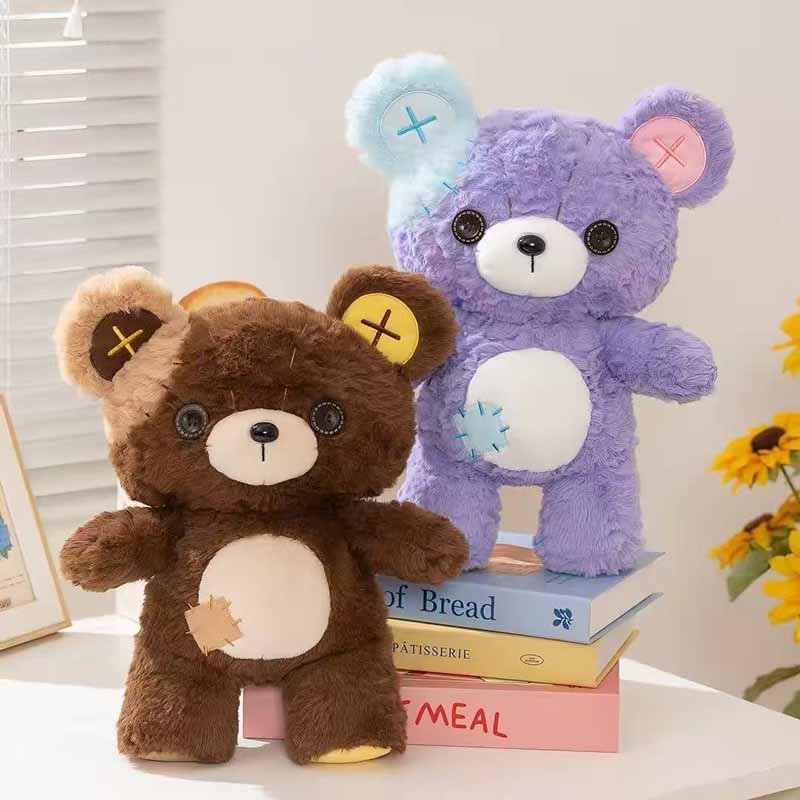
Character Plush Programs
- Face, body and costume zoning.
- Color accuracy under different lighting.
- Embroidery visibility after filling.
- Fabric direction across symmetrical panels.
- Availability for future collection extensions and replenishment.

Collectible Plush Series
- Shared body materials and controlled color boards.
- Compact pile suitable for smaller pattern pieces.
- Clear differences between regular and premium editions.
- Packaging compression and recovery.
- Batch control that reduces mixed shades across one assortment.

Charms and Keychains
- Lightweight yet stable outer fabrics.
- Dense surfaces for small facial details.
- Reinforced areas around loops and hardware.
- Controlled thickness at narrow limbs and ears.
- Materials that recover after repeated handling inside bags or pockets.

Retail Plush Collections
- Handfeel appropriate for the intended retail tier.
- Reliable colors across multiple production batches.
- Care labels and fiber-content information.
- Compatibility with retail boxes, polybags or gift packaging.
- Replacement planning for long-running core SKUs.
Physical Swatches Connected to Digital Material Records
Physical Samples Reveal Real Product Behavior
Screens and photographs cannot fully represent pile direction, thickness, stretch, surface friction or recovery. Physical swatches remain essential when assessing materials for character development and commercial production.
Handfeel and density:
Two polyester fabrics may share a similar color but feel completely different because of fiber fineness, pile density, backing and finishing. A dense short-pile fabric can feel smooth and controlled, while a lower-density version may reveal backing when stretched over a filled curve.
Pile direction:
Fabric is viewed and brushed in several directions. A change in pile direction may create lighter or darker areas even within one color. Facial panels, ears, limbs and body pieces must follow intentional directional rules.
Stretch and backing:
Stretch is checked across length, width and diagonal directions. Excessive movement can alter dimensions after filling, while a rigid backing may limit curved structures or produce harder seams.
Craft trials:
Embroidery, printing, appliqué, trimming or bonding may be tested on the actual material. A design that looks clean on a flat swatch may wrinkle or disappear after sewing and filling.
Product application:
Promising materials are applied to sample panels or full prototypes. Final decisions consider appearance, touch, shape, cost, availability and production risk together.
Digital Records Protect Production Continuity
Every approved material needs an identity beyond a supplier’s marketing name. Pufumi can assign a Material Code and connect it with specifications, project history and production records.
Core identification:
Records may include material type, fiber composition, supplier, internal code, supplier code, shade, pile length, GSM, usable width, backing and stretch direction.
Commercial status:
Stock condition, sample availability, production MOQ, expected procurement route and lead-time conditions are recorded. Dynamic information is reviewed again before quotation or production release.
Application history:
The record can identify products, samples and SKUs that used the material. Experience from previous embroidery trials, sewing issues, packing compression or quality inspection becomes reusable knowledge.
Approval control:
Approved swatch photographs, signed references, sample versions and BOM links help prevent an early concept material from being confused with the final production material.
Continuity planning:
Backup sources or alternative material directions can be recorded for important long-term SKUs. A substitution still requires comparison, documentation and approval before production.
Explore Twelve Core Plush Fabric Categories

Minky Fabric

Velboa Fabric

Short Plush

Microfiber Plush

Faux Fur

Sherpa Fabric

Fleece Fabric

Velvet Fabric

Printed Plush Fabric

Custom-Dyed Fabric

Recycled Polyester Fabric

Specialty Texture Fabric
Match Fabric Performance to Plush Product Type
The ranges below provide development references rather than fixed rules. Final material direction depends on artwork, scale, structure, target market, quantity and retail positioning.
| Plush Product | Typical Size Direction | Recommended Fabric Direction | Key Selection Priority | Common Risk |
|---|---|---|---|---|
| Plush Bag Charm | 7–12 cm | Dense short plush or controlled minky | Low weight and compact detail | Thick seams distort the shape |
| Mini Collectible | 8–15 cm | Short plush, velboa or microfiber plush | Facial definition and SKU consistency | Pile covers small embroidery |
| Blind Box Plush | 8–18 cm | Stable short pile with controlled colors | Multi-SKU consistency | Mixed shades or material lots |
| Licensed Character Plush | 15–35 cm | Short plush, minky or zoned materials | Silhouette and expression | Fabric direction changes the face |
| Baby Plush | 15–30 cm | Soft material selected with full product review | Touch, attachment design and care | Unsupported safety assumptions |
| Mascot Plush | 20–50 cm | Minky, short plush or mixed textures | Brand recognition and structure | Overly soft fabric loses shape |
| Realistic Animal Plush | 20–60 cm | Faux fur with zoned pile lengths | Natural hair flow | Shedding, trimming and compression |
| Plush Doll | 20–45 cm | Short plush, microfiber or velvet | Face, clothing and body proportion | Fabric bulk affects clothing fit |
| Plush Pillow | 30–80 cm | Minky, fleece or sherpa | Comfort and shape recovery | Filling migration or surface pilling |
| Premium Collectible | 15–40 cm | Dense microfiber, velvet or selected faux fur | Refined finish and retail perception | Limited supply continuity |
| Weighted Plush | 25–50 cm | Stable plush with reinforced inner structure | Weight distribution and seam control | Outer fabric stretches around weight |
| Large Display Plush | 50 cm and above | Stable pile with structural support | Shape retention and transport recovery | Compression and inconsistent filling |
Read Plush Fabric Specifications With Greater Accuracy
Technical data becomes valuable when each field is connected to a product result, manufacturing decision or quality checkpoint rather than treated as an isolated number.
| Specification | What It Describes | Product Impact | Production Review |
|---|---|---|---|
| Fiber Composition | Main fibers and blend | Touch, care and documentation | Confirm against supplier records |
| Pile Length | Visible fiber height | Detail visibility and visual depth | Measure representative areas |
| GSM | Fabric weight per square meter | Density, handfeel and cost | Compare approved and incoming lots |
| Usable Width | Effective cutting width | Material consumption and layout | Confirm after edge exclusion |
| Stretch Direction | Lengthwise, crosswise and diagonal movement | Dimensions and filling expansion | Mark direction on patterns |
| Backing Construction | Knitted or woven base supporting the pile | Seam, embroidery and shape stability | Inspect before cutting |
| Surface Sheen | Light reflection across the pile | Photography and perceived color | Review under controlled lighting |
| Color Route | Stock, closest match or custom dye | Schedule, MOQ and repeatability | Approve a physical reference |
| Shrinkage Behavior | Dimensional change after treatment or care | Finished size and appearance | Test when relevant to the product |
| Embroidery Compatibility | Stability under needle penetration and thread density | Wrinkling and detail clarity | Complete a trial on real fabric |
| Print Compatibility | Ability to hold artwork and color | Gradient, pattern and line quality | Review flat and sewn samples |
| Material Status | Sample, available, reserved, approved or discontinued | Development and reorder continuity | Reconfirm before production |
| Alternative Direction | Pre-evaluated replacement route | Continuity when supply changes | Require comparison and approval |
How Pile and Texture Change the Finished Product

Short and Smooth Fabrics Preserve Fine Character Details
Short-pile materials are often selected for licensed characters, anime designs, mini collectibles and embroidered faces because they leave eyes, mouths and line details visible. A compact surface also makes color blocking easier to read from retail distance.
Facial clarity:
Embroidery sits closer to the backing and remains visible after filling. Eye outlines, eyelashes, mouths and small logos can be developed with less interference from long fibers.
Silhouette control:
A short surface follows the underlying pattern more closely. Head shape, cheeks, limbs and costume edges appear defined, making pattern accuracy especially important.
Seam visibility:
Limited pile coverage means uneven seams, puckering or panel mismatch cannot be hidden easily. Precise cutting, stable sewing and balanced filling become essential.
Stretch response:
Minky and other knitted short-pile fabrics may stretch around rounded areas. A sample must confirm whether the design remains within the intended dimensions after filling.
Photography:
Compact surfaces usually create cleaner product photographs, although directional sheen may still produce visible light and dark areas. Cutting direction should remain consistent across symmetrical panels and all units within one SKU.
Short pile is therefore not simply the “easy” choice. It transfers more responsibility to pattern accuracy, embroidery positioning, seam quality and surface finishing.

Long and Textured Fabrics Create Depth but Need Control
Long-pile faux fur, sherpa and specialty textures can transform an ordinary body shape into a distinctive animal, fantasy creature or premium character. The same material can also hide critical details when applied without zoning or trimming.
Pile zoning:
Faces may use a shorter pile while the body, tail or ears use longer material. The combination preserves recognition while creating visual depth.
Natural hair flow:
Realistic animal projects may require different directions across the back, face, belly, legs and tail. Pattern markings must show the intended flow for every panel.
Trimming and grooming:
Fibers near eyes, noses, mouths and seam lines may need controlled trimming. Grooming after sewing pulls trapped fibers out of seams and restores the intended surface.
Sewing difficulty:
Long fibers can enter seam allowances, obscure guide marks or create uneven edge thickness. Cutting and sewing methods should limit loose fibers and protect pile quality.
Packaging recovery:
Dense fur may remain flattened after tight packing. Packing trials evaluate compression level, recovery time, brushing instructions and retail presentation.
A loose swatch may feel impressive while performing poorly on a finished product. Approval should include a representative sewn area or full prototype.
Four Routes for Accurate Plush Fabric Color Development
Stock Color Selection
- Compare the swatch under neutral and retail-style lighting.
- Check both pile directions for visual shade changes.
- Review fabric, embroidery thread and printed parts together.
- Confirm current availability before quotation.
- Retain the approved swatch with the Material Code and sample record.
Closest Available Match
- Identify non-negotiable colors and flexible secondary colors.
- Compare the closest shades beside the artwork reference.
- Apply the selected option to a prototype.
- Review how curvature and filling affect perceived color.
- Record approval before the material enters the final BOM.
Pantone Target Review
- Confirm the intended Pantone system and code.
- Establish tolerance through physical samples.
- Compare face, body, costume and packaging colors together.
- Review the approved shade on a sewn product.
- Retain the final signed or digitally approved reference.
Custom Dye Development
- Confirm base material, GSM and finishing before color development.
- Review minimum dye-lot requirements and timing.
- Approve the physical result, not only a photograph.
- Reserve enough material for the approved order where required.
- Recheck future dye lots against the retained standard.
Compare Embroidery, Printing and Appliqué Compatibility
Decoration methods interact differently with pile, stretch and backing. The most suitable process depends on the artwork task and finished product structure.
| Process | Best Uses | Suitable Fabric Direction | Main Engineering Risk | Recommended Validation |
|---|---|---|---|---|
| Embroidery | Eyes, mouths, line art, logos and small symbols | Stable short pile or supported medium pile | Puckering, hidden stitches or surface hardness | Trial embroidery on production fabric |
| Digital Printing | Gradients, detailed animal markings and complex artwork | Printable short pile with controlled stretch | Distortion, weak detail or color variation | Printed strike-off and sewn panel |
| Sublimation Printing | Full-color polyester artwork | Compatible light-colored polyester base | Color shift and artwork distortion | Color sample under production settings |
| Screen Printing | Bold graphics and limited-color areas | Smooth and stable surfaces | Ink cracking or uneven coverage | Wash, bend and surface review |
| Appliqué | Large color blocks, costume pieces and raised shapes | Stable base fabric with compatible edge finish | Thick edges, lifting or poor alignment | Sewn prototype with final panel shape |
| Heat Transfer | Small graphics and selected branding details | Smooth surfaces suited to bonding temperature | Surface flattening, peeling or stiffness | Bonding test and flex review |
| Mixed Technique | Complex faces, clothing and layered designs | Zoned fabrics selected per process | Excess thickness and inconsistent appearance | Full sample rather than separate swatches |
Fabric Grain and Pile Direction Shape Every Pattern
Direction Rules Protect Symmetry and Character Expression
Fabric Grain covers the structural direction of a textile, including lengthwise, crosswise and diagonal behavior. Pile Direction describes how visible fibers lie across the surface. Both influence the final product.
Facial panels:
Left and right facial pieces must follow coordinated directions. Reversed pile can make one cheek look darker, change the apparent eye position or create an uneven expression under photography.
Body panels:
Stretch direction affects body width, height and depth after filling. If front and back panels respond differently, the product may twist or lean.
Ears, limbs and tails:
Small parts can appear mismatched when fibers point in different directions. Long ears or tails may also curl differently when grain control is inconsistent.
Multi-SKU collections:
Shared materials need one approved directional rule. Without it, characters within the same collection may show different sheen or tactile response despite using the same material code.
Pattern records:
Direction arrows are added to relevant pattern pieces. Instructions identify exceptions where natural animal hair flow or deliberate visual effects require a different orientation.
Direction control begins during engineering. It cannot be corrected reliably after all panels have been cut.
Cutting Plans Balance Appearance, Yield and Piece Control
Plush fabric cutting is not based only on fitting as many pieces as possible onto a roll. The layout must preserve direction, shade grouping, panel identity and clean edges.
Usable width:
Actual usable width may be narrower than the nominal roll width after edge areas and quality defects are excluded. Consumption is calculated from the controlled cutting width.
Panel nesting:
Pieces are arranged to maintain approved direction. Rotating a panel to save fabric is not acceptable when it changes pile, stretch or appearance.
Lot separation:
Rolls with visible shade or texture differences are not mixed casually within one product. Cutting batches may be separated by material lot and production batch.
Piece identification:
Complex characters may include head, face, body, clothing, accessories and internal support panels. Bundles are coded to prevent mixing between sizes, colors or SKUs.
Defect avoidance:
Stains, holes, uneven pile, damaged backing and print defects are marked before cutting. A defect map can guide panel placement and exclusion.
Cutting release:
Production cutting begins after material inspection, pattern release and directional instructions are ready. Any approved material change triggers a review of consumption and pattern behavior.
Sewing Details Must Match Each Plush Fabric Structure

Seam Engineering Changes With Fabric Thickness and Stretch
A plush seam must hold filling pressure while remaining visually clean and comfortable. Fabric construction determines how the seam behaves during turning, filling and long-term handling.
Seam allowance:
The allowance is defined by pattern area, material stability, product size and stress level. Narrow facial areas, curved limbs and large load-bearing openings may require different solutions.
Stretch management:
Highly elastic material can feed unevenly and create wavy seams. Panel matching marks, controlled feeding and correct operator handling help preserve dimensions.
Pile management:
Long fibers are moved away from the stitching path where possible. After sewing, trapped pile is released from the seam to restore a continuous surface.
Backing strength:
A soft surface does not guarantee a strong backing. Areas around hardware loops, weighted inserts, wings, tails or handles may require reinforcement.
Curves and corners:
Tight curves need accurate clipping, turning and shaping. Bulky fabric can reduce the internal space of small ears, fingers or costume details.
Closing openings:
The final hand-closing or machine-closing area is positioned where it remains secure and visually discreet. Filling pressure around the opening is checked before closure.

Production Sewing Requires Repeatable Work Instructions
An approved sample may be produced by a highly experienced sample maker, but bulk production requires clear operations that trained sewing teams can repeat.
Operation breakdown:
The sewing sequence identifies which panels are joined first, where embroidery or appliqué must be completed, and when accessories or internal reinforcements are inserted.
Reference samples:
Operators and line inspectors use approved samples, seam references and process photographs rather than verbal instructions alone.
Critical points:
Facial curves, narrow limbs, attachment loops, clothing edges and high-stress seams receive added attention. Critical operations may be assigned to experienced personnel.
In-process inspection:
Panels are checked before filling hides the internal seam. Open seams, skipped stitches, wrong panel direction, asymmetry and mixed components are corrected earlier.
SKU separation:
Multi-character programs use coded bundles, workstations or controlled changeovers. Similar colors and shared body shapes require particularly clear identification.
Surface finishing:
After sewing, pile is brushed from seams, loose fibers are removed and long fur is trimmed where specified. Finishing instructions define which areas remain natural and which require shaping.
From Fabric Swatch to Approved Production Sample
Candidate Materials Are Tested Through Real Sample Development
Sample work begins after artwork, target size, quantity, material direction and project conditions are sufficiently clear. The schedule starts when required information, sample arrangements and key material decisions are ready.
Initial review:
Pufumi studies the product form, target handfeel, color, pile, surface craft, target market and retail position. Two to four material directions may be shortlisted where comparison is useful.
Swatch comparison:
Candidate materials are reviewed for pile, GSM, stretch, backing, color, craft compatibility, MOQ and availability. Unsuitable options are removed before full sample work whenever possible.
Pattern interpretation:
The selected fabric is considered during pattern development. Stretch, thickness and pile influence panel shape, seam placement and filling volume.
Craft trial:
Embroidery, printing or appliqué is tested on the intended material. Position and scale are evaluated again after sewing and filling.
Prototype:
The first complete sample checks proportion, structure, expression, touch and material behavior. A technically attractive swatch may still be rejected if it weakens the character or production stability.
Pufumi’s internal development references are normally 7–12 working days for standard plush samples, 12–20 working days for complex samples and 15–30 working days for multi-SKU sample groups. Actual timing depends on material status, structure, approvals and specialized processes.
Final Material Approval Must Support Mass Production
A visually accepted prototype is not automatically ready for manufacturing. Production release requires the final material, construction and files to work together.
Revision control:
Feedback is converted into measurable actions. Material changes are separated from pattern, embroidery, filling or color adjustments so each revision can be evaluated correctly.
Production material:
The approved sample should use the intended production fabric whenever possible. An early substitute is identified clearly and cannot silently become the bulk standard.
BOM release:
Material Code, color, consumption, supplier direction, placement and approved alternatives are entered into the BOM. Related thread, filling, accessories and packaging are also confirmed.
Golden reference:
Approved samples, photographs and material swatches provide visual and tactile references for production and inspection.
Bulk-material review:
Incoming production material is compared with the approved standard before cutting. Significant differences in color, pile, GSM, backing or touch are escalated.
Production schedule:
The manufacturing calendar is confirmed after material readiness, released patterns, packaging status, order quantity and quality requirements are known. Delivery planning includes production, inspection, packing and logistics rather than sewing time alone.
Fabric, Filling and Internal Support Work as One System

Fabric Stretch Changes Filling Pressure and Final Dimensions
Filling expands the sewn shell and reveals how the fabric, pattern and seam system work together. Two products made from the same pattern can look different when the outer materials have different stretch or density.
Head shape:
A highly elastic face fabric may widen after filling, changing eye spacing and cheek volume. Stable short pile may hold a sharper silhouette but expose pattern inaccuracies more clearly.
Body depth:
Fabric movement influences how the body expands forward, sideways and vertically. Filling quantity alone cannot correct a pattern that grows in the wrong direction.
Limbs and narrow parts:
Thick pile and seam bulk reduce the internal space of small arms, legs, fingers, ears and tails. Filling tools, sequence and target firmness are adjusted accordingly.
Handfeel zoning:
The head may require controlled density for expression, while the body remains softer for hugging. One uniform filling pressure is rarely suitable for every region.
Weight control:
Target product weight can support consistency, but weight is reviewed together with touch and shape. Equal weight does not guarantee equal distribution.
Sample approval includes defined measurement points, appearance references and filling expectations. Final tolerances are agreed according to product size, structure and manufacturing method.

Shape Support Must Remain Stable After Packing
Some designs need internal reinforcement to preserve ears, muzzles, feet, standing posture or accessories. Support methods are selected to achieve shape without creating unwanted hard areas.
Ear and fin support:
Interlining, thin foam or layered fabric may preserve upright or extended shapes. The method is evaluated for softness, edge appearance and target age.
Muzzle and face volume:
Pattern construction and localized filling are preferred before adding rigid support. Facial depth should remain stable without feeling unnatural.
Feet and standing posture:
Foot structure, filling distribution and bottom design work together. A standing product is checked on a level surface after handling and packing.
Weighted structures:
Weighted material is contained within engineered inner bags and positioned to control balance. Outer fabric and seams must not carry the load without support.
Transport recovery:
A finished product is reviewed after representative packaging. Flattened fur, bent ears, shifted filling and distorted posture reveal whether additional structural or packing adjustments are needed.
A product that only looks correct after extensive manual reshaping may not be ready for stable mass production.
Select Standard, Premium or Project-Specific Fabric Routes
Standard Production Fabrics
Standard production materials support dependable retail programs where color availability, stable supply, controlled cost and repeatable manufacturing are major priorities.
- Suitable for core character plush and replenishment SKUs.
- Often available in established colors and constructions.
- Easier to compare across several qualified supply directions.
- Supports controlled embroidery, sewing and bulk planning.
- Selected only after physical review and product sampling.
A standard route remains product-specific. Pile, GSM, backing and stretch still need to match the intended shape and craft.
Premium Handfeel Fabrics
- Suitable for collectibles, lifestyle collaborations and premium editions.
- May improve softness, sheen or surface uniformity.
- Can increase cutting loss, packaging volume or material MOQ.
- Requires clear comparison against the standard route.
- Should create a benefit visible or tangible in the finished product.
Project-Specific Fabrics
Project-specific materials are considered when a design requires a unique shade, pile, print, recycled-content direction or exclusive texture unavailable in normal stock ranges.
- Custom dyeing for critical brand colors.
- Printed surfaces for gradients or animal markings.
- Special pile length or mixed-texture construction.
- Recycled polyester or other documented material goals.
- Exclusive effects for limited collections.
Development may involve higher procurement minimums, longer preparation, specialized testing and more complex reorder planning. Commercial conditions are confirmed before final selection.
Incoming Fabric Inspection and Material Lot Traceability
Incoming Material Inspection
- Color and directional shade appearance.
- Pile length, density and visible surface consistency.
- GSM and usable width where specified.
- Stretch, backing and edge condition.
- Stains, holes, broken pile, print defects or contamination.
- Roll identification and delivered quantity.
Material Lot Coding
- Identify which production batch used each fabric lot.
- Separate lots where visible shade differences exist.
- Trace embroidery thread, filling, hardware and packaging as required.
- Link quality findings with affected SKUs.
- Retain remaining reference material where suitable.
- Support future reorder comparison and investigation.
Controlled Material Changes
A substitute is not approved merely because its commercial name sounds similar. Pile, GSM, stretch, backing, color, touch and craft performance are compared before any replacement enters production.
- Explain why the original source cannot be used.
- Present a physical replacement sample.
- Review cost and schedule impact.
- Check whether testing or documentation may be affected.
- Obtain authorization before use.
- Update the BOM, Material Code and production records.
Multi-Stage Quality Control Protects Fabric and Product Consistency

Cutting and Bundling
- Inspect pile and grain before spreading.
- Exclude visible defects from usable panels.
- Control shade by material lot.
- Count panels before transfer.
- Separate sizes, colors and SKUs.
- Protect printed or directional pieces from reversal.

Embroidery and Printing
- Confirm artwork and file version.
- Compare thread or print color with the approved reference.
- Check position against panel marks.
- Review distortion, puckering and missing stitches.
- Verify left-right orientation.
- Inspect representative first pieces before volume processing.

Sewing and Filling
- Review skipped stitches, open seams and panel mismatch.
- Confirm reinforced areas and attachment loops.
- Check facial symmetry before final closing.
- Control filling distribution by region.
- Compare dimensions, weight and handfeel with references.
- Groom seams and release trapped pile.

Finishing and Packing
- Confirm expression, posture and surface grooming.
- Check labels, care information and approved markings.
- Verify SKU, barcode and packaging version.
- Review retail box or bag presentation.
- Confirm carton assortment and quantity.
- Record final findings and shipment readiness.
Material Choices Begin With Safety and Market Requirements
Product Risk Inputs
- Intended age classification.
- Countries and retail channels.
- Accessible small parts and attachments.
- Long pile, filling and internal components.
- Printed, coated or bonded surfaces.
- Electronic, weighted or functional elements.
- Cleaning and care expectations.
Material Evidence Review
- Confirm the document belongs to the chosen material.
- Review whether color or finishing changes affect relevance.
- Distinguish supplier information from laboratory results.
- Keep current and superseded records separate.
- Connect approved documents with the BOM.
- Avoid extending one report to unrelated products or materials.
Finished Product Preparation
Final evaluation considers the complete plush product, including outer fabric, filling, embroidery, accessories, labels, packaging and any functional components.
- Prepare representative finished samples.
- Confirm the target-market testing route.
- Coordinate required documents and sample quantities.
- Record the exact SKU and production version.
- Assess material substitutions before release.
- Retain approval and test-related records.
Pufumi supports product preparation and third-party testing coordination while keeping laboratory work and legal responsibilities clearly distinguished.
Responsible Material Options Need Clear Supporting Evidence

Recycled Polyester Options
- Confirm recycled-content information for the chosen material.
- Review color, pile, GSM and handfeel.
- Compare embroidery and sewing behavior.
- Check current MOQ and procurement timing.
- Link the approved source with the project BOM.
- Retain relevant supplier and batch records.

Natural Material Directions
- Review shrinkage and wrinkle behavior.
- Assess achievable pile and softness.
- Compare color range and batch stability.
- Test embroidery, sewing and care performance.
- Evaluate cost and supply continuity.
- Confirm whether the material suits the intended product category.

Responsible Claim Control
- Define exactly what the claim refers to.
- Confirm the supporting document and validity.
- Avoid applying a material claim to the entire product without basis.
- Record supplier, batch and material identity.
- Recheck evidence after a source or material change.
- Align packaging and marketing language with available records.
Material Selection Case for Four Plush SKUs
Project and Material Review
- 1.5 mm short plush at approximately 260 GSM.
- 2.5 mm minky at approximately 300 GSM.
- 6 mm faux fur at approximately 340 GSM.
- A recycled-polyester short-pile option at approximately 280 GSM.
Final Selection and Control
The approved construction used dense short plush on the face and inner ears, with minky on the head sides, body and limbs. The combination preserved embroidery clarity while retaining the soft handfeel expected for the collection. The sample group was completed within a 16-working-day development window after material direction and artwork files were released. Two review rounds covered facial width, cheek filling, eye position, fabric zoning and costume fit. Final materials were assigned individual Material Codes and entered into the BOM. Bulk planning used separate fabric-lot records for the four character colors. Cutting bundles, embroidery panels and retail boxes followed SKU codes to reduce mixing. A 32-day manufacturing window was planned after sample, BOM, packaging and material release, followed by final inspection and shipment preparation.
Frequently Asked Questions
A plush fabric library is a structured collection of physical swatches and digital material records used for product development. It can include composition, pile length, GSM, width, stretch, backing, color, supplier, availability, MOQ, limitations and suitable applications. At Pufumi, approved materials can also connect with sample IDs, BOMs, production lots and repeat-order records.
No single fabric suits every character. Short plush or velboa often supports facial clarity, while minky creates a softer rounded appearance. Faux fur adds depth to animals and fantasy characters. Selection depends on size, silhouette, embroidery, color, filling, retail position, production quantity and future supply requirements.
Minky usually provides a softer, fuller handfeel and may have more stretch. Velboa often has a shorter, flatter surface that supports clear outlines and printed effects. Exact performance varies by construction. Pufumi compares GSM, pile, backing, stretch and finished sample behavior rather than selecting by name alone.
Longer pile can cover fine stitches and soften the visible outline of eyes, mouths or logos. Short pile keeps embroidery clearer but may reveal puckering or positioning errors more easily. An embroidery trial on the production fabric is recommended before final sample approval.
Pufumi can review stock shades, closest available matches and custom-dyed routes against a Pantone target. Final approval is based on a physical fabric sample because fiber, pile direction, sheen and lighting affect perceived color. Custom dyeing may involve material MOQ, additional development and longer preparation.
Client-specified material can be evaluated when sufficient technical information and physical samples are available. Pufumi reviews cutting, sewing, embroidery, filling, documentation, MOQ, availability and production risk. Supplied material does not automatically become an approved production material until compatibility and quantity have been confirmed.
Standard plush samples are commonly evaluated at 7–12 working days after the required materials, files and sample arrangements are ready. Complex samples may require 12–20 working days, while multi-SKU groups may require 15–30 working days. Specialized materials, custom dyeing, packaging and approval speed can affect timing.
Incoming rolls are identified and inspected before cutting. Material lots can be linked with production batches, SKUs and inspection records. Shade or texture differences are separated where needed. Approved swatches and material codes support comparison during production and future repeat orders.
Recycled polyester options can be evaluated for selected fabric constructions, colors and pile directions. Availability and documentation vary by supplier and project. Pufumi reviews handfeel, GSM, craft compatibility, MOQ, timing, evidence and continuity before recommending a material.
No. Fabric approval confirms the selected material direction for appearance, touch and manufacturing. Finished-product compliance depends on the complete construction, target age, sales market, filling, attachments, decoration, labels, packaging and applicable testing. Material documents form only one part of the product review.

Trust, Compliance & Production Assurance
Confidence for global brands and complex plush programs
Pufumi evaluates each project according to its target market, age grade, materials, construction, labeling, and packaging requirements. Depending on the assigned production site and project scope, our team can support ISO 9001 quality-management documentation and coordinate testing to EN71, ASTM F963, CPSIA, REACH, and other applicable standards. Factory audits, certifications, and test reports are verified by issuing body, validity period, facility, and product scope, giving brands greater transparency from sample development through controlled production and delivery.














Start Your Plush Fabric and Product Review
Pufumi helps established brands, IP owners, entertainment companies, collectible labels and retail programs connect material selection with sample development and production planning. A useful review begins with the product rather than an isolated request for “the softest fabric.”
Please provide the available project information:
- Company name, website and primary contact.
- Artwork, character sheets, 3D files or physical references.
- Product form, target size and intended posture.
- Estimated order quantity and number of SKUs.
- Preferred handfeel, pile or material reference.
- Pantone codes or physical color references.
- Embroidery, printing, appliqué or accessory requirements.
- Target age, sales countries and retail channels.
- Packaging direction and required labeling.
- Sustainability or material-document requirements.
- Desired sample date, launch date and delivery destination.
Pufumi will review the artwork, structure, color, quantity and product requirements before proposing suitable material directions. Recommendations may include available stock fabrics, closest color matches, premium alternatives, custom development routes or combinations of several materials. Commercial terms and timing are confirmed after material availability and project complexity have been evaluated.

