 Skip to content

Custom Plush Pricing Factors
Understand what drives custom plush costs before approving materials, samples, packaging, production quantities, and delivery plans.
- 8 core pricing inputs: quantity, size, fabric, structure, decoration, accessories, packaging, and market requirements.
- 500 pcs per SKU: a common starting point for evaluating standard core plush programs.
- 1,000 pcs per SKU: often more stable for mini plush, keychains, bag charms, and complex packaging.
- 7-12 working days: an internal development benchmark for standard plush samples after the required files, sample scope, payment, and key materials are confirmed.
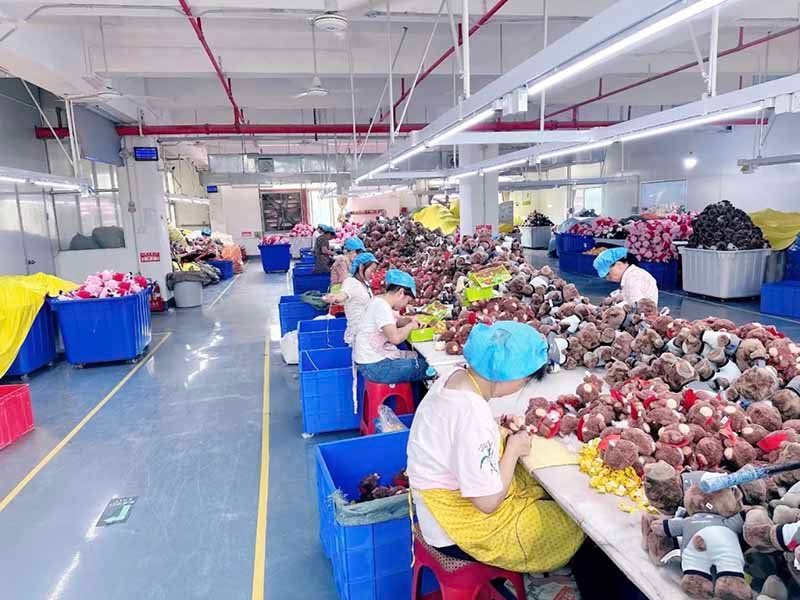
- 58+ development specialists: designers, pattern makers, and sample technicians support projects through Pufumi’s core Dongguan manufacturing base.
How Is Custom Plush Pricing Calculated?
Development Costs
- Complex characters normally require more pattern and sample work than basic forms.
- A 10 cm character with layered clothing can require more development than a simple 30 cm animal.
- Packaging mockups, electronic modules, custom-dyed fabrics, and unusual accessories may require separate development.
- Sample fees and production setup fees should be listed separately because they cover different work.
Manufacturing Costs
- Unit cost normally improves when fixed preparation work is spread across a larger quantity.
- Multiple SKUs increase changeovers, identification work, material separation, and packing controls.
- A quoted unit price remains valid only for the listed size, materials, quantity, packaging, and trade terms.
- Product changes after sample approval can require updated pricing.
Post-Production Costs
- Large plush products are often charged by volumetric weight rather than actual weight.
- Gift boxes and window boxes can reduce carton loading efficiency.
- Market-specific testing depends on age grading, structure, materials, features, and intended sales regions.
- Retail programs may also require barcode verification, carton labels, warehouse routing marks, and destination-specific documentation.
Eight Factors Behind Every Custom Plush Quote
Order Quantity
Product Size
Fabric Selection
Pattern Complexity
Surface Decoration
Added Components
Packaging Format
Market Requirements
What Should a Complete Plush Quote Include?
Comparable quotations need matching assumptions. Every major cost, exclusion, responsibility, and change condition should be visible before sample development or bulk production begins.
| Quote Component | Required Definition | Pricing Impact |
|---|---|---|
| Product specification | Finished dimensions, posture, net weight, filling weight, materials, colors, crafts, accessories | Establishes the manufacturing baseline |
| Quantity | Total quantity and quantity per SKU, size, color, and packaging version | Determines setup allocation and production efficiency |
| Sample scope | Sample type, included development work, material status, revision boundary | Separates prototype expenses from bulk costs |
| Unit price | Price based on a named specification and quantity tier | Supports accurate supplier comparison |
| Setup charges | Embroidery digitizing, printing preparation, tooling, packaging dies, fixtures | Identifies one-time or repeatable preparation costs |
| Packaging | Unit pack, printed materials, inserts, cartons, labels, assembly | Affects both product cost and shipping volume |
| Testing | Target market, age grade, SKU coverage, material coverage, laboratory scope | Prevents compliance expenses from appearing late |
| Quality control | In-process checks, key-point checking, final inspection, AQL scope | Clarifies how production consistency will be controlled |
| Trade terms | EXW, FOB, CIF, DAP, DDP, currency, port, destination | Defines freight, duty, insurance, and risk boundaries |
| Lead time | Sample, materials, packaging, production, inspection, and dispatch | Connects pricing with the actual launch schedule |
| Exclusions | Freight, duty, retesting, storage, photography, special documentation | Reduces unexpected charges |
| Quote validity | Material-price validity, exchange-rate basis, production window | Defines when costs require rechecking |
How Quantity and MOQ Change Unit Cost
One Quantity Can Hide Several Economic MOQs
A quotation should define quantity at design, color, size, material, and packaging level. A program containing 6,000 pieces can still have six independent 1,000-piece SKUs, each with separate face embroidery, clothing, labels, and retail boxes.
- Development allocation: Pattern work, embroidery files, printing setup, packaging dielines, and production preparation are distributed across the confirmed quantity. A larger run reduces the allocation per unit, but only when the same setup can serve the full run.
- Material purchasing: Standard fabrics may be available from stock, while custom-dyed fabric, printed fabric, specialty faux fur, electronics, metal hardware, and printed packaging often carry separate supplier MOQs. A product MOQ cannot be evaluated without reviewing component MOQs.
- Production changeovers: Every design change requires material separation, machine setting, first-piece verification, sewing-line instructions, accessory preparation, and packing-line control. Ten short runs generally cost more to manage than one continuous run.
- Inspection planning: More SKUs require more approved samples, measurement records, barcode checks, packaging versions, carton marks, and defect separation. Total quantity alone cannot represent the workload.
Pufumi normally evaluates standard core plush programs from approximately 500 pieces per SKU. Mini plush, plush keychains, bag charms, custom-dyed materials, and complex retail packaging often become more stable near 1,000 pieces per SKU. Final MOQ depends on structure, materials, crafts, packaging, and project schedule.
Quantity Tiers Need the Same Specification
A useful tier quotation may compare 500, 1,000, 3,000, 5,000, and 10,000 pieces, but each tier must use identical specifications. Replacing premium fabric, reducing filling, simplifying embroidery, or removing inspection creates a different product rather than a genuine quantity saving.
- Stable assumptions: Keep finished size, fabric code, filling weight, embroidery coverage, accessories, packaging, testing scope, and trade terms unchanged across every tier.
- SKU allocation: State whether the quantity applies to one SKU or a collection. A 5,000-piece quote for one design cannot be directly compared with a 5,000-piece quote divided across eight characters.
- Capacity window: Quantity can influence production scheduling. Material availability, sewing-line capacity, packaging readiness, testing, and inspection must align with the required launch date.
- Reorder economics: Archived patterns, embroidery programs, BOM records, packaging files, and retained samples can reduce repeated development work. Materials and prices still require rechecking because stock, dye lots, supplier conditions, and regulations may change.
Why Plush Size Does Not Scale Linearly
Size influences material area, filling volume, sewing accessibility, detail retention, carton loading, and freight. Smaller or larger does not automatically mean simpler.

Mini Plush

Core Plush

Premium Plush

Large Plush
How Fabric and Filling Choices Affect Pricing

Standard Short Pile
- Common purchasing cycle: approximately 7-15 days for standard short-pile fabric.
- Main cost variables: GSM, density, color stock, stretch, and usable width.
- Suitable for: character faces, structured shapes, mini plush, and clear graphic details.

Minky and Soft Plush
- Common purchasing cycle: approximately 10-20 days.
- Main cost variables: weight, elasticity, surface treatment, and color availability.
- Suitable for: premium soft-touch products, baby-oriented concepts, and rounded characters.

Long-Pile Faux Fur
- Common purchasing cycle: approximately 20-35 days.
- Main cost variables: pile length, density, dye stability, cutting direction, and trimming.
- Suitable for: realistic animals, premium creatures, and textured collector products.

Filling and Weight
- Standard filling purchasing cycle: approximately 3-7 days.
- Main cost variables: grams per unit, resilience, internal zoning, and special inserts.
- Production control: approved filling weight and touch reference should be recorded for each SKU.
Why Simple-Looking Plush Can Cost More
Pattern Piece Count
- Narrow pieces may be difficult to turn without distortion.
- Curved panels require accurate notches and seam matching.
- Directional fabric must follow an approved pile map.
- Mirrored pieces require left-right control.
- Small deviations can change the silhouette after filling.
Sewing Accessibility
- Seam allowance must remain stable around tight curves.
- High-stress attachment points may need reinforcement.
- Long-pile fabric requires pile clearing from seam lines.
- Clothing can block access to body-closing areas.
- Manual turning can stretch small panels.
Shaping and Symmetry
- Filling zones should define where volume is firm or soft.
- Left-right parts need symmetry references.
- Facial features require measurement from center and eye lines.
- Hair, fur, and clothing may require brushing or positioning.
- Standing or sitting forms need balance checks.
How Surface Decoration Changes Plush Cost

Embroidery
- Dense areas may stiffen soft fabric.
- Long pile can hide fine stitches.
- Small facial details require controlled registration.
- Designs crossing seams need additional alignment planning.
- Separate body panels may require separate embroidery operations.

Printing
- Screen printing may require separate color preparation.
- Digital printing supports complex artwork but needs color calibration.
- Printed fabric must follow the correct cutting direction.
- Stretch can distort graphic dimensions.
- Surface pile may reduce edge sharpness.

Applique
- Laser or die cutting may improve repeatability.
- Small pieces can shift during sewing.
- Edge finishing affects fraying and appearance.
- Thick layers can change the local shape.
- Contrasting materials need compatible stretch.
What Accessories Add to the Final Price

Layered Clothing
- Confirm fixed or removable construction.
- Record front, back, and dressing direction.
- Define closures, hems, and seam finishes.
- Control logo and decoration placement.
- Include clothing parts in the BOM and packing checklist.

Metal Hardware
- Record material and surface finish.
- Confirm ring or clip opening direction.
- Evaluate product balance while hanging.
- Protect plated surfaces during packing.
- Keep spare components for production replacement.

Molded Components
- Confirm fixed, sewn, or embedded attachment.
- Review sharp edges and accessible points.
- Record mold version and color code.
- Verify compatibility with stuffing and washing.
- Separate component batches for traceability.

Sound and Light
- Electronic sample evaluation often requires 20-35 working days.
- Battery type and replacement access must be defined.
- Every unit may require function checking.
- Wiring should not distort the exterior shape.
- Packaging should protect switches and modules.

Weighted Components
- Define total added weight.
- Secure particles inside a separate internal enclosure.
- Prevent migration into the head or limbs.
- Reinforce high-load seams.
- Review intended age, use, and marketing position.

Removable Pieces
- Define attachment and removal method.
- Review small-part implications.
- Use SKU-specific packing lists.
- Consider replacement-part planning.
- Verify every pack before carton sealing.
What Your Plush Sample Fee Covers
Sample Development
- Standard plush sample benchmark: 7-12 working days.
- Complex character sample benchmark: 12-20 working days.
- Multi-SKU sample group benchmark: 15-30 working days.
- Electronic sample benchmark: 20-35 working days.
Revision Work
- Each revision should use a written revision brief.
- Comments should identify location, required change, and priority.
- Size, material, structure, or function changes may alter cost.
- Revision timing commonly ranges from 5-10 working days per round.
- Major changes may require a new pattern or new material sample.
Production Setup
- Sample development and production setup serve different purposes.
- New sizes or colorways may require additional preparation.
- Custom packaging can carry separate tooling or dieline expenses.
- Setup reuse on reorders depends on unchanged specifications and usable files.
- Testing, bulk freight, and special tooling should be listed separately when excluded.
Why Multi-SKU Programs Need Separate Cost Planning
Shared components can improve collection economics, while independent structures, colors, packaging, and approvals create separate cost and MOQ requirements.
| Cost Layer | Potentially Shared | Usually SKU-Specific | Pricing Consideration |
|---|---|---|---|
| Body pattern | Common body, limbs, basic posture | Different head shapes, tails, wings, hair | Shared engineering reduces repeated pattern work |
| Main fabric | Common base fabric and backing | Unique character colors or textures | Color availability and supplier MOQ remain important |
| Embroidery | Common technique and thread families | Face, logo, expression, costume details | Every file and location requires verification |
| Clothing | Shared garment block | Character-specific prints, shapes, trims | Layer count and dressing labor affect unit cost |
| Accessories | Common ring, clip, or component | Unique props and molded pieces | Supplier MOQ can differ by color or design |
| Packaging structure | Shared box size and insert system | Artwork, barcode, rarity, language | Shared dielines reduce repeated setup |
| Testing | Shared materials under an accepted coverage plan | Different features, age grades, electronics | Laboratory scope requires project-specific confirmation |
| Production | Shared process and line instructions | Separate changeovers and first-piece checks | More SKUs create additional control work |
| Packing | Shared carton format | SKU ratio, card, box, barcode, carton mark | Anti-mixing controls increase handling |
| Reorder | Archived patterns and records | Updated materials, labels, laws, packaging | Every repeat order needs a difference review |
How Packaging Changes Unit and Shipping Cost

Polybag
- Good carton efficiency.
- Limited premium presentation.
- Warning and market requirements need review.
- Large products may require thicker material.
- Bag dimensions should match the filled product without excessive empty space.

Paper Sleeve
- Lower volume than a full box.
- Suitable for hanging or shelf presentation.
- Needs stable attachment without crushing the product.
- Barcode and legal information can be integrated.
- Mockup review should include the fully stuffed product.

Blind Box
- Packaging MOQ often applies per artwork version.
- Ratio control requires documented packing instructions.
- Inner bags may be needed for concealment.
- Carton labels must not reveal hidden contents incorrectly.
- Packaging sample development commonly needs 7-15 working days.

Window Box
- Window size should display key features.
- Internal ties or inserts may be required.
- Box depth strongly affects carton loading.
- Print and window registration require control.
- Drop, compression, and shelf handling may need review.

Gift Box
- High presentation value.
- Higher packaging MOQ and development expense.
- Larger empty space can increase freight.
- Inserts must avoid crushing fur or clothing.
- Unboxing sequence should be checked with a finished product.

Display Carton
- Requires carton-strength and display review.
- Product orientation affects shelf impact.
- Perforations and tear-away panels need testing.
- Pack quantity should match store handling.
- Outer-carton and display codes must remain consistent.
What Determines Plush Testing Costs?
Market, Age, and Product Classification Come First
- United States: Applicable requirements may involve ASTM F963 provisions, CPSIA limits, third-party testing, a Children’s Product Certificate, and tracking information. Not every ASTM F963 clause applies to every plush product. Scope depends on age grading and product features.
- European Union: Product safety assessment, applicable EN 71 testing, conformity procedures, CE marking, technical documentation, warnings, and responsible economic operators may require coordination. Packaging languages and market destinations should be confirmed early.
- Multi-market programs: One laboratory report should not be assumed to cover every country. Material coverage, colorways, electronic components, accessible parts, weighted fillings, labels, and packaging versions can change the test plan.
Product Changes Can Trigger New Review or Retesting
Testing cost can change when a product adds a new material, color, coating, accessory, battery, sound module, weighted insert, removable part, printed surface, packaging claim, or intended age. A change considered visually minor may alter chemical, mechanical, flammability, labeling, or small-part assessment.
- Sample quantity: Laboratories may require several samples for destructive testing. Multi-SKU collections need a documented coverage plan rather than assumptions based only on similar appearance.
- Material evidence: Supplier declarations, previous reports, composition records, batch information, and material codes can support planning. Documents must match the material entering the actual order.
- Retest boundary: Failed results, expired evidence, changed suppliers, different colors, revised structures, or new markets may lead to additional testing. Retest expenses should be defined before production release whenever possible.
- Schedule impact: Testing and compliance confirmation commonly require approximately 7-20 days, depending on market, laboratory, sample condition, and test scope. Production should not be scheduled around an unverified assumption.
Why Quality Control Belongs in the Quote

Material and Cutting
- Material codes should match the approved BOM.
- Dye-lot differences require review before cutting.
- Directional fabrics need a cutting map.
- Mixed panels should be isolated immediately.
- Nonconforming material should remain outside production.

Embroidery and Sewing
- First pieces should be reviewed before continuous production.
- Critical facial positions should use measurement references.
- High-stress points need defined reinforcement.
- Long-pile seams require trapped-fur inspection.
- Sewing defects should be corrected before filling hides the seam.

Filling and Shaping
- Approved filling weight should be recorded per SKU.
- Filling zones can use different firmness levels.
- Facial volume should be checked against the Golden Sample.
- Left-right symmetry needs visual and dimensional review.
- Overfilling can distort embroidery and seam lines.

Packaging and Release
- Critical label and SKU items may require full checking.
- Barcodes should be scanned rather than visually assumed.
- Hidden-edition ratios need packing records.
- Defects should be isolated from accepted goods.
- Shipment documents must match physical carton counts.
Unit Price Is Not Total Landed Cost
A commercially useful comparison follows every cost from development through delivery to the nominated warehouse, retail center, fulfillment partner, or distribution facility.
| Cost Stage | Typical Components | Main Variables |
|---|---|---|
| Product development | Pattern engineering, sample labor, materials, digitizing, revisions | Complexity, sample type, revision count |
| Bulk manufacturing | Fabric, filling, embroidery, sewing, assembly, shaping | Size, quantity, SKU count, workmanship |
| Components | Hardware, clothing, electronics, weighted inserts, molded parts | Specification, MOQ, tooling, function |
| Packaging | Labels, bags, cards, boxes, inserts, cartons, assembly | Structure, print, quantity, packaged volume |
| Compliance | Material documentation, laboratory samples, testing, certification support | Market, age grade, features, SKU coverage |
| Quality | Incoming checks, first-piece checks, process inspection, final inspection | Risk level, critical points, inspection scope |
| International logistics | Export handling, freight, insurance, destination charges | Carton volume, weight, route, season |
| Import | Duties, taxes, customs clearance, brokerage | HS classification, destination, trade terms |
| Warehousing | Receiving, pallet handling, labeling, storage, appointments | Channel and facility requirements |
| Final delivery | Trucking, parcel fulfillment, retail distribution, 3PL handling | Destination count, carton format, service level |
Typical planning ranges
- Material purchasing: approximately 7-35 days, depending on material category.
- Bulk production: approximately 25-45 days after production release and material readiness.
- International delivery: approximately 7-45 days, depending on route and shipping method.
- Large or boxed plush should be calculated using carton dimensions and volumetric weight before final approval.
How Pufumi Builds Your Plush Quotation
Brief Review
Structure Assessment
Material Assessment
Cost Range
Sample Planning
Specification Freeze
Final Quotation
Change Control
Designing Plush Around a Commercial Cost Target
Good Cost Direction
- Use approved stock colors when brand accuracy permits.
- Keep facial embroidery and signature features.
- Reduce hidden pattern pieces with no structural purpose.
- Select a straightforward unit pack.
- Share components across related SKUs.
- Match product dimensions to efficient carton loading.
Better Cost Direction
- Use premium fabric on visible touch areas.
- Combine embroidery with appliqué for large color blocks.
- Add structured clothing where character identity requires it.
- Use printed sleeves or retail boxes with controlled dimensions.
- Apply dedicated color and filling standards.
- Build a clearer multi-SKU packaging system.
Best Cost Direction
- Use custom textures or color development where essential.
- Preserve complex silhouette and facial engineering.
- Add collector cards, inserts, or premium gift packaging.
- Increase manual shaping and appearance checks.
- Prepare market-specific labels and documentation.
- Plan retained samples and long-term reorder records.
How Cost Optimization Protected Character Identity
Original Collection and Main Cost Pressures
The early engineering review identified five major cost pressures:
- Eight independent custom-dye requirements created separate material MOQs and longer purchasing schedules.
- Large solid embroidery areas increased stitch time and stiffened several costume panels.
- Hair and garment structures used pattern pieces hidden after assembly.
- Every box used a different insert size despite similar finished dimensions.
- The original box depth limited carton loading to 24 units.
Standard sample development used a 12-working-day first-sample plan. Two revision rounds followed, each focused on measurable adjustments rather than broad visual comments. The approval file recorded face measurements, pattern versions, material codes, embroidery files, filling weights, clothing orientation, and box specifications for every SKU.
Approved Changes and Production Result
Material review compared custom dyeing with available production colors under controlled lighting. Five characters retained custom colors because color accuracy was central to recognition. Three characters moved to approved close-match stock colors after physical swatch review. The decision reduced independent material preparation while preserving the intended collection palette.
Large costume graphics moved from solid embroidery to appliqué with embroidered outlines. Face embroidery remained unchanged. Hidden garment panels were consolidated where no visual, structural, or dressing function was lost. Six characters shared one engineered body block, while heads, hair, clothing, and signature details remained independent.
Packaging engineers standardized the internal support structure across all eight SKUs. Box depth moved from 145 mm to 118 mm after posture and compression-recovery checks. Carton loading increased from 24 to 30 units while keeping the front-facing retail presentation intact.
Production controls included SKU-coded cutting bundles, separated embroidery panels, accessory kits, line-clearance records, box-and-barcode scans, and documented carton ratios. The program entered a 25-45-day bulk production window after Golden Sample, BOM, packaging, and production files were released.
The final result was not defined by an unsupported savings percentage. Value came from fewer unnecessary material MOQs, lower embroidery machine time, fewer hidden sewing operations, better carton utilization, and a clearer repeat-order specification while preserving the licensed character features.
How to Compare Quotes From Plush Manufacturers
Match Product Specifications
- Ask for material descriptions and physical swatches.
- Compare embroidery coverage and locations.
- Check whether filling weight is defined.
- Confirm fixed versus removable components.
- Record the approved sample version.
Match Quantity Allocation
- State total quantity and SKU split.
- Confirm MOQ at material and packaging level.
- Request consistent quantity tiers.
- Identify hidden-edition or assortment ratios.
- Review repeat-order conditions separately.
Match Development Scope
- Define sample type.
- Confirm revision boundaries.
- Separate sample and setup expenses.
- Identify packaging mockup costs.
- Confirm whether international sample freight is included.
Match Quality Scope
- Request a product-specific quality checklist.
- Ask which items receive full checking.
- Confirm Golden Sample control.
- Review defect classification.
- Clarify third-party inspection options.
Match Compliance Scope
- Confirm applicable markets.
- Define age grading.
- List electronic or weighted features.
- Ask which SKUs are covered.
- Separate factory audits from product testing.
Match Delivery Boundaries
- Use the same destination.
- Confirm carton assumptions.
- Compare volumetric weight.
- Identify excluded duties or fees.
- Check quote validity and shipping season.
Custom Plush Pricing Frequently Asked Questions
No universal unit price applies. Cost depends on quantity per SKU, dimensions, fabric, filling, pattern complexity, embroidery or printing, clothing, accessories, packaging, testing, inspection, trade terms, and shipping destination. Pufumi first reviews the artwork and commercial requirements, then provides an initial range or project quotation based on stated assumptions.
Different quotations may use different fabrics, filling weights, embroidery coverage, sample scope, packaging, inspection, testing, freight, or trade terms. One supplier may include development and compliance work while another lists only an ex-factory product price. A valid comparison requires the same specification and cost boundary.
Larger quantities generally improve setup allocation, material purchasing, and production efficiency. Savings depend on SKU allocation. One design at 5,000 pieces usually runs more efficiently than ten designs at 500 pieces each. Special materials, custom packaging, electronics, and short production windows can limit quantity savings.
MOQ can apply at several levels: design, color, size, material, accessory, and packaging version. Standard core plush programs are commonly evaluated from around 500 pieces per SKU. Mini plush, keychains, bag charms, and complex packaging often become more stable near 1,000 pieces per SKU.
Sample fees can cover artwork review, structure interpretation, pattern development, materials, embroidery digitizing, cutting, sewing, filling, shaping, assembly, and internal review. Special fabrics, electronic components, packaging prototypes, international delivery, additional revisions, testing, and bulk tooling may be quoted separately.
Standard plush samples commonly require 7-12 working days after files, scope, payment, and key materials are ready. Complex characters often require 12-20 working days. Multi-SKU sample groups may require 15-30 working days, while electronic samples can require 20-35 working days.
Sample-fee credit is evaluated by project and must be written into the quotation or commercial agreement. Development difficulty, tooling, sample quantity, revision work, and bulk-order value can affect the decision. No automatic deduction should be assumed without written confirmation.
Testing fees may be included, allocated, or listed separately. The quotation should identify market, age grade, laboratory scope, SKU coverage, material coverage, sample quantity, certificate requirements, and retesting conditions. Product testing should not be confused with a factory social or quality-system audit.
Yes. Pufumi can review target purchase price, retail position, quantity, channel, non-negotiable character features, materials, crafts, packaging, and delivery requirements. Good, Better, and Best options can show where value is preserved and where engineering changes may improve commercial feasibility.
Provide company details, artwork, target dimensions, quantity per SKU, number of SKUs, intended market, age grade, material preference, accessories, functions, packaging, target cost, launch date, and shipping destination. Clear front, side, and back views improve engineering accuracy for complex characters.
Trust, Compliance & Production Assurance
Confidence for global brands and complex plush programs
Pufumi evaluates each project according to its target market, age grade, materials, construction, labeling, and packaging requirements. Depending on the assigned production site and project scope, our team can support ISO 9001 quality-management documentation and coordinate testing to EN71, ASTM F963, CPSIA, REACH, and other applicable standards. Factory audits, certifications, and test reports are verified by issuing body, validity period, facility, and product scope, giving brands greater transparency from sample development through controlled production and delivery.













Get a Quote Based on Your Project
Accurate custom plush pricing begins with a clear commercial and technical brief. Send the available artwork and core project conditions, even when materials or packaging remain under discussion. Pufumi will review manufacturability, cost drivers, information gaps, sample requirements, and the conditions needed for a formal quotation.
For an efficient first review, include:
- Company name and business email
- Character artwork or product reference
- Target finished size
- Quantity per SKU
- Number of designs or colorways
- Intended sales market
- Intended age grade
- Preferred materials or touch direction
- Clothing, hardware, electronics, or weighted features
- Individual packaging requirements
- Target purchase cost or retail position
- Required sample, launch, or warehouse date
- Shipping country, city, or nominated port
Unreleased character assets can be submitted under an NDA. Files are used for project evaluation, quotation, sample development, production planning, quality control, packaging, delivery, and approved reorder management.

