Skip to content

Plush 3D Model to Physical Toy Manufacturer
Turn approved digital character assets into engineered physical plush products ready for sampling, review, scalable manufacturing, packaging, and repeat production.
- Review digital geometry, reference renders, textures, dimensions, poses, and non-negotiable character features before physical development begins.
- Develop soft-form structures through paper patterns, seam planning, material selection, embroidery mapping, filling control, and physical prototype validation.
- More than 58 designers and pattern makers.
- Standard samples generally require 7–12 working days; complex character samples generally require 12–20 working days after development conditions are complete.
From Digital Models to Physical Plush Production
Digital Asset Review
Pattern Engineering
Prototype Validation
Scalable Manufacturing
Built for Teams Managing Commercial Character Assets
Game Studios
Animation Companies
Entertainment IP Owners
Collectible Brands
Design Agencies
Global Retail Programs
Files We Review Before Plush Engineering Begins
Geometry Files
- Include the approved model version.
- Confirm the intended pose.
- State the measurement unit.
- Identify removable or floating parts.
- Mark unfinished model areas.
- Provide a lightweight export when native files are unusually large.
Native Design Files
- Remove unnecessary scene assets.
- Name important body parts.
- Separate accessories where possible.
- Identify mirrored components.
- Confirm whether subdivision is applied.
- Include the software version used for the approved file.
Character Turnarounds
- Use consistent camera height.
- Keep scale consistent.
- Include top and bottom views when relevant.
- Show hidden clothing details.
- Mark the preferred standing or seated position.
- Identify the primary recognition view.
Texture References
- Provide texture maps separately.
- Identify metallic or emissive effects.
- Mark gradient areas.
- Separate printed and embroidered details.
- Confirm required logo proportions.
- State whether color matching is critical.
Character Standards
- Mark non-negotiable features.
- Identify approved alternate expressions.
- Confirm restricted materials.
- List required trademarks.
- State territory and product scope.
- Provide authorized asset contacts.
Commercial Requirements
- Target height or seated height.
- Quantity per SKU.
- Sales markets.
- Intended age group.
- Packaging format.
- Required arrival date.
- Testing or retailer protocols.
- Planned product extensions.
How Pufumi Reviews Plush Model Feasibility
A structured review identifies design risks before costly patterns, embroidery programs, special materials, packaging tools, or multiple physical samples are commissioned.
Six Reviews Before Pattern Development Starts
Pufumi evaluates the submitted character as a soft manufactured product, not simply as an attractive digital sculpture.
Design feasibility: Silhouette, face, proportions, colors, costume, posture, and signature features are checked against the intended physical size. Extremely thin horns, fingers, hair strands, floating ornaments, narrow gaps, or sharp geometry may require controlled simplification. Proposed changes should protect character recognition rather than remove important identity.
Structural feasibility: Engineers consider whether the product can be sewn, turned, filled, balanced, handled, packaged, and repeatedly produced. Head weight, body support, limb position, base area, tail location, and large accessories can affect sitting, standing, hanging, or display stability.
Material feasibility: Digital surfaces are translated into actual pile length, fabric weight, stretch, backing, sheen, texture, printability, embroidery compatibility, and color availability. Long pile may create realistic fur but cover facial seams and small markings. High-stretch material may soften the hand feel while changing final dimensions.
Process feasibility: Embroidery, printing, appliqué, layered fabrics, trimming, accessory sewing, internal support, and special shaping are assessed individually. Details positioned too close to seams can shift during sewing and filling. Large embroidered areas may stiffen the fabric or distort curved panels.
Compliance feasibility: Target age, market, detachable components, small parts, cords, batteries, weighted inserts, labels, warnings, and packaging determine the applicable path. Compliance planning begins before development rather than after production has finished.
Commercial feasibility: Quantity by SKU, material minimums, packaging complexity, sample scope, approval sequence, launch timing, and logistics are reviewed together. The output may be Ready for Sampling, Clarification Required, Engineering Adjustment Required, or Not Recommended in the proposed form.
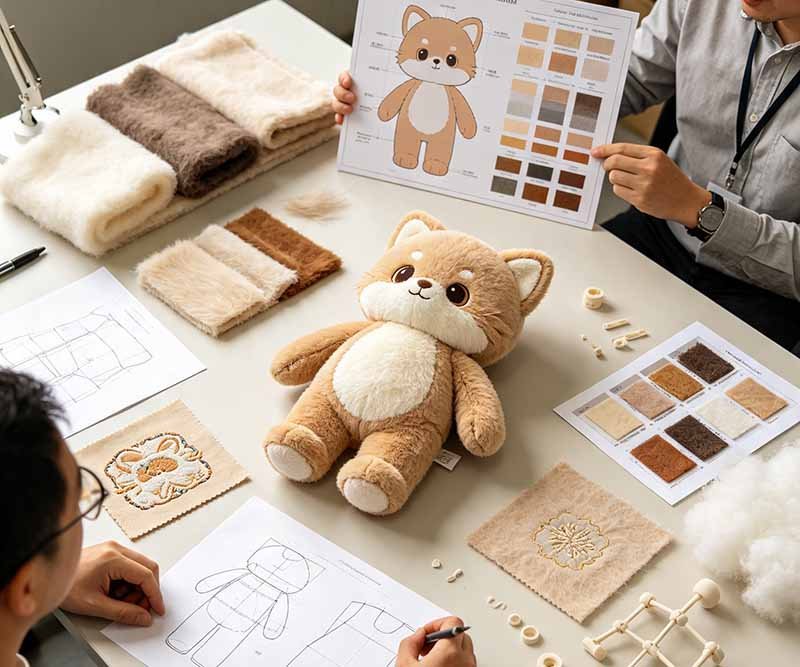
Why Digital Geometry Cannot Become Sewing Patterns Automatically
Digital Model Logic
- Surface curvature can be mathematically continuous.
- Textures can create details without physical thickness.
- Mirrored geometry can remain perfectly symmetrical.
- Accessories may attach without a real load path.
- Thin areas do not need sewing access.
- Shape remains unchanged by storage or transportation.
Plush Pattern Logic
- Curves are created through multiple sewn panels.
- Seams influence face shape and overall volume.
- Stretch changes length, width, and symmetry.
- Filling pressure changes the visible silhouette.
- Accessories require reinforced physical attachment.
- Finished appearance must remain repeatable across operators and production lots.
Five Engineering Stages From Model to Plush

Asset Review

Soft Form Interpretation

Pattern Translation

Prototype Revision

Production Release

Preserving Character Identity Through Soft Product Engineering
Recognition depends on controlled relationships between silhouette, proportions, facial landmarks, color, costume, and signature elements—not on reproducing every polygon.
Protect the Features Fans Recognize First
Pufumi begins by identifying the character’s primary recognition view and the visual features that cannot be lost. For many plush characters, the front view carries the strongest identity: face outline, eye spacing, mouth position, head-to-body ratio, ears, hairstyle, main color blocks, and signature clothing.
Silhouette control: Outer contour is compared from front, side, rear, and three-quarter angles. A character may look correct from the front but appear too flat, deep, narrow, or top-heavy from the side.
Facial landmarks: Eye centers, eye distance, brow angle, muzzle projection, nose position, mouth curve, cheek width, and face-panel seams are mapped together. Embroidery alone cannot correct a face when the underlying pattern and filling are wrong.
Proportion hierarchy: Head, body, arms, legs, ears, tail, costume, and accessories are evaluated as one system. Enlarging the head without adjusting the body and base may create balance or packaging problems.
Signature details: Unique hair shapes, masks, markings, clothing panels, equipment, symbols, and color blocks are ranked by recognition importance. Small products retain fewer details, so high-value identity cues must receive priority.
Approved simplification: Very thin, floating, sharp, or visually complex digital features may require thickness, attachment, scale, or technique changes. No major visual interpretation should be changed silently. Proposed adjustments are explained and submitted for approval.
Physical comparison: Prototype photography follows consistent front, side, rear, top, bottom, and three-quarter views. Critical measurements are recorded rather than judged only by general impressions such as “more cute” or “slightly bigger.”
Translating Digital Geometry Into Stable Plush Volume
A digital silhouette must be recalculated for fabric elasticity, seam tension, filling pressure, gravity, handling, storage, and physical balance.
Build Volume for a Soft, Filled Product
Digital geometry shows visible volume, but physical plush receives volume through panel curvature, seam relationships, material behavior, filling distribution, and shaping. A direct visual copy without compensation often creates a flat face, narrow head, overfilled body, uneven limbs, or unstable posture.
Head depth: Front and side dimensions are reviewed together. Enlarging only the front face can create a thin profile, while excessive rear depth can push the face forward or make the character look heavy.
Face projection: Muzzles, cheeks, noses, brows, and eye areas may need separate panels or localized filling. Printed shadows and digital sculpting cannot substitute for real three-dimensional construction when projection defines identity.
Body thickness: Chest, abdomen, back curve, hips, and base need enough volume to support the intended pose. A seated character requires different lower-body geometry from a standing, hanging, or hugging product.
Limb structure: Arms and legs must maintain recognizable shape without becoming rigid. Narrow joints may be difficult to turn and fill, while wide joints can change posture and clothing fit.
Ears, tails, and protrusions: Thin elements may need interfacing, foam, layered fabrics, internal seam control, or selective filling. Structure should survive packaging and handling without creating hard, unsafe, or permanently deformed areas.
Filling expansion: The same pattern can produce different shapes when filling weight, density, order, and operator technique change. Critical zones are defined so cheeks, forehead, body, limbs, and base receive controlled support.
Physical recovery: Prototype evaluation includes hand compression, rest recovery, packaging fit, and posture checks. A design requiring extensive manual reshaping for every unit may need pattern or internal-structure improvements before production release.


Pattern Engineering for Complex Three-Dimensional Character Forms
Production-ready patterns convert approved appearance into numbered, measurable, sewable parts with controlled seams, material direction, assembly order, and repeatable shaping.
From Continuous Surfaces to Controlled Fabric Panels
Pufumi’s Dongguan core factory uses experienced pattern makers and sample technicians to turn character forms into cuttable and sewable structures. The work involves much more than tracing the outline of a rendered model.
Panel decomposition: Head, face, muzzle, body, limbs, ears, tail, costume, hair, shoes, props, and decorative layers are divided according to curvature and assembly logic. Hidden panels may be added to create depth or control tension.
Panel identification: Every part requires a project code, SKU, pattern version, part name, material code, color, quantity, left-right direction, pile direction, and orientation. Similar-looking pieces across several characters must remain distinguishable during cutting and sewing.
Curve creation: Rounded cheeks, foreheads, backs, bellies, and limbs are formed through controlled panel curves and seam relationships. Too few panels can flatten complex shapes; too many panels can increase visual seams, labor, cost, and production variation.
Face engineering: Facial panels are coordinated with embroidery files, seam locations, filling pressure, and landmark measurements. Eye and mouth embroidery may be technically centered on a flat panel but shift after sewing and filling if the pattern is not engineered around the final three-dimensional form.
Turning and filling access: Narrow fingers, horns, tails, shoes, and costume pieces need enough access for turning, filling, and inspection. Some digital shapes must be thickened or divided to prevent incomplete filling, trapped fabric, twisted seams, or excessive handwork.
Assembly sequence: Embroidery, printing, appliqué, layered decoration, subassemblies, main sewing, turning, filling, attachment, closing, trimming, and shaping follow a defined order. Incorrect sequencing can make parts inaccessible or create visible rework.
Pattern validation: The first pattern is judged through the physical prototype. Approved corrections are returned to the controlled pattern set rather than performed only as hand adjustments on one sample.
Seam Placement and Pattern Count Shape Final Results
Controlled Seam Mapping
- Face seams should support cheek, forehead, muzzle, and jaw shape without crossing important embroidery.
- Body seams should control front-back depth, posture, and filling distribution.
- Limb connections should match intended movement, load direction, and visual position.
- Closing seams should remain accessible for filling and final inspection while staying visually discreet.
- High-stress areas may require reinforced stitching, hidden tape, wider seam allowance, or internal support.
- Long-pile fabrics need seam grooming so trapped fibers do not create visible lines.
Balanced Pattern Counts
- Simple rounded characters may need fewer major body panels.
- Human or game characters may need separate facial, hair, clothing, and accessory components.
- Small formats require fewer, larger details because narrow panels become difficult to sew and turn.
- Large display products may need more structural zones to control filling and posture.
- Multi-SKU programs benefit from shared body architecture only when shared components do not reduce character identity.
- Final panel count is approved after balancing appearance, production stability, cost, and inspection needs.
Matching Digital Surfaces With Real Plush Materials

Short-Pile Fabrics
- Pile length supports clear seams.
- Stable backing improves embroidery registration.
- Stretch must match pattern compensation.
- Surface sheen affects perceived color.
- Fabric weight influences body structure.
- Physical swatches confirm hand feel and appearance.

Long Faux Fur
- Pile direction must be marked on every pattern.
- Cutting should reduce fiber damage.
- Seams require grooming after sewing.
- Face areas may need shorter companion fabric.
- Trimming may define muzzle or eye zones.
- Batch consistency includes pile length and density.

Printed Surfaces
- Print method must match fiber composition.
- Curved panels may stretch artwork.
- Pattern placement must follow cutting direction.
- Seams can interrupt continuous graphics.
- Physical samples confirm color and hand feel.
- Screen colors remain references, not production standards.

Custom Material Programs
- Confirm supplier capability.
- Approve physical color standards.
- Record lot and material codes.
- Revalidate when suppliers change.
- Reserve material for repeat production where appropriate.
- Separate supplier certificates from finished-product compliance claims.
Converting Digital Details Into Manufacturable Surface Features

Embroidery Details
- Facial files align with landmark measurements.
- Dense stitching may stiffen soft fabric.
- Small text requires readability review.
- Pile height affects stitch visibility.
- First pieces are checked after sewing and filling.
- Every SKU and expression needs a controlled file number.

Printed Graphics
- Artwork version is linked to the SKU.
- Colors are approved on actual material.
- Position aligns with pattern boundaries.
- Heat can change fabric texture.
- Curved surfaces may distort images.
- Printed appearance is checked before and after filling.

Fabric Layering
- Edges need clean finishing.
- Small layers may require embroidery reinforcement.
- Clothing thickness affects body proportions.
- Layer order follows assembly access.
- Color boundaries remain measurable.
- Loose corners are checked during inspection.

Attached Accessories
- Define decorative or load-bearing use.
- Identify pull direction.
- Connect to reinforced internal areas.
- Review removable parts by intended age.
- Protect soft surfaces from hard edges.
- Test final posture inside packaging.
- Record attachment method in workmanship files.
Stuffing, Balance, and Shaping Define Final Character Form
Zoned Filling Control
Target Weight Range
Balance and Posture
Final Shaping
Prototype Development From First Build to Golden Sample
Engineering Prototype
- Confirms overall form.
- Reveals turning and filling problems.
- Tests unusual accessories.
- Identifies unstable posture.
- Does not authorize bulk production.
- Records unresolved technical questions.
First Physical Sample
- Measures key dimensions.
- Compares facial landmarks.
- Checks material behavior.
- Reviews silhouette and thickness.
- Photographs important details.
- Separates design comments from manufacturing defects.
Revision Sample
- Updates the Revision Brief.
- Changes controlled pattern versions.
- Revises embroidery or print files.
- Rechecks connected dimensions.
- Preserves approved areas.
- Records added requirements separately.
Pre-Production Sample
- Verifies final materials.
- Confirms released techniques.
- Checks final dimensions.
- Reviews labels and packaging.
- Supports final inspection planning.
- Identifies remaining production risks.
Golden Sample
- Assigned a sample ID.
- Records approval date.
- Identifies approved scope.
- Stored under controlled conditions.
- Used for first-article review.
- Supports repeat-order comparison.

Project Requirements, Sampling Windows, and Production Planning
| Project Item | Typical Pufumi Evaluation Basis | Important Planning Conditions |
| Digital input | Approved geometry plus renders and specifications | Model version, pose, scale, textures, and non-negotiable features must agree |
| Standard plush sample | 7–12 working days | Begins after files, sample terms, and key material direction are complete |
| Complex character sample | 12–20 working days | Complex faces, costumes, accessories, long pile, unusual posture, or premium finishing |
| Multi-SKU sample group | 15–30 working days | Depends on shared patterns, shared materials, character differences, and approval sequence |
| Packaging sample | 7–15 working days | Printed boxes, inserts, cards, finishes, and special tooling may extend the schedule |
| Core plush quantity | Commonly evaluated from 500 units per SKU | Final quantity depends on size, construction, material, packaging, and production setup |
| Mini, keychain, or charm quantity | Commonly evaluated from 1,000 units per SKU | Small formats often involve dense details, hardware, and more handling per unit |
| Bulk production | Confirmed after final production release | Golden Sample, BOM, packaging, testing path, material readiness, and deposit status affect timing |
| Compliance preparation | Defined by target age and market | Product structure determines applicable requirements; not every clause applies to every product |
| Delivery planning | Based on required arrival date | Production, inspection, testing, packaging, freight, customs, and warehouse receiving are planned backward |
Released Production Files Protect Approved Character Designs
One controlled production package connects every approved visual, material, construction, packaging, and inspection decision to the correct SKU and version.
Build One Executable Source for Every Production Team
Sample approval is not complete until the approved decisions are converted into files that production, purchasing, QC, packaging, and repeat-order teams can execute consistently.
Approved asset reference: The designated 3D model, turnaround, expression, and texture version are identified. Updated game or animation files cannot automatically replace a model already released for production.
Plush Interpretation Sheet: Soft-form decisions record silhouette, thickness, posture, materials, techniques, dimensional adjustments, and approved simplifications. The document explains how digital features were translated into physical construction.
Pattern set: Every pattern carries project, SKU, version, panel, material, direction, and quantity information. Superseded patterns are removed from active production areas.
Embroidery and print files: Program numbers, actual dimensions, positions, thread or color references, fabric identity, and approval status are linked to the correct parts and SKUs.
Measurement specification: Product height, width, depth, facial landmarks, limb dimensions, accessory positions, and reasonable soft-product tolerances are documented.
BOM: Materials, colors, filling, threads, labels, hardware, accessories, clothing components, and packaging are coded and connected to approved suppliers or physical standards.
Workmanship notes: Stitching, seam allowance, attachment, turning, filling, closing, trimming, grooming, and final shaping requirements are defined.
Packaging specification: Unit packaging, barcode, hangtag, care label, copyright information, carton quantity, carton marks, and market version are controlled.
QC checklist: Incoming, first-article, in-line, final-product, packaging, and shipment checks reference the Golden Sample and released files.
Version status: Draft, Sample, Approved, Released, Revised, Archived, and Obsolete states prevent old information from returning to production.

Scale One Character Across Multiple Plush Product Formats

Mini Plush
- Common sizes include approximately 4–6 inches.
- Narrow fingers and thin accessories may be combined.
- Embroidery dimensions require readability checks.
- Smaller openings increase turning and filling difficulty.
- Packaging and display orientation affect final posture.
- A scaled-down Core Plush pattern is rarely sufficient.

Core Plush
- Common programs may use approximately 8–12 inches.
- Proportions balance shelf impact and shipping volume.
- Materials can express several texture zones.
- Clothing construction receives more definition.
- Golden Sample standards support ongoing replenishment.
- Packaging may include polybag, hangtag, sleeve, or retail box.

Plush Keychain
- Hardware must connect to a reinforced load path.
- The character should face forward while hanging.
- Metal edges should not damage the fabric.
- Dense details may need embroidery simplification.
- Weight should remain appropriate for bags or keys.
- Each hardware and color version needs controlled coding.

Premium Edition
- Larger products require stronger volume control.
- Premium materials need physical approval.
- Packaging must protect shape and presentation.
- Limited versions require accurate identification.
- Extra details need defined inspection checkpoints.
- Repeat-order rights and material availability should be considered early.
Control Approved Designs Through Stable Bulk Manufacturing

Production Release
- Project and SKU codes identify all work.
- Released versions replace development drafts.
- Production questions follow an escalation path.
- Changes require documented review and approval.

Material Lot Control
- Lot identities remain traceable.
- Color zones are checked under controlled lighting.
- Long pile is reviewed for direction and density.
- Substitutions require approval before use.

Cutting and Identification
- Left and right parts remain distinguishable.
- Printed patterns follow registration marks.
- Defective fabric areas are isolated.
- Bundles travel with part and quantity identification.

Sewing Control
- First sewn units are reviewed.
- Landmark alignment is measured.
- High-stress attachments are reinforced.
- Repeated defects trigger line correction.

Filling and Shaping
- Facial volume is checked visually and dimensionally.
- Limbs receive even distribution.
- The base supports the intended pose.
- Final shaping follows documented instructions.

Packaging Release
- Packing areas separate active SKUs.
- Barcode identity is checked.
- Product orientation protects the face and accessories.
- Carton counts match released packing rules.
Quality Inspection for 3D-Driven Plush Production Programs
Incoming Materials
- Separate material lots.
- Record discrepancies.
- Isolate nonconforming inputs.
- Recheck approved substitutions.
- Protect client-approved materials.
- Link materials to production batches.
Embroidery and Printing
- Verify file version.
- Check actual dimensions.
- Measure position.
- Review thread or print color.
- Inspect edge and surface quality.
- Confirm appearance on the filled form.
Sewing and Alignment
- Review first articles.
- Inspect critical assemblies.
- Compare seam placement.
- Check trapped pile.
- Identify open or weak seams.
- Record repeated defect patterns.
Filling and Weight
- Check head and face support.
- Compare paired limbs.
- Review body density.
- Test sitting or hanging position.
- Inspect closing seams.
- Confirm final shaping quality.
Character Fidelity
- Review consistent photography angles.
- Measure key landmarks.
- Check expression changes.
- Compare side depth.
- Confirm accessory orientation.
- Isolate units outside approved tolerances.
Packaging and Final Inspection
- Verify SKU-to-package matching.
- Scan selected barcodes.
- Check product orientation.
- Confirm packaging protection.
- Review carton data.
- Retain approved batch records and samples.
Protecting Licensed Assets and Market Compliance Requirements
IP Asset Protection
- NDA review can occur before file submission.
- Authorized model versions receive controlled identification.
- Access is limited to personnel required for evaluation and execution.
- Client files are not reused for unrelated projects.
- Unapproved projects are not displayed publicly.
- Copyright and trademark placement follows supplied authorized files.
- Obsolete files remain separated from active production versions.
- Projects without a clear rights basis may be declined.
Compliance Planning
The applicable path depends on target market, intended age group, structure, materials, small parts, cords, filling, accessories, batteries, electronic functions, labels, warnings, and packaging. No single report automatically proves worldwide compliance.
- Define markets and age grading before development.
- Review detachable parts and attachment methods.
- Prepare BOM and material information.
- Produce representative testing samples.
- Coordinate with qualified third-party laboratories where required.
- Separate factory audits from finished-product testing.
- Separate material certificates from final product compliance.
- Record manufacturing information supporting client or importer obligations.
- Recheck requirements when product structure or market scope changes.
Illustrative 3D Model to Plush Development Case
The following program illustrates a realistic engineering and production structure. Figures demonstrate project management logic and should be replaced by an approved public case when available.
Four Game Characters Developed Into a 3,600-Piece Plush Series
A game merchandise program supplied four approved character models, front-side-rear renders, texture maps, Pantone references, target dimensions, and a list of protected character features. The planned assortment contained four 20 cm seated plush SKUs at 900 units per character, for a total of 3,600 units.
Initial engineering challenge: Every model used a large head, narrow neck, layered costume, asymmetrical hair, and one character-specific accessory. Several costume details existed only as textures, while hair tips and equipment were too thin for stable soft construction.
Soft-product interpretation: Pufumi separated the designs into shared and character-specific systems. All four products used a coordinated seated proportion and common filling logic, while facial panels, hair, clothing, embroidery, and accessories remained independently engineered. Thin hair points were converted into layered fabric shapes. Printed costume shadows became appliqué or embroidery where a real seam or raised surface was visually necessary.
Pattern development: Each character required approximately 22–29 controlled fabric parts, excluding packaging and labels. Face panels were linked to separate embroidery programs. Accessories used reinforced sewn attachments connected to structural seams rather than surface stitching alone.
Sample schedule: The four-SKU development group was planned across 24 working days after complete files, sample terms, and initial material direction were confirmed. Round one focused on head depth, face landmarks, and sitting balance. Round two adjusted eye spacing, hair volume, costume thickness, and accessory angle.
Production preparation: Approved Golden Samples were linked to individual pattern sets, BOMs, embroidery files, measurements, workmanship notes, filling instructions, hangtags, barcodes, and QC checklists. Every character received an independent SKU code.
Packing plan: Units were individually protected, packed 24 pieces per export carton, and separated by SKU. The 3,600-unit order required 150 cartons before any additional samples or spare quantities. Carton labels identified character, SKU, quantity, and carton sequence.
Quality control: First-article review checked embroidery position, side depth, costume alignment, accessory angle, and seated stability. In-line inspection monitored sewing and filling. Final inspection compared random units with Golden Samples and verified SKU-to-packaging accuracy.
The result was a production-ready four-character assortment with controlled development records, separate SKU files, repeatable construction, and documentation suitable for future replenishment.

Frequently Asked Questions
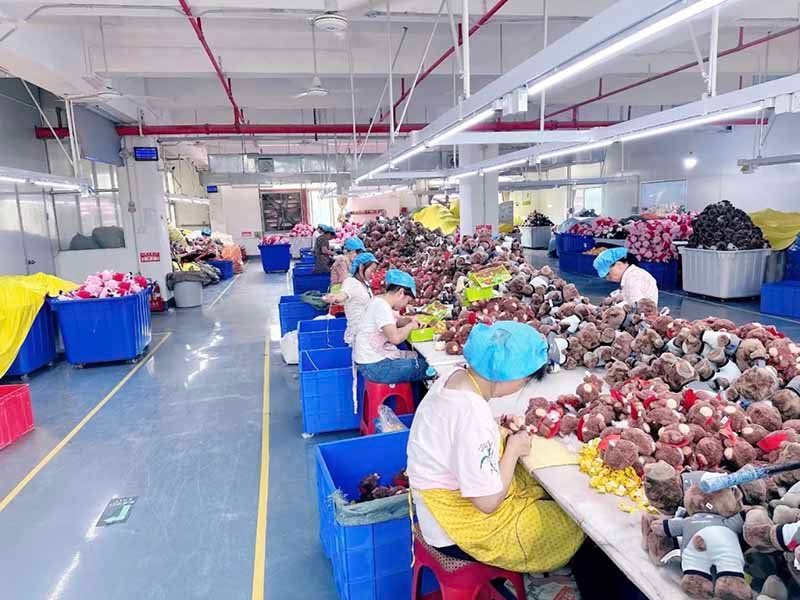
Trust, Compliance & Production Assurance
Confidence for global brands and complex plush programs
Pufumi evaluates each project according to its target market, age grade, materials, construction, labeling, and packaging requirements. Depending on the assigned production site and project scope, our team can support ISO 9001 quality-management documentation and coordinate testing to EN71, ASTM F963, CPSIA, REACH, and other applicable standards. Factory audits, certifications, and test reports are verified by issuing body, validity period, facility, and product scope, giving brands greater transparency from sample development through controlled production and delivery.















Submit Your 3D Model for Engineering Review
Send the approved digital character package so Pufumi can evaluate the path from geometry to physical plush production. Useful information includes the company name, project contact, character count, approved model format, target pose, target dimensions, quantity per SKU, launch markets, intended age group, packaging format, required arrival date, authorization status, and confidentiality requirements.
Model files may include OBJ, FBX, STL, clean geometry exports, native design references, texture maps, and consistent front, side, rear, and three-quarter renders. Include Pantone references or physical color standards where accurate brand color matters. Mark facial landmarks, costume elements, proportions, symbols, or accessories that cannot be changed during engineering interpretation.
After receiving the project package, Pufumi can review:
- Digital asset completeness
- Character fidelity priorities
- Soft-form and structural feasibility
- Pattern and seam complexity
- Fabric, embroidery, printing, and accessory directions
- Sample scope and estimated development window
- Quantity and SKU allocation
- Packaging and production requirements
- Target-market compliance considerations
- Timeline risks and required approval stages
Confidential projects may begin with an NDA review before full files are released. Formal quotations and schedules are prepared after sufficient information is available to define the real product structure and execution scope.