Skip to content


A fabric can look excellent on a swatch card and still produce the wrong plush toy. This happens more often than many product teams expect. Once fabric is cut into small curved panels, embroidered, sewn, turned and filled, its pile length, stretch and backing begin to influence the face, body proportions and even the apparent color of the finished character. Short plush is popular precisely because it gives designers a useful balance between softness and visual control, especially when a plush product contains detailed facial features, logos or compact shapes.
Short plush fabric is a soft pile textile with relatively short surface fibers that create a smooth, controlled plush surface while keeping embroidery, facial features, seams and small contours visible. Most commercial versions used for plush products are polyester-based, although pile length, GSM, density, stretch, backing and finish vary between fabrics. It is especially useful for detailed character and small-format plush products.
Consider two prototypes cut from exactly the same pattern. One uses dense short plush, while the other uses a longer, looser pile. Nothing in the sewing pattern has changed, yet the second toy may suddenly appear to have wider cheeks, smaller eyes and softer facial boundaries because the fibers cover part of the original geometry. That is the real reason fabric selection deserves more attention than simply asking which material feels the softest.
What Is Short Plush Fabric?
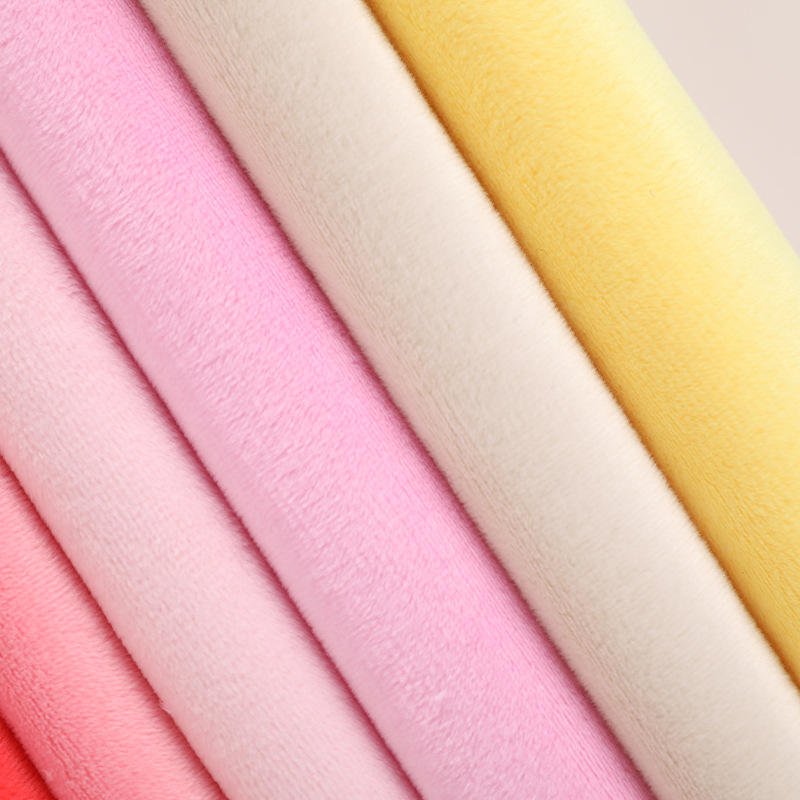
Short plush fabric is a soft textile with a relatively low pile that keeps the underlying shape of a plush product easy to see. It is commonly used for character faces, mascots, mini plush, keychains and other designs where embroidery and clear outlines matter. Short plush is a broad material category rather than one globally standardized construction, so specifications vary between mills and suppliers.
What Is Short Plush Made Of?
Most short plush used in commercial stuffed products is made primarily from polyester. Polyester is widely used because it can be manufactured in many colors, pile effects, densities and finishes while remaining practical for repeated production. It also works well with the cutting, embroidery and sewing processes used for character plush, mascots, collectible plush, mini plush and other soft products. However, the phrase “short plush” does not identify one fixed material composition, and polyester content alone says very little about how the fabric will behave in a finished toy.
Two materials described as polyester short plush can still feel and perform very differently. One may use finer fibers and a compact backing that creates a smooth, velvety surface, while another may have a looser pile and higher stretch. Their appearance can become even more different after stuffing, particularly around cheeks, paws and rounded body areas. That is why experienced product developers look beyond the fiber-content line and examine pile, GSM, density, backing, elasticity, usable width and surface direction before approving a fabric for production.
Pufumi’s material management follows this type of specification-based approach. Its Fabric Library records material type, composition, pile length, GSM, width, elasticity, backing, color, supplier, availability and production suitability rather than treating a fabric name as a sufficient specification. This matters because a repeat order months later needs a reproducible material reference, not just a note saying “use the soft white short plush again.”
What Does Short Pile Mean?
Pile refers to the fibers that rise above the base fabric and create the soft surface people associate with plush textiles. Short pile simply means that these visible fibers remain relatively close to the backing compared with medium-pile or long-pile materials. There is no single global millimeter threshold that every supplier uses to define “short plush,” so the term should be understood as a functional material category rather than a rigid international specification.
The lower surface height gives short plush one of its biggest advantages: the pattern geometry remains visible. Embroidered eyes, mouths, eyebrows, lettering and logos are less likely to disappear beneath the fibers. Color-block boundaries also remain easier to read. This becomes especially important as product size decreases, because even a modest increase in visible fiber length can visually consume a large percentage of a small face, ear or limb.
Short pile can also make manufacturing easier to inspect. Stitching positions, embroidery alignment and seam transitions are more visible during sample review and quality control. The trade-off is that the fabric may not provide the deep, natural fur effect required by certain realistic animals or shaggy characters. The right question is therefore not whether short pile is universally better, but whether the product needs clean visual definition more than dramatic fur texture.
How Is Short Plush Fabric Made?
Short plush used for soft toys is commonly produced as a knitted pile textile. A textile base provides the structural foundation, while raised fibers create the soft surface. Depending on the mill and the intended finish, the material may then be dyed, brushed, sheared, heat-set or otherwise finished to control pile uniformity, hand feel, gloss and surface direction. These finishing choices help explain why two short plush materials with similar nominal composition can look and feel surprisingly different.
The backing deserves as much attention as the pile. A flexible knitted backing can help a plush toy feel soft and rounded, but excessive stretch may change the dimensions of the finished product. If the strongest stretch runs horizontally across a character’s face, stuffing pressure can make that face wider than expected. The same pattern rotated in another direction can produce a visibly different shape even though the sewing pattern itself has not changed.
Finishing also affects photography and retail appearance. Some short plush has a strong directional sheen, meaning the surface becomes lighter or darker depending on how the fibers are brushed. Other versions are more matte and visually stable. These differences are difficult to judge from supplier photographs alone, which is why serious product development should include actual swatches and prototype testing before a final fabric is approved.
What Are the Key Properties of Short Plush?

The most important properties of short plush include pile length, density, GSM, stretch, backing stability, thickness and pile direction. Together, these characteristics determine how the material feels, how clearly embroidery appears, how a stuffed shape holds its proportions and how consistently the product can be reproduced. A fabric should therefore be evaluated as a complete construction rather than judged by softness alone.
How Soft and Dense Is Short Plush?
Softness and density are related, but they are not the same thing. A fabric can feel very soft because it uses fine fibers while still having relatively low pile density. When that fabric is stretched across a rounded plush head or firmly filled body, the backing may become visible between the fibers. Another fabric may feel slightly less silky on the flat swatch yet produce a richer finished appearance because its pile is denser and more evenly distributed.
Density also affects embroidery. Dense, stable short plush tends to provide better visual support around embroidered eyes, mouths and logos because the surrounding surface remains more uniform. A sparse or highly elastic material can pull inward around dense embroidery, making the fabric pucker or changing the shape of the facial panel. These problems are much easier to see after the embroidered piece is sewn and stuffed than when it is lying flat on an embroidery frame.
GSM is useful when comparing fabrics, but it should not be mistaken for a complete quality score. A heavier material may feel more substantial, yet the additional weight could be concentrated in the backing rather than the pile. Pufumi’s material specifications treat GSM, pile, density, thickness, elasticity and backing as separate characteristics because changing any one of them can alter the final plush product.
| Material Property | Practical Measurement | Main Effect on Plush Products |
|---|---|---|
| Pile length | Millimeters or approved physical swatch | Controls detail visibility and surface character |
| GSM | g/m² | Indicates material weight and overall substance |
| Density | Mill specification or approved swatch | Influences backing visibility and fullness |
| Stretch | Horizontal, vertical and diagonal comparison | Affects stuffed dimensions and shape |
| Thickness | Compressed and uncompressed comparison | Influences small seams and turning |
| Backing stability | Stretch and seam test | Affects seam performance and shape retention |
| Pile direction | Marked cutting orientation | Controls shade, gloss and visual consistency |
Does Short Plush Stretch?
Many short plush fabrics have some degree of stretch because of their knitted construction, but the amount and direction differ considerably. Some materials move mainly across the width, while others have more balanced stretch or noticeable diagonal give. The important production question is not simply whether the material stretches, but how that stretch interacts with each pattern piece once the toy is filled.
Consider a nearly round character head. If the most elastic fabric direction runs from left to right, filling pressure may widen the face and increase the perceived distance between the eyes. Rotate the material direction and the same sewing pattern may produce a taller, narrower head. On a large generic animal this difference may be acceptable, but on a licensed character or compact collectible it can change the expression enough to become a sample-approval issue.
Stretch also matters when suppliers propose substitute materials. A replacement can match the original color and feel similar by hand while still producing a different body shape because the backing stretches more. For this reason, material substitutions should be evaluated using both technical data and an actual sewn test, particularly when the approved product depends on tightly controlled facial or body proportions.
How Does Pile Direction Affect Appearance?
Pile direction determines how surface fibers lie, and that changes the way light reflects from the fabric. Run your hand one way across a directional short plush and the surface may look smooth and slightly lighter; brush it in the opposite direction and the same material can appear darker or more reflective. The effect can remain visible after the fabric becomes a finished plush toy, particularly in studio photography or under bright retail lighting.
Symmetrical facial panels are especially sensitive. If the left cheek is cut with the pile running downward and the right cheek is cut in the opposite direction, customers may believe the two panels were dyed differently even though they came from the same fabric roll. Similar mismatches can appear on pairs of ears, arms, legs or feet, particularly when the material has a slight sheen.
Pile direction therefore needs to be controlled during pattern layout rather than left to operator preference. Pufumi records pile direction and fabric grain as production variables that can enter paper patterns, cutting instructions, BOM information and QC checks. Even short pile can show directional variation, so consistent cutting orientation becomes important when hundreds or thousands of products are expected to look like the approved sample.
Is Short Plush Good for Plush Toys?

Yes. Short plush is especially effective for plush toys that need softness without losing facial detail, embroidery clarity or controlled outlines. It is frequently suitable for character plush, anime and game characters, mascots, mini plush, keychains and collectible products. It is less suitable when the design depends on deep, shaggy or highly realistic fur, where longer pile or faux fur may provide a more appropriate visual effect.
Which Plush Designs Suit Short Plush?
Short plush works particularly well when a character is recognized through graphic features rather than natural fur. Large embroidered eyes, sharply positioned mouths, clear facial color blocks, signature logos and compact ear shapes all benefit from a relatively controlled surface. The fibers remain close enough to the backing that the viewer can still read the underlying pattern geometry without the material visually overwhelming the design.
Anime characters, game characters and mascots are common examples. Their identity may depend on very specific eye spacing, cheek shape, eyebrow angle or color-block boundaries. These visual cues can be softened when long fibers sit across the face. A dense short plush allows designers to keep a tactile surface while protecting the visual clarity needed for character recognition.
Short plush is not automatically the best choice for every product. A realistic wolf, shaggy bear or fantasy creature with a dramatic mane may need longer pile or faux fur to communicate the intended personality. Good fabric selection therefore starts with the design language. If the product depends on clear shape and graphic detail, short plush is usually one of the first materials worth testing. If it depends on natural hair movement, another pile structure may perform better.
Is Short Plush Good for Character Faces and Embroidery?
Character faces are one of the strongest applications for short plush because embroidery needs to remain visually readable after the fabric is sewn and filled. Long fibers can partially cover eyelashes, narrow mouth lines, small lettering or the edges of embroidered eyes. Short plush reduces that interference and gives both designers and inspectors a clearer surface for judging placement, symmetry and expression.
The material still needs sufficient backing stability. Very stretchy short plush can contract around dense embroidery, making the area pucker or pulling the face panel inward. This is especially important when a character has large satin-filled eyes or a substantial embroidered logo. Testing should therefore be done on the actual production-intent fabric rather than on a convenient substitute that happens to be similar in color.
After embroidery, the panel should be sewn into the intended shape and stuffed before final approval. Embroidery that looks perfectly positioned when flat can move visually once the panel becomes curved. On character projects, the correct sequence is therefore fabric test, embroidery test, sewn sample and filled evaluation. This simple discipline catches many facial issues before they become bulk-production problems.
Is Short Plush Suitable for Mini Plush and Keychains?
Short plush is often a strong choice for Mini Plush, keychains, bag charms and blind-box formats because small products have very little space for construction error. On a product around 8–15 cm tall, depending on the character, ears, hands, shoes and facial panels can already be only a few centimeters wide. Long fibers can visually consume part of that limited space and make sharp details appear softer than intended.
Thickness matters almost as much as pile height. Small plush products may have several layers meeting around narrow ears, limbs or facial joins. If the fabric is too bulky, seam allowances accumulate and make those areas difficult to turn cleanly. The result can be stiff corners, thick hands or a face that appears wider simply because too much material is trapped in the seam.
Pufumi’s material records specifically identify short plush as suitable for products that require clear character contours and significant embroidery, including anime characters, game characters, mascots, Mini Plush and Keychain projects. For compact formats, an actual-size prototype remains essential because an enlarged sample cannot accurately predict how pile thickness and seam bulk will behave after miniaturization.
| Plush Format | Short Plush Suitability | Main Reason |
|---|---|---|
| Anime character plush | High | Preserves facial embroidery and clear color blocks |
| Game character plush | High | Supports detailed expressions and accessories |
| Mascot plush | High | Keeps logos and recognizable outlines visible |
| Mini Plush | High | Reduces visual bulk at small scale |
| Plush Keychain | High | Works well with compact construction |
| Blind Box Plush | High | Supports small collectible formats |
| Realistic shaggy animal | Medium–Low | Longer pile may create a more natural coat |
| Long-haired fantasy character | Medium–Low | Faux fur or long plush may better express hair movement |
Which Short Plush Specifications Matter?

The most important short plush specifications are pile length, GSM, density, usable width, stretch, backing construction, thickness, color and pile direction. These values should be evaluated together because one correct parameter cannot compensate for several unsuitable ones. A complete specification gives designers, pattern engineers, purchasing teams and quality inspectors a shared reference that can be reproduced when the product moves from prototype to bulk production.
Which Pile Height and GSM Should You Choose?
There is no universal pile height that is correct for every short plush project. The appropriate level depends on the scale of the product, the amount of embroidery, the desired hand feel and how much surface texture the character needs. Lower pile generally makes small facial details and seam boundaries easier to read, while slightly fuller short plush can create a softer, more substantial impression without moving into the visual territory of long plush.
Scale changes the decision significantly. A pile that looks subtle on a 35 cm plush can appear much more prominent when the same material is used on a 10 cm keychain. Product developers should therefore compare the pile height with the actual dimensions of the eyes, ears and other recognition features instead of judging the material in isolation.
GSM measures fabric weight in grams per square meter and is useful for comparing materials, but it is not a standalone measure of quality. Two fabrics with similar GSM can feel different because one carries more weight in the backing while another carries more weight in the surface pile. For reliable selection, GSM should be reviewed together with pile, density, thickness and stretch rather than used as a shortcut for “premium” or “basic.”
Which Backing and Stretch Work Best?
The ideal backing is stable enough to support sewing and embroidery while remaining flexible enough to produce the desired plush feel. A very loose backing may allow seams to spread visibly after stuffing or cause curved panels to distort. A backing that is excessively stiff can make the product feel rigid and can create difficulty when small parts need to be turned after sewing.
One of the simplest development tests is to sew two curved pieces from the candidate material, turn the seam and fill the test piece to approximately the intended firmness. This reveals whether the backing begins to show, whether the seam opens visually and whether the material expands in an unexpected direction. A flat swatch alone rarely provides that information.
Stretch should also be mapped before pattern finalization. If the fabric is significantly more elastic in one direction, pattern pieces may need a fixed orientation to prevent bulk variation. Small character heads are particularly sensitive because relatively small changes in width or height can alter the expression. For projects where appearance is tightly controlled, a predictable backing is often more valuable than maximum elasticity.
How Should Color Be Approved?
Color should ideally be approved on the actual short plush construction rather than by screen image or Pantone reference alone. The same nominal color can look different on short plush, Minky, velvet or faux fur because pile geometry and surface gloss change the way light is reflected. Directional short plush can even appear to have two shades depending on whether the fibers are brushed with or against the light.
For custom-dyed projects, the approved physical swatch should be connected to the exact fabric specification, including pile, GSM, supplier and material code. If the product uses several materials in one color family, those materials should be viewed together under consistent lighting. A red short plush body and a red woven garment may technically correspond to the same target color while still appearing different because one surface is matte and the other is reflective.
Production availability also needs confirmation before a sample is treated as final. A beautiful swatch has limited value if the supplier cannot reproduce the same construction for bulk production. Material availability, MOQ, lead time and repeatability belong in the approval decision because production reliability is part of material quality.
| Specification | What to Confirm | Risk if Ignored |
|---|---|---|
| Pile | Approved physical appearance or measured reference | Hidden details or changed silhouette |
| GSM | Supplier specification | Different hand feel and sewing behavior |
| Stretch | Direction and relative movement | Shape variation after filling |
| Density | Approved swatch or mill reference | Backing becomes visible |
| Backing | Structure and stability | Seam or facial distortion |
| Width | Usable production width | Incorrect yield and costing |
| Color | Physical swatch plus reference | Dye-lot or visual mismatch |
| Direction | Pattern orientation | Shade and gloss inconsistency |
| Availability | Sample and bulk status | Unplanned material substitution |
How Does Short Plush Compare With Other Fabrics?
Short plush generally offers clearer detail than long plush and faux fur while often providing a fuller feel than basic low-pile Velboa. Compared with Minky, the differences depend strongly on the exact construction because supplier terminology overlaps. The most reliable comparison is based on actual pile, density, backing, stretch and finished product performance rather than assuming that every fabric sold under the same commercial name behaves identically.
Is Short Plush the Same as Velboa or Minky?
Short plush, Velboa and Minky can overlap visually, but they should not automatically be considered interchangeable. Commercial naming varies among mills and markets, so one supplier’s “short plush” may look similar to another supplier’s Minky or Velboa. This is why experienced sourcing teams rely on actual construction and approved samples rather than assuming the commercial fabric name defines performance.
Velboa is commonly associated with a short, relatively flat pile and a clear surface texture. It can perform well on stuffed animals and basic character products where a smooth appearance and efficient production are important. Some short plush constructions feel fuller or more refined while still maintaining a relatively low surface height. Minky is generally associated with a very soft hand and may have more noticeable stretch depending on the specific construction.
The practical comparison should include pile length, GSM, backing, elastic direction, density and embroidery behavior. A proposed replacement should be sewn and filled before approval if the product depends heavily on facial accuracy. Similar color is not enough, and similar supplier terminology is not enough. If the new fabric changes the shape, embroidery result or hand feel of the approved product, it should be treated as a different material.
How Does Short Plush Compare With Long Plush and Faux Fur?
The most important difference is visual control. Short plush follows the geometry of the pattern closely, allowing viewers to see the face shape, seam placement, color blocks and embroidery with relatively little interference from the surface fibers. Long plush and faux fur create much more depth and movement, which can produce a warmer, more natural or dramatic appearance but can also conceal small design details.
For realistic animals, fantasy creatures with manes or characters intentionally designed to look shaggy, longer materials may be the better choice. Fibers can be brushed and trimmed to imitate natural hair flow and create a stronger sense of volume. The same material may be unsuitable for a small anime face where the eyes and mouth need to remain sharply visible.
Long materials also add manufacturing steps. Cutting can generate more loose fibers, pile may become trapped in seams, facial regions may need trimming and compressed packaging can temporarily flatten the surface. Short plush reduces many of these variables, although it cannot reproduce the same visual depth. Neither category is universally superior; each serves a different character language and production objective.
Which Fabric Gives Better Character Detail?
Short plush is usually one of the strongest materials to evaluate when a design contains detailed facial embroidery, clean logos, small color blocks and compact character shapes. Its relatively low surface fibers allow the eye to read these features with less interference. Velboa can also perform well when a flatter surface is acceptable, while Minky can offer stronger tactile softness if its stretch and density remain suitable for the pattern.
Long plush and faux fur generally require larger decorative features or localized trimming when precise embroidery must remain visible. Fleece offers extremely clear detail because it lacks a traditional raised plush pile, but its surface character is visually different and may not provide the softness or premium plush feel expected for certain products.
The decision should therefore begin with design priorities rather than a ranking of which fabric sounds more expensive. If character likeness is the main objective, clarity may matter more than maximum fluffiness. If rich tactile texture is the selling point, a fuller pile may justify some reduction in visual sharpness. Experienced product development is largely about managing that trade-off intentionally.
| Fabric | Detail Visibility | Surface Depth | Small-Plush Suitability | Typical Use |
|---|---|---|---|---|
| Short Plush | High | Low–Medium | High | Character plush, mascots, mini plush |
| Velboa | High | Low | High | Animals and clean-surface characters |
| Minky | High–Medium | Medium | High–Medium | Soft-touch character and gift plush |
| Long Plush | Medium–Low | High | Medium–Low | Fluffy animals and long-haired characters |
| Faux Fur | Low for fine details | Very High | Low | Realistic animals and premium texture |
| Fleece | High | Very Low | High | Simple shapes and flat-texture plush |
How Do You Choose Short Plush for Production?
Choose short plush by working backward from the character design, finished size, embroidery, target hand feel and production requirements. Candidate materials should be tested in an actual prototype, not approved only as flat swatches. Once the correct material is confirmed, pile, GSM, backing, stretch, color and direction should be documented so production can reproduce the same appearance consistently in the approved quantity and future repeat orders.
How Should Fabric Match the Character Design?
Material selection should begin with the character rather than the fabric catalogue. Identify the visual features that make the design recognizable: eye shape, face width, ear silhouette, signature color blocks, logos, clothing or unusual textures. Then decide which surfaces need precise visual definition and which areas would benefit from richer texture. This approach prevents the common mistake of using one attractive fabric everywhere simply because it feels premium.
A single plush product can use several pile structures. Short plush may be used for the face and hands, while longer pile appears on the hair, tail or costume. Mixing materials is often more accurate than forcing one fabric to solve every design problem. The challenge is to manage thickness changes where those materials meet so that seams remain clean after turning and stuffing.
Finished size must be considered at the same time. The same short plush that looks balanced on a 30 cm character can overpower an 8 cm bag charm because the pile occupies a larger proportion of the visible surface. When discussing a new project with a manufacturer, artwork, target dimensions, planned quantity, target market and preferred hand feel provide a much stronger foundation for material selection than simply asking for “high-quality plush fabric.”
How Should Pile Direction Be Controlled?
Pile direction should be established during pattern engineering rather than after bulk material reaches the cutting table. Major pattern pieces can be marked with directional arrows so operators know exactly how the fabric should be placed. Symmetrical components such as cheeks, ears, arms and legs deserve particular attention because inconsistent orientation can make matched parts appear to have different shades under light.
Some products intentionally use different directions. A realistic animal may need one direction on the back and another around the muzzle to imitate natural fur flow. Even then, the rule should be documented rather than improvised. Direction becomes especially important when several characters share the same fabric in a multi-SKU program because inconsistent cutting can make one character appear glossier or darker than another despite using material from the same dye lot.
Fabric yield must be calculated around these directional requirements. Rotating a pattern piece may save material, but that saving has little value if the finished product looks inconsistent with the approved sample. Pufumi’s documented practice is to connect fabric grain and pile-direction information with pattern files, cutting instructions, BOM records and quality checks so repeat production does not depend on memory alone.
What Should Be Approved Before Mass Production?
Fabric should be approved as part of the complete product rather than as an isolated swatch. An attractive material can behave poorly after dense embroidery, and a fabric that sews well may stretch too much when firmly filled. The production-intent material therefore needs to pass through the actual operations it will experience before the project is released into mass production.
The approved production package should identify the material code, composition, color, pile characteristics, GSM, backing, stretch orientation and pile direction. Embroidery files, pattern versions, filling requirements and decorative components should all correspond to the same approved product version. If a supplier later proposes a replacement, the new fabric should be compared against these records rather than accepted because it looks similar in a photograph.
A pre-production sample or equivalent final sample should represent bulk materials and construction as closely as practical. Pufumi’s documented development path includes initial samples, revision samples, pre-production confirmation and Golden Sample management, with approved samples, BOM information and production files forming the basis of production control. This documentation becomes particularly valuable when successful products are reordered months later and customers expect the new batch to reproduce the same face, touch and overall character.
A useful final material and production check can include:
- Approved physical fabric swatch or controlled material code
- Confirmed color reference and dye-lot requirements
- Recorded pile and GSM specification
- Confirmed backing and stretch direction
- Pattern pieces with documented pile orientation
- Embroidery tested on production-intent material
- Approved pre-production or final confirmation sample
- Golden Sample available for bulk comparison
- Final BOM linked to the approved material
- Defined approval process for any future material substitution
Conclusion
Short plush has become an important material in character-focused plush development because it provides something many designs need: softness without excessive visual interference. A well-selected short plush can keep embroidered expressions, logos, facial panels and compact silhouettes easy to read while still giving consumers the tactile surface they expect from a plush product. That balance makes the material particularly useful for mascots, anime and game characters, mini collectibles, keychains and other products where character recognition depends on relatively small details.
At the same time, “short plush” should never be treated as a complete technical specification. The actual result depends on pile length, GSM, density, backing, elasticity, thickness, direction, color behavior and the way the material responds to embroidery, seams and filling. A fabric that performs beautifully on one large mascot may be too bulky or elastic for a compact bag charm, even when both products use similar artwork.
For brands developing custom plush products, the most useful question is therefore not simply whether short plush is suitable. The better question is which exact short plush construction supports the character, survives the intended production process and can be reliably sourced again when the product is reordered. When fabric selection is supported by real swatches, actual-size prototypes, controlled material records and an approved production sample, it becomes a repeatable product-development decision rather than a matter of personal preference.
Frequently Asked Questions
Is short plush fabric usually polyester?
Most commercial short plush used for stuffed toys is polyester-based because polyester offers a broad range of colors, pile effects and surface finishes while remaining practical for large-scale manufacturing. However, the term “short plush” describes a fabric style rather than guaranteeing one specific fiber composition. The actual composition should always be confirmed through the supplier specification, BOM or material documentation, especially when fiber-content labeling or sustainability claims are important for the target market.
What is short plush fabric used for?
Short plush is commonly used for character plush, mascots, stuffed animals, Mini Plush, plush keychains, bag charms, collectible plush and other products where the surface needs to remain soft without covering important visual details. It is particularly useful around embroidered faces, logos and color-blocked areas. It can also be combined with longer materials on hair, tails or costumes when a design needs both precise facial definition and richer texture elsewhere.
Is short plush better than Minky for plush toys?
Neither material is automatically better. Short plush can be advantageous when the design needs a controlled surface, precise embroidery and compact geometry, while Minky is often chosen for its very soft hand and comfortable tactile character. Individual fabrics vary considerably in GSM, density and stretch, so the correct comparison should be made between actual swatches and prototypes rather than relying only on the fabric names printed in supplier catalogs.
What is the difference between short plush and Velboa?
Velboa is generally associated with a very short and relatively flat pile, while some fabrics sold as short plush have a fuller, softer surface. The distinction is not universal because manufacturers and mills sometimes use overlapping commercial terminology. For production purposes, the safest approach is to compare actual pile, GSM, density, backing, stretch and embroidery performance. Two fabrics with different trade names can behave similarly, while two materials carrying the same name can perform differently.
Is short plush suitable for embroidery?
Short plush is often well suited to embroidery because its relatively low pile allows eyes, mouths, lettering and logos to remain visible. However, pile height alone does not guarantee a good result. Backing stability, density, stretch, embroidery stitch density and digitizing also influence the final appearance. Important facial embroidery should therefore be tested on the actual production-intent fabric and reviewed again after the panel has been sewn and stuffed into its final three-dimensional shape.
Can short plush be used for small plush keychains?
Yes. Short plush is frequently suitable for small plush keychains, Mini Plush and compact collectible formats because the lower pile helps maintain visual clarity at reduced scale. Material thickness and backing still need careful evaluation because bulky seam allowances can distort small hands, ears, feet and faces. The most reliable method is to create an actual-size prototype rather than assuming that a fabric proven on a larger plush product will behave the same way after the pattern is miniaturized.