Skip to content

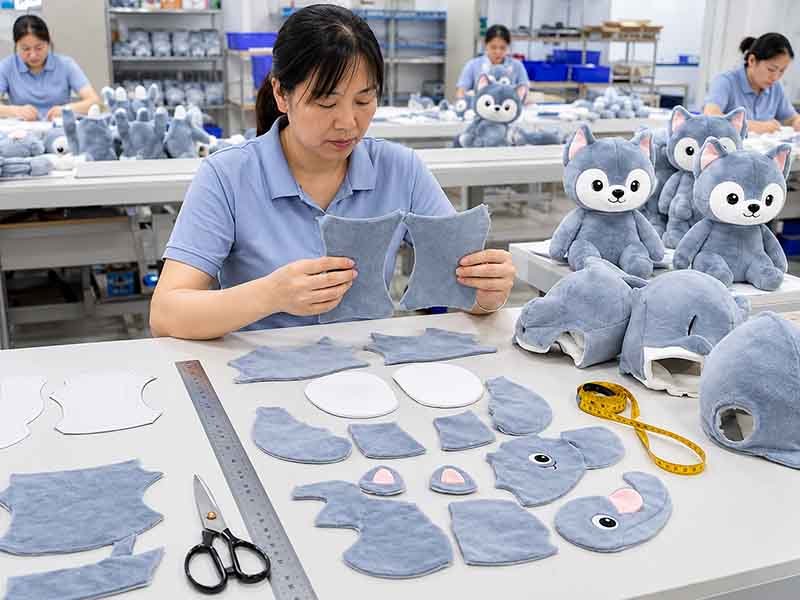
Finding a company that can sew a plush toy is rarely the hardest part of launching a custom plush product on Amazon. The difficult part begins after the first attractive prototype arrives. The factory must reproduce the approved face, proportions, embroidery, hand feel, labels, packaging, and barcode across hundreds or thousands of units, while the seller still has to deal with testing, import documentation, freight, Amazon receiving, customer reviews, inventory planning, and the next reorder. A supplier that performs well at only one stage can still create expensive problems later in the product cycle.
The best plush manufacturers for Amazon sellers are suppliers that combine strong product development with repeatable production, practical U.S. compliance support, accurate packaging and barcode execution, quality control, shipment preparation, and reliable replenishment. Instead of comparing factories mainly by unit price, sellers should evaluate sample quality, MOQ by SKU, production documentation, testing support, FBA readiness, landed cost, and repeat-order control.
That distinction becomes much clearer once a product begins selling. Saving a few cents on the first purchase order feels important when the listing has no sales history, but it becomes far less important when the next production run reaches Amazon with inconsistent expressions, mixed SKUs, incorrect packaging, unreadable labels, or a late delivery that leaves the listing out of stock. A good plush manufacturing relationship is therefore less like purchasing a one-time promotional item and more like building a repeatable product system that can support a listing for several seasons or several years.
What Do Amazon Sellers Need From a Plush Manufacturer?
Amazon sellers need a plush manufacturer that can connect product development, repeatable manufacturing, quality control, U.S. compliance preparation, packaging, barcode verification, logistics, and replenishment. A factory does not become suitable for Amazon merely because it can produce a good prototype. The real test is whether the approved product can move through production and fulfillment repeatedly without losing its design identity or operational accuracy.
Amazon-Ready Manufacturing
There is no official factory designation called an “Amazon-certified plush manufacturer,” so the useful question is whether a supplier understands how factory decisions affect the finished selling unit. An attractive stuffed animal can still become a difficult Amazon product if the barcode sits on a curved surface, a polybag is poorly sized, two character variants are mixed in the same carton, or the packaging design increases shipping volume more than expected. Product development and fulfillment therefore need to be considered together rather than handled by completely separate teams.
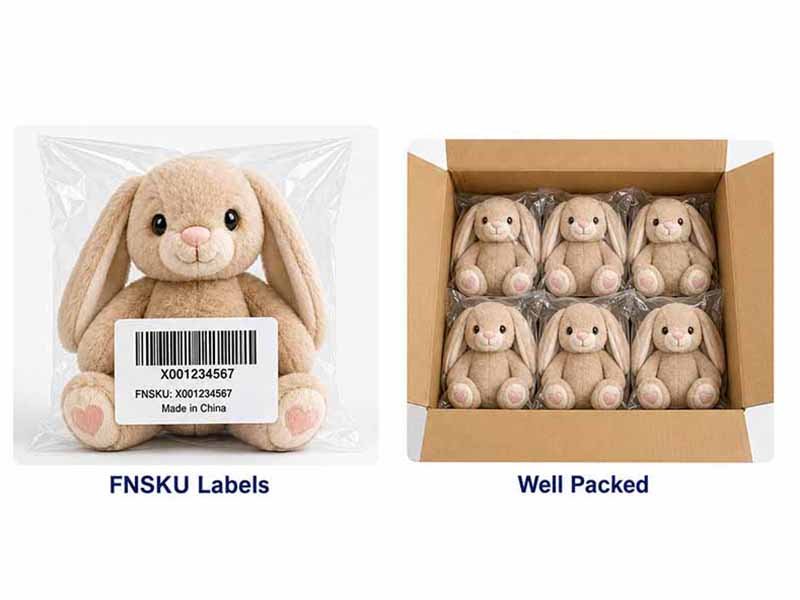
Amazon’s current FBA guidance describes preparation as a combination of correct barcodes, secure packaging, and product-specific preparation. Its July 2026 guidance also identifies plush products among categories requiring bagging preparation and gives specific requirements for bag fit, sealing, barcode visibility, and suffocation warnings where applicable. A manufacturer supporting Amazon projects should therefore be comfortable receiving seller-approved files and turning those requirements into controlled packaging and inspection instructions instead of simply being told to “make it FBA-ready.”
A useful custom plush manufacturing program can involve much more than sewing. Depending on the project, the manufacturer may need to review artwork, convert two-dimensional character drawings into patterns, select fabric pile and weight, develop embroidery, test filling density, refine balance, make several sample revisions, prepare labels and packaging, release bulk-production files, inspect finished goods, coordinate testing samples, and organize shipment preparation. The more of these stages that are managed through one documented project workflow, the lower the chance that important information disappears between departments.
Pufumi’s documented project structure, for example, covers design evaluation, engineering, sample development, bulk manufacturing, QC, packaging coordination, compliance support, logistics, and repeat-order management. Its production system uses approved samples, BOM information, production files, packaging records, and quality standards as references rather than relying only on informal instructions. This type of process becomes especially useful for Amazon products that are expected to generate multiple reorders or expand into several related SKUs.
MOQ and Sampling
MOQ should be discussed at SKU level rather than treated as a single total-order number. A 4,000-piece order may sound large, but if it is divided among sixteen characters, the manufacturer is effectively dealing with 250 pieces of each design. Fabric procurement, embroidery programming, printed packaging, woven labels, metal accessories, electronic parts, custom dyeing, and production setup can each have their own economic minimums, so two orders with the same total quantity can have very different manufacturing feasibility.
Pufumi’s internal evaluation framework typically begins standard core plush projects around 500 pieces per SKU, while mini plush, keychains, bag charms, and products involving more complex packaging are often operationally more stable around 1,000 pieces per SKU. Actual feasibility still depends on structure, materials, color count, accessories, packaging, and the purchasing minimums of individual component suppliers. Those figures are best understood as project-screening references rather than universal industry minimums.
Sampling deserves the same attention because a prototype is not simply a small version of mass production. The first sample is usually where teams discover that a flat illustration creates an oversized head when converted to fabric, that an eye needs to move several millimeters, that a tail cannot support its intended angle, or that an embroidery design becomes visually heavy once stitched onto plush fabric. Those findings need to be translated into revised patterns and production instructions rather than solved only by hand on one prototype.
Experienced development systems often distinguish Prototype, Revision Sample, Engineering Sample, Pre-Production Sample, Packaging Mockup, Golden Sample, and Retention Sample. The terminology differs among manufacturers, but the commercial purpose is similar: progressively turn an idea into a product that can be reproduced. A seller should therefore ask not only, “How many days does sampling take?” but also, “What exactly is being approved at each stage, and what becomes the final production reference?”
Lead-Time and Inventory
Factory production time is only one part of the real inventory cycle. If a manufacturer quotes thirty days for bulk production, that does not mean the product will be saleable on Amazon thirty days after the purchase order is placed. Material preparation, packaging production, laboratory testing, inspection, freight booking, international transport, customs processing, domestic delivery, fulfillment-center receiving, and Amazon inventory processing can add substantial time before units become available for sale.
The most useful planning method is to work backward from the required inventory-ready date. Sellers can establish a target date for inventory to become available, subtract estimated Amazon or 3PL receiving time, then subtract domestic transportation, customs, international freight, QC, bulk production, and material preparation. This creates a much more realistic order-release date than simply asking a factory for its normal manufacturing lead time.
Material availability deserves particular attention with custom plush. Stock polyester fabric may be easy to reorder, while a custom-dyed minky, unusual long-pile fur, proprietary printed textile, molded accessory, embroidered patch, woven label, or printed retail package can extend the schedule. If an evergreen Amazon product begins selling consistently, sellers should identify which materials can be reproduced quickly and which ones may need advance reservation before inventory reaches the reorder point.
A practical replenishment timeline can therefore be viewed as: sales forecast → reorder trigger → specification confirmation → material reservation → production → inspection → export preparation → freight → customs → Amazon or 3PL receiving → saleable inventory. The more accurately each stage is measured from real purchase orders, the more useful future inventory forecasts become. A manufacturer that provides realistic milestone dates can be more valuable than one that repeatedly quotes aggressive lead times and then changes them after production begins.
Reliable Reorders
The first order shows whether a manufacturer can create the product once. The second, third, and fourth orders show whether the product is actually controlled. Plush products can gradually change even when nobody intentionally modifies the design. Fabric lots can vary slightly, filling density can shift, embroidery placement can move, workers may shape the face differently, packaging artwork may be updated, and a replacement accessory supplier may use slightly different dimensions.
Reliable repeat production therefore depends on retained records. A strong reorder file can include the approved Golden Sample, pattern version, BOM version, embroidery files, printing files, fabric references, accessory specifications, approved packaging artwork, barcode version, QC standards, previous inspection findings, retained production samples, and any approved changes introduced after the first order.
Pufumi’s sample records can connect Project Code, SKU Code, Sample Type, Pattern Version, BOM Version, Packaging Version, and Approval Status, while its repeat-order process retrieves the previous Golden Sample, BOM, retained sample, packaging version, and material status before a new production run is released. These controls matter more as the listing becomes valuable because customers expect the product arriving eighteen months later to resemble the photographs and reviews generated by the original version.
Which Are the 20 Best Plush Manufacturers?

There is no independent global body that ranks every plush manufacturer, so “best” should be interpreted as suitability rather than an absolute league table. The following 20 companies form a practical sourcing shortlist based on publicly visible custom-plush, OEM/ODM, retail, brand, or ecommerce capabilities. Amazon sellers should still verify current MOQ, sampling, factory structure, product testing support, quality systems, packaging, and fulfillment execution before placing an order.
How This Shortlist Was Built
A useful manufacturer comparison starts by acknowledging that different plush programs require different strengths. A simple branded teddy bear with two embroidered logos does not need the same engineering depth as a licensed game character with layered clothing, removable accessories, multiple embroidery zones, retail packaging, and six related SKUs. Similarly, a company specializing in project management for North American organizations may offer a different value proposition from a factory-direct manufacturer in China.
Public websites are useful for identifying potential suppliers because they reveal product categories, stated manufacturing models, sampling services, target customers, and sometimes production or testing support. They are not enough to complete due diligence. Manufacturing claims should be tested during the RFQ, sample, and pre-production stages by asking how the supplier controls versions, handles revisions, prepares testing samples, verifies packaging, records QC findings, and manages later reorders.
The manufacturer list below therefore should be used to create a smaller candidate pool rather than treated as a final purchasing decision. Several companies position themselves around direct OEM/ODM production, while others emphasize premium design development, mascots, destination retail, or managed custom projects. The strongest supplier for a specific Amazon brand will depend on product complexity, expected order size, required communication model, compliance responsibilities, and long-term replenishment expectations.
| Manufacturer | Publicly Visible Fit | Practical Point to Verify |
|---|---|---|
| Pufumi | Character, multi-SKU, retail-ready and FBA-oriented programs | SKU control, packaging, compliance pathway, replenishment |
| CustomPlush | Commercial custom toys for retailers and corporations | Manufacturing structure, MOQ, packaging and Amazon preparation |
| The Plush Maker | Factory-direct OEM/ODM and ecommerce sellers | Sample-to-bulk consistency and project-specific MOQ |
| Delsney | Scaled custom plush, private label and ecommerce programs | Multi-SKU control, QC records and fulfillment execution |
| Mavo Toys | Custom plush production and ecommerce programs | Barcode, packaging and reorder workflow |
| Bella Plush | OEM/ODM custom plush manufacturing | Scaling from development quantities into repeat bulk production |
| Kinwow | Custom and private-label plush | Packaging control and bulk-production documentation |
| Toy Gift Supply | OEM custom plush and retail programs | MOQ assumptions and final selling-unit preparation |
| Plushies 4U | Commercial custom plush production | Material consistency and reorder records |
| DreamPlush | Custom stuffed toys, mascots and smaller plush formats | Multi-format SKU and packaging management |
| Hansightoy | Export-oriented plush manufacturing | Development depth, QC checkpoints and volume fit |
| Stuffed Animal Pros | Managed custom stuffed-animal projects | Manufacturing source, QC responsibility and shipment route |
| Happy Worker | Design-led premium custom toys | MOQ, production model and long-term replenishment |
| Mascot Factory | Custom branded mascot plush | Character approval, commercial quantity and packaging |
| Custom Plush Innovations | North American custom-plush project management | Factory-level control and total landed cost |
| Soft Stuff Creations | Destination, attraction and branded retail plush | Omnichannel packaging and fulfillment pathway |
| Maris Plush | OEM/ODM custom plush | Bulk fidelity, sample control and material changes |
| CudoraToy | End-to-end OEM/ODM plush production | Production-file discipline and quality documentation |
| PlushCraft | Character and retail custom plush | Inspection definition, packaging and barcode verification |
| Plush Factory | Broad OEM/ODM plush manufacturing | Scalability, compliance support and reorder stability |
Direct Manufacturers and Managed Suppliers
Pufumi is relevant to sellers developing character, collectible, private-label, and multi-SKU plush programs that need manufacturing to connect with packaging, barcode control, quality inspection, and repeat-order management. Its supporting manufacturing resources include a core owned factory established in 2007 and a project team with more than 58 plush designers and pattern/sample specialists, around half of whom have more than fifteen years of development experience. This makes it particularly suited to projects where character interpretation and production documentation matter alongside ordinary sewing capacity.
CustomPlush operates as a division of Beverly Hills Teddy Bear Company and publicly states that it has about thirty years of toy-industry experience serving corporations, retailers, and entertainment-related customers. Its commercial-development background can be useful for organizations that value a U.S.-facing custom-toy business model, although Amazon sellers should still ask specifically how packaging, barcode files, testing responsibilities, production inspections, and FBA shipment preparation are handled for their own product.
The Plush Maker publicly positions itself as an owned-factory custom plush manufacturer serving brands, importers, ecommerce sellers, IP owners, and other commercial customers. Its current website states that selected projects may begin around 500 pieces, that sampling often falls around 7–14 days after details are confirmed, and that bulk production can commonly fall around 25–45 days depending on quantity, materials, process, and capacity. These are useful planning references, but every seller should confirm them against the actual product rather than treating published ranges as guaranteed lead times.
Delsney presents a larger-scale custom plush model with OEM/ODM development, private-label services, product engineering, packaging support, compliance content, and an explicit solution category for Amazon sellers. Its publicly stated team and production structure make it worth comparing for larger or more complex programs, particularly where several SKUs or product types may be developed together. As with all suppliers, the most useful verification is how those resources are assigned to the specific project rather than the total number available across the organization.
Flexible Development and Retail Programs
Mavo Toys, Bella Plush, Kinwow, Toy Gift Supply, Plushies 4U, DreamPlush, Hansightoy, and similar China-based custom manufacturers represent another useful part of the shortlist. Their websites publicly describe combinations of OEM/ODM development, pattern creation, sampling, private-label production, export experience, or retail-oriented plush. For Amazon sellers, the main comparison should focus on how each company converts these broad capabilities into repeatable control for the specific SKU.
One practical way to compare this group is to send the same artwork and project brief to several suppliers and study the questions they ask before quotation. A factory that requests target size, quantity per design, target market, intended age, packaging format, launch date, material preferences, and testing expectations is usually thinking about the entire product. A supplier that immediately quotes from one photograph without asking for these variables may be fast, but the resulting number is likely based on assumptions that will change later.
Smaller or more flexible MOQs can be valuable during product validation, but sellers should also ask whether the first small production run uses the same material source and construction method that a future 5,000-unit or 10,000-unit run would use. A trial order is most useful when it validates the future supply chain, not only the demand for a version produced through a temporary or unusually manual process.
Specialist and Project-Managed Options
Stuffed Animal Pros, Happy Worker, Mascot Factory, Custom Plush Innovations, and Soft Stuff Creations provide different sourcing models from a straightforward factory-direct arrangement. Their public positioning includes project-managed custom stuffed animals, design-led development, mascot specialization, North American client support, and destination or attraction retail. These models can be useful when the seller values local project communication, design interpretation, or broader merchandising support.
A managed supplier does not automatically mean better or worse quality. The practical question is where decisions and accountability sit. Sellers should understand where production occurs, who approves the factory, who performs inspection, who coordinates testing, where the final goods are checked, and whether inventory can move directly from production to FBA or must pass through another warehouse. Every extra stage can add cost, but it can also add useful inspection or fulfillment flexibility when the process is deliberate.
Maris Plush, CudoraToy, PlushCraft, and Plush Factory round out the shortlist with publicly visible OEM/ODM or custom-plush manufacturing programs. These companies can be worthwhile comparison candidates for sellers seeking additional factory options, but published claims should always be verified through samples, production documentation, inspection planning, and current commercial terms before a meaningful purchase order is released.
How Do You Compare Plush Suppliers?
Compare plush suppliers with the same structured criteria rather than letting the lowest unit price determine the result. Development quality, sample-to-bulk consistency, QC, compliance support, Amazon packaging, MOQ, landed cost, and replenishment all influence the commercial outcome. A factory that costs slightly more per unit can still create a lower total cost if it prevents relabeling, returns, production drift, or emergency freight.
Production Control
The most revealing supplier question is often simple: “After we approve this sample, what exactly tells the production team how to make it?” A weak answer relies mostly on the physical sample and staff experience. A stronger answer describes a controlled file containing the approved pattern, BOM, embroidery or printing data, material references, measurements, labels, packaging instructions, and quality standards. The terminology varies among factories, but the objective is the same: production should not depend on somebody remembering a previous conversation.
Pufumi’s engineering process uses a Production File Package containing patterns, BOM information, process instructions, embroidery files, printing files, color references, labels, packaging, and QC standards. Engineering changes are reviewed when the customer alters size, material, structure, packaging, function, or target market because those changes may affect patterns, cost, timing, production feasibility, and testing. This type of change control is particularly important for Amazon products because a late packaging or material modification can affect much more than the product’s appearance.
Sellers should also examine the path between departments. Design staff may understand the desired expression, while sewing supervisors focus on construction efficiency and QC teams focus on measurable acceptance criteria. The supplier needs a method that translates one team’s decisions into another team’s instructions. When this handoff is weak, the common result is a prototype that looks excellent but bulk production that gradually shifts away from it.
Bulk Consistency
Plush quality is highly visual and tactile, which makes consistency more difficult to describe than it is for a simple molded component. Two toys can use the same nominal materials while looking noticeably different because eye spacing changes, the muzzle receives more filling, the seam position shifts, or the fabric pile lies in another direction. Customers may not know the technical reason, but they often notice immediately that one face looks more appealing than another.
A Golden Sample is useful because it creates a physical reference, but measurable standards should support it wherever possible. Finished height, head width, eye spacing, embroidery dimensions, product weight, label position, and critical accessory placement can often be recorded. Less measurable characteristics such as hand feel or facial expression can still be checked through trained comparison against an approved reference and photographic examples.
Pufumi’s project quality planning can identify character silhouette, facial expression, eye position, logo accuracy, fabric color, hand feel, dimensions, weight, seam strength, filling level, accessory attachment, barcode data, packaging version, and carton labeling as project-specific quality characteristics. Its internal approach may assign 100% checks to higher-risk items such as FNSKU scanning, barcode readability, mixed-SKU risks, specified electronic functions, or critical accessories rather than relying only on final statistical sampling.
MOQ, Cost, and Evidence
Quotation comparison becomes unreliable when suppliers are pricing different products under the same product name. One manufacturer may quote stock fabric, standard polyester filling, simple embroidery, and a clear polybag, while another assumes custom color matching, two sewn labels, a hangtag, a printed retail box, and specific inspection requirements. The second quotation may appear expensive even though it is actually describing a more complete finished selling unit.
A useful sourcing scorecard forces the team to evaluate evidence alongside cost. The weights below are not industry rules; they are a practical starting point that can be adjusted according to the product. A licensed character may deserve more weight on sampling and visual fidelity, while a simple high-volume plush pillow may justify greater weight on landed cost and repeat-order efficiency.
| Evaluation Area | Practical Weight | Useful Evidence |
|---|---|---|
| Sampling and engineering | 20% | Prototype quality, revision records, technical responses |
| Bulk consistency | 20% | Golden Sample, BOM, pattern and production files |
| Quality control | 15% | Incoming, inline, final and packaging inspection |
| Compliance support | 15% | BOM, test samples, traceability and laboratory coordination |
| FBA and packaging | 10% | Barcode verification, unit packaging, carton control |
| Commercial terms | 10% | MOQ, price assumptions, payment and revision terms |
| Replenishment | 10% | Retained samples, material records and reorder controls |
The value of this approach becomes obvious when quotations are close. Suppose one factory is $0.18 cheaper per unit but cannot clearly explain how its packaging versions are controlled. Another supplier costs more but demonstrates reliable scan verification, retained production samples, documented revisions, and a repeat-order procedure. For a 3,000-piece first order, the price difference matters. For a product expected to generate five more reorders, the process difference may matter much more.
Multi-SKU Control
Amazon brands often create complexity faster than their manufacturing systems can handle it. One successful character becomes four characters, then each becomes a core plush, mini plush, keychain, and holiday edition. A modest product family can quickly become sixteen or twenty SKUs that share similar fabrics, components, cartons, and packaging designs.
The main risk is identity loss. A correctly manufactured plush placed in the wrong printed bag is the wrong commercial unit. A correct unit receiving another SKU’s barcode can create an even more complicated problem because the physical error enters the inventory system. Similar character variants should therefore remain identifiable through cutting, embroidery, sewing, filling, inspection, packaging, scanning, and carton packing.
Useful control methods can include production travelers, dedicated bins, SKU cards, physically separated packing stations, batch identifiers, barcode scanning, and independent carton verification. The exact system does not need to be sophisticated, but it should not rely entirely on workers remembering which nearly identical item belongs in which package.
A practical test during supplier selection is to ask the factory to describe how it would manage four character variations with identical body shapes but different facial embroidery, hangtags, FNSKUs, and carton quantities. A detailed answer involving documents and physical separation is much more meaningful than a generic statement that the company has handled many SKUs before.
What U.S. Compliance Do Plush Products Need?

U.S. plush compliance depends on the product’s intended audience, construction, materials, and applicable federal rules. Children’s toys may require consideration of ASTM F963, CPSIA requirements, third-party testing, tracking information, and a Children’s Product Certificate. Since July 8, 2026, importers of products subject to CPSC certification requirements also need to account for mandatory electronic filing of certificate data with U.S. Customs and Border Protection.
ASTM F963 and Finished-Product Testing
ASTM F963 is central to the U.S. toy-safety framework, but it should not be presented as a permanent factory certificate that automatically covers every plush product a manufacturer produces. CPSC guidance identifies the federal toy-safety standard and explains that children’s toys may be subject to requirements involving mechanical and physical hazards, small parts, stuffing materials, plastic film, sound-producing functions, and other features depending on the construction of the actual product.
That product-specific approach matters because three plush products that look similar on a website can have very different risk profiles. A simple embroidered soft toy, a plush containing a sound module, and a plush with detachable plastic accessories do not necessarily require the same assessment. The intended age also matters because requirements concerning small parts, warnings, and other hazards can vary according to who the product is designed for.
The manufacturer should be able to prepare production-representative samples, accurate BOM information, labels, and manufacturing details for testing. Sellers should be cautious when a supplier responds to every compliance question by sending one old laboratory report from another product. That document may demonstrate experience, but it does not automatically establish compliance for a new design made with different materials and features.
Changes after testing also require discipline. If the original fabric becomes unavailable or a factory wants to substitute a coating, plastic component, filling material, or electronic module, the change should be reviewed before production continues. A commercially convenient substitution can affect performance or compliance as well as appearance, so it should not be treated only as a purchasing decision.
CPSIA, CPC, and 2026 eFiling
CPSIA compliance is broader than one chemical test. Children’s products subject to CPSC-enforced safety rules may need third-party testing and certification, along with consideration of requirements such as lead, phthalates, tracking information, and other applicable children’s-product rules. CPSC states that children’s products designed or intended primarily for children twelve or younger and subject to relevant safety rules require testing by a CPSC-accepted third-party laboratory.
A Children’s Product Certificate is also different from the laboratory test report. The laboratory provides test results, while the legally responsible manufacturer or importer certifies the product based on the applicable evidence. For imported children’s products, the U.S. importer is generally responsible for issuing the CPC. A Chinese factory can help with test samples, BOMs, production dates, label information, manufacturing details, and communication with the laboratory, but that assistance does not simply transfer the importer’s legal responsibility to the overseas supplier.
A major operational change took effect on July 8, 2026. CPSC states that importers of consumer products subject to certification requirements must electronically file certificate data for imported shipments through U.S. Customs and Border Protection’s Partner Government Agency Message Set, subject to the applicable implementation rules. For Amazon sellers importing directly, this makes organized compliance records even more important before cargo is dispatched.
| Compliance Area | Practical Relevance | Main Information to Control |
|---|---|---|
| ASTM F963 / 16 CFR Part 1250 | Children’s toys where applicable | Finished-product design, mechanical features, stuffing, accessories, warnings |
| CPSIA-related rules | Children’s products where applicable | Lead, phthalates, tracking and applicable children’s-product rules |
| Third-party testing | Required for applicable children’s-product safety rules | Production-representative sample, BOM and correct test scope |
| CPC | Applicable certified children’s products | Product identification, applicable rules, test records, responsible party |
| Tracking information | Children’s products | Manufacturer/private labeler, place/date, batch or run information |
| CPSC certificate eFiling | Applicable imported regulated products from July 8, 2026 | Certificate data prepared for CBP electronic filing |
Tracking and Product Classification
Tracking information is often discussed as a labeling requirement, but it is also a useful manufacturing tool. CPSC explains that children’s products need distinguishing information that allows details such as manufacturer or private labeler, production place and date, and batch or run information to be ascertained. When a product-quality issue appears after launch, these records can make the difference between investigating one production batch and treating an entire inventory history as potentially affected.
A useful internal traceability chain can connect SKU, purchase order, manufacturing facility, production date, material batch, QC record, laboratory report, carton, and shipment. If twenty complaints appear involving one embroidery feature, this chain helps the seller and manufacturer determine whether the products came from one batch, one material change, one embroidery setup, or several unrelated orders.
Product classification deserves similar care. Calling an item a “collectible” or printing a higher age recommendation on packaging does not automatically determine its legal classification. CPSC considers factors such as intended use, presentation, advertising, consumer recognition, and age-determination guidance when evaluating whether a consumer product is primarily intended for children. Sellers should therefore align product design, listing imagery, packaging, marketing language, and compliance planning rather than treating an age label as a shortcut.
For ambiguous products, a qualified laboratory or compliance professional can provide additional guidance. The manufacturer knows how the product is made, but the seller or importer also needs to understand how it will be marketed and sold in the United States. Those two perspectives should be connected early in development.
IP and Confidential Development
Safety compliance does not create intellectual-property rights. A product can pass every mechanical, chemical, and labeling requirement and still create serious commercial problems if the seller has no legal right to use the character, artwork, logo, or brand identity reproduced on the plush.
This matters particularly for Amazon products inspired by anime, games, films, sports teams, universities, entertainment characters, artists, creators, and established brands. A legitimate manufacturer should be comfortable asking customers to confirm ownership or authorization before moving protected assets into commercial production.
Pufumi’s documented policy limits projects to customer-original or legally authorized character, logo, and brand assets and does not accept clearly unauthorized third-party IP production. Customer project materials are restricted to legitimate project activities such as evaluation, sampling, production, testing, packaging, delivery, and repeat-order management rather than being reused for unrelated customers or products.
Confidentiality also matters before launch. Unreleased character designs, new product concepts, target costs, launch schedules, packaging artwork, and licensing documents can be commercially sensitive. Sellers working on meaningful IP or private-label launches should discuss access control, NDA procedures, sample photography, and permission to publish case studies before sharing a complete asset package.
How Does Amazon FBA Plush Fulfillment Work?

FBA preparation should begin during product development rather than after mass production. Sellers need to confirm the selling-unit package, barcode method, packaging warnings, SKU identity, carton configuration, and shipment route before final packing. The manufacturer can then execute approved files, verify scans, separate SKUs, check cartons, and ship either to Amazon or a 3PL according to the confirmed inventory plan.
FBA-Ready Packaging
Amazon’s current FBA preparation guidance states that inventory needs appropriate barcodes, secure packaging, and category-specific preparation before it reaches a fulfillment center. The July 2026 Amazon guide specifically lists plush products among categories that require bagging. It states that bags should be transparent, completely sealed, appropriately sized, and carry a suffocation warning when the opening is larger than five inches; barcode information must remain readable from the outside.
Those operational requirements should be considered alongside branding. A plush item might use a clear polybag, printed bag, hangtag, paper sleeve, window box, gift box, blind-box package, or another retail format. Each choice affects presentation, protection, barcode placement, warnings, carton dimensions, freight volume, and the condition of the product when the customer opens it.
The most common development mistake is approving the plush body first and treating packaging as a separate project several weeks later. Once the final retail package is introduced, the product may sit differently, a barcode may need another position, a carton may hold fewer pieces, and a warning or copyright line may require additional space. The better approval unit is therefore the complete selling unit: product, sewn labels, hangtag, insert, packaging, barcode, and all customer-facing information.
Compression also needs practical testing. Plush products are often light but bulky, so reducing volume can lower freight cost. Excessive compression, however, can deform the face, flatten long-pile fabric, damage accessories, crease clothing, or create poor presentation after unpacking. Packaging optimization is useful only when the product can recover consistently.
Barcode and FNSKU Control
Amazon currently uses manufacturer barcodes, Amazon barcodes, and Transparency barcodes in different circumstances. Sellers should confirm the barcode method applicable to their account and product before instructing the factory because an FNSKU is not automatically the correct choice for every unit. Amazon’s July 2026 guidance explains the different barcode categories and recommends placing labels on smooth, flat surfaces rather than edges, corners, or curves.
When an Amazon barcode is required, the useful manufacturing workflow is simple but disciplined. The seller confirms the listing and barcode method, provides the approved file, and identifies which SKU receives which label. The manufacturer then prints or applies the barcode, checks placement, scans the label, verifies the scan against product identity, and confirms the final packaging before carton packing.
Pufumi’s documented FBA process uses customer-provided FNSKU files when applicable rather than independently generating unconfirmed identifiers. Its checks include scan readability, SKU or ASIN correspondence, label position, wrinkles, reflection, obstruction, and correct association between the selling unit and the supplied file. These checks matter most in multi-SKU programs because one incorrect label can turn a physically correct item into incorrectly identified inventory.
Barcode inspection should therefore be treated as data verification rather than sticker application. A label can look neat and still contain the wrong code. The final check needs to establish that the barcode is readable, correctly positioned, and linked to the intended product.
FBA or 3PL
Shipping directly from the factory to FBA removes one handling stage and can be efficient when unit packaging, barcodes, carton configuration, and shipment data are already accurate. This route is often attractive for stable products with straightforward shipments, particularly when the seller does not need domestic inspection, relabeling, or reserve inventory outside Amazon.
A 3PL introduces additional receiving, storage, and handling costs, but it can create flexibility. Sellers can keep part of the inventory outside FBA, replenish Amazon in smaller batches, support Shopify or wholesale orders from the same stock, conduct domestic inspections, relabel inventory, or respond more easily when the fulfillment strategy changes.
The decision becomes clearer when the complete cost is modeled instead of comparing only international freight. Sellers should consider factory-to-port or airport transport, international shipping, customs brokerage, duties, domestic transport, 3PL receiving, storage, pick and pack, relabeling, Amazon inbound costs, and the financial cost of keeping too much inventory in the wrong place.
Inventory maturity also matters. A newly launched 1,000-unit product may need a different route from a proven item selling hundreds of units each week. Manufacturers that can prepare both direct-FBA shipments and 3PL shipments give sellers more freedom to change the fulfillment model as sales history develops.
Landed Cost and Replenishment
Plush products have unusual freight economics because they often occupy a large volume relative to their weight and factory price. A packaging design that adds only a few centimeters in one direction can materially change carton volume across thousands of units. Conversely, a more efficient packing method can reduce freight cost without requiring any change to the plush itself.
Landed cost should therefore include more than the ex-factory price. Product cost, packaging, testing, inspection, export cartons, international freight, duties, brokerage, domestic transport, 3PL costs, Amazon inbound costs, relabeling, repacking, and emergency replenishment can all influence the final margin.
Pufumi’s landed-cost framework specifically recognizes costs created by incorrect labels, wrong packaging, warehouse rejection, relabeling, repacking, customs delays, and urgent replenishment rather than treating the factory unit price as the only relevant cost. This is particularly useful for Amazon sellers because a very small operational error can become expensive when thousands of units need to be corrected after arriving in another country.
The same thinking applies to replenishment. A useful reorder point considers expected demand during the entire replenishment cycle plus suitable safety stock. That cycle includes material preparation, production, inspection, freight, customs, and receiving. Once an Amazon listing becomes successful, maintaining supply continuity can be more valuable than squeezing another few cents from the next purchase order.
Which Plush Manufacturer Fits Your Business?
The right plush manufacturer depends on the commercial model behind the product. Private-label sellers may prioritize repeatable production and landed cost, licensed-IP programs require stronger character and approval control, and multi-SKU brands need disciplined version management. The best final decision comes from sending the same detailed RFQ to several suitable manufacturers, comparing their samples and project responses, and judging the complete operating fit.
Private-Label Programs
Private-label plush may involve fewer licensing approvals than a major entertainment character, but that does not make the manufacturing system simple. The commercial selling unit can include custom fabrics, embroidered features, a woven brand label, care label, hangtag, insert card, printed packaging, product barcode, and master-carton identification. Those components need to match the same approved SKU and remain controlled through future reorders.
Product differentiation also deserves attention. Many Amazon categories contain visually similar stuffed animals, so a private-label brand may compete through material hand feel, unusual proportions, distinctive colors, better facial embroidery, functional details, or more thoughtful packaging rather than relying only on lower price. These elements need to be translated into measurable or repeatable manufacturing standards if they are expected to remain part of the brand identity.
The supplier should also demonstrate that the production method can scale. A 300- or 500-unit initial order may be made with highly manual attention that is difficult to reproduce when the next order reaches 5,000 pieces. Sellers should ask whether the same fabric sources, patterns, embroidery programs, and quality criteria will be used as quantities grow.
For an evergreen private-label SKU, the real manufacturing objective is not to produce the first shipment successfully. It is to create a controlled product definition that can be reproduced when the original project manager changes, the fabric supplier changes a lot number, packaging receives a revision, or the seller needs another order a year later.
Licensed IP Programs
Licensed character projects add formal approval pressure to ordinary custom manufacturing. Style guides, front and side references, protected logos, approved color values, character proportions, copyright lines, territory-specific packaging, and licensor feedback may all need to be incorporated before production begins.
Approval needs a defined scope because “approved” can mean several different things. A licensor may approve the facial expression without approving fabric, confirm the product body while packaging is still being revised, or approve a prototype that is not yet ready for mass production. Treating one informal approval as permission to release every element can create costly changes later.
Pufumi’s documented approval system records submitted items, version numbers, feedback, required changes, approval status, approver, date, and effective scope. It distinguishes product, packaging, Golden Sample, and production-release decisions so one approval does not automatically replace another. This type of version discipline is valuable whenever several departments, a licensor, and a manufacturer are working on the same character.
Character fidelity also deserves a different level of attention from generic stuffed animals. A few millimeters of eye movement, a slightly incorrect head-to-body ratio, or an inaccurate costume detail may change how fans recognize the character. Strong licensed-plush manufacturing therefore combines aesthetic judgment with controlled patterns, embroidery, materials, and approval records rather than treating accuracy as an informal visual preference.
Multi-SKU Programs
Multi-SKU plush programs require the factory to think in terms of product systems instead of isolated items. One character can become an 8-inch core plush, a mini plush, a keychain, a bag charm, a gift-set version, and a seasonal edition. Adding several characters can quickly create dozens of combinations with similar fabrics and components but different labels, barcodes, packaging, and carton quantities.
The supplier needs to maintain identity throughout the workflow. Pattern versions, material allocations, embroidery files, accessories, product SKUs, packaging SKUs, barcode files, carton quantities, and shipment allocations should all remain linked. Physical separation matters too, because documentation alone will not prevent errors if similar products are mixed together at a crowded packaging table.
Pufumi’s production approach assigns different product types to appropriate production and packaging arrangements, including complex character projects, smaller hanging plush, garment-bearing products, and retail-packaging programs. The broader lesson is that a manufacturer should be able to explain how different product complexities are routed and controlled rather than simply stating that all designs can run through the same ordinary line.
A useful test is to ask the shortlisted supplier exactly how it would prevent four similar characters from receiving the wrong embroidery, hangtag, barcode, or carton allocation. If the answer includes identifiable work batches, separated components, packaging controls, scanning, and final reconciliation, the seller has much stronger evidence of multi-SKU readiness.
RFQ and Final Selection
A good RFQ improves supplier selection because it forces several manufacturers to quote the same commercial product rather than filling missing information with different assumptions. Useful project information includes artwork, dimensions, quantity by SKU, target country, intended age or audience, fabric preferences, embroidery or printing, accessories, packaging, barcode requirements, testing expectations, target shipment date, destination, and preferred trade term.
Pufumi’s RFQ framework similarly captures SKU-level quantities, channel information such as Amazon or DTC, packaging requirements, FNSKU or UPC/EAN considerations, target market, compliance needs, landed-cost targets, launch timing, and FBA or 3PL requirements. The purpose is not to make the inquiry unnecessarily complicated; it is to reduce the number of hidden assumptions inside the quotation.
Once samples and quotations arrive, the final decision should follow a consistent sequence: product fit → engineering response → sample quality → revision quality → MOQ → compliance support → production control → packaging and FBA execution → landed cost → replenishment. Comparing suppliers in this order makes it harder for an attractive unit price to hide problems that will appear later.
A factory that is twenty cents more expensive may still be the financially stronger choice if it reduces barcode corrections, packaging rework, customer returns, emergency air freight, and repeat-order variation. Conversely, a premium supplier is not automatically justified for a simple product with limited development risk. The most valuable manufacturing partner is the one whose capability matches the complexity and commercial life of the specific product.
Choosing a plush manufacturer for Amazon is ultimately a decision about product continuity rather than simply purchasing stuffed toys. The supplier becomes part of the system behind the listing photographs, customer reviews, inventory availability, packaging experience, and every reorder that follows. When development files, approved samples, testing information, QC records, barcode execution, carton data, and replenishment planning remain connected, a plush SKU has a much better chance of becoming a stable product rather than a sequence of disconnected purchase orders. For brands developing custom character, private-label, or multi-SKU plush programs, an early project review with Pufumi can help identify manufacturing, packaging, quality, and fulfillment issues before they become expensive changes during mass production.
What is a good MOQ for custom plush toys sold on Amazon?
There is no universal ideal MOQ because the practical quantity depends on product size, fabric, number of SKUs, embroidery, accessories, custom colors, packaging, and factory setup. For many commercial custom-plush projects, several hundred pieces per SKU is a common starting point for evaluation, while small plush, keychains, complex packaging, or custom-dyed materials can require higher quantities. Sellers should compare MOQ with expected sales velocity and landed cost rather than treating the lowest available minimum as automatically better.
Do Amazon FBA plush products need FNSKU labels?
Not every FBA unit automatically uses the same barcode method. Amazon currently supports manufacturer barcodes, Amazon barcodes, and Transparency barcodes under different eligibility conditions, so the seller should confirm the correct option for the product and account before sending label files to the factory. When an Amazon barcode such as an FNSKU is required, it should be associated with the correct SKU, placed on an appropriate surface, and scanned before shipment rather than only visually checked.
What testing does a plush toy need for the U.S. market?
Testing depends on the finished product’s intended age, design, materials, and functions. A children’s plush toy may be subject to the federal toy-safety standard, applicable CPSIA requirements, small-parts considerations, tracking information, and other CPSC-enforced rules. Products subject to children’s-product safety rules generally require appropriate third-party testing by a CPSC-accepted laboratory and certification. Sellers should determine the applicable requirements for the actual product rather than relying on a generic factory report from a different design.
Who issues the CPC for an imported children’s plush toy?
For imported children’s products, the U.S. importer is generally responsible for issuing the Children’s Product Certificate based on applicable passing test results and required product information. The overseas manufacturer can provide production samples, BOM information, factory details, dates, labels, and testing support, while the laboratory provides the test results. The CPC should not be confused with a laboratory report, and the responsible U.S. party should maintain access to the supporting compliance documentation.
Should Amazon sellers ship plush directly to FBA or use a 3PL?
Direct factory-to-FBA shipping can reduce handling when packaging, barcodes, carton quantities, and shipment details are already accurate. A 3PL can be more flexible when a seller wants reserve inventory, smaller Amazon replenishments, domestic inspection, relabeling, or fulfillment for Shopify, wholesale, and other channels. The better route depends on international freight, customs, receiving charges, storage, domestic transport, Amazon inbound costs, inventory turnover, and the likelihood that units will require changes after arriving in the United States.
How can Amazon sellers keep repeat plush orders consistent?
Repeat consistency improves when the manufacturer keeps more than photographs of the previous order. A useful reorder package includes the approved Golden Sample, pattern version, BOM, material references, embroidery and printing files, packaging artwork, barcode version, previous QC standards, retained samples, and approved changes. Before every reorder, the supplier should compare current materials and specifications against these records so replacements or design drift are identified before mass production rather than after finished goods arrive.
What should I send a plush manufacturer before requesting a quote?
A useful RFQ should include artwork, target dimensions, quantity by SKU, intended market and age group, preferred materials, embroidery or printing requirements, accessories, packaging, barcode needs, testing expectations, destination, and required timing. If some details are still undecided, identify them clearly instead of guessing. Giving several shortlisted manufacturers the same project information produces quotations that are far easier to compare and usually reveals which suppliers understand the commercial requirements beyond simply calculating a sewing price.