Skip to content


Sherpa is one of those fabrics that most people recognize before they know its name. Its curly, wool-like surface appears on jackets, blankets, cushions, winter accessories and an increasing range of tactile merchandise. Yet once a design moves from a mood board into actual manufacturing, “use Sherpa” is no longer a complete material specification. Two fabrics sold under the same name can differ noticeably in weight, pile density, stretch, backing stability and how well they hold embroidery after sewing and stuffing.
Sherpa fabric is a soft, raised-pile textile designed to create a fluffy, curly surface similar to sheep fleece. Modern commercial Sherpa is usually made from polyester, although acrylic, blended and recycled-polyester constructions are also available. It is commonly chosen for warmth, softness and visual texture and is used in apparel, blankets, accessories, home products and selected plush products where tactile character matters more than extremely fine surface detail.
That difference between a fabric name and a real production specification matters more than it first appears. A cream Sherpa swatch may look perfect beside a character illustration, only for the first sewn sample to reveal that the pile covers the mouth embroidery, the backing stretches the head wider than expected, or the texture flattens after packaging. Sherpa can create a memorable product, but only when its softness, structure and manufacturing behavior are considered together.
What Is Sherpa Fabric?

Sherpa fabric is a soft, wool-like textile with a raised, curled or clustered pile that resembles sheep fleece. Most modern versions are synthetic and commonly polyester-based. The term describes a style of surface rather than one fixed technical specification, so Sherpa fabrics can differ significantly in weight, pile height, density, stretch, backing structure, color stability and sewing behavior.
What Does Sherpa Fabric Feel Like?
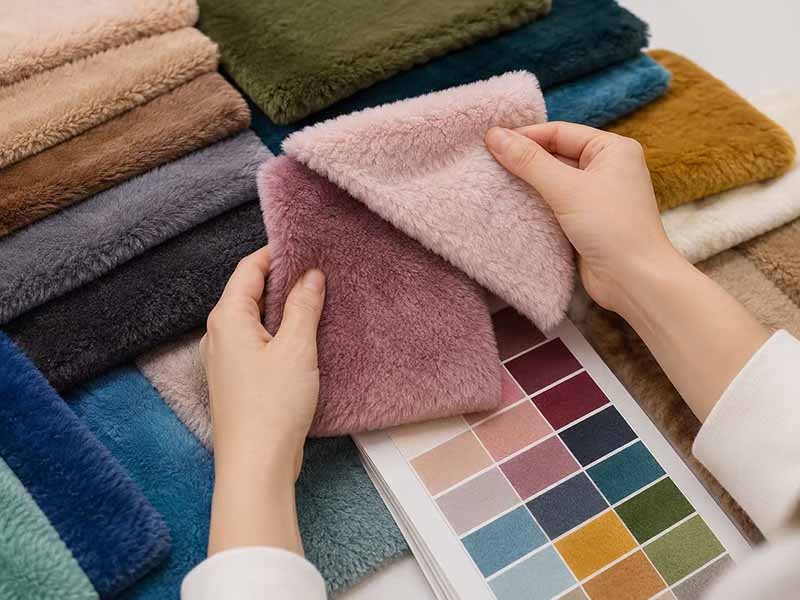
Sherpa normally feels soft, lofty and slightly irregular. Unlike smooth Minky or microfiber plush, its surface contains small curls or clustered fibers that create a more textured handfeel. The material often feels visually warm even before it is touched because consumers associate this type of surface with lambswool, winter jackets, blankets and other comfort-oriented products.
The exact handfeel varies considerably between constructions. A compact Sherpa with dense, tightly formed curls can feel substantial and controlled, while another fabric with longer or more open pile may feel lighter, fluffier and less structured. Yarn thickness, pile density, finishing and backing all influence how the material behaves. This is why a photograph alone is rarely enough for serious product development. A physical swatch is far more useful when handfeel is part of the product’s retail value.
Stuffing can also change the way Sherpa feels. A loose swatch may appear very soft because the backing is relaxed, but once the same material is pulled around a rounded head or firmly filled body, the surface can become tighter. On a large cushion-style plush this may be barely noticeable, while on a small character with strongly curved pieces it can noticeably alter both touch and appearance.
Sherpa therefore works especially well when a product brief contains ideas such as warm, cozy, winter, home, comforting or natural-looking. It contributes more than softness alone; the texture becomes part of the visual identity of the finished product.
Is Sherpa Fabric Real Wool?
Most modern Sherpa fabric is not real wool. Commercial Sherpa is generally manufactured from synthetic fibers, particularly polyester, and designed to reproduce part of the curly, soft appearance associated with sheep fleece. Acrylic fibers and blended constructions are also available, while some projects use recycled-polyester versions when suitable sourcing and documentation are available.
The visual similarity can create confusion in product descriptions. A customer may request a “wool-like” material because that is the easiest way to explain the desired appearance. That request should not automatically be translated into actual wool content. “Wool-like” describes the surface character; the fiber composition must still be checked from the material specification and supplier documentation.
This distinction becomes especially important when products carry composition, environmental or marketing claims. A synthetic Sherpa should not be described as natural wool merely because it has a similar texture. Likewise, a recycled-looking aesthetic does not prove that recycled fiber is present. The material declaration should follow the verified fiber composition and approved bill of materials rather than visual assumptions.
For plush manufacturing, synthetic Sherpa is often practical because it can be produced in many colors, pile effects and weights while remaining compatible with conventional textile cutting and sewing processes. The important question is not whether synthetic material is inherently better or worse, but whether the selected construction provides the handfeel, stability and repeatability required for the finished product.
Is Sherpa Fabric a Type of Fleece?
Sherpa is commonly grouped with fleece fabrics because both are usually knitted synthetic textiles with raised surfaces. The main difference is appearance. Standard fleece normally has a relatively uniform brushed face, while Sherpa is deliberately finished to create more irregular curls or clusters that imitate the appearance of sheep fleece.
Commercial terminology overlaps considerably. Depending on the supplier and market, similar materials may be described as Sherpa fleece, teddy fleece, shearling-style fleece or high-pile fleece. Those names can be useful for searching, but they are not reliable enough to control a production material. Two suppliers using the same term may offer fabrics with different weights, backing structures and surface densities.
For a finished plush product, these differences affect more than appearance. A flatter fleece usually exposes embroidery more clearly and creates less seam bulk. Sherpa produces more visual depth and warmth but may hide delicate details. A simple rounded bear may therefore benefit from the added texture, while a small licensed character with detailed facial embroidery may perform better with short plush or Minky.
Experienced material selection focuses on measurable and observable properties rather than debating the exact commercial category. Fiber content, GSM, pile height, density, directional stretch, backing and approved physical swatches provide a much stronger basis for manufacturing than the word “Sherpa” alone.
What Does Sherpa Fabric Look Like?
Sherpa generally has a matte or low-luster surface formed by compact curls, loops or irregular fiber clusters. Cream, white and beige are strongly associated with the classic look because they reinforce the visual connection with natural sheep fleece, but commercial Sherpa is available in a much broader range of colors for fashion, home and branded-product applications.
The irregular surface creates small areas of shadow, giving a single-color fabric more depth than a flat fleece. On a rounded plush body, this can make simple shapes appear fuller and softer without adding complicated decoration. Seams can become less visually obvious because the pile breaks up their edges, which is particularly useful on animals, pillows and simple sculptural characters.
The same property creates a design limitation. Raised fibers can surround or partially cover embroidery, especially thin mouths, small eyelashes, narrow lettering and other delicate elements. A fabric that looks luxurious across the body may therefore be unsuitable for a face containing several millimeters of tightly spaced detail.
Lighting and pile direction also change the visible surface. Panels cut in opposite directions may reflect light differently and appear lighter or darker even when they come from the same fabric roll. This effect is subtle on some Sherpa fabrics and very noticeable on others, so cutting direction should be established during sampling instead of being left to chance during production.
What Is Sherpa Fabric Made Of?

Most commercial Sherpa fabric is made primarily from polyester, although acrylic fibers, blends and recycled-polyester constructions are also available. Fiber composition alone does not define performance. For production, composition should be evaluated together with fabric weight, pile height, density, width, stretch and backing because these parameters determine how Sherpa behaves during cutting, embroidery, sewing, stuffing, packaging and future repeat production.
Which Fibers Are Used in Sherpa?
Polyester is the most common fiber used for modern Sherpa because it supports a broad range of colors, pile structures, weights and surface finishes. Polyester-based Sherpa can be engineered to feel compact and dense or loose and fluffy depending on yarn choice, knitting construction and finishing. This flexibility makes it suitable for apparel, home textiles and many types of soft merchandise.
Acrylic appears in some Sherpa or wool-like fabrics because it can deliver a dry, warm handfeel that visually resembles natural wool. Blended materials are also possible when manufacturers need to adjust texture, stretch, cost or other characteristics. In certain constructions, the pile yarn and backing may have different structures, making it especially important to review the actual material specification rather than relying on appearance.
For a commercial plush program, composition should be recorded with the material code and bill of materials. That information supports labeling, sourcing, testing and repeat production. If the product uses several fabrics, each material should remain separately identifiable because replacing one Sherpa with another supposedly equivalent fabric can change both appearance and dimensional behavior.
Pufumi’s material-management framework follows this principle by recording fabric type, composition, pile length, GSM, width, elasticity, backing and other sourcing and application information rather than treating Sherpa as a single interchangeable fabric category.
| Material Parameter | Unit or Record Type | Practical Production Value |
|---|---|---|
| Fiber composition | % by fiber | Supports labeling and sourcing control |
| Fabric weight | GSM / g/m² | Helps compare fullness, cost and bulk |
| Pile height | mm | Influences texture and detail visibility |
| Usable width | cm or in | Affects cutting yield and consumption |
| Stretch | Direction + measured extension | Influences stuffed dimensions |
| Backing | Construction description | Affects sewing and shape stability |
| Color | Approved reference | Supports batch and brand consistency |
| Supplier/batch | Traceable code | Supports replenishment control |
| Approved swatch | Physical reference | Confirms handfeel and surface appearance |
How Is Sherpa Fabric Made?
Sherpa is generally constructed on a knitted textile base and then finished to create the raised, wool-like surface seen on the final fabric. Yarn selection, knitting structure, brushing, raising, curling and other finishing operations influence whether the result feels dense and compact or loose and highly fluffy. Different mills may use different production routes, which is one reason Sherpa varies so widely between suppliers.
The manufacturing process matters because the visible pile and structural backing work together. A flexible backing may make the fabric easier to drape but can stretch more strongly during stuffing. A tighter backing can improve dimensional stability yet create more resistance when very small sewn components need to be turned right-side out.
Pile formation also affects decorative processes. Dense, short curls may allow embroidery to remain visible, while a taller or more open surface can surround the thread until small details nearly disappear. Simply increasing embroidery density does not always solve the problem because excessive stitching can stiffen or distort the backing.
When Sherpa is being evaluated for a plush product, the best approach is to treat the finished textile as an engineered material rather than focusing only on how it was made at the mill. The decisive question is whether the completed construction performs successfully through the full downstream sequence of cutting, embroidery, sewing, turning, filling, shaping and packaging.
Is Sherpa Fabric Usually Synthetic?
Yes. The Sherpa used in most commercial apparel, home products and plush applications is synthetic, with polyester especially common. Synthetic construction gives textile mills flexibility in color, weight and surface engineering while allowing the familiar wool-like appearance to be reproduced without requiring natural sheepskin or wool-based construction.
The word “synthetic” should not be used as shorthand for quality. A high-density polyester Sherpa with a stable backing can provide excellent handfeel and production consistency. A lower-quality material may look similar in a small photograph but reveal its backing when stretched, flatten quickly under pressure or release more loose fibers than expected.
The practical evaluation should therefore focus on measurable behavior. Does the pile recover after compression? Does the backing retain the intended stuffed shape? Can the supplier reproduce the color? Does embroidery remain visible? Can the fabric be sourced for another production run several months later? These questions have much more commercial relevance than fiber type alone.
Polyester also integrates well with the other synthetic fabrics commonly used in plush production, including Minky, short plush, fleece and faux fur. Mixed-material products can therefore combine different textures while remaining within familiar sewing and quality-control processes, provided that each material is separately approved and documented.
Are Recycled Sherpa Fabrics Available?
Yes. Sherpa-style fabrics can be manufactured using recycled polyester when appropriate recycled yarn and mill capability are available. These options are relevant for brands that have defined recycled-content objectives or want their material choices to support a broader sustainability program. The visual result can be very similar to conventional polyester Sherpa, so recycled content cannot be reliably identified by touch or appearance.
The critical issue is documentation. A fabric described casually as “eco Sherpa” should not automatically be treated as verified recycled material. The declared recycled percentage, supporting supplier records and applicable certification scope should be reviewed when the product will carry specific environmental claims.
For production, recycled content does not remove the normal engineering requirements. The material still needs an approved pile, GSM, backing, color, stretch and handfeel. If a recycled construction produces the right brand story but cannot maintain color or texture across repeat production, the sourcing team still has a commercial problem to solve.
Pufumi’s internal material policy follows the same evidence-based principle: recycled-polyester projects should retain records supporting recycled content and supplier documentation, while environmental claims should stay within the evidence available for the selected material.
How Does Sherpa Fabric Perform?

Sherpa performs particularly well when softness, loft, warmth and visible texture are central to the design. Its raised pile creates an insulating and comforting surface, while polyester-based constructions can remain relatively lightweight compared with their visual volume. Actual performance varies with weight, density, backing and finish, so shedding, recovery, stretch and durability should be assessed on the selected fabric rather than assumed from the name alone.
Is Sherpa Fabric Warm?
Sherpa is widely associated with warmth because raised pile creates small air spaces between and around the fibers. Trapped air slows heat transfer, which is the same basic reason fleece-type materials are widely used in jackets, linings and blankets. A thicker or higher-loft fabric often feels warmer, although the exact thermal performance depends on construction rather than the word Sherpa itself.
For plush products, technical thermal insulation is rarely the main objective. More important is the perception of warmth. A customer sees the textured surface and immediately connects it with winter clothing, soft blankets and comfort. That visual association can make Sherpa especially valuable in seasonal or home-oriented merchandise even though the product is not being sold as thermal equipment.
Winter bears, lambs, snow characters, cabin-inspired designs and holiday products are natural applications. In these products the fabric becomes part of the story. A simple rounded animal in Sherpa can feel more seasonal than the identical pattern made in flat fleece because the material communicates its theme before the packaging is read.
Claims such as “Sherpa is always warmer than fleece” should still be avoided. Sherpa can itself be a fleece construction, and fabric weight, pile density and structure can change the result. For product design, the more useful question is whether the selected fabric delivers the desired warm visual and tactile experience without introducing unnecessary sewing bulk.
Is Sherpa Fabric Soft?
Sherpa is normally selected because softness is one of its strongest characteristics, but softness changes considerably between materials. Yarn thickness, fiber fineness, curl structure, pile density and finishing all affect the handfeel. A dense material may feel cushioned and substantial, while an open pile can feel lighter and airier.
The backing also matters. Consumers touch the pile, but manufacturers have to work with the complete fabric. A soft surface attached to a stiff backing can feel less flexible after the material is sewn into a small product. On the other hand, an extremely stretchy backing may feel pleasant in a loose swatch but distort the intended shape after stuffing.
Handfeel should therefore be reviewed through the full sample process. Start with the loose fabric, then test an embroidered panel and a sewn shell. After stuffing, handle the product in the areas consumers are likely to touch most. Finally, check the material after the proposed packaging has compressed it for a representative period.
This sequence catches a common problem: a fabric that looks and feels luxurious on a flat sample card does not always retain the same character once it has been stretched over a three-dimensional product. The finished sample, rather than the raw swatch, should remain the final reference.
Does Sherpa Fabric Shed or Pill?
Sherpa can shed, pill, flatten or become matted, but these outcomes depend strongly on pile construction, density, fiber anchoring and finishing. Some loose fiber during cutting is normal because the cutting blade passes directly through raised pile. That temporary production lint should be distinguished from ongoing shedding in the finished product.
A more useful quality assessment separates several surface issues. Cutting lint can often be controlled through cleaning during production. Continuing fiber release may indicate weaker pile anchoring. Pilling usually develops through repeated friction, while matting results from a combination of pressure, moisture and surface rubbing. Flattening after packaging is another issue because compressed pile may not always recover immediately.
For plush manufacturing, packaging recovery deserves special attention. A sample may leave the sewing line with a full, attractive surface and then spend days or weeks inside a carton. If the fibers remain flattened after unpacking, the consumer may perceive a quality problem even though the fabric passed inspection before packing.
Repeat orders introduce another layer of control. Even the same supplier can produce small batch-to-batch differences in pile, color, backing or stretch. Retaining an approved swatch and finished production sample makes those differences easier to detect before a new run is released.
How Do You Wash Sherpa Fabric?
There is no single washing method that applies to every Sherpa product. Care depends on actual fiber composition, backing, dyeing, surface finishing and, most importantly, the construction of the finished item. A polyester Sherpa blanket may tolerate a care method that is not appropriate for a stuffed product containing electronic parts, weighted components, adhesives or rigid accessories.
When a product needs a washable claim, evaluation should extend beyond the loose fabric. Check whether the pile mats, whether dimensions change, whether the backing distorts and whether colors or embroidery are affected. The material should then be reviewed again after complete drying because a damp or partially dried pile does not provide an accurate picture of final recovery.
Stuffed products introduce additional concerns. Filling can hold moisture for much longer than the outer fabric. Internal squeakers, sound modules, wires or weighted inserts can make normal machine washing inappropriate even when the Sherpa surface itself is technically washable.
Care instructions should therefore be established at the finished-product level. A product should not automatically be described as machine washable merely because its face fabric is polyester. The complete combination of fabric, filling, trims, structure and accessories determines which cleaning method can be responsibly recommended.
How Is Sherpa Different From Other Fabrics?
Sherpa differs from fleece, shearling, faux fur and teddy fabrics mainly through material origin and surface character. Sherpa is usually a synthetic textile designed to imitate curly sheep fleece. Standard fleece is generally flatter, shearling is animal-derived skin with wool attached, faux fur covers a broader range of fur-like effects, and teddy fabric overlaps heavily with Sherpa in commercial naming. Actual specifications remain more reliable than names.
How Is Sherpa Different From Fleece?
The easiest difference to see is surface structure. Standard fleece usually has a relatively even, brushed appearance. Sherpa normally has a more three-dimensional surface made from curls or fiber clusters, producing a texture that visually resembles sheep fleece. The distinction is useful for product design even though the textile categories overlap.
In plush development, fleece usually offers a cleaner working surface. Thin embroidery lines, small lettering and color boundaries remain more visible because there is less pile surrounding the stitches. It can also create thinner seam intersections, which is helpful on small accessories and products with many pattern pieces.
Sherpa contributes more visual volume. It can make a simple body look fuller, softer and more seasonal without adding printed graphics or decorative panels. The trade-off is reduced detail visibility and potentially greater sewing bulk.
A manufacturer may therefore use both materials in the same product. Sherpa can form the body while fleece or short plush is used for clothing, feet, a face panel or areas carrying a logo. This type of material zoning allows each surface to perform the function it handles best rather than asking a single fabric to solve every design requirement.
| Feature | Sherpa | Standard Fleece | Faux Fur | Teddy Fabric | Natural Shearling |
|---|---|---|---|---|---|
| Typical source | Usually synthetic | Usually synthetic | Usually synthetic | Usually synthetic | Animal-derived |
| Surface | Curly, wool-like | Brushed, flatter | Fur-like, directional | Curly or fuzzy | Natural wool |
| Visual volume | High | Low–medium | Medium–very high | Medium–high | Medium–high |
| Fine embroidery clarity | Medium–low | Medium–high | Often low | Medium–low | Variable |
| Seam bulk | Medium–high | Usually lower | Medium–high | Medium–high | High |
| Common plush role | Cozy body texture | Simple panels/details | Realistic animal coats | Lifestyle texture | Rare in mainstream plush |
How Is Sherpa Different From Shearling?
Sherpa and shearling can appear similar from a distance, but their material origins are fundamentally different. Genuine shearling consists of sheepskin or lambskin with the wool attached to the skin. Sherpa is usually a knitted synthetic textile created to reproduce part of that soft, curly visual effect without using the same natural hide structure.
That difference changes the manufacturing route. Sherpa is supplied and processed like a textile roll. It can be laid, cut, embroidered and sewn using production methods familiar to the soft-toy and apparel industries. Natural shearling behaves much more like a leather-and-wool combination and requires different cutting, handling and care considerations.
The distinction is also important for consumer communication. Synthetic Sherpa should not be presented as genuine shearling or natural wool simply because it resembles those materials. When a customer asks for a “shearling look,” that expression often describes the intended aesthetic rather than a mandatory fiber specification.
For custom product development, this creates flexibility. A design team can define the appearance they want—compact curls, natural cream color, soft wool-like texture—and then evaluate synthetic Sherpa constructions that deliver the effect while remaining suitable for the required price, pattern structure, sewing process and target-market documentation.
How Is Sherpa Different From Faux Fur?
Faux fur is a much broader family of synthetic pile textiles intended to reproduce many different animal-coat effects. Some faux fur is short and dense; other versions contain long, directional fibers suitable for manes, tails and realistic animal bodies. Sherpa occupies a narrower visual space because its surface is generally compact, curly and fleece-like rather than composed of clearly separated long hairs.
This difference has a direct impact on plush design. Faux fur is often the stronger choice when the character depends on realistic hair flow or dramatic visual layering. Wildlife characters, lions, long-haired pets and premium animal merchandise may need directional faux fur because the individual fibers become part of the anatomy.
Sherpa is more effective when the intended impression is warmth and softness rather than realistic hair. Lambs, rounded bears and cozy seasonal characters fit naturally into this material language.
Both fabrics can hide embroidery, although long faux fur usually creates the more difficult condition. Mixed construction is common for that reason. A realistic animal may use faux fur across the body, Sherpa on selected woolly areas and short plush on the face. The strongest material plan often comes from combining textures instead of treating the project as a one-fabric decision.
Is Sherpa the Same as Teddy Fabric?
Sherpa and teddy fabric are not guaranteed to be identical, although their commercial names overlap considerably. Teddy fabric generally describes a fuzzy, looped or curly surface associated with teddy coats and soft fashion products. Sherpa describes a similarly wool-like, sheep-fleece-inspired surface, and some suppliers use the names almost interchangeably.
This naming inconsistency is common in global textile sourcing. One supplier may describe a compact curly construction as Sherpa, another as teddy fleece and a third as boucle-style fleece. The names help buyers find possibilities, but they are not strong enough to control a production order.
A better sourcing request describes the intended material using measurable properties. Composition, GSM, pile height, density, backing, stretch and fabric width should be recorded, while color and handfeel should be confirmed through an approved physical swatch.
This becomes especially important when supply changes. A product that depends entirely on “the beige teddy fabric from last time” is vulnerable if the original supplier discontinues the material. A product supported by a proper specification has a better chance of finding an acceptable alternative without losing its character. In repeat manufacturing, a reliable material definition should survive a change in supplier terminology.
Which Products Use Sherpa Fabric?

Sherpa is commonly used in products where warmth, softness and visible texture are central to the design, including jackets, coat linings, blankets, cushions, accessories and selected plush products. In plush manufacturing it is especially effective for winter characters, sheep and lamb designs, rounded animals, home-oriented plush and branded gifts, while highly detailed miniatures may require smoother fabrics around important facial or logo areas.
Which Clothing Products Use Sherpa?
Sherpa appears frequently in cold-season garments, including jackets, coat linings, vests, hoodies, collars, hats, boots and other accessories. Sometimes the material is used internally to create a soft lining, while fashion products may place it on the exterior because the curly surface itself has strong seasonal visual appeal.
This connection with apparel can also influence merchandise development. Fashion and lifestyle brands often repeat the same material story across several categories. A winter apparel collection containing Sherpa jackets can be supported by character accessories, bag charms or promotional plush using a related fabric, helping merchandise feel connected rather than developed as an unrelated item.
An apparel Sherpa should still be tested before it is released for plush production. Clothing panels are generally larger and remain flexible during wear. Small plush characters contain tighter curves, more seam intersections and internal filling pressure. The same fabric can behave quite differently under those conditions.
A useful development approach is to treat an apparel fabric as an initial candidate rather than an automatic approval. Sew it into the intended plush size, test any embroidery, stuff the product to the planned firmness and examine how much the material stretches around the smallest pattern pieces. The finished sample will reveal whether the visual connection to the clothing collection can be achieved without compromising the plush structure.
Which Home Products Use Sherpa?
Sherpa is widely used in blankets, throws, cushions and comfort-oriented home products because texture carries much of the product’s visual value. A simple cream blanket can feel more premium when the surface has sufficient loft and depth, and the same principle applies to character cushions and home-oriented plush.
Large rounded products are particularly compatible with Sherpa. They usually have enough surface area for the texture to be appreciated without requiring numerous tiny seams. Their facial features are also often simple, allowing designers to use larger embroidery shapes that remain visible above the pile.
Home products introduce an important packaging consideration. Large soft items consume shipping volume, so compression is common. Sherpa may flatten while the product is packed, and different constructions recover at different rates after unpacking. The material should therefore be evaluated after realistic compression rather than only in its freshly finished condition.
For e-commerce programs, this can influence the complete customer experience. A product that looks excellent on the factory table but remains crushed when the consumer opens the carton can generate disappointment even if the construction itself is sound. Packaging density, shipping efficiency and pile recovery need to be balanced rather than optimized separately.
Is Sherpa Good for Plush Toys?
Sherpa can be an excellent plush material when the product’s design benefits from tactile texture. It is particularly effective for lambs, winter animals, soft bears, lifestyle characters, home plush and seasonal merchandise. These products typically rely on silhouette and touch rather than extremely fine surface artwork, allowing the pile to become part of the intended character.
The size and complexity of the face are often the quickest indicators of suitability. A 25 cm rounded animal with large embroidered eyes and a simple mouth may work beautifully in Sherpa. A much smaller collectible containing thin eyebrows, several eye highlights, miniature text and multiple closely spaced embroidery elements presents a very different challenge.
Sherpa also works well as a secondary material. A character may have a Minky face and Sherpa body, or a smooth body with a Sherpa jacket, belly, ear panel or accessory. This allows the design to retain the cozy texture without sacrificing clarity where recognition matters.
Pufumi includes Sherpa among the material categories used for custom plush development and identifies it as particularly relevant to lifestyle products, winter themes, warm-touch designs, home plush and selected branded gifts, while recognizing that it is not ideal for every dense embroidery area.
| Plush Application | Sherpa Fit | Main Benefit | Main Risk to Check |
|---|---|---|---|
| Lamb or sheep plush | High | Natural wool-like character | Face-detail visibility |
| Winter bear | High | Strong seasonal texture | Seam bulk |
| Home plush/pillow | High | Soft, cozy surface | Compression recovery |
| Brand gift plush | Medium–high | Distinct tactile identity | Logo clarity |
| Mascot | Medium | Friendly visual warmth | Complex facial graphics |
| Mini collectible | Low–medium | Unique texture | Small seams and embroidery |
| Plush keychain | Low–medium | Fashionable appearance | Limited detail area |
| Realistic animal | Medium | Useful on selected zones | Faux fur may be more natural |
When Is Sherpa Not Suitable?
Sherpa becomes less suitable when the design depends on extremely precise surface detail. A very small character may contain eyes, eyebrows, mouth lines, logos and decorative marks packed into only a few centimeters of space. Raised fibers surrounding those features can make the approved artwork look softer or less readable after embroidery.
Narrow pattern pieces can create another problem. Thick pile increases the amount of material trapped inside seam allowances. Where several seams converge on a small foot, hand or facial structure, the combined thickness may form a hard area or prevent the part from turning cleanly.
Smooth printed artwork is another warning sign. If a design depends on crisp printed gradients, fine linework or accurately positioned graphics, Sherpa’s irregular surface may not provide the most stable printing base. A smoother fabric or separate appliqué panel may be more appropriate.
Experienced product development therefore treats material choice as local rather than absolute. Sherpa can remain on the body while another fabric is used for the face. Fleece may handle clothing panels, short plush can improve facial embroidery, and appliqué can create controlled color blocks. Rejecting Sherpa for one area does not mean rejecting it for the entire product; it means using each textile where it adds the most value.
How Do You Choose Sherpa for Plush Products?
Choose Sherpa for plush products by evaluating a real specification and complete prototype rather than selecting the material from photographs alone. Composition, GSM, pile height, density, stretch, backing, color and pile direction should be established before production, then verified through embroidery, cutting, sewing, stuffing and packaging. For repeat orders, retain approved material references so new batches can be compared against the original standard.
Which Specifications Matter Most?
Sherpa should be defined with enough technical information that the approved material can be understood by another person months later without relying on memory. Composition and color are only the starting point. Fabric weight, pile height, density, stretch, backing construction and width can all change the resulting plush even when two fabrics look similar in photographs.
GSM is particularly useful because it gives a measurable record of fabric weight per square meter. Higher GSM often corresponds with a fuller material, although weight alone does not prove quality. A lighter, tightly constructed Sherpa can sometimes look denser than a heavier but loosely formed fabric. GSM should therefore be evaluated together with pile density and backing.
Pile height determines how strongly the material affects the design. A compact surface keeps more embroidery exposed. A taller or fluffier construction creates stronger tactile impact but can soften outlines and increase seam bulk.
A disciplined material library brings these variables together. Pufumi’s internal fabric records connect material type, composition, pile length, GSM, width, stretch, backing, supplier, availability and application information to sampling and later production control. This type of traceability becomes especially valuable when a successful item needs to be reproduced after the original development team has moved on to other projects.
How Do Pile and Stretch Affect Shape?
Pile affects what the eye sees, while stretch can alter the actual geometry of the finished product. Plush patterns are cut as two-dimensional pieces, but once they are stitched and filled, the fabric’s elasticity becomes part of the three-dimensional engineering. If Sherpa stretches more strongly across one direction, a nominally round head can become noticeably wider after stuffing.
This effect becomes more obvious when a prototype originally developed in short plush is converted into Sherpa without pattern adjustments. Head width, limb thickness and body circumference may shift even though the same paper pieces and stuffing weight are used.
Fabric direction therefore needs to be controlled during cutting. The pattern should indicate how major pieces align with the fabric grain and, where relevant, the pile. Leaving orientation entirely to the cutting operator can create unnecessary variation between pieces or SKUs.
Pile direction also changes appearance. Light reflects differently when curls lean or open in different directions. On a face, inconsistent orientation can create an apparent color difference between left and right panels. Pufumi’s production framework therefore records fabric grain and pile direction as engineering variables that influence color, handfeel, contour and dimensional consistency.
Is Sherpa Suitable for Embroidery?
Sherpa can be embroidered successfully, but the embroidery design should be tested on the exact production fabric before the product is released. Raised pile can surround thread and reduce the apparent thickness of small lines. An eye that looks bold on smooth fabric may look noticeably softer when the surrounding Sherpa curls partially cover its edge.
Fine eyelashes, miniature mouths, narrow logos and small text deserve particular attention. Simply increasing stitch density is not always the answer. Excessive embroidery can stiffen the backing, create puckering or change the handfeel around the design.
Several practical adjustments can improve the result. Thin lines can be made slightly broader, unnecessary micro-details can be simplified and high-priority facial elements can be moved to a smoother fabric panel. Local pile trimming is possible in some constructions, while appliqué can create a clean foundation for embroidery or logos.
For character products, facial recognition should normally take priority over preserving one fabric across the entire surface. Pufumi’s embroidery guidance similarly notes that short plush and Minky tend to support clear embroidery more easily, while highly fluffy surfaces may require trimming, material substitution or complementary decoration. A mixed-material solution often looks more deliberate than forcing fine embroidery into an unsuitable pile.
How Should Sherpa Be Sampled and Controlled?
Sherpa should be approved as part of the actual product rather than only as a loose swatch. The first step is to confirm the material specification and physical handfeel. The same fabric should then be used for embroidery or appliqué trials so the team can see whether important graphics remain clear.
After decorative testing, the complete shell should be cut using the planned pile direction, sewn and turned. Stuffing then reveals how the backing behaves under pressure and whether the shape still matches the approved artwork. Measurements, symmetry and surface appearance should be checked again at this stage rather than assuming the pattern alone controls the result.
Packaging should be part of the same evaluation. A finished prototype can be placed in the intended polybag, retail box or shipping arrangement and then reviewed after compression. This helps identify permanent flattening, pile distortion or areas that need additional recovery before the product reaches the consumer.
Once approved, the physical swatch and finished sample should remain linked to the material code and production files. On repeat orders, incoming Sherpa should be compared against those references for color, pile, handfeel, backing and stretch. The objective is not simply to produce one attractive sample. It is to define a material and process that can repeatedly create the same retail product.
Conclusion
Sherpa looks simple because its main appeal is immediately visible: a soft, curly surface that feels warm and familiar. From a product-development perspective, however, the material becomes much more interesting. Fiber composition determines what can accurately be said about the textile. GSM and density influence fullness and cost. Pile height controls how much embroidery remains visible. Stretch changes stuffed proportions, while backing construction affects sewing stability and surface recovery.
Those variables explain why Sherpa can be an excellent choice for a large winter bear and a frustrating choice for a highly detailed miniature character. Both products may be described as plush toys, yet they ask completely different things from the fabric.
The strongest material decisions therefore begin with the intended consumer experience and work backward into specification and engineering. If the product should look cozy, warm and tactile, Sherpa deserves serious consideration. If recognition depends on tiny facial lines, small logos or extremely crisp graphics, the design may need a shorter pile or mixed-material construction.
For custom plush development, a useful material process does more than choose the softest swatch. It connects the approved appearance with composition, pile, GSM, backing, stretch, embroidery behavior, sample approval, production records and future repeat orders. That is how a visually attractive material becomes a dependable commercial product rather than a one-time prototype.
Frequently Asked Questions
Is Sherpa Fabric Polyester?
Most commercial Sherpa is polyester-based, although acrylic, recycled polyester and blended constructions are also available. The term Sherpa describes a wool-like pile appearance rather than a legally fixed fiber composition, so the exact percentages should always be confirmed from the supplier specification or product BOM. This matters especially when a product will display fiber-content, recycled-content or sustainability claims, because visual appearance does not provide reliable evidence of composition.
Is Sherpa Fabric Warmer Than Fleece?
Sherpa is not automatically warmer than every fleece because Sherpa itself is commonly a fleece-style construction. Actual warmth depends on fabric weight, density, pile height and the amount of air trapped within the structure. A lightweight Sherpa can provide less insulation than a dense technical fleece. For plush products, however, Sherpa’s main advantage is often the strong visual and tactile impression of warmth rather than measurable garment insulation performance.
Does Sherpa Fabric Shed?
Sherpa can release loose fibers, particularly during cutting when raised pile is physically sliced, but continuing shedding varies considerably with fabric quality and construction. A well-developed product should distinguish temporary cutting lint from weak pile anchoring or ongoing surface deterioration. Rub tests, handling checks, cleaning during production and post-packaging inspection can help determine whether the selected material will maintain an acceptable surface through manufacturing, shipping and consumer handling.
Is Sherpa Fabric Good for Stuffed Animals?
Sherpa is well suited to many stuffed animals, especially lambs, sheep, winter bears, rounded characters, home plush and products designed around a cozy handfeel. It becomes more difficult when a character contains very small facial embroidery, dense logos or numerous narrow pattern pieces. In those cases, using Sherpa on the body and a shorter-pile fabric on detail-sensitive areas can preserve both tactile character and facial clarity.
Can Sherpa Fabric Be Embroidered?
Yes, Sherpa can be embroidered, but the exact fabric should be tested before production. Curly pile can partly cover thin stitches, small lettering and detailed facial elements. Increasing stitch density may help in some cases but can also stiffen or distort the fabric. Larger embroidery shapes, thicker lines, local pile trimming, appliqué or short-pile face panels are common ways to improve clarity while retaining Sherpa elsewhere on the product.
What Is the Difference Between Sherpa and Teddy Fabric?
Sherpa and teddy fabric often overlap in commercial terminology, and similar textiles may be sold under either name. Both can have curly, fluffy synthetic surfaces, but the names alone do not guarantee identical construction. For reliable sourcing, compare composition, GSM, pile height, density, stretch, backing and handfeel rather than relying on the label. An approved physical swatch provides a much stronger production reference than the supplier’s marketing name.
How Do You Choose Good Sherpa Fabric for Plush Products?
Start with the intended product rather than looking for a universally “best” Sherpa. Check fiber composition, GSM, pile height, density, stretch, backing, color, width and supplier consistency, then test the actual fabric through embroidery, cutting, sewing, stuffing and packaging. The approved swatch and finished sample should be retained for bulk-production and reorder comparison. A fabric is suitable only when it delivers both the desired consumer experience and stable manufacturing performance.