Skip to content


A plush fabric can feel excellent in the hand and still become a poor choice once it is sewn into a three-dimensional product. The pile may be soft, the color may match perfectly, and the material may survive ordinary pulling without obvious damage. Then the prototype is stuffed to its intended firmness, and a pale line begins to appear beside a curved body seam. The sewing thread is still intact, yet the fabric is slowly moving away from the stitch line. That is the point where a material-selection question becomes a seam-engineering question.
Plush fabric seam slippage is tested by sewing controlled specimens and applying force across the seam while measuring either the force needed to produce a defined opening or the opening produced under a defined load. The method must match the fabric construction and specification, because woven and knitted plush backings cannot automatically be assessed under the same formal seam-slippage standard.
This distinction matters long before a product reaches final inspection. A weak seam system may look acceptable while the shell is empty, survive sample-room handling, and only reveal itself after filling, repeated squeezing, transportation, or consumer use. In experienced plush development teams, seam slippage is therefore not treated as a single laboratory number. It is treated as evidence about how fabric structure, cutting direction, stitch settings, seam allowance, reinforcement, pattern geometry, and stuffing pressure work together in the finished product.
What Is Plush Fabric Seam Slippage?
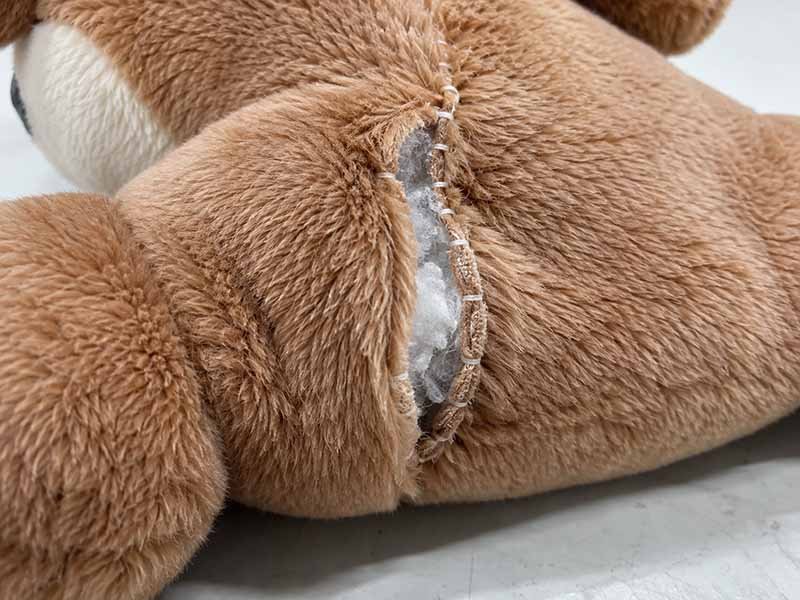
Plush fabric seam slippage occurs when the textile structure near a sewn seam shifts under tension and creates a visible opening while the stitches may remain intact. It differs from simple thread breakage because the weakness can be in the fabric structure rather than the sewing thread. Correctly identifying the failure mechanism is the first step toward choosing an effective corrective action.
Seam Slippage vs. Seam Strength
Seam strength and seam slippage are related, but they answer different questions. Seam strength is generally concerned with the force a sewn construction can withstand before a defined failure occurs. Seam slippage focuses more specifically on movement of the textile structure around the stitch line. A seam can therefore remain unbroken while already showing enough opening to be visually unacceptable or structurally concerning.
This distinction prevents a common troubleshooting mistake. When a seam opens, the quickest reaction is often to specify stronger sewing thread. That may help if the thread itself is breaking, but it does little when the backing is moving away from an intact stitch line. If the fabric tears along the needle line, the problem may be different again, involving needle size, stitch density, local fabric strength, or excessive perforation.
ASTM D1683/D1683M-22 reflects this broader view of sewn-seam performance in woven fabrics. The standard considers seam engineering variables such as thread, seam type, stitch type, and stitch density, and it can identify failure involving fabric rupture, stitching failure, or yarn displacement at the seam.
| What You Observe | Likely Failure Mode | Useful Measurement | First Areas to Check |
|---|---|---|---|
| Sewing thread breaks first | Stitching failure | Breaking force, N | Thread size, tension, stitch formation |
| Seam opens while thread stays intact | Fabric displacement or slippage | Seam opening, mm; force, N | Backing stability, seam design |
| Fabric tears beside the stitch line | Needle-line or fabric failure | Breaking force, N | Needle size, stitch density, substrate strength |
| Backing becomes visible before rupture | Seam grinning | Opening width, mm | Fabric structure, seam allowance |
| Seam looks fine empty but opens after filling | Product structural loading | Opening in stuffed condition | Filling pressure, pattern volume, reinforcement |
What Seam Grinning Looks Like
Seam grinning is often the earliest visible sign that the fabric-and-seam combination is approaching an unacceptable condition. Instead of a dramatic tear, the two sides of the seam separate slightly and expose the backing, thread, internal layer, or filling. In products made from short-pile materials, even a small opening can become obvious because there is not enough pile to visually cover the seam.
Longer pile can temporarily hide the same weakness. A faux-fur body may appear normal immediately after finishing, but handling can push the pile away from the seam and reveal the underlying gap. This is why visual inspection should not be limited to a relaxed product sitting on a table. A critical seam should also be observed while the surrounding area is placed under realistic tension, particularly around the face, neck, crotch, limb roots, tail bases, and tight body curves.
Appearance matters almost as much as ultimate strength in many character and collectible products. A seam may never reach catastrophic rupture, but a visible line through the forehead or front torso can already make the product commercially unacceptable. For that reason, engineering teams should record not only the maximum force achieved but also when visible opening starts and whether it disappears after the load is released.
Why Stuffing Changes the Problem
A flat textile specimen experiences substantial stress mainly while it is being loaded in a test machine. A stuffed plush shell can remain under internal pressure continuously. Polyester filling pushes outward against the fabric, and that pressure rises as a product becomes firmer, smaller relative to its fill volume, or more strongly shaped through curved pattern pieces.
The effect is especially noticeable on compact collectible plush, tightly filled heads, round bellies, narrow necks, small limbs, and sculpted facial structures. These areas can place load close to a short length of seam. A laboratory specimen with a long straight seam does not reproduce every aspect of that geometry, which is why acceptable flat-fabric performance should not be treated as proof that every finished plush construction will behave the same way.
Experienced product developers therefore look at seam performance twice: first in a controlled textile or internal material test, and again in the actual stuffed sample. If the fabric performs well as a flat specimen but opens after filling, the root cause may be pattern volume, local stuffing pressure, seam position, or reinforcement rather than the material alone. That second level of evaluation is particularly important before a high-volume order is released.
Diagnose Before You Correct
A useful seam investigation starts by examining exactly what moved, stretched, or broke. Check whether the sewing thread is intact. Look closely at the needle holes. Observe whether backing yarns or loops have shifted toward the seam. Compare the opening in both principal fabric directions. Examine the same area before and after stuffing, then compare it with a lower-stress area made from the same material.
This approach avoids expensive overcorrection. Increasing stitch density may create more perforations. Using thicker thread may require a larger needle. Reducing filling may stabilize the seam but ruin the approved silhouette. Replacing an entire fabric program can affect handfeel, color matching, embroidery, packaging volume, cost, lead time, and repeat-order consistency. The most effective solution is often a targeted change once the dominant failure mode has been identified.
Scale makes this discipline even more important. A problem appearing in only 1% of a 20,000-piece production run still means 200 units may be affected. Small weaknesses that look tolerable during casual sample handling can become expensive when multiplied across several SKUs, multiple shipments, or long-term replenishment programs.
Which Plush Fabrics Need Slippage Testing?

Plush fabrics deserve closer seam-slippage evaluation when their backings are easily distorted, relatively open, highly elastic, lightweight, or used in products with concentrated seam stress. Surface softness and pile density alone cannot predict performance. Backing structure, directional stretch, recovery, seam design, filling pressure, and product geometry usually provide more useful information about whether a material will remain stable after sewing.
Look Beyond the Pile
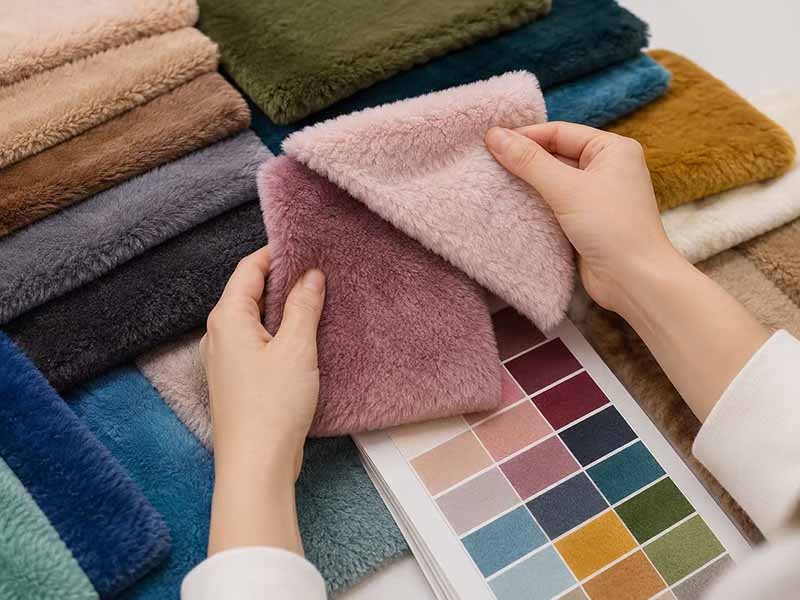
“Plush fabric” describes a broad group of materials rather than one single textile construction. Two fabrics may have nearly identical pile height, softness, and surface appearance but behave very differently after sewing because their backings are constructed differently. Many Minky, Velboa, fleece, Sherpa, and faux-fur materials use knitted substrates, while other velvet or specialty pile materials may use woven or more complex structures.
When seam opening is the concern, the backing deserves as much attention as the pile. The sewing thread transfers load into the textile around the needle penetrations, so a luxurious surface does not automatically mean the substrate can hold a stable seam. A material may feel substantial because of dense or long pile while the structural backing remains relatively light, elastic, or easy to distort.
Fabric weight should therefore be interpreted carefully. GSM measures mass per unit area, but it does not tell you how much of that mass belongs to pile, backing, coating, or other construction features. A 320 g/m² long-pile fabric is not automatically more seam-stable than a 240 g/m² short plush with a tighter substrate. For serious material comparisons, backing construction and seam behavior need to be observed directly rather than inferred from weight alone.
Backing Density and Stretch
Directional stretch often reveals more about seam risk than a simple hand-pull test. Many knitted plush materials extend noticeably more in one direction than another, and those differences can affect both sewing and finished-product stability. A torso seam placed along the more extensible direction may behave differently from the same seam rotated 90 degrees, particularly once the shell is stuffed firmly.
Recovery is equally important. Some fabrics extend under load and return close to their original dimensions. Others retain part of the distortion after the force is removed. Persistent deformation near the seam can leave visible grinning even after the product is no longer being squeezed or stretched. That may be a greater commercial concern than temporary elastic extension.
A practical material review should record the supplier and lot, GSM, thickness where relevant, pile length, substrate construction, major stretch directions, recovery behavior, cutting direction, and seam appearance after sewing and filling. Pufumi’s documented material-evaluation process considers factors such as GSM, pile length, handfeel, elasticity, shedding, thickness, supply stability, and suitability for the intended product rather than approving materials from appearance alone.
Higher-Stress Product Areas
Seam risk is rarely distributed equally across a plush product. A wide body seam on a softly filled pillow can behave very differently from a short seam holding a narrow leg, tail, wing, or hanging point. Localized load is often more important than overall product size because the same amount of pulling force may be concentrated into a much smaller stitched area.
Particular attention is useful around limb connections, tail roots, ear and wing attachments, hanging loops, keychain fixing points, narrow neck transitions, crotch areas, tightly curved facial seams, weighted inner-bag locations, and openings around electronic modules. These areas may experience internal pressure, repeated handling, or both. Reinforcing every seam is rarely necessary, but identifying genuinely high-risk zones early can prevent excessive construction changes elsewhere.
Pufumi’s documented production system identifies facial curves, attachment points, limbs, tail roots, wing connections, removable structures, battery-related areas, and weighted-pouch regions as higher-attention positions during sewing and QC. This kind of location-based control is especially useful when one fabric is being used across a family of different characters and product formats.
When Testing Becomes More Important
The need for structured seam evaluation increases whenever the project introduces uncertainty. A new fabric supplier, a lighter backing, a material substitution, a different dye or finishing source, a firmer stuffing target, a smaller product size, or a change in seam position can all alter the way the final construction carries load.
Repeat orders deserve attention as well. Commercial fabric names are not precise technical identities. A supplier may continue calling a material “Minky 220” or “short plush 250 GSM” while changing yarn, backing density, knitting setup, finishing, or another production variable. If the product is sensitive to seam stability, the most important question is whether the new lot behaves like the approved material, not whether the invoice uses the same product name.
Multi-SKU collections create another layer of risk. A material that works well on a soft, round character may struggle on a narrow-limbed design with several attachment points. Material approval should therefore be connected to the actual product construction whenever possible. The more a fabric contributes to shape and structural performance, the less sensible it is to approve it from a loose swatch alone.
Which Seam Slippage Standard Should You Use?
Choose the seam-slippage method according to fabric construction, test purpose, customer specification, and intended end use. ISO 13936-1 and ISO 13936-2 address yarn slippage at seams in woven fabrics, while ASTM D1683/D1683M-22 covers failure in sewn seams of woven fabrics. Knitted-back plush materials should not automatically be claimed as tested under these woven-fabric standards without confirming that the method is applicable.
ISO 13936-1 and ISO 13936-2
ISO 13936-1:2004 addresses resistance to yarn slippage at a sewn seam in woven fabrics using a fixed seam-opening method. ISO states that the publication was reviewed and confirmed in 2023, so the existing edition remains current. ISO 13936-2:2004 covers the same broad property using a fixed-load method and is also listed by ISO as current after its 2023 review.
The practical difference matters because the two approaches describe performance in different ways. A fixed-opening method asks how much force is associated with reaching the defined seam-opening condition. A fixed-load method asks how the seam behaves when subjected to the prescribed load. Those results should not be placed side by side as though they were interchangeable numbers.
This is a common source of confusion when suppliers exchange laboratory reports. A figure such as “3 mm opening” is incomplete unless the reader knows the applied load, direction, seam construction, and test method. Likewise, a force value in newtons is difficult to interpret without knowing which opening criterion or failure event it represents. Meaningful comparison requires the same method and equivalent specimen preparation.
| Standard | Primary Focus | Published Fabric Scope | Result Concept |
|---|---|---|---|
| ISO 13936-1:2004 | Yarn slippage at sewn seam | Woven fabrics | Force related to fixed seam opening |
| ISO 13936-2:2004 | Yarn slippage at sewn seam | Woven apparel and upholstery fabrics, including stretch woven fabrics | Slippage/opening under fixed load |
| ASTM D1683/D1683M-22 | Failure in sewn seams | Woven fabrics | Seam strength, rupture and yarn displacement behavior |
| ASTM D434-95 | Historical yarn-slippage test | Woven fabrics | Withdrawn in 2004; ASTM lists no replacement |
ASTM D1683/D1683M
ASTM D1683/D1683M-22 is currently listed as the active ASTM test method for failure in sewn seams of woven fabrics. The method applies force perpendicular to the seam and addresses seam strength as well as the force at which the sewn construction can produce yarn slippage or displacement. ASTM also emphasizes that thread size, seam type, stitch type, and stitch density are important seam-engineering variables.
That framing is useful for plush product development because it reinforces an important point: the material does not operate alone. A strong fabric sewn with an unsuitable seam can perform poorly, just as a carefully engineered seam cannot fully compensate for an unstable substrate. Test results therefore need to stay connected to the exact sewing configuration used to produce the specimen.
ASTM also makes clear that the test does not predict actual wear performance of a seam. For stuffed products, that limitation deserves attention. Laboratory loading does not reproduce every effect of long-term stuffing pressure, repeated squeezing, twisting, attachment pulling, packaging compression, transportation, and consumer handling. A textile test is valuable evidence, but it should be one layer of a broader validation process.
What About ASTM D434?
ASTM D434 still appears in older textile guides, archived specifications, testing websites, and supplier documents. That can create confusion because the method was historically associated with resistance to yarn slippage in woven fabrics using a standard seam. ASTM currently identifies D434-95 as withdrawn in 2004 and states that there is no replacement listed for that withdrawn document.
When an older customer specification still mentions ASTM D434, the safest approach is not to quietly substitute another standard or pretend the reference is current. Clarify the performance requirement the customer is trying to control, then agree on the relevant present-day method or laboratory protocol before production decisions are made.
Legacy specifications are common in established supply chains. Technical manuals can be carried forward for many years, even when one referenced standard changes status. Treating that as a documentation issue rather than an opportunity to make assumptions helps prevent disputes when procurement teams, factories, and third-party laboratories later compare reports produced under different procedures.
Knitted-Back Plush Needs Caution
This is one of the most important distinctions in plush seam testing. ISO 13936-1, ISO 13936-2, and ASTM D1683/D1683M all describe woven-fabric applications in their published scopes. Many widely used plush materials, however, are built on knitted substrates. Minky, fleece, Velboa, Sherpa, and faux fur are frequently encountered in knitted constructions, although exact structures vary by supplier and product.
A knitted plush can still have serious seam-opening problems, but the existence of the problem does not automatically make a woven-fabric test standard formally applicable. A qualified textile laboratory may recommend another method, a customer-specific protocol, or a carefully controlled internal comparative procedure depending on the fabric and the decision being made.
Internal screening remains valuable. A manufacturer can sew several candidate fabrics using identical conditions and compare how they behave under the same controlled load. That can be very useful for material development, even when it is not a formal compliance test. The important part is accurate language: describe an internal comparison as an internal comparison rather than presenting it as an ISO or ASTM pass when the full method or stated scope was not followed.
How Do You Prepare the Test?

Prepare a seam-slippage test by identifying the fabric and production lot, conditioning specimens according to the selected method, cutting them in the correct directions, and controlling the thread, needle, stitch type, stitch density, seam construction, and seam allowance. Consistent preparation is essential because changing sewing variables can alter the result enough to hide the true difference between materials.
Identify the Material First
A test specimen should have a clear identity before it is cut. Record the supplier, fabric code, production lot, color, composition where known, GSM, thickness where relevant, pile length, backing construction, finish, and intended product location. If several lots or rolls are being compared, maintain that identification through sewing, testing, photography, and final reporting.
Lot control is more important than it may appear. Two deliveries sold under the same commercial fabric name can differ because of yarn changes, knitting or weaving adjustments, finishing conditions, dyeing, coatings, or other process variation. If failed and passed specimens are mixed after cutting, one of the most useful clues in the investigation is immediately lost.
It is also helpful to photograph both the pile surface and backing before sewing. After testing, those images can be compared with the failed specimen to determine whether the structure elongated, shifted, tore, or enlarged around needle holes. For complex products, note where the material will be used. A body panel, face panel, long tail, hanging accessory, and weighted base may place very different demands on the same textile.
Control Direction and Sampling
Fabric direction can change seam performance dramatically. Woven materials have warp and filling directions, while knitted backings often have noticeably different extension and recovery along their principal axes. A specimen cut along the more stable direction can create an optimistic result if the production pattern later places the same seam along a more extensible direction.
This is why directional testing should reflect both the formal method and real pattern orientation. If a torso seam will run along a particular material axis, that orientation should be understood during engineering review. Where multiple critical seams use different orientations, testing more than one direction can reveal risks that would otherwise remain hidden until the stuffed prototype is completed.
Formal standards specify their own specimen dimensions, conditioning, sampling, and calculation requirements, and those requirements should be followed when a report is expected to claim compliance. Internal development tests do not need to pretend to be formal standards, but they still benefit from repeatable sampling. One successful strip cut from one location is an observation; several consistent specimens from representative material provide much stronger evidence.
Keep Sewing Variables Stable
Informal fabric comparisons often become unreliable because more than one variable changes at the same time. If Fabric A is sewn with a 10 mm seam allowance and Fabric B with a 6 mm allowance, the final numbers do not isolate the fabric difference. The same problem occurs when needle size, thread, seam type, machine tension, or stitch density changes between samples.
A useful test record should capture enough information for another technician to reproduce the seam. That does not mean recording every machine detail imaginable. It means documenting the variables that materially affect the construction and the interpretation of the result.
| Test Record | Practical Unit or Description |
|---|---|
| Fabric code and lot | Supplier or internal identification |
| GSM | g/m² |
| Thickness | mm, when relevant |
| Pile length | mm, when relevant |
| Test direction | Warp/filling or defined fabric axis |
| Thread | Fiber type and size designation |
| Needle | Needle system and size |
| Stitch type | Defined seam construction |
| Stitch density | Stitches per unit length |
| Seam allowance | mm |
| Test method | Standard number or internal protocol |
| Applied force | N |
| Seam opening | mm |
| Failure mode | Slippage, thread break, fabric tear |
| Product condition | Flat specimen, empty shell, stuffed sample |
Pufumi’s documented sewing process uses Released Patterns and Seam Maps and treats stitch spacing, seam allowance, and reinforcement locations as controlled production variables. This is useful not only for testing but also for repeat production, because successful construction settings can be transferred into released manufacturing documentation rather than remaining dependent on an individual operator’s memory.
Standard Seam vs. Production Seam
A controlled standard seam and an actual production seam answer different but complementary questions. A standard seam is useful when the main goal is to compare Fabric A with Fabric B under equivalent conditions. By holding the seam system constant, the material difference becomes easier to see.
A production seam answers the more practical question: will the exact construction intended for the product work? That may involve a different seam allowance, reinforcement, curved geometry, local attachments, or other features that are not represented in a basic comparative specimen.
Both approaches can be used at different stages. Early development can eliminate obviously unstable materials with a controlled comparison. Engineering samples can then validate the real construction. This is particularly useful when one plush product contains several seam types. A straight body seam, facial curve, tail root, hanging loop, and hand-closing seam do not perform the same structural job, even when they are made from the same main fabric.
How Is Seam Slippage Tested?

Seam slippage is tested by sewing controlled specimens, placing them in suitable tensile-testing equipment, applying force perpendicular to the seam, and measuring either the force associated with a defined seam opening or the opening produced under a defined load. For formal reporting, specimen dimensions, conditioning, loading procedure, calculations, and acceptance rules must follow the complete selected test method rather than a simplified workshop version.
Fixed Seam Opening Method
ISO 13936-1 represents the fixed seam-opening approach for woven fabrics. The core engineering idea is to determine how much resistance the textile thread system provides before the seam reaches the defined opening condition. ISO currently lists ISO 13936-1:2004 as published and confirmed following its 2023 review.
This type of measurement is useful because ultimate rupture is not always the first commercially important failure. Two fabrics may eventually break at similar forces, yet one can begin showing visible seam grinning much earlier. For a character plush with visible facial or torso seams, the earlier opening may be the more meaningful problem because the product can become visually unacceptable long before the thread or fabric reaches maximum breaking force.
During development, observe not only the final result but also the progression. Note when the opening first becomes visible, whether it grows smoothly or suddenly, whether one side shifts more than the other, and whether the opening remains after the specimen is unloaded. These observations help distinguish recoverable extension from permanent structural movement.
Fixed Load Method
ISO 13936-2 uses a fixed-load approach for woven fabrics. Rather than centering the result on the force associated with a defined opening, the method examines slippage behavior under the specified loading condition. ISO describes the method as suitable for apparel and upholstery woven fabrics, including stretch woven fabrics containing elastomeric yarns.
The practical lesson is that seam-opening numbers need context. A report saying “2.8 mm” does not tell a sourcing or engineering team enough on its own. The reader must also know the test method, applied load, specimen direction, seam construction, material identity, and acceptance requirement.
Supplier comparisons become especially unreliable when those conditions differ. A fabric tested under one method should not be declared better than another fabric tested under a different method simply because one numerical value looks smaller. The purpose of standardization is precisely to create comparable conditions. When the objective is material selection, select one appropriate method or agreed internal protocol and apply it consistently to every candidate.
Sewn-Seam Failure Testing
ASTM D1683/D1683M-22 provides a broader sewn-seam performance test for woven fabrics. ASTM states that the method measures sewn seam strength by applying force perpendicular to the seam and can identify the force at which the seam system produces yarn slippage or displacement. The method also recognizes the importance of thread, seam construction, stitch type, and stitch density.
For plush development, the failure sequence can be more informative than a single maximum number. Watch whether the thread breaks, the fabric tears beside the seam, or the backing starts moving before either component ruptures. Look for enlarged needle holes, asymmetrical distortion, and changes that occur in only one test direction.
Photographs are useful here. A clear image of the specimen at the relevant failure stage allows the factory, customer technical team, sourcing team, and laboratory to discuss the same physical condition. Descriptions such as “weak seam” or “fabric opened a little” are difficult to act on. A measured opening, known load, material lot, documented seam, and photograph create a much stronger quality record.
Repeat and Compare
Textiles naturally vary, which is why a high-volume decision should not depend on one specimen. Formal methods provide their own sampling and reporting requirements, and those requirements should control whenever compliance or official reporting is involved. Internal development trials should still use repeat specimens even when they are not intended for certification.
Variation itself can be diagnostic. If several specimens produce closely grouped results, the material and seam combination is behaving predictably. If one specimen is strong, one is moderate, and another opens much earlier, the average can hide an important stability problem. Investigate roll position, fabric direction, backing variation, sewing consistency, seam allowance, thread tension, or local material defects before simply accepting the mean result.
When troubleshooting, change one important variable at a time where practical. Test the original condition, then alter only seam allowance. Next evaluate reinforcement while keeping the fabric constant. Then compare an alternative fabric under the original seam settings. This sequence shows which modification actually created the improvement and helps prevent unnecessary changes to cost, handfeel, or appearance.
How Do You Judge the Results?
Judge seam-slippage results against the defined test method, product specification, failure mode, intended use, and finished-product risk. There is no responsible universal seam-opening number that automatically passes every plush fabric. A result becomes meaningful only when the load, opening, fabric direction, seam construction, material identity, and acceptance criterion are clearly connected to the product being manufactured.
What Counts as a Pass?
A pass means the tested construction satisfies the requirement established for the project under the agreed method. That requirement may come from a brand specification, retailer quality manual, laboratory protocol, purchase agreement, or another relevant technical document. The important point is that the limit needs to be known before production, not invented after a problem appears.
ASTM’s published information recognizes that seam slippage exceeding values in customer specifications, or values agreed between purchaser and supplier, may reduce the integrity of the product enough to affect intended use. This is a more useful way to think about acceptance than searching for a single number that supposedly applies to every textile product.
The required performance can reasonably differ by location and construction. A hidden decorative seam does not create the same visual risk as a seam running through a character’s face. A lightly filled plush pillow does not create the same sustained pressure as a small, firm collectible. A hanging-point seam carries a different functional responsibility from a broad torso seam. Acceptance should therefore remain connected to actual product risk.
Avoid the “Magic Number” Trap
Technical teams often ask for one convenient answer: how many millimeters of seam opening is acceptable? Without the method and loading condition, that number is incomplete. A 3 mm opening measured under one prescribed force is not automatically equivalent to a 3 mm result generated under another procedure.
The same applies to force. A value associated with a fixed opening is not the same thing as the maximum force required to break the seam. When reports are compared across laboratories or suppliers, the basic information should include the method, applied force or opening criterion, fabric direction, seam construction, and observed failure mode.
Material identity belongs in that record as well. An old report may not represent a new production lot if the substrate, supplier, finishing process, or other construction details have changed. Repeat-order programs benefit from retaining approved material references and comparing new production against them where practical, especially when seam behavior is known to be sensitive.
Read the Failure Pattern
The appearance of the failed specimen often points directly toward the corrective action. Gradual displacement around an intact stitch line suggests that fabric stability deserves attention. Sharp thread rupture with relatively stable fabric points more strongly toward the sewing system. A straight tear running beside many needle penetrations may indicate that the material has been weakened along the stitch line.
Directional differences can also be useful. If specimens in one orientation perform substantially worse than those cut in another, pattern placement or cutting direction may become part of the solution. If flat specimens remain stable while stuffed prototypes begin to open, the root cause may lie in product geometry or filling pressure rather than general fabric strength.
This is where experienced manufacturing judgment matters. Replacing the main material may be unnecessary if only one short attachment seam needs reinforcement. Conversely, repeatedly modifying the seam can become inefficient if the substrate itself remains unstable. The purpose of testing is not to produce a pass/fail stamp as quickly as possible. It is to identify which variable is actually limiting the product.
Turn Test Results Into Production Controls
A test becomes valuable only when its result changes a manufacturing decision. If a wider seam allowance improves stability without changing the product shape, that information should enter the released pattern or sewing instruction. If one direction performs poorly, cutting orientation may need control. If an alternative backing consistently produces better performance, material approval should capture the exact fabric code and lot requirements.
The same principle applies to filling. If the seam opens only when the sample is filled beyond the approved firmness, the project may need a filling target, weight tolerance, or another practical control tied to the reference sample. If reinforcement solves a high-load attachment problem, the reinforcement location and construction need to be documented so every sewing line applies the same solution.
Pufumi’s documented quality system uses Golden Samples, released production files, incoming inspection, process inspection, finished-product checks, nonconformance records, and corrective-action records to support production consistency and traceability. The value of that system is that a successful seam solution can be reproduced on future lots rather than rediscovered every time the product is reordered.
How Do You Prevent Seam Slippage in Plush Products?
Prevent seam slippage by treating the fabric, pattern, seam allowance, stitch settings, reinforcement, and stuffing level as one connected system. Start with a sufficiently stable material, control the sewing variables, reinforce genuine high-load areas, and validate the finished stuffed sample. When a problem appears, identify the actual failure mechanism before changing several variables, because the most effective correction is usually targeted rather than excessive.
Improve the Material-Seam Combination
When seam opening appears, the main fabric is one possible cause, but it should not automatically receive all the blame. Begin with the current production construction and create controlled comparisons. If alternative materials with similar pile and handfeel show much better seam stability under the same sewing conditions, the substrate may be the dominant limitation.
Material changes still involve trade-offs. A more stable backing must also meet requirements for softness, color, pile length, visual character fidelity, stretch, embroidery compatibility, printing, shedding, packaging behavior, availability, repeat-order stability, and cost. A technically strong replacement that changes the character’s face, drape, or tactile identity may not be a commercially acceptable solution.
For licensed or collectible products, it is often sensible to test seam-engineering adjustments before replacing a material that is central to the approved appearance. If those adjustments become extreme, expensive, or difficult to reproduce, however, the textile may simply be poorly matched to that construction. Strong product development is about finding the balance where the visual material and the manufacturing system support each other.
Adjust Seam Engineering Carefully
Several sewing changes can improve seam stability, but stronger is not always better. Increasing seam allowance can provide more material outside the stitch line, yet excessive allowance can create bulk or distort small curves. Increasing stitch density creates more load-transfer points, but extremely dense penetration can weaken some substrates along the needle line.
Thicker thread may resist breakage but can require a larger needle, creating larger holes. Reinforcement can be highly effective around limbs, tails, hanging points, weighted structures, or other concentrated-load areas, but adding it everywhere can increase stiffness, labor, material use, and cost without improving low-risk regions.
Controlled trials are therefore more useful than universal rules. Change one parameter, repeat the test, and inspect the failure again. The objective is to move the weakest link to an acceptable level without creating a new problem elsewhere. In repeat production, the successful combination of fabric, needle, thread, stitch settings, seam allowance, and reinforcement should become part of the manufacturing specification rather than depending on operator judgment.
Control Filling Pressure
Stuffing is usually discussed in terms of softness and shape, but it also changes seam loading. A firmer product pushes the shell outward more strongly, which can make seam grinning appear in areas that looked stable before filling. This is especially common in small round bodies, tightly sculpted heads, narrow legs, and products with strong three-dimensional contours.
Reducing filling may make the seam close again, but that is not automatically the right solution. If the approved design requires a firm head or rounded belly, an under-filled product may lose character fidelity and feel cheap. Instead, engineers can evaluate pattern volume, local reinforcement, seam location, seam allowance, backing stability, and filling distribution to reduce concentrated pressure while preserving the intended appearance.
Consistency matters during mass production as well. If one operator produces very firm units and another produces softer ones, seam load and appearance can vary even when every other production parameter is identical. Where filling materially affects structure, the project may benefit from a controlled filling weight, defined handfeel range, or direct comparison against an approved Golden Sample.
Validate the Finished Product
Fabric testing and finished-product validation should complement each other. Flat specimens help isolate fabric and seam variables under controlled conditions. A finished plush prototype reveals how those variables interact with curved patterns, stuffing pressure, accessories, attachments, internal bags, electronic modules, and real product geometry.
Inspect the most highly stressed areas after filling and shaping. Compare them with the empty shell. Handle the prototype in the ways consumers are reasonably expected to handle it, while keeping any formal product-safety testing separate and aligned with the applicable market requirements. Pay particular attention to the face and head, neck, crotch, limb roots, tail and ear attachments, closing seam, hanging points, weighted structures, and areas surrounding internal modules.
A practical development sequence is material evaluation, controlled seam comparison, engineering sample, stuffed-product review, approved pre-production reference, bulk process control, applicable third-party testing, and final inspection. This does not guarantee that every product will be free from every possible defect, but it creates a far stronger evidence chain than relying on one hand-pull test or a single laboratory number.
Conclusion
Seam slippage is easy to underestimate because the first warning sign can look cosmetic. The thread may still be intact, the toy may still hold its shape, and the gap may be visible only when the fabric is stretched. In reality, that small opening can reveal a mismatch between textile structure, cutting direction, seam construction, filling pressure, or product geometry. Once production reaches thousands of pieces, that mismatch can become a costly quality problem.
The most reliable approach is to test the right question at the right stage. Use appropriate textile methods when the fabric construction fits their scope, keep specimen and sewing conditions controlled, record both numbers and failure modes, and then validate the real stuffed product. For knitted-back plush, avoid forcing woven-fabric standards onto the material simply because the terminology sounds familiar. A transparent internal comparison is more useful than an inaccurate compliance claim.
For custom plush programs, seam stability should ultimately become part of the same development system as material approval, pattern engineering, sample revisions, Golden Sample control, production QC, and repeat-order records. Pufumi’s documented manufacturing framework connects material selection, released engineering files, sewing control, quality inspection, and production traceability so that approved decisions can be carried into bulk manufacturing rather than being recreated from memory.
The best final question is therefore not simply, “Is this fabric strong enough?” A more useful question is whether this exact fabric, sewn with this exact construction and filled to this exact product requirement, can remain visually acceptable and structurally stable through repeatable production. When the answer is supported by controlled tests, documented samples, and measurable manufacturing controls, seam stability becomes a manageable engineering parameter instead of a late-stage surprise.
Frequently Asked Questions
What is the difference between seam slippage and seam strength in plush fabric?
Seam strength describes the overall ability of a sewn construction to resist force before a defined failure occurs, while seam slippage refers more specifically to movement of the textile structure around the stitch line. A seam can show serious grinning even when the thread has not broken. This distinction matters because stronger thread may improve a thread-break problem but may not solve unstable backing movement or fabric displacement.
Which ISO standard is used for seam slippage testing?
ISO 13936-1:2004 uses a fixed seam-opening method for determining resistance to yarn slippage at a seam in woven fabrics, while ISO 13936-2:2004 uses a fixed-load method. ISO currently lists both editions as confirmed after review in 2023. These standards should not automatically be applied to knitted-back plush materials because their stated scope is focused on woven fabrics.
Is ASTM D434 still valid for seam slippage testing?
ASTM D434-95 is not a current ASTM test method. ASTM lists the standard as withdrawn in 2004 and states that there is no replacement for the withdrawn document. Older brand manuals or online textile references may still mention D434, so the intended requirement should be clarified rather than silently substituting another test. ASTM D1683/D1683M-22 is currently active for failure in sewn seams of woven fabrics.
Can Minky and Velboa use ISO 13936 seam slippage testing?
Not automatically. Many Minky, Velboa, fleece, Sherpa, and faux-fur materials use knitted backings, while ISO 13936-1 and ISO 13936-2 are written for woven fabrics. The actual substrate construction should be identified before selecting a method. A qualified laboratory may recommend an applicable alternative or a project-specific protocol, while manufacturers can still use controlled internal comparisons for material development without describing those trials as formal ISO compliance.
What causes seam grinning after a plush toy is stuffed?
Seam grinning after stuffing can result from unstable fabric backing, excessive stretch, insufficient seam allowance, unsuitable stitch settings, concentrated pattern geometry, or high internal filling pressure. The problem is often most visible around curved heads, narrow necks, limb roots, crotch seams, tail attachments, and other short high-load areas. Comparing the empty shell with the stuffed sample helps determine whether the dominant cause is fabric behavior or product structure.
How can a manufacturer reduce seam slippage without changing the plush fabric?
A manufacturer can evaluate seam allowance, stitch density, needle size, thread choice, seam type, local reinforcement, cutting direction, pattern volume, and filling pressure before replacing the material. Changes should preferably be tested one at a time so the engineering team can identify which modification actually improves performance. Reinforcing only high-stress areas is often more practical than making every seam heavier, stiffer, and more expensive.
Should seam slippage be tested before mass production?
Yes, when seam stability is a meaningful risk for the material or product construction. Testing is especially useful when introducing a new substrate, changing suppliers or lots, using firm stuffing, creating narrow attachments, or developing a high-volume repeat program. The strongest workflow combines material-level evaluation with an actual stuffed prototype and then transfers successful seam settings into the approved production specifications, Golden Sample references, and QC process.