Skip to content

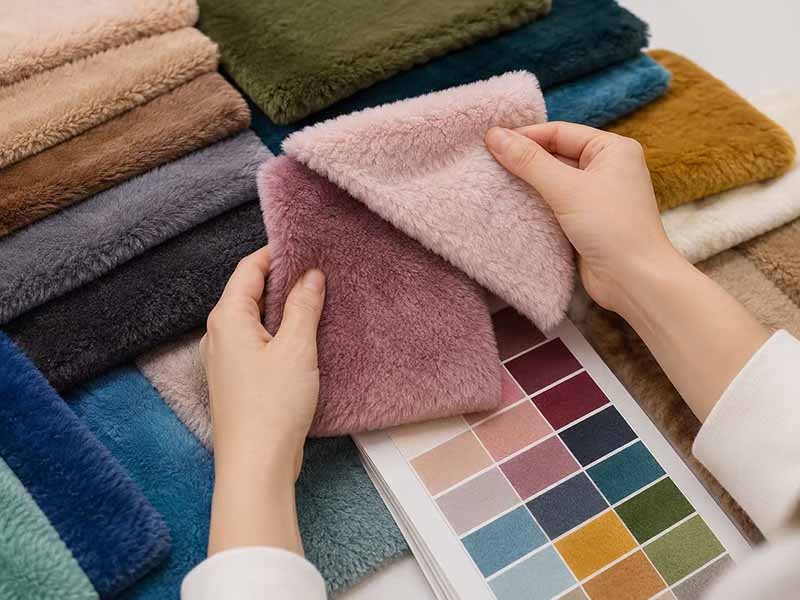
Choosing plush fabric looks simple when you are holding a few attractive swatches, but the real decision begins after the fabric is cut, embroidered, sewn, filled, packed, shipped, handled, and eventually reordered. A fabric that feels excellent in your hand may stretch too much around a character’s face. A long pile that looks luxurious on an animal may cover the mouth or eyes. A perfectly matched custom color may create unnecessary delays if the project only needs a small amount across several SKUs. Material selection therefore has to balance appearance with engineering and production reality.
The right fabric for a custom plush project should match the product type, finished size, character details, desired hand feel, pile length, GSM, density, stretch, decoration method, target age, sales market, durability needs, packaging, budget, production quantity, and reorder plan. The best material is not simply the softest or most expensive option; it is the one that produces the intended result consistently from approved sample through bulk production.
A useful test is to imagine the product several months after launch. Will a bag charm still look presentable after rubbing against a backpack? Will the character’s embroidery remain clear after stuffing? Will a compressed long-pile plush recover well after shipping? Can the same color and hand feel be reproduced when the product is reordered? These questions reveal far more about the right fabric than a swatch labeled “premium plush.”
What Should You Define Before Choosing Plush Fabric?

Define the product before choosing the fabric. Start with the plush format, size, intended user, critical character features, surface feel, decoration methods, sales market, handling conditions, quantity, packaging, target cost, launch date, and reorder expectations. Once these variables are clear, many unsuitable fabrics can be eliminated before they create unnecessary sampling, sourcing, or production problems.
Define Product Use
The first question is not “Which plush fabric is best?” but “What does the finished product need to do?” A collectible character, a daily-use bag charm, a large cuddle plush, and a realistic animal can all use polyester-based plush fabrics, yet their material requirements are very different. A collectible usually depends more heavily on facial fidelity, color consistency, surface quality, and presentation, while an accessory that travels on a handbag or backpack has to tolerate much more friction and handling.
Product scale changes the decision further. A fabric that looks balanced on a 30 cm character may overwhelm the features of a 10 cm mini version. Long pile can visually shrink small eyes and mouths, while thick backing and several layers of seam allowance can make tiny hands, ears, or feet difficult to shape cleanly. A larger plush has more room for texture, but larger surfaces can reveal directional color differences and may show compression marks after packing.
It is useful to define the product in practical language rather than broad adjectives. “Soft and premium” gives a development team little guidance. “A 20 cm seated character with embroidered eyes and mouth, a fitted fabric jacket, a soft but stable head, and retail-box presentation” immediately creates measurable material requirements. That description connects fabric choice with pattern construction, embroidery, filling density, packaging, and production control.
| Product Type | Main Fabric Priority | Common Material Risk |
|---|---|---|
| Character plush | Face clarity and silhouette | Pile hides embroidery |
| Mini collectible | Controlled thickness and detail | Bulky seams distort shape |
| Bag charm | Abrasion and surface durability | Pilling or surface wear |
| Cuddle plush | Softness and recovery | Material feels stiff after filling |
| Realistic animal | Texture and pile direction | Fur flow looks unnatural |
| Retail collectible | Appearance and repeatability | Batch variation becomes visible |
| Baby-oriented product | Product-specific suitability | Shedding, cleaning, component risk |
Know the End User
The intended user should influence fabric selection before samples are made. A decorative collectible that mainly stays on a shelf experiences little abrasion, while a keychain or bag charm may rub against clothing, metal hardware, zippers, bags, and other objects every day. A plush intended for repeated cuddling will be judged much more heavily on softness, surface recovery, and how the material behaves after repeated compression.
Target age also changes the material brief. A soft surface should never be treated as proof that the complete product is appropriate for a particular age group. The outer fabric, seams, filling, decorative elements, attachments, internal supports, electronics, weighted inserts, removable parts, and intended use all interact. Material selection is therefore part of a broader product evaluation rather than a stand-alone safety decision.
Ask how the product will actually live after it leaves the factory. Will it be carried outdoors? Will it spend most of its time in a retail box? Will consumers squeeze it repeatedly? Will it be attached to a bag? Could it require regular cleaning? Each answer changes the balance between softness, surface durability, pile length, colorfastness, backing strength, and cleanability.
A highly textured fabric that looks impressive under studio lighting may become less attractive after months of friction. A long, soft pile may feel luxurious when new but require more grooming after shipping. A delicate velvet-like surface can be appropriate for a premium display item yet poorly suited to an accessory designed for continuous handling. The end-use scenario is therefore one of the most useful filters in the entire selection process.
Protect Key Character Details
A character is rarely recognized because of every detail equally. Eye spacing, mouth shape, facial proportions, ears, silhouette, trademark colors, clothing, logos, or one distinctive accessory may carry most of the character identity. These features need to be identified before fabric is approved because the wrong material can weaken them even when the original pattern and embroidery files are technically correct.
Long pile is one of the most common sources of conflict. It can make the body look richer and more tactile while reducing the visibility of small facial embroidery. Highly reflective surfaces can make an approved color appear different depending on pile direction and lighting. Thick material can create excess bulk around small facial seams, while strong stretch can pull the position of the eyes or mouth after filling.
Mixed-material construction often solves this problem more effectively than forcing one fabric across the entire product. A face can use short pile for clarity while the body uses a longer material for texture. Inner ears can use a flat contrasting fabric, paw pads can use a stable surface for embroidery, and clothing can use woven or knitted fabrics while the character body remains plush.
The important point is to protect recognition before optimizing cost or simplifying construction. When a character moves into a smaller size, a different material, or a later reorder, the features that define the character should remain the reference point. A material decision is successful only when it supports the character rather than asking the character design to compensate for the material.
Set Commercial Limits
Material selection is also a sourcing decision, so quantity, timing, cost, and future availability should be discussed while the design team is still comparing options. A beautiful fabric can become a poor commercial choice when its minimum material quantity is too high for one color, the supplier cannot support repeat orders, or the lead time conflicts with a fixed entertainment release, retail reset, holiday, event, or promotional launch.
Multi-SKU projects make this particularly important. A total order may be substantial, yet one special color might only be used on a small section of one character. When fabric consumption is divided across several characters, colors, sizes, and packaging versions, a custom-dyed or uncommon textile may become less practical than it first appeared. Stock materials can sometimes provide better continuity even when they are not a perfect theoretical match.
Custom dyeing can be valuable when color is central to an IP, sports team, university, or brand identity. However, the project should allow time for color matching, sample review, bulk dyeing, incoming inspection, and possible correction. Dye-lot differences should also be considered if the product is intended to stay in the market long enough for several production runs.
A useful material brief therefore includes finished size, estimated quantity per SKU, number of colors, target market, target age, critical artwork details, required decoration methods, packaging direction, target cost range, expected launch date, and reorder expectations. When these commercial limits are clear early, the material team can propose options that work not only in the sample room but also in a realistic production schedule.
Which Fabrics Work Best for Custom Plush?

There is no single fabric that works best for every custom plush project. Minky is widely used when a soft, refined hand feel matters; Velboa and short plush help preserve clear shapes and embroidery; Faux Fur supports realistic or long-haired effects; Sherpa adds strong texture; printed fabrics reproduce complex graphics; and custom-dyed materials help control important brand or character colors.
Minky
Minky is one of the most common starting points for modern character plush because it combines a soft surface with relatively good control over embroidery and shape. It can work well for cuddle products, character merchandise, premium gifts, collectible plush, and products where tactile quality is a major part of the consumer experience. The important point is that “Minky” describes a broad family of materials rather than one fixed engineering specification.
Different Minky constructions can vary in pile appearance, GSM, density, stretch, backing, surface finish, and recovery. Two materials carrying the same general name can create noticeably different results on an identical paper pattern. A stretchier Minky may create softer curves and a more squeezable body, but it can also make facial proportions or finished dimensions harder to control. A denser option may feel more substantial while creating thicker seam intersections.
Embroidery should be tested on the exact material planned for production. Dense eyes, mouths, brows, or logos introduce thread tension into a relatively small area. If the backing is very soft or elastic, the fabric can pull or wrinkle around the stitch field. The real judgment should therefore happen after the panel has been sewn into the product and the head has been filled.
Minky is strongest when the product needs a smooth, soft surface without losing too much detail. It should not be selected because the word itself sounds premium. Compare actual weight, stretch, density, surface appearance, backing, and performance on the finished prototype before deciding which Minky construction belongs in the production specification.
Velboa and Short Plush
Velboa and short plush are practical choices when clear contours, visible embroidery, and controlled surface behavior matter more than deep fluffiness. They are frequently useful for game characters, animation characters, mascots, mini plush, keychains, and designs with small embroidered facial features. The shorter surface keeps eyes, mouths, logos, and seam geometry easier to read after the product is filled.
The main trade-off is tactile positioning. A flatter surface may not deliver the same rich hand feel as a high-density Minky or longer plush. That does not make it lower quality. It simply gives the material a different job. If the product depends on facial accuracy and a clean silhouette, a controlled short surface can produce a stronger result than a much softer but visually disruptive long pile.
Short plush becomes especially valuable as product size decreases. On a compact character, several millimeters of visible fiber can cover a meaningful percentage of an eye or mouth. Thick pile around small seam intersections can also make the face appear rounder or less precise than the approved artwork. A stable short-pile surface provides the pattern and embroidery teams with more predictable visual boundaries.
The useful comparison is therefore not “Which material is better?” but “Which material makes the most important features easiest to recognize?” A premium collectible and a small bag charm may both be high-quality products while requiring completely different surface behavior. Material quality should always be judged against the product brief rather than against a universal softness scale.
Faux Fur and Sherpa
Faux Fur is useful when the pile itself is an important visual feature. Realistic animals, long-haired characters, fantasy creatures, furry monsters, zoo merchandise, theme-oriented animal products, and selected premium collectibles can benefit from the movement and depth created by longer fibers. The material can make a product look dramatically more dimensional, but that added visual value comes with more production variables.
Long pile can cover embroidery, become trapped in seams, change the apparent outline, and require trimming around facial features. Pile direction can make two neighboring panels look different even when they come from the same roll. Packaging also matters because long fibers can remain flattened after compression and require brushing or recovery time before the product looks like the approved sample again.
Sherpa produces a different visual effect. Its irregular, wool-like surface gives a strong sense of warmth and comfort, making it useful for lifestyle plush, winter themes, cozy home products, and characters that benefit from a deliberately soft and textured appearance. The same surface can make very fine embroidery or highly detailed printing harder to reproduce clearly.
Specialty material is therefore most useful when the texture has a clear role. If Faux Fur makes an animal species more believable or Sherpa strengthens the cozy personality of a character, the added complexity may be worthwhile. If the texture adds little to recognition or consumer experience, a more controlled surface can often deliver better consistency at lower engineering risk.
Printed and Custom-Dyed Fabric
Printed fabric is useful when the design contains gradients, animal markings, repeated graphics, complex clothing patterns, or surface artwork that would be inefficient to create through several sewn panels or dense embroidery. It can preserve visual complexity without dramatically increasing pattern-piece count, but successful printing depends heavily on the surface underneath the graphic.
A smooth, stable fabric generally provides clearer edges than a deep or irregular pile. Long fibers can break up thin lines, while strong stretch can distort the artwork after filling. Highly textured surfaces may create uneven visual coverage, and dark base colors can affect the appearance of printed colors depending on the process. Print trials on the actual production-intent fabric are therefore much more valuable than digital mockups alone.
Custom-dyed fabric solves a different problem. It allows a project to move closer to important IP colors, brand colors, university colors, or sports-team colors when available stock fabrics do not provide an acceptable match. The commercial decision should consider not only visual accuracy but also material MOQ, color-approval time, bulk dyeing time, expected lot variation, and future reorder requirements.
| Fabric Type | Typical Surface | Strong Applications | Main Control Points |
|---|---|---|---|
| Minky | Soft and smooth | Character and cuddle plush | Stretch, GSM, backing |
| Velboa | Short and controlled | Animals and standard characters | Density, hand feel |
| Short Plush | Short pile | Faces, mini plush, embroidery | Detail visibility |
| Faux Fur | Long and dimensional | Realistic and furry characters | Shedding, trimming, direction |
| Sherpa | Wool-like texture | Cozy lifestyle products | Detail visibility, surface consistency |
| Fleece | Flat and soft | Simple forms and fabric accessories | Pilling, appearance |
| Velvet | Fine directional sheen | Premium accents | Pressure marks, pile direction |
| Printed Fabric | Graphic surface | Gradients and complex patterns | Print clarity, colorfastness |
| Custom-Dyed Fabric | Targeted project color | IP and brand programs | MOQ, lot control, lead time |
How Do Fabric Specs Affect the Finished Plush?

Fabric specifications influence shape, touch, appearance, and repeatability more than the material name alone. Pile length controls detail visibility, GSM and density influence fullness, backing affects sewing and stability, stretch changes the three-dimensional shape after filling, and grain or pile direction affects color, gloss, symmetry, and dimensions. These properties should be recorded as production information rather than described only as “soft” or “thick.”
Pile Length
Pile length changes the visible geometry of a plush product. Short pile exposes embroidered eyes, mouth lines, appliqué edges, and seam contours more clearly. Medium pile softens those edges and creates a fuller surface, while long pile introduces much stronger depth and movement. The challenge is that the same fibers creating an attractive fluffy appearance can also reduce facial clarity.
The effect becomes stronger as the finished product gets smaller. A pile length that looks perfectly proportioned on a 30 cm animal may cover too much of the facial area when the same design is reduced to a 10 cm keychain. This is one reason smaller versions should not be created by simply scaling down the original pattern and using the same fabric without additional validation.
Pile length can also vary by body area. A realistic animal can use shorter material around the muzzle while keeping longer fur across the neck, body, or tail. A fluffy fantasy character can retain deep pile across the torso while using trimmed or shorter material around the eyes. This approach preserves both texture and character recognition.
Longer surfaces create additional production tasks as well. The team must control pile direction during cutting, remove trapped fibers from seams, trim or groom selected areas, and consider recovery after carton compression. Pile length is therefore not merely a visual styling choice; it affects pattern development, sewing, finishing, inspection, packaging, and repeatability.
GSM and Density
GSM, or grams per square meter, gives the project team a measurable way to compare materials, but it should never be treated as a simple quality ranking. A heavier fabric is not automatically better. Surface density, yarn construction, pile structure, backing, stretch, and finishing all influence how a particular GSM feels and behaves in the finished plush.
A denser surface can reduce visible backing when the fabric stretches across rounded areas and may create a fuller, more refined hand feel. At the same time, heavier or denser fabrics can increase seam bulk, make small parts harder to turn, and create greater thickness where several panels intersect. Those effects become especially noticeable on mini plush, fingers, ears, tails, and tightly constructed facial areas.
A lighter or lower-density material may offer greater flexibility and lower material weight, but insufficient density can expose the backing when the pile separates. It can also provide less support for dense embroidery or create a thinner touch than the customer expects from a premium product. The correct balance therefore depends on product size, shape, handling expectations, and intended retail positioning.
For controlled manufacturing, GSM should be recorded together with pile specification, usable width, stretch behavior, backing, thickness, color reference, material code, and supplier information. Combining these values turns fabric selection from a subjective swatch decision into something that purchasing, sample development, production, incoming inspection, and later reorders can all understand consistently.
Stretch and Backing
Stretch becomes important after filling because internal pressure can change the dimensions of the fabric panels. If one direction stretches more than another, the finished head or body may become wider, longer, or rounder even though the paper pattern dimensions have not changed. A material substitution can therefore alter the silhouette without any change to the cutting file.
This is particularly important when moving from a stable short plush to a more elastic Minky or other knitted plush surface. The same face pattern may suddenly appear broader or softer. That can be beneficial when the desired style is rounded and cuddly, but it can also reduce fidelity on a character whose face needs to remain tightly controlled.
Backing determines how the surface behaves under seam tension. A softer backing can improve flexibility and tactile comfort while providing less resistance to deformation. A more stable backing helps preserve geometry but may feel firmer. Neither is universally better. A large cuddle plush and a detailed licensed character can require very different compromises between flexibility and structural control.
Embroidery adds another layer. Dense stitch fields pull against the fabric, so thin or highly elastic backing can wrinkle or shift around the stitched area. Material changes should therefore be checked on the actual prototype rather than approved by matching color and softness alone. Shape, stretch, backing, embroidery, and filling work together as one system.
Grain and Pile Direction
Plush fabric has direction, and direction can change both appearance and dimensions. Pile reflects light differently depending on whether it is viewed with or against the fiber direction. The same roll can therefore appear lighter, darker, shinier, or more matte when neighboring panels are cut in opposite directions. Long-pile and velvet-like fabrics make this especially obvious, but short surfaces can show the effect under strong photography or retail lighting as well.
Faces are particularly sensitive. If the left and right facial panels use inconsistent pile direction, the finished character can look asymmetrical even when the actual color and embroidery are identical. Consumers may describe the difference as a color problem when the real cause is fiber orientation and light reflection.
Fabric grain and stretch direction influence shape too. If one arm is cut across a more elastic direction and the opposite arm follows a more stable direction, the two pieces can respond differently after filling. This type of variation becomes difficult to correct through sewing alone because the material itself is behaving differently.
Pattern and cutting documents should therefore include direction information wherever it matters. Head, face, body, ears, limbs, tails, clothing, and accessories can each require an intentional orientation. In multi-SKU projects, maintaining consistent direction rules also helps a collection look like one coordinated product family rather than several unrelated production batches.
How Does Fabric Affect Character Detail and Decoration?

Fabric and decoration should be developed together. Embroidery needs sufficient surface stability and visible stitch exposure, printing needs compatible pile, texture, color, and stretch, and small characters need controlled fabric thickness. When one surface cannot deliver every requirement, mixed-material construction can improve facial clarity, texture, and character recognition without forcing the entire plush to use one compromised fabric.
Embroidery
Embroidery is widely used for plush eyes, mouths, eyebrows, logos, and fine graphic details because it provides a durable surface treatment without introducing separate hard components. The quality of the embroidery, however, depends on the fabric beneath it as much as on the embroidery file itself. A design that looks excellent on one short-pile surface can become partially hidden or distorted on another material.
Long pile is the most obvious challenge. Fibers can rise above the stitches and visually reduce the size of small features. Increasing embroidery size can improve visibility but may change the original character proportions. Localized trimming can expose the stitches more effectively, yet it creates another manual operation that needs to remain consistent across production.
Fabric stability matters just as much. Dense embroidery introduces repeated needle penetration and thread tension into a small area. Thin or highly elastic fabric can pucker, stretch, or pull away from the intended geometry. That means embroidery tests should use the actual production-intent material rather than a convenient substitute chosen only because it runs easily on the embroidery machine.
Review embroidery after the panel has been sewn and filled. Check edge definition, trapped fibers, thread coverage, position relative to seams, puckering, color contrast, and symmetry from front, side, and 45-degree views. A small change in an eye or mouth can affect the entire expression, so facial embroidery deserves disproportionately careful evaluation.
Printing
Printing becomes valuable when the artwork includes gradients, complex body markings, repeated patterns, garment graphics, or multiple colors that would be inefficient to construct through separate panels and embroidery. It can preserve visual complexity while keeping pattern-piece count under control, but a plush surface behaves very differently from flat paper or smooth woven fabric.
Long fibers can interrupt thin printed lines because the color sits across a moving surface. Heavy texture may break up edges, while stretch can distort graphics after filling. A dark base color can affect the final appearance of printed colors, and some print processes can make the treated area feel noticeably firmer or more plastic-like than the surrounding fabric.
For that reason, printing should be evaluated for more than visual clarity. The development team should look at color reproduction, edge definition, hand feel, positioning, durability, and how the image changes when the material is bent, sewn, stretched, and stuffed. A technically successful print can still fail the product brief if it creates an uncomfortable hard patch on a cuddle product.
Positioned graphics need even closer coordination with the cutting pattern. An animal marking, eye patch, clothing logo, or character pattern has to land in the correct place after the panel is cut and sewn. Small positional shifts that would be irrelevant on an abstract print can become immediately visible when the printed element is tied to facial or character anatomy.
Small-Scale Details
Small plush products make material and decoration decisions less forgiving because every millimeter occupies a larger percentage of the total character. Seam allowances, embroidery fields, fabric thickness, pile length, appliqué edges, and internal layers all compete for limited physical space. This is one reason mini plush, blind-box plush, keychains, and bag charms often require more simplification than larger versions of the same character.
Long pile can cover the eyes or mouth, while thick fabric intersections can distort the cheeks, ears, hands, or feet. Multiple appliqué layers can make a tiny component rigid. Very detailed embroidery may become difficult to position consistently when the available facial area is small and the seam lines are close together.
The solution is usually to identify which details carry the strongest recognition and protect those first. A small character does not necessarily need every line from the original artwork. It needs the correct eye shape, mouth, color blocking, silhouette, and signature features that allow someone to recognize the character immediately.
Material choice can support that simplification. Short pile improves visibility, a thinner backing reduces seam bulk, printing can replace overly complex color-panel construction in selected areas, and embroidery can replace small separate components when appropriate. Small-format development is therefore a process of protecting identity while removing physical details that cannot be produced cleanly at the new scale.
Mixed-Fabric Construction
Mixed materials often solve conflicts that one fabric cannot solve alone. A long-haired animal may need Faux Fur on the body but a shorter material around the face. An inner ear may use a smooth contrasting textile, while the paw pads need a stable surface for embroidery. A character’s clothing may use ordinary garment fabric even when the body is made from plush.
The strength of this approach is that each material performs a specific function. The face can preserve expression, the body can provide texture, and accessories can create visual contrast without forcing one surface to do everything. The challenge is that different materials can stretch, compress, reflect light, and behave under sewing pressure in different ways.
A common development problem occurs when a long-pile material creates the desired animal texture but hides the eyes and mouth after packing. Instead of removing the long material entirely, changing only the facial zone to short pile can preserve the fluffy body while restoring character clarity. This type of solution usually produces a stronger commercial product than choosing between “all short” and “all long.”
Mixed-material designs still need careful prototype review. Check transitions between fabrics, seam thickness, stretch differences, color harmony, and the way surfaces respond together after filling and packaging. Different materials should create a deliberate visual hierarchy rather than the impression that available scraps were simply combined.
How Do Safety and Durability Affect Fabric Choice?
A commercial plush fabric has to perform beyond the sample room. Shedding, colorfastness, abrasion, pilling, dimensional change, compression recovery, decoration compatibility, cleaning method, target age, and destination market can all influence material suitability. Safety and compliance should be evaluated for the finished product and its actual use, rather than assumed from marketing descriptions such as “soft,” “premium,” or “child-friendly.”
Target Age and Market
Target age and destination market should be known before the final material is locked because similar-looking plush products can face very different product requirements. A children’s toy, an adult collectible, a decorative object, a bag charm, an electronic plush, and a weighted plush can use similar outer surfaces while creating very different considerations once the complete construction is taken into account.
Softness is a consumer characteristic, not a complete safety classification. The finished product may include outer fabric, filling, embroidery, labels, seams, metal attachments, plastic parts, batteries, speakers, weighted inserts, supports, removable clothing, or other components. The interaction between those parts and the intended age or use determines the appropriate product evaluation.
Material documentation becomes valuable at this stage. Composition information, supplier records, BOM data, approved samples, and relevant declarations make it easier to understand what changed if a new batch or replacement material is introduced later. That evidence also helps technical teams prepare product samples and documentation when third-party testing is required for a specific market or customer program.
The safest commercial approach is to avoid absolute material claims that extend beyond the available evidence. A project should establish its target market, intended age, construction, and required evaluation path first. Fabric selection can then support that path instead of relying on broad labels that may not describe the complete finished product accurately.
Shedding and Surface Wear
A clean new swatch does not reveal how the material will look after repeated handling. Shedding, abrasion, and pilling become much more important when the product is carried, rubbed, squeezed, or handled continuously. Keychains and bag charms experience particularly demanding surface contact because they move against bags, clothing, zippers, and other accessories throughout normal use.
Long-pile fabrics and realistic fur can release loose fibers, especially around freshly cut edges. Some loose material can be removed during sewing and finishing, but the underlying surface construction still affects long-term performance. Lower-density surfaces may also reveal backing more quickly when fibers move apart after abrasion.
Pilling is another concern. Some fleece, knitted, looped, or blended fabrics can form visible fiber balls after repeated friction. The structure may remain intact while the product still looks noticeably older. That distinction matters commercially because consumers often judge fabric quality first through appearance and touch rather than through laboratory terminology.
Practical evaluation should therefore include more than visual inspection. Rub the surface, brush the pile in different directions, bend the material, inspect the backing, and compare high-contact areas on a finished sample after realistic handling. The goal is not to claim that one material will never wear. It is to choose a surface whose expected wear profile matches the actual life of the product.
Cleaning and Compression Recovery
A fabric that can tolerate washing does not automatically create a washable plush. The complete product may contain embroidery backing, internal support, foam, electronic modules, battery compartments, weighted inserts, adhesives, metal hardware, removable accessories, or layered clothing that changes the appropriate care method. Cleaning instructions therefore need to be considered at product level rather than copied from the fabric specification alone.
Depending on construction, the appropriate care direction might involve surface cleaning, hand washing, controlled machine washing, removable-cover washing, or decorative care only. The fabric itself should still be checked for dimensional change, texture changes, color movement, matting, and how the pile behaves after drying.
Compression recovery is equally practical because plush products occupy substantial shipping volume. Carton packing, warehouse stacking, and intentional compression can flatten pile, distort the face, or create pressure marks. Long-pile, Sherpa-like, pillow-style, and large cuddle products generally make these effects more visible than compact short-pile designs.
One useful development test is to place the sample in the proposed production packaging and reproduce a realistic packing condition before approval. After unpacking, inspect the face, pile, body shape, accessories, and contact marks. Consumers do not see a fresh sample directly from the sewing table; they see a product after storage and transportation, so material behavior under those conditions matters.
Material Documentation
Material records become especially valuable when a product is reordered. A fabric should not exist in the production file only as “white Minky” or “brown long plush.” Critical materials should have an identifiable code or specification that connects the approved sample with the purchasing, incoming inspection, production, and reorder process.
Useful records include color reference, pile specification, GSM, usable width, backing, stretch behavior, supplier, approved swatch, relevant composition information, and the production batch that used the material. These records make it possible to investigate later differences in color, touch, pile, or performance without relying on memory.
Sustainability claims also require evidence. Terms such as recycled, organic, natural, or environmentally friendly can influence labels, customer documentation, and marketing. They should therefore be supported by the appropriate supplier or certification documents for the specific material rather than applied simply because the fabric looks natural or feels soft.
The same principle applies when a material changes. If the original fabric is unavailable, a visually similar substitute may still differ in GSM, pile, stretch, backing, print behavior, embroidery performance, or supporting documentation. A controlled material record allows the new option to be compared against the approved reference before it enters production.
How Do You Approve Fabric for Bulk Production?
Fabric approval should move through several controlled stages: compare candidate materials, validate the leading options on the actual product, confirm color and decoration behavior, lock the selected specification into the BOM and approved sample, inspect incoming bulk fabric, and record production lots. This reduces the risk that a strong prototype becomes a noticeably different production order or that a successful first order becomes difficult to repeat.
Compare Candidate Swatches
Fabric comparison works best when each candidate is reviewed using the same criteria. Hand feel matters, but it should sit beside measurable and commercial considerations such as color, pile, GSM, stretch, backing, embroidery performance, printing suitability, surface durability, material MOQ, lead time, cost, supplier stability, and expected reorder availability.
This structured approach becomes especially useful when different departments value different things. A designer may prefer the softest option, procurement may prefer a material with more reliable supply, and the sample team may be concerned that the softest candidate stretches too much around the face. Recording the differences creates a common basis for discussion rather than turning the decision into personal preference.
Rejection reasons are useful too. “Not selected” teaches the team very little. A note such as “pile covers small facial embroidery,” “surface reflects too strongly under side lighting,” “fabric pills during repeated rubbing,” or “material cannot support expected replenishment” becomes reusable development knowledge for the next project.
The strongest material is often not the candidate that scores highest on one feature. It is the one that creates the best total product while remaining manufacturable, available, and repeatable. A structured comparison keeps that balance visible before the project commits time and money to full prototype development.
Validate on the Prototype
A flat swatch cannot show how the fabric will behave around a three-dimensional head, under filling pressure, beside another material, or around dense embroidery. That is why material approval for a complex plush should not stop at the swatch stage. The leading material should be tested on the actual product, and close alternatives can be compared through controlled prototypes when the decision is important enough.
The completed sample should be reviewed from multiple angles. Look at color and pile under front, side, and 45-degree views. Check whether the material changes the silhouette, whether facial embroidery remains centered, whether seam thickness creates unwanted ridges, and whether stretch has altered the proportions compared with the artwork.
Decoration trials should also be included. A material may look excellent as the main body surface but perform poorly when printed or densely embroidered. If the product includes several fabrics, the transitions should be evaluated after filling because different stretch rates can change the way seams sit.
Sampling is therefore not only about making the character look right. It is also a controlled test of whether the selected material, pattern, filling, embroidery, printing, and construction can work together. The best prototype becomes useful when it evolves into a production reference, not when it remains a one-off sample that cannot be reproduced consistently.
Lock Production Data
Once the selected fabric works on the approved sample, the description should become formal production information. A phrase such as “pink soft plush” is not specific enough for purchasing or repeat production. The manufacturing file should identify the exact material, color, relevant physical specifications, intended use area, and approved version.
A Bill of Materials is one of the most practical places to connect these decisions. The main fabric, secondary fabrics, filling, embroidery thread, printed components, hardware, labels, and packaging can all be linked to a defined product version. For critical outer fabric, the production reference can include material code, color, pile, GSM, supplier, and approved physical sample where appropriate.
Incoming bulk fabric then needs to be compared against that approved information before large-scale cutting begins. Practical checks can include color, pile, GSM, usable width, direction, backing, stretch, stains, holes, loose fiber, lot identification, quantity, and consistency with the approved sample. Catching a material problem before cutting is much less costly than discovering it after thousands of panels have already entered sewing.
| Approval Gate | Main Question | Useful Production Record |
|---|---|---|
| Candidate review | Which fabric direction is strongest? | Material comparison |
| Physical sample | Is color and touch acceptable? | Approved swatch |
| Prototype | Does the fabric work on the real design? | Sample version |
| Decoration trial | Does embroidery or printing perform well? | Trial approval |
| Pre-production sample | Does the intended production combination work? | PPS |
| Final reference | What should bulk production match? | Golden Sample |
| Incoming fabric | Does bulk material match approval? | Incoming inspection |
| Production lot | Which material batch was used? | Fabric Lot / BOM |
| Reorder review | Does the new batch still match? | Retained-sample comparison |
Control Lots and Reorders
The first production run is not the end of material management. The same nominal fabric can vary between batches in color, hand feel, pile, stretch, backing, or surface finish. These differences become more important when a character remains in the market for several production cycles or when multiple SKUs in one collection need to look consistent side by side.
Fabric-lot records make it possible to connect an actual production batch with the material that entered it. Useful data can include material code, color, pile, GSM, usable width, supplier, dye lot, roll number, arrival date, inspection status, and the SKUs that used the batch. Keeping the same dye lot within one SKU or production run where practical helps reduce avoidable visible differences.
Reorders should be compared with approved or retained references rather than relying only on a supplier’s material name. A fabric called by the same name two years later may have changed in construction or finishing. Physical comparison can identify whether the new supply remains close enough to the established product.
Substitution deserves the same discipline. Shortages, discontinued materials, price changes, production delays, batch problems, or new customer requirements can make replacement necessary. The alternative should be evaluated for appearance, color, pile, GSM, touch, stretch, embroidery and printing behavior, MOQ, lead time, packaging effect, and reorder availability before it replaces the original specification.
Conclusion
Choosing fabric for a custom plush project is not a competition to find the softest swatch or the most expensive material. The strongest choice is the fabric that makes the character look right, feels appropriate for the intended product, supports embroidery or printing, survives realistic handling and packaging, fits the commercial plan, and can be reproduced with reasonable consistency when production moves beyond the first sample.
Good material decisions usually come from a sequence of small, disciplined choices. Define the product and user first, compare realistic fabric candidates, understand pile, GSM, stretch, backing, and direction, test the material on the actual design, and then convert the approved result into controlled production information. When those steps are followed, fabric stops being a decorative afterthought and becomes one of the main tools for protecting character fidelity, product quality, and long-term repeatability.
For a project that already has artwork, target size, approximate quantity, and market direction, it is often more productive to compare two or three realistic material combinations than to search indefinitely for a theoretical “best plush fabric.” A development team with access to material samples, pattern engineering, embroidery trials, production records, and repeat-order controls can help turn those early preferences into a material choice that still makes sense when the product reaches bulk production.
Frequently Asked Questions
What Is the Best Fabric for a Custom Plush Toy?
There is no universal best fabric because the correct choice depends on the product. Minky is often suitable when softness and a refined surface matter, short plush can be better for detailed character faces, and Faux Fur is useful when visible long hair or realistic texture is part of the design. Product size, embroidery, stretch, durability, cost, and production continuity should be considered together before making the final decision.
Is Minky Better Than Velboa for Plush Toys?
Minky is not automatically better than Velboa. Minky often provides a softer and more refined hand feel, while Velboa can offer a shorter and more controlled surface that works well for clear outlines and embroidery. A character that depends on tactile softness may benefit from Minky, while a mini plush or detailed mascot may perform better with Velboa or another short-pile material. The actual fabric specification matters more than the category name.
What GSM Is Good for Plush Fabric?
There is no single GSM that is correct for every plush product because weight needs to be interpreted together with density, pile, backing, stretch, and product size. Higher GSM can create a fuller surface but may increase seam bulk, while lighter materials can be easier to work with on small parts but may expose backing more easily. The safest approach is to compare candidate GSM values on the actual prototype rather than approving fabric weight in isolation.
Does Pile Length Affect Plush Embroidery?
Yes. Pile length can significantly change how embroidery appears on the finished product. Long fibers may rise above small stitches and partially hide eyes, mouths, logos, or fine lines. Short pile usually makes embroidery easier to see and control. If a design needs a fluffy body and precise facial embroidery, using shorter fabric on the face or trimming the pile around critical details can often produce a better result.
Can Different Fabrics Be Used on the Same Plush?
Yes, and mixed-material construction is often one of the best solutions for complex designs. A realistic animal may use long Faux Fur on the body and short plush on the face, while inner ears, paw pads, clothing, or accessories use different textiles. The materials should still be tested together because different stretch, thickness, pile direction, and compression behavior can affect seams, shape, color appearance, and production consistency.
How Should Fabric Be Approved Before Bulk Production?
Fabric approval should normally move from candidate swatches to physical material review, prototype testing, decoration trials, pre-production confirmation, and a final approved reference. The selected fabric should then be connected to the BOM or production specification, and incoming bulk material should be checked against that approval before cutting begins. This process reduces the risk of differences between the prototype, bulk production, and later reorders.
How Do You Keep Plush Fabric Consistent for Reorders?
Consistency improves when the original material is documented with a material code, color reference, pile specification, GSM, supplier information, approved swatch or retained sample, and production-lot history. A reorder should be physically compared against the approved reference rather than relying only on the same material name. When the original fabric is unavailable, the replacement should be tested for color, touch, pile, stretch, decoration behavior, and production compatibility before approval.