Skip to content

Choosing a custom plush manufacturer looks straightforward until a real brand project reaches the sample room. A supplier may have attractive photos and a competitive quotation, yet the practical questions begin later: Can the team translate a flat character into a balanced three-dimensional product? Will the face still look right across thousands of units? Can several SKUs move through sampling, testing, packaging, inspection, and shipment without version confusion? For US programs, the manufacturing decision also touches product classification, applicable safety rules, importer responsibilities, retail labeling, and increasingly structured certificate data.
The best custom plush manufacturers for US brands in 2026 are not simply the lowest-cost factories or the companies with the largest online galleries. Strong candidates combine product development, controlled sampling, repeatable bulk production, transparent factory relationships, quality documentation, target-market compliance support, IP discipline, packaging capability, and realistic delivery planning. Depending on the project, the right partner may be a US manufacturer, a North American-managed overseas program, a European production manager, or a direct Asian factory.
The useful question is therefore not, “Which company is number one?” It is, “Which manufacturing system best fits this product, volume, channel, and risk profile?” A 12-foot promotional mascot, a 10-character blind-box series, a 12 cm bag charm, and a licensed children’s plush may all need different answers. The shortlist below is designed to help brands make that distinction before the expensive part of the project begins.
What Should US Brands Look for in a Plush Manufacturer?
US brands should evaluate a plush manufacturer through six practical lenses: manufacturing transparency, pattern and sample development, sample-to-bulk control, US compliance support, packaging readiness, and repeat-order discipline. MOQ and unit price still matter, but they are more useful when viewed alongside character accuracy, production documentation, testing responsibilities, inspection standards, launch timing, and the supplier’s ability to reproduce an approved product consistently.
Manufacturing Model
The first issue to clarify is what kind of company will actually execute the order. The custom plush market includes owned factories, manufacturing groups using several controlled facilities, North American companies coordinating overseas production, specialist project-management firms, and direct factories that still outsource selected processes such as embroidery, printing, molded accessories, electronic modules, retail packaging, or third-party testing. None of these structures is automatically superior; the important factor is whether responsibility is clear and the process remains controlled.
Before treating a quotation seriously, ask who develops the pattern, where the first physical sample is made, where cutting and sewing occur, which processes are subcontracted, which legal entity signs the contract, who performs final inspection, and who controls packaging and export documentation. Those questions expose the difference between a transparent supply chain and a sales story. A company that can describe its owned, managed, and specialist resources separately is usually easier to audit than one that simply says everything is “in-house” without explaining where each process happens.
For Pufumi, the operating structure is deliberately separated into the Shenzhen Oneier operating entity, a core owned Dongguan plush factory, other managed production resources, and specialist partners used for processes such as materials, embroidery, printing, accessories, packaging, testing coordination, and logistics. The core Dongguan factory was established in 2007 and supports pattern development, sampling, sewing, stuffing, shaping, quality control, and bulk production. This structure is useful for complex programs because the project-management layer remains responsible even when a specialist process is performed outside the core sewing floor.
A useful sourcing test is to map the project into four layers: product development, manufacturing, quality control, and commercial delivery. If the same supplier can explain who owns every layer, the brand can evaluate risk intelligently. If nobody can explain who controls embroidery files, packaging revisions, or final release authority, the supply chain may look cheaper at quotation stage but become expensive when a problem appears after approval.
Sampling and Development
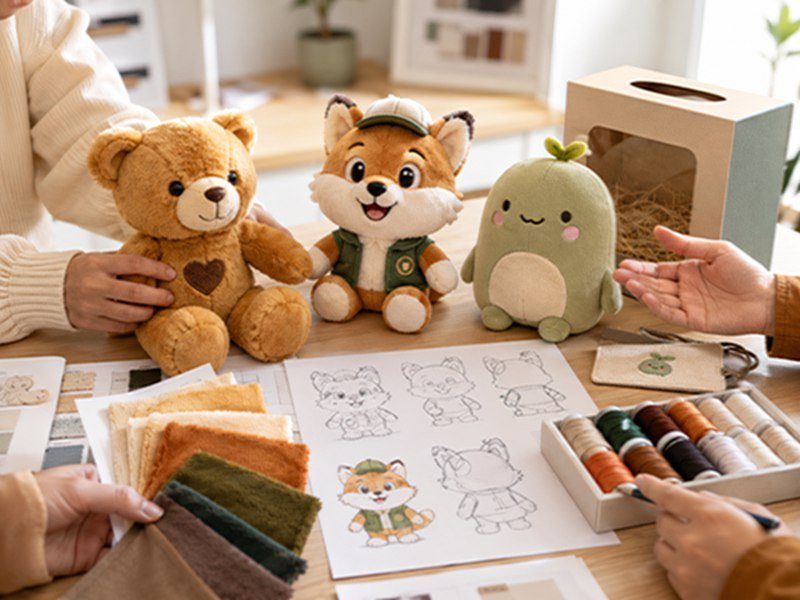
Custom plush sampling is a form of soft-product engineering. The team must translate artwork into paper patterns and material choices that behave correctly after cutting, embroidery, sewing, turning, filling, shaping, and handling. A design with a large head, narrow legs, asymmetric hair, layered clothing, or tiny facial embroidery may look simple on screen but require several structural decisions before it becomes stable enough for repeat production. Experienced sample teams often ask more questions at this stage because unresolved details are much cheaper to correct before mass production begins.
A mature development path may include concept review, pattern draft, first prototype, revision sample, material confirmation, pre-production sample, and a Golden Sample. Not every project needs every label, but the underlying principle is important: each physical version should have a clear purpose. The first prototype tests the interpretation. Revision samples correct proportion, expression, materials, or structure. A pre-production sample should move closer to real production materials and processes. The Golden Sample becomes the physical reference for the bulk line and future reorders.
Across custom plush manufacturing, standard samples are often planned in roughly one to three working weeks once complete information and usable materials are available, while complex IP characters, custom-dyed fabrics, electronics, multi-SKU collections, intricate clothing, or custom packaging can extend the timeline. Pufumi’s internal sample-room reference for regular projects is generally 7-12 working days after required information, payment, and key material conditions are ready, while complex samples are assessed separately. Its sample workflow covers prototypes, revision samples, engineering samples, PPS, and Golden Samples rather than treating every sample as interchangeable.
The more useful performance metric is not simply “days to first sample.” Brands should track the total path from complete brief to approved production reference. A rushed seven-day prototype followed by four unclear revision cycles can delay a launch more than a carefully developed twelve-day first sample that reaches approval after one focused correction. The best sample teams also turn subjective feedback into measurable instructions, such as moving both eyes inward 3 mm, reducing mouth width, adjusting filling density, or replacing a specific fabric code.
US Compliance
A manufacturer serving the United States should understand that compliance begins with product classification, intended age, construction, and target channel rather than with a generic statement that the factory is “ASTM certified.” For children’s products subject to applicable CPSC-enforced rules, third-party testing through a CPSC-accepted laboratory and a Children’s Product Certificate may be required. The exact testing scope depends on the finished product and cannot be responsibly determined from a supplier’s older report for a different plush design.
For imported children’s products, the US importer generally carries the responsibility for issuing the CPC based on applicable test results. The overseas manufacturing side still plays a major operational role because it may need to provide accurate factory information, production dates, BOM data, material details, test samples, label execution, tracking information, packaging files, and corrective-action support. A strong manufacturer therefore does not claim to replace the US responsible party; it provides the manufacturing evidence that allows that responsible party to complete its obligations correctly.
The documentation burden became even more visible in 2026. Beginning July 8, 2026, importers of most regulated consumer products subject to CPSC certification requirements must electronically file certificate data with US Customs and Border Protection under CPSC’s eFiling framework, with a later effective date for qualifying Foreign Trade Zone entries. For US brands importing plush, this increases the value of accurate manufacturer identity, product data, test records, and production traceability because inconsistent information can create customs and compliance friction before the goods reach the warehouse.
Pufumi’s US-market framework specifically records target market, intended age, applicable rules, testing items, responsible party, labeling requirements, certificate requirements, laboratory requirements, and manufacturing support scope. In practical terms, that includes ASTM F963 and CPSIA considerations where applicable, CPC-supporting data, tracking labels, test-sample preparation, packaging information, and coordination with third-party laboratories. The useful principle is not to promise that every plush automatically complies, but to establish the correct route for the actual product before bulk production.
Quality and Retail Readiness
A perfect sample does not prove that a supplier can manufacture 5,000 or 50,000 consistent units. Samples are usually built by highly experienced development workers who can spend much more time on each piece than a production line. Bulk production introduces multiple operators, fabric lots, embroidery batches, different stuffing workers, production pressure, packaging handling, and shift changes. The quality system must therefore translate the approved sample into repeatable instructions, checkpoints, and escalation rules.
Typical controls can include incoming material inspection, first-piece confirmation, embroidery-position checks, sewing and seam review, filling or weight checks, accessory attachment, finished appearance, labeling, barcode verification, packaging inspection, and nonconforming-product isolation. Depending on the product, needle management, metal detection, pull testing, functional checks, battery or electronics verification, and special retailer requirements may also enter the plan. A Golden Sample is valuable because it gives production and QC teams a physical reference when a drawing or written specification cannot fully communicate appearance.
Retail readiness adds another layer. A brand selling through Amazon, specialty retail, museum stores, theme parks, campus stores, subscription programs, or major retail distribution centers may need UPC or EAN data, FNSKU labels, hangtags, copyright lines, woven labels, care information, inner-pack rules, assortment ratios, carton marks, pallet labels, or display packaging. These requirements should be confirmed before mass production because the cheapest moment to correct a packaging error is before the packaging is printed.
A useful manufacturer does not separate product quality from warehouse reality. It understands that a technically good plush can still become a commercial problem if the carton ratio is wrong, the barcode is unreadable, a copyright line is outdated, or the product cannot arrive at the 3PL in the agreed configuration. For long-term programs, quality therefore extends from fabric selection and facial symmetry all the way to the final carton and the ability to reproduce the same SKU on the next order. Pufumi’s documented organization includes incoming, process, finished-goods, and packaging quality roles linked to Golden Sample control.
| Evaluation Area | Practical Evidence to Request | What It Helps Confirm |
|---|---|---|
| Factory identity | Legal entity, production address, factory relationship | Who actually controls the order |
| Sampling | Revision records, PPS, Golden Sample process | Development discipline |
| Materials | BOM, fabric codes, approved swatches | Repeatability and substitutions |
| Quality | Incoming, inline, final and packaging QC records | Bulk consistency |
| US compliance | Test support, manufacturer data, label execution | Readiness for applicable US requirements |
| Retail packaging | UPC/EAN, FNSKU, cartons, display examples | Channel readiness |
| Reorders | Archived patterns, BOM versions, retention samples | Long-term consistency |
Which Are the 18 Best Custom Plush Manufacturers for US Brands?

The following 18 companies are best treated as a sourcing shortlist rather than an absolute ranking. They represent different operating models, including US manufacturing, North American-managed overseas production, European production management, and direct Asian manufacturing. Each can be relevant for a different project profile, so brands should verify the current legal entity, facility relationship, sample process, audits, testing support, production terms, and capacity for the exact SKU before releasing a purchase order.
1. Pufumi
Pufumi is a plush product development and manufacturing brand under Shenzhen Oneier Technology Co., Ltd., focused on IP owners, entertainment companies, toy and collectible brands, lifestyle brands, mature retail programs, and other projects that need more than basic sewing capacity. Its business covers licensed and entertainment character plush, game and anime characters, mascots, blind-box and collectible programs, plush keychains, bag charms, retail-ready products, and multi-SKU collections. The emphasis is on moving from artwork and product ideas through sampling, approvals, manufacturing, packaging, inspection, and replenishment rather than selling ready-stock plush.
Its core Dongguan factory resources include more than 58 designers, pattern makers, sample makers, and related development personnel, with roughly half of that group having more than 15 years of relevant development, design, sampling, or production experience. The broader operating model combines the core owned factory with managed production resources and specialist suppliers for selected processes. For US brands, the strongest fit is likely to be character-heavy or multi-SKU projects where sample revisions, production files, packaging versions, IP handling, and repeat-order control matter as much as initial unit price.
2. CustomPlush
CustomPlush operates as a division of The Beverly Hills Teddy Bear Company and presents a long-established North American-facing custom toy program with offices in the United States and Hong Kong. Its public information states roughly 30 years of custom-toy experience and a client history that includes corporations, retailers, and movie studios. The commercial advantage of this model is that a US brand can work through a familiar project interface while the manufacturing program is coordinated through an international production structure.
Its published process moves from requirements and quotation into prototype development, revisions, production approval, manufacturing, testing, and delivery. That makes the company relevant for corporate merchandise, entertainment projects, retail products, and organizations that prefer a managed development route instead of direct factory sourcing. Procurement teams should still verify the specific production facility, inspection plan, testing responsibility, and technical-file ownership for each project because a strong front-end project team is most valuable when the back-end production controls are equally clear.
3. Stuffed Animal Pros
Stuffed Animal Pros is built around guided project management for custom plush and publicly advertises quantities ranging from single pieces to programs above 10,000 units. Its customers include businesses, organizations, authors, sports teams, and brands, while the process emphasizes quotation, a physical sample, customer approval, production, and shipment. This can be attractive for teams that do not have an internal toy-development or sourcing department and want more help translating a creative request into a finished product.
The company’s broad quantity range is useful because it occupies a different position from factories that only become economical at several hundred or several thousand units. That flexibility should still be evaluated carefully against the actual production method, sample cost, landed cost, and compliance needs of a commercial retail SKU. For larger or repeat programs, US brands should ask how technical specifications, approved samples, inspection criteria, and future reorder references are transferred between the project-management team and the production facility.
4. Best Plush Inc.
Best Plush Inc. has operated in the custom plush market since 1988 and positions itself around US customers that need promotional plush, corporate merchandise, branded giveaways, and custom stuffed products. Its operating model combines a US commercial presence with a long-running overseas factory network, allowing the company to manage design, development, manufacturing, importing, and delivery as a coordinated service. This can reduce the number of suppliers a marketing or promotional team needs to manage directly.
The company publicly discusses third-party testing and US safety requirements for relevant products, which is useful, but project teams should still confirm the exact test plan for the finished SKU rather than treat general compliance language as proof for a new design. Best Plush is most compelling where project management, importing convenience, and promotional-product experience are priorities. As with any factory-network model, brands should ask which facility will produce the actual order and how quality records, approvals, and production specifications remain consistent across that network.
5. Big Plush
Big Plush stands apart because domestic US manufacturing is a central part of its proposition. Its South Carolina operation is strongly associated with custom giant plush, mascots, entertainment builds, corporate activations, and branded display pieces, while its public business page advertises production from a single piece to 1,000 or more depending on the project. That operating range makes it particularly relevant to oversized, event-driven, or domestically positioned programs that do not fit the economics of a conventional Asian retail-plush factory.
The company is a good reminder that “best manufacturer” depends on the job. A 15-foot mascot for a launch event and a 100,000-unit blind-box collection should not be evaluated with the same scorecard. For US brands that need Made-in-USA positioning, close physical collaboration, or unusually large custom products, Big Plush can be a distinctive candidate. For high-volume multi-SKU retail programs, brands should compare material sourcing, unit economics, accessory ecosystems, and capacity with overseas alternatives before deciding.
6. Custom Plush Innovations
Custom Plush Innovations is a family-owned company based in London, Ontario, serving customers across Canada and the United States through a North American project team and long-standing overseas production relationships. The company traces the current Custom Plush Innovations brand to 2010 and offers custom plush toys, mascots, keychains, teddy bears, promotional products, and packaging options for both retail and marketing use. The model is designed to make overseas production easier for organizations that prefer to work with a regional commercial team.
Its service structure can be useful for universities, sports organizations, agencies, hospitals, retailers, and corporate programs that value communication and guided execution. Because the manufacturing itself relies on overseas production partnerships, larger brands should verify which factory is assigned, how samples and technical files are controlled, how product testing is tied to the final SKU, and whether patterns, materials, and specifications are archived for reorders. The value of the model is strongest when local project management produces measurable operational control rather than simply another communication layer.
7. Kinwin
Kinwin positions itself as a China-based OEM/ODM plush manufacturer serving brands, retailers, e-commerce businesses, gift channels, theme parks, and character projects. Its public materials describe more than 17 years of industry experience and a manufacturing setup with 15 production lines, while its services cover design interpretation, sampling, custom materials, bulk manufacturing, packaging, quality control, and export. The company is therefore a useful candidate for brands that want a direct Asian manufacturing relationship rather than a North American-managed production program.
Published MOQ, sample, and production information can vary by product type, which is normal in plush manufacturing and should be confirmed at SKU level. US brands should focus less on one headline MOQ and more on how the factory handles paper patterns, embroidery files, fabric batches, first-piece approval, testing samples, and retail packaging. Kinwin’s relevance is strongest when a program needs conventional OEM/ODM scale with a broad custom-plush product range and the brand is comfortable managing an international factory relationship directly.
8. Maple Eye Toys
Maple Eye Toys combines custom plush development with wholesale toy sourcing, giving it a broader product and sourcing identity than a factory focused exclusively on complex licensed characters. Its custom workflow publicly emphasizes multi-view artwork, pattern making, trial samples, complete samples, and revision cycles, which is useful because it shows that physical development is treated as an iterative process. The company also works across conventional plush categories, dolls, characters, and related custom products.
For US brands, Maple Eye can be relevant when the sourcing program includes both fully custom products and more conventional plush categories. The broader operating scope makes project-specific verification particularly important for complex IP work. A supplier that performs well on standard animal plush may not automatically have the same skill with asymmetrical anime hair, layered costumes, tiny facial embroidery, or unusual structural proportions. Brands should ask for recent products with comparable difficulty, verify the producing entity, and confirm how testing and production records are connected to the final order.
9. Custom Plush Maker
Custom Plush Maker states that it was founded in 2005 and supplies overseas customers with custom stuffed animals and OEM/ODM services. Its public website advertises a starting MOQ of 100 pieces for selected programs, a prototype-first workflow, and testing support around EN71, ASTM, CPSIA, and ISO 8124 depending on the project. It also publishes content on NDAs and licensed characters, which makes the company relevant to brands exploring custom IP merchandise and comparatively accessible initial quantities.
The headline MOQ should be treated as an entry point rather than a universal commercial promise. Custom fabrics, molded accessories, embroidery, printed boxes, electronics, or several SKUs can each create separate minimums. For a larger US brand, the more important questions concern sample approval, production-file control, inspection criteria, material continuity, and how the factory prepares the data and samples needed for applicable US testing. The company belongs on the shortlist where lower-volume custom production and a direct overseas relationship are priorities, provided the project-specific evidence supports the website claims.
10. Maris Plush
Maris Plush presents itself as a custom plush manufacturer with 18 years of experience and a direct production system covering pattern making, cutting, sewing, stuffing, embroidery, finishing, accessory assembly, inspection, packaging, and delivery coordination. Its public workflow is unusually easy to follow: design and requirement discussion, sampling and approval, bulk production, packaging, and shipment. The company also publishes indicative MOQ and timing information, including standard programs commonly starting around several hundred pieces per design and sampling often planned in the one-to-two-week range.
This transparency makes Maris a useful direct-factory candidate for brands comparing manufacturing systems rather than marketing claims. Procurement teams should still verify which processes are truly internal for the proposed SKU because specialist embroidery, printing, accessories, and packaging can involve outside partners even within a factory-led program. For US projects, brands should also confirm the exact laboratory, test scope, label requirements, and importer responsibilities before production. Maris is most relevant where direct technical communication and conventional factory execution are important selection criteria.
11. The Plush Maker
The Plush Maker states that it has produced custom plush since 1998 and operates through an owned manufacturing facility in Dongguan. Its current public information gives a useful set of reference points: selected custom projects may start around 500 pieces, sampling is commonly quoted at 7-14 days after details are confirmed, bulk production is often 25-45 days after approval and deposit, and approximate monthly output can reach around 300,000 units depending on product type and factory loading. Those figures are useful planning inputs rather than guaranteed terms.
Its product range includes character plush, mascots, anime-inspired products, large plush, promotional items, and other custom formats. The company also states that testing can be arranged according to the target market and project requirements, which is more credible than presenting one generic safety certificate as universal coverage. For US brands, The Plush Maker is a strong comparison point for direct Dongguan sourcing, especially when the team wants factory-level access, a clear paid-sample process, and production scale beyond boutique manufacturing.
12. Bella Plush
Bella Plush, operating as Dongguan Bella Toys Co., Ltd., presents a direct Dongguan factory model with OEM and ODM services for custom stuffed animals, mascots, character plush, keychains, and related products. Its public website advertises more than 10 years of plush manufacturing experience, more than 2,000 custom designs, shipment to more than 30 countries, and a starting MOQ of 100 pieces for selected projects. It also promotes fast sampling and support for market-specific testing requirements.
That combination can appeal to brands that want relatively accessible quantities without moving to a one-off artisan model. The main procurement task is to separate a headline starting MOQ from the real economics of the intended product. Custom-dyed fabric, dense embroidery, multiple packaging versions, or special accessories may quickly move the practical minimum upward. For US programs, brands should verify the exact current factory documentation, sample plan, test route, inspection process, and production schedule rather than relying on the most optimistic numbers published on a marketing page.
13. DreamPlush
DreamPlush identifies its legal operating entity as Dongguan DreamPlush Toys Co., Ltd. and presents a direct factory operation for stuffed animals, keychains, cotton dolls, brand mascots, and custom retail products. Its current website states more than 10 years of experience, approximately 100,000 units of monthly capacity, sampling around 15 days for many projects, and project-dependent MOQs commonly starting in the 100-500-piece range. It also shows pattern making, sewing, embroidery, stuffing, gluing, and closing operations as part of its Dongguan production floor.
The company is particularly relevant to smaller-format products such as 8-15 cm keychains and bag charms, where a few millimeters of embroidery displacement can materially change the face and where hardware attachment becomes a structural issue. Brands evaluating DreamPlush should test the exact intended size rather than assuming a larger plush can simply be scaled down. Published capacity and lead times should also be confirmed against the requested production month, materials, packaging, and SKU count because factory loading and product complexity can shift actual availability.
14. Mavo Toys
Mavo Toys is a Dongguan-based OEM/ODM custom plush manufacturer that states more than 15 years of experience, 10 production lines, more than 15 in-house designers and pattern makers, a starting MOQ around 500 pieces per design, and sample planning of approximately 10-15 business days. Its product range covers stuffed animals, keychains, mascots, characters, baby plush, dolls, and other custom formats, with packaging and testing support positioned for international brands and retailers.
The company’s public focus on IP protection, character accuracy, revision workflows, and retail-ready packaging makes it relevant to brand and licensed-merchandise projects. US companies should verify the exact audit and compliance documentation currently applicable to the facility selected for the order, then define product classification, age grading, applicable tests, label information, and the responsible US importer before bulk release. Mavo is most useful as a shortlist candidate where a brand wants a direct Dongguan manufacturing relationship with clearly published design, sampling, and line-capacity references.
15. CJL Plush
CJL Plush presents itself as an OEM, ODM, and fully custom stuffed-toy manufacturer serving international brands, importers, wholesalers, retailers, and promotional companies. Its published production workflow is straightforward and commercially useful: design and requirement confirmation, material selection and safety review, sample development and revision, sample approval, mass production with in-line QC, and final inspection before shipment. This sequence gives a sourcing team a practical framework for asking what documentation sits behind each production stage.
Compared with some other manufacturers in this list, CJL publishes fewer detailed capacity or timing metrics on its main website. That is not automatically a weakness, but it means the procurement team should request more project-specific evidence before narrowing the shortlist. Useful requests include business registration, factory location, current production availability, recent comparable samples, sample timing, MOQ per SKU, applicable audit reports, testing support, and actual QC forms. CJL is best evaluated through the quality of those responses rather than through unsupported assumptions about scale.
16. PlushCraft
PlushCraft positions itself around character-accurate OEM/ODM plush for IP merchandise, corporate gifts, retail collections, museums, tourism retail, e-commerce, and branded campaigns. Its current website states more than 10 years of customization experience, more than 3,000 sample projects, a typical mass-production reference of around 45 days, and 100% inspection before shipment. It also emphasizes design refinement, sampling, production QC, packaging, and delivery rather than limiting the service to sewing.
The most important due-diligence question is what the published inspection language means operationally. A factory may visually inspect every finished piece while still using sampling plans for measurements, seam strength, barcode checks, or other specifications. US brands should therefore request the inspection checklist, defect definitions, escalation procedure, and relationship between the approved sample and bulk release. If the underlying documents support its public positioning, PlushCraft can be a relevant candidate for brands that prioritize character development and retail presentation alongside manufacturing.
17. Toy Gift Supply
Toy Gift Supply operates from its own Dongguan factory and positions itself toward brands, retailers, museums, campus stores, cafés, boutiques, and promotional programs. Its public information states a standard MOQ starting around 500 pieces per design and a development route that covers artwork review, sample feasibility, materials, private-label packaging, quality control, bulk production, and export. The company’s retail-channel framing is useful because it treats the plush and its packaging as one commercial product rather than two separate purchasing tasks.
This makes Toy Gift Supply worth evaluating for relatively straightforward retail collections, mascots, mini keychains, gift-shop merchandise, and programs where hangtags, cards, pouches, gift boxes, blind boxes, or display trays are important. For complicated licensed characters, electronics, or highly engineered collectibles, brands should request comparable examples before assuming the same capability. As with any newer supplier website, factory documents, current capacity, test support, sample quality, and written QC standards should be checked before a purchase order is released.
18. Kids&Stuff
Kids&Stuff Merchandise Ltd. is based in Bulgaria and operates as a European production-management partner for custom plush, mascot costumes, and branded merchandise. Its service is structured around approved characters and brand guidelines, with the team managing artwork review, feasibility, sampling, mass production, packing, import, transport, and delivery through an international manufacturing network. That makes it different from a single direct factory and potentially useful for organizations that value centralized European project management.
The model is particularly relevant to leisure parks, attractions, entertainment properties, and brands operating European merchandise programs alongside other markets. For a US-only project, the brand should compare the additional management layer with suppliers that specialize more directly in US importing, testing, and warehouse requirements. Kids&Stuff illustrates an important sourcing principle: a production partner can create value without owning every sewing machine, but the commercial team should still be able to identify the actual factory, approval process, quality standard, and responsibility chain behind the finished product.
| Manufacturer | Publicly Described Model | Useful Public Reference | Likely Starting Fit |
|---|---|---|---|
| Pufumi | Owned + managed manufacturing resources | 58+ core development personnel | Character, IP, multi-SKU programs |
| CustomPlush | US-facing managed production | About 30 years in custom toys | Corporate and entertainment programs |
| Stuffed Animal Pros | Managed custom production | 1 to 10,000+ units advertised | Flexible guided projects |
| Best Plush Inc. | US company + factory network | Established 1988 | Promotional and corporate plush |
| Big Plush | US manufacturing | 1 to 1,000+ units advertised | Made-in-USA and oversized plush |
| Custom Plush Innovations | Canadian management + overseas partners | Current brand since 2010 | Retail and promotional programs |
| Kinwin | Direct OEM/ODM manufacturing | 17+ years stated | Brand and factory-direct programs |
| Maple Eye Toys | Custom + wholesale sourcing | Multi-stage sampling workflow | Mixed sourcing and characters |
| Custom Plush Maker | Direct custom manufacturer | 100-piece starting MOQ on selected work | Lower-volume custom programs |
| Maris Plush | Direct manufacturing | 18 years stated | Full-process custom manufacturing |
| The Plush Maker | Owned Dongguan facility | ~300K/month stated capacity | Factory-direct production |
| Bella Plush | Dongguan factory | 100-piece starting MOQ advertised | Flexible OEM/ODM projects |
| DreamPlush | Dongguan factory | ~100K/month stated capacity | Keychains, mascots, dolls |
| Mavo Toys | Dongguan OEM/ODM factory | 10 lines; MOQ from 500 stated | Brands, IP and retail |
| CJL Plush | OEM/ODM manufacturer | Six-stage public workflow | Conventional custom plush |
| PlushCraft | OEM/ODM manufacturer | 3,000+ sample projects stated | Character and retail merchandise |
| Toy Gift Supply | Dongguan factory | MOQ from 500 stated | Retail-channel merchandise |
| Kids&Stuff | European production manager | Sampling-to-delivery management | European and managed programs |
How Do These Plush Manufacturers Compare?

These manufacturers differ more by operating model and control system than by country alone. A useful comparison should cover sample accuracy, MOQ by SKU, production documentation, compliance support, packaging, landed cost, communication load, and reorder control. A slightly higher unit price can be commercially cheaper when it reduces revisions, rework, missed launch dates, labeling mistakes, inconsistent batches, or internal sourcing time.
MOQ and Production Scale
MOQ is frequently misunderstood because a single finished-product number hides several different production minimums. A factory may agree to sew 500 units while the fabric mill requires a larger custom-dye run, the printed box supplier wants 1,000 pieces, and a molded charm or electronic sound module has another minimum. A six-character collection with 600 units per design therefore behaves very differently from one character with 3,600 units even though the total quantity is identical.
Published starting MOQs among the manufacturers in this shortlist range from approximately 100 units for selected programs to 500 pieces or more for many direct-factory projects, while specialist domestic manufacturers may accept much smaller quantities. Those public numbers should be used for initial filtering, not final purchasing decisions. The more valuable question is what quantity gives stable material, sewing, packaging, and inspection economics for each SKU while protecting the approved design.
Pufumi uses 500 pieces as an important internal screening reference for enterprise custom projects but evaluates actual MOQ by product structure, SKU count, color, material, packaging, process complexity, and supplier minimums. This is representative of how complex plush programs work in practice. Mini plush, keychains, custom-dyed materials, retail boxes, electronics, and multi-SKU assortments can each push the practical minimum in different directions even when the factory’s nominal sewing MOQ remains unchanged.
Scale also needs interpretation. A published monthly capacity figure does not tell a brand how much capacity is available for its own order or what product mix produced that number. One hundred thousand simple claw-machine toys require very different labor from one hundred thousand licensed characters with clothing, embroidery, and gift boxes. Ask for the proposed production window, line allocation, sample approval deadline, material reservation plan, and peak-season assumptions rather than treating a headline capacity figure as a reserved slot.
Sample-to-Bulk Consistency
Sample accuracy and bulk consistency are related but different skills. Development specialists can hand-adjust a prototype until the face looks excellent, yet bulk production requires operators to reproduce that appearance using patterns, embroidery files, material codes, dimensions, filling instructions, and approved references. The real manufacturing test begins when the project moves from a few carefully made samples to thousands of units produced across several stations and possibly more than one shift.
Small dimensional changes matter disproportionately on character products. A 3 mm eye shift on a 35 cm mascot may be difficult to notice; the same shift on a 10 cm keychain can completely change the expression. For licensed and collectible products, brands should therefore control both absolute measurements and visual relationships such as eye spacing, head-to-body ratio, mouth width, ear angle, costume placement, and how the product sits or hangs.
A useful control chain is Golden Sample, controlled BOM, approved artwork, first-piece review, inline inspection, finished-goods inspection, packaging check, and retention sample. Pufumi’s internal character-evaluation system, for example, gives significant weight to overall silhouette, proportions, face and expression, embroidery placement, materials, accessories, and structural stability. Its documented sample process also archives version IDs, dates, material status, BOM versions, customer comments, and the final approved Golden Sample for production and reorders.
When comparing suppliers, request the actual QC form rather than accepting phrases such as “strict QC” or “100% inspection.” Ask which characteristics are checked on every piece, which are sampled, what counts as critical, major, or minor defects, who has authority to stop production, and how rejected units are isolated and rechecked. Those answers reveal whether the factory has a repeatable system or simply relies on experienced workers to notice problems informally.
Compliance and Documentation
US compliance is one of the easiest areas for supplier marketing to become misleading because the same words can describe very different levels of capability. A supplier may display ASTM, CPSIA, CE, or EN71 language because it has previously coordinated testing, while another supplier may have current factory processes, material records, and laboratory relationships that make project-specific testing much easier. Neither statement proves that a new plush design already meets the requirements that apply to it.
For applicable children’s products in the United States, federal rules can require third-party testing by a CPSC-accepted laboratory and certification through a CPC. CPSC states that more than 600 accepted laboratories operate worldwide across different scopes, but the selected laboratory must be accepted for the specific tests required. Product classification, intended age, materials, small parts, attachments, electronic functions, labeling, and use all influence the test plan, so a prior report for another toy should never substitute for a project-specific review.
Since July 8, 2026, certificate data for most imported regulated consumer products subject to CPSC certification must also be filed electronically with CBP under the CPSC eFiling regime. This makes accurate manufacturer data and product records more operationally important. US importers should know who the actual manufacturer is, which factory produced the goods, what product and test data support the certificate, and how those records connect to the shipment entering the country.
The strongest manufacturers support that process without pretending to become the US responsible party. They can provide BOMs, material information, production dates, factory details, test samples, label execution, packaging files, batch information, and corrective-action records. When a supplier cannot explain who should issue the CPC or assumes that an overseas “certificate” automatically satisfies the importer’s responsibilities, the brand should slow the project down until the compliance route is clarified.
Packaging and Landed Cost
The lowest FOB quotation is not always the lowest-cost program. A supplier may be $0.25 cheaper per unit but require separate packaging procurement, additional inspection, relabeling after arrival, or a larger inventory buffer because the production schedule is unreliable. Another supplier may quote a higher unit price while delivering a product that is correctly labeled, packed, tested, inspected, and ready for the intended warehouse. The second option can produce a lower total commercial cost even though the factory price looks worse on the first spreadsheet.
A more complete equation is: landed cost equals product, packaging, testing, inspection, freight, duty, brokerage, warehousing, rework exposure, and delay exposure. Retail packaging can also affect the physical design. A plush compressed into a tight box may need better shape recovery. A keychain must hang correctly from a display card. A blind-box product needs controlled assortment ratios. A theme-park or museum program may need story cards, retail-ready cartons, and simple replenishment labeling.
Packaging requirements should therefore enter the project before bulk production. The brand should define hangtags, woven labels, care labels, copyright lines, polybags, retail boxes, blind boxes, display trays, UPC or EAN codes, FNSKU labels, master-carton information, pack ratios, and pallet needs while the sample is still being finalized. A packaging error identified after 10,000 units are sealed is fundamentally different from the same error identified on a printed mockup.
For manufacturers that advertise FBA, 3PL, or retail-DC support, ask for a real packing workflow rather than a logo on a service page. Who checks barcode readability? Who confirms the carton label? What happens when one SKU is packed in the wrong assortment? How are packaging revisions approved? These are mundane questions, but they often determine whether an order moves directly into stock or sits in a warehouse waiting for expensive correction.
Are US or Overseas Plush Manufacturers Better?

Neither US nor overseas manufacturing is universally better. Domestic US production can provide origin value, easier local communication, lower quantities, and specialty oversized capability. Established Chinese manufacturing clusters often offer deeper material, embroidery, accessory, packaging, and scale resources. Hybrid companies reduce international sourcing workload by managing overseas production locally. The right model depends on product complexity, SKU count, order volume, origin requirements, internal sourcing capability, landed cost, and launch timing.
US Manufacturing
US manufacturing becomes especially valuable when domestic origin is part of the product strategy rather than simply a preference. This can include corporate or institutional procurement requirements, Made-in-USA positioning, premium low-volume programs, giant event mascots, television or film props, and projects where close physical collaboration has measurable value. Big Plush illustrates this segment through a South Carolina operation focused heavily on custom and oversized work, with quantities that can begin far below the normal MOQ of an industrial Asian factory.
Domestic manufacturing can simplify time-zone communication, reduce some international freight complexity, and make factory visits easier for US teams. It does not automatically mean a project will be cheaper or faster. Specialty fabrics may still need to be sourced, labor availability can constrain capacity, and complex development can take significant time regardless of geography. Brands should also verify exactly how any country-of-origin marketing claim applies to the final product, particularly when imported materials or components are involved.
The economic case is strongest when domestic origin itself creates commercial value. A 12-foot branded mascot used at a product launch may justify US manufacturing even at a high unit cost because the project is low-volume, highly visible, and time-sensitive. A 12 cm collectible sold through mass retail at a narrow target margin may produce a completely different sourcing conclusion. Comparing these projects only through hourly labor cost misses the reason the customer is buying the product.
For brands evaluating a US factory, the same manufacturing questions still apply: Who makes the pattern? How is the sample approved? What is the material lead time? What processes are outsourced? What testing is applicable? How is the product inspected and archived for repeat orders? Domestic geography can reduce certain risks, but it does not replace product engineering or production control.
China Manufacturing
China remains central to custom plush manufacturing because its advantage is broader than sewing cost. Established manufacturing clusters offer dense access to short-pile plush, long-pile fabric, minky, fleece, sherpa, embroidery, printing, labels, stuffing, metal hardware, plastic parts, electronic modules, retail packaging, laboratory services, and export logistics. A complex character can touch many of those suppliers before the factory has produced the first approved production unit.
Consider a 10-character collectible collection using four fabric constructions, sixteen embroidery colors, multiple costumes, metal bag hardware, woven labels, ten individual retail boxes, a display carton, and different SKU ratios. The sewing line is only one part of the project. A capable lead manufacturer must coordinate materials, patterns, embroidery files, accessory delivery, packaging approvals, line scheduling, inspection, and final packing while keeping the versions aligned.
The disadvantages are real and should be planned rather than minimized. US brands sourcing directly from China need stronger written specifications, disciplined version control, importer and compliance knowledge, longer physical transport planning, and clear communication across time zones. Vague instructions become more expensive when the factory is thousands of miles away. A comment such as “make the face cuter” invites interpretation; an annotated image requesting that both eyes move inward 3 mm creates a controlled change.
Several manufacturers in this shortlist operate in Dongguan or other established Chinese manufacturing regions, which demonstrates the continuing importance of the ecosystem for custom character, keychain, mascot, and retail programs. The best China-based partner is not necessarily the factory with the cheapest sewing quote. It is the one that can coordinate the wider supplier network while keeping the approved sample, BOM, packaging, and quality standard intact.
Hybrid Production
Hybrid production sits between domestic manufacturing and direct overseas sourcing. A North American or European commercial team manages the customer relationship while production occurs wholly or partly through overseas factories or partner networks. CustomPlush, Stuffed Animal Pros, Best Plush, Custom Plush Innovations, and Kids&Stuff represent variations of this model. The brand pays not only for manufacturing but also for project translation, factory communication, importing knowledge, coordination, and sometimes reduced internal workload.
This can make good economic sense for a company that buys custom plush occasionally and does not employ full-time sourcing, product-engineering, or import specialists. The managed partner may collect the artwork, organize the sample, consolidate factory questions, arrange revisions, coordinate testing, and manage delivery. A direct-factory quotation may look lower, but the internal labor required to manage the project can erase part of that difference.
The trade-off is reduced direct visibility into factory economics and, in some models, less immediate access to engineering decisions. Brands should therefore ask which activities are performed by the local team and which by the manufacturing facility. Who owns the pattern? Who approves material substitutions? Who signs off on quality? Can the brand inspect the actual factory? What happens if the current partner factory cannot support the reorder?
A hybrid model is most valuable when the management layer changes the project outcome, not merely the invoice path. If the local team shortens approval cycles, prevents packaging mistakes, translates creative feedback into usable factory instructions, and coordinates import responsibilities, its margin can be justified. If it simply forwards emails between the brand and the factory, direct sourcing may offer better control for an experienced procurement team.
Total Commercial Cost
The best sourcing decision compares total commercial outcome rather than geography or factory price in isolation. Suppose Supplier A quotes $4.20 FOB and Supplier B quotes $4.55. If Supplier A needs one additional sample cycle, requires a separate packaging vendor, produces a higher inspection failure rate, or causes a three-week launch buffer, the apparent $0.35 saving can disappear quickly. Supplier B may still be the wrong choice if the brand already performs those services internally and does not need the extra support.
A weighted scorecard is useful because it forces the team to agree on what actually matters. A licensed character program may place 25% of its decision on sample accuracy and only 10% on direct unit price. A simple promotional giveaway may reverse those priorities. A large retailer may assign more weight to compliance documentation, packaging, OTIF performance, and factory audits. The scorecard is not an industry standard; it is a way to stop one easy number from dominating a complex decision.
| Decision Factor | Example Weight for a Retail Plush Program | What to Measure |
|---|---|---|
| Sample accuracy | 20% | Proportion, face, material, revisions |
| Bulk quality control | 20% | QC plan, defects, Golden Sample control |
| Compliance support | 15% | Test data, labels, traceability, documentation |
| Landed cost | 15% | Product through warehouse receipt |
| Production reliability | 10% | Capacity, material plan, schedule realism |
| Packaging capability | 8% | Retail packs, barcodes, carton accuracy |
| Project management | 7% | Response quality, version control, escalation |
| Reorder control | 5% | BOM, pattern archive, retention sample |
How Do You Verify a Custom Plush Manufacturer?
Verify a plush manufacturer through connected evidence rather than polished marketing. Confirm legal identity, factory relationship, manufacturing address, sample workflow, comparable projects, audit records, quality forms, testing support, IP controls, and production documentation. Then use a paid sample project to test how the team handles questions, revisions, and technical trade-offs. Trust grows when the same facts remain consistent across the website, quotation, documents, people, and actual product.
Factory Evidence
Start with identity because every other claim depends on knowing who the supplier actually is. Ask for the registered company name, business license, production address, quotation entity, payment entity, and factory relationship. If the sales company and sewing factory are different organizations, that is not automatically a problem. The concern is whether the relationship is explained clearly and whether the factory named in the audit, test documentation, or production plan is the factory intended to make the order.
Then move from identity to connected evidence. Useful materials include current factory photographs or live video, relevant social or quality audits, recent test-report examples, production-flow records, sample records, QC forms, packaging examples, and export documentation where appropriate. Do not collect files simply to fill a supplier folder. Cross-check names, addresses, dates, and scope. A BSCI report for one facility does not prove another factory in the network has the same status, and a test report for a simple teddy bear does not certify a new electronic plush character.
Capacity claims deserve the same treatment. If a factory states 300,000 units per month, ask what products produced that output and what capacity is available during the requested period. A small claw-machine plush and a complex 45 cm licensed character use very different labor. A realistic supplier will discuss current line loading, material lead times, sample approval deadlines, and seasonal constraints instead of treating annual or monthly capacity as a guaranteed space reservation.
Pufumi’s own objective-fact governance follows this logic internally: company identity, factory relationships, capacity, MOQ, compliance statements, audits, and other externally used facts are expected to come from controlled records rather than being improvised by marketing staff. Brands can apply the same standard externally. Every important supplier claim should be traceable to a document, a facility, a process, or a live project behavior that supports it.
Sample Test
A paid sample project is one of the most revealing supplier tests because it exposes the way the team thinks before mass production. Send shortlisted manufacturers the same artwork, dimensions, quantity, target market, packaging assumptions, and intended age information, then compare the questions they ask. Strong development teams often identify proportion conflicts, sewing limitations, fabric behavior, small-part concerns, unstable accessories, or unrealistic details before they make the first prototype.
Once the sample arrives, review it systematically rather than using only subjective comments such as “cute” or “not close enough.” Photograph the front, side, rear, and 45-degree views. Measure key dimensions. Check intended symmetry. Compare eye position to the centerline, examine embroidery edges, feel stuffing distribution, inspect hidden seams, look at accessory attachment, and evaluate the product after it has spent several days in the proposed packaging. Small issues often become more visible after the plush has been compressed or handled.
Revision comments should be measurable whenever possible. “Move both eyes inward 3 mm” is more useful than “make the expression softer.” “Reduce mouth width from 34 mm to 29 mm” can be checked on the next sample. “Use approved swatch B instead of current body fabric” leaves less room for interpretation than “make the fabric more premium.” The objective is not to eliminate creative judgment but to convert approval comments into instructions the production team can repeat.
Pufumi’s sample archive system records Sample ID, version, date, material status, BOM version, modification points, customer feedback, and storage location, while the approved Golden Sample is retained as a reference for bulk production, QC, and repeat orders. Whether a brand chooses Pufumi or another manufacturer, asking for an equivalent version-control method is one of the clearest ways to judge whether sample development is connected to production discipline.
Production Control
After sample approval, verification shifts from creative skill to repeatability. Ask what information the production line receives before cutting begins. A useful production package can include the approved Golden Sample, pattern version, BOM, embroidery files, critical dimensions, material references, accessory specifications, labels, packaging files, and special quality points. If these instructions exist only inside one salesperson’s chat history, the risk of sample-to-bulk drift rises immediately.
The next question is how the first production pieces are released. Does a supervisor compare them with the approved sample? Are critical dimensions recorded? Is embroidery positioning checked? How is stuffing density controlled? What happens if a fabric lot is visibly different from the approved swatch? Which person has authority to stop production, isolate nonconforming material, or require a corrective action before the line continues?
Nonconforming-product handling is a useful maturity test. A professional answer normally includes identification, isolation, correction or replacement, reinspection, and documentation. “The workers will fix it” may be acceptable as part of the physical correction but not as the entire control method. Brands should understand how defects are counted, how trends are escalated, and how the final inspection determines whether the shipment can be released.
Repeat orders reveal whether the system was documented properly. Six months after a successful launch, the manufacturer should be able to retrieve the approved pattern, material code, embroidery file, packaging specification, QC standard, and prior production reference without rebuilding the product from memory. This is especially important for collectibles and licensed products because customers may compare old and new batches side by side and notice small differences that would be invisible in a one-time promotional giveaway.
IP and Red Flags
Custom plush projects often require the factory to see unreleased assets long before the public launch. Those files can include character turnarounds, licensing guides, future product drops, packaging, price targets, retailer plans, and internal launch dates. An NDA is useful, but confidentiality is ultimately an operational behavior. Brands should ask who can access files, where unreleased samples are stored, whether factory staff can photograph production, whether completed products can appear on social media, and whether customer patterns are shown to other clients.
Pufumi’s documented IP policy limits customer character assets, logos, packaging, and project information to project-related evaluation, quotation, sampling, production, testing, packaging, delivery, and repeat-order management. Projects that lack customer permission are not intended to be used publicly as marketing cases. Similar questions should be asked of every supplier handling sensitive IP, especially when the design is tied to a game launch, film release, licensing window, or unreleased collectible series.
Red flags often appear before a brand ever sees the factory. Be cautious when a supplier provides a final quotation without asking size or quantity, promises that every design will pass US testing before reviewing the product, refuses to identify the manufacturing facility, cannot explain sample revisions, changes materials without approval, uses an unrelated test report as universal proof, or refuses reasonable third-party inspection. Showing many famous characters without being able to discuss authorization is another warning sign for serious IP owners.
One of the most reassuring phrases a manufacturer can use is, “We need to review this before we confirm.” That response may feel slower than an immediate yes, but it often signals that someone is considering material availability, pattern feasibility, testing, production capacity, or commercial risk. Experienced procurement teams learn that a responsible limitation stated early is cheaper than an unrealistic promise discovered after the deposit has been paid.
Which Manufacturer Is Right for Your Project?
The right manufacturer is the one whose development skill, factory structure, compliance support, and control system match the risk profile of the actual program. Licensed characters need high fidelity and approval discipline; collectibles need multi-SKU control; keychains need precision at small scale; retail products need packaging and warehouse accuracy; repeat programs need archived BOMs, Golden Samples, and version records. Select for project fit rather than headline MOQ, geography, or first quotation alone.
Character and Licensed Plush
Licensed and character plush are unforgiving because the customer already knows what the character is supposed to look like. A generic rabbit can tolerate a slightly different eye position and remain attractive; a familiar game or animation character can look wrong immediately when the face, silhouette, color, costume, or signature accessory drifts. For these programs, the sample room and pattern team matter more than the size of the sales department.
Brands should evaluate front, side, and rear views, facial landmarks, head-to-body ratio, eye spacing, embroidery direction, ear or hair geometry, costume layers, props, trademark placement, copyright lines, and approved color standards. The development team also needs to distinguish between visual details that are critical to character identity and hidden structural choices that can be adjusted for manufacturability. A seam can sometimes move; the character’s signature eye shape may not be negotiable.
Licensed projects add formal approval complexity. Comments may come from the brand, licensor, product manager, compliance team, and retailer at different stages. The manufacturer needs version control so that one department does not approve a sample based on outdated artwork while another is reviewing a newer packaging file. The production release should clearly identify which sample, BOM, embroidery file, labels, and packaging version are final.
Pufumi’s strongest positioning is in character, licensed, collectible, and multi-SKU programs, supported by a development team focused on pattern interpretation, sample revision, materials, and production engineering. Other shortlist candidates such as CustomPlush, Mavo Toys, PlushCraft, and Kids&Stuff also publicly emphasize character or branded product development. The final choice should come from a difficult sample test and documented approval process rather than a gallery containing attractive finished products.
Collectibles and Keychains
Collectible plush creates a different problem because the brand is controlling variety and consistency at the same time. A blind-box collection may contain six, eight, twelve, or more characters, sometimes with hidden editions, different colorways, several launch waves, and tightly controlled assortment ratios. Each SKU may have a different pattern, embroidery file, fabric mix, accessory, label, and package while still needing to feel like part of one coherent product family.
The operational questions become very specific. Is there one BOM per SKU? Are similar fabrics coded clearly enough to prevent mixing? Does each character have its own Golden Sample? How are embroidery files named and versioned? How are cartons packed to the required assortment? How are hidden editions separated and counted? Can the supplier reserve or re-source the same material for a second release six months later?
Small keychains and bag charms create another layer of difficulty because a design cannot simply be scaled down mechanically. At 8-15 cm, seam allowance occupies a larger percentage of the body, embroidered features become more sensitive, narrow limbs may lose shape, and metal attachment points introduce structural load. A 2 mm eye movement that is insignificant on a large plush can transform the expression of a 9 cm charm. The correct approach is usually to re-engineer proportions for the intended size.
Manufacturers such as DreamPlush, Maple Eye Toys, Maris Plush, Mavo Toys, and Pufumi all present capabilities around smaller custom plush formats, while Pufumi’s internal product system also covers blind-box and multi-SKU programs. For collectible projects, the best supplier is often the one with the strongest version discipline and packing control rather than the fastest sewing line or the lowest price per piece.
Retail and Reorders
Retail production begins where many attractive sample portfolios end. A plush can be beautifully manufactured and still create a serious operational problem if the UPC is wrong, the FNSKU is missing, the carton ratio does not match the PO, the copyright line is outdated, a hangtag uses an old artwork version, or the 3PL receives a shipment that cannot be scanned into stock. Packaging and warehouse requirements therefore belong in product development, not in a last-minute handoff after production.
For Amazon, define FNSKU responsibility and packaging configuration early. For retail chains, confirm inner packs, carton labels, barcode placement, and master-carton specifications. For licensed products, lock approved copyright text before printing. For blind boxes, define assortment ratios and display-carton configuration. For theme parks, museums, and destination retail, consider how replenishment SKUs will be identified and whether staff can restock without opening every carton.
Repeat orders are the next test of manufacturer maturity. A second production run should reference the same Golden Sample, pattern, BOM, fabric code, embroidery file, label artwork, packaging specification, carton information, and QC standard unless a formal change has been approved. When an original fabric is no longer available, the manufacturer should present a replacement for approval rather than silently substituting a similar material.
A supplier that preserves this history can support annual product planning and long-lived merchandise far better than one optimized only for one-off production. For brands building a character franchise, theme-park assortment, university mascot line, or evergreen e-commerce SKU, reorder stability is not an administrative detail. It is a product-quality requirement because consumers can compare a new batch directly with the item they already own.
RFQ and Final Selection
Supplier comparison becomes more meaningful when every finalist receives the same RFQ. A message asking, “How much for 5,000 plushies?” encourages each supplier to price a different assumption. One may quote a simple stock fabric and polybag, another may assume custom embroidery and a box, while a third may exclude testing. The prices appear comparable only because the underlying project has not been defined.
A useful RFQ normally includes the product type, artwork or reference images, target dimensions, quantity per SKU, target market, intended age or use, preferred materials if known, accessories or special functions, packaging requirements, expected testing route, destination, and target launch or warehouse date. For multi-SKU collections, provide the quantity and packaging version for every design instead of only the total order quantity.
Pufumi’s formal RFQ system uses the same logic, capturing product information, design files, SKU structure, quantities, target market, packaging, compliance, budget, schedule, and logistics before a responsible quotation is prepared. This improves both costing and risk review because engineering, purchasing, packaging, compliance, and production teams can evaluate the same brief instead of discovering major requirements after the sample has been approved.
After receiving quotations, narrow the field through three filters. First, can the supplier make the product well? Second, can it reproduce the approved product consistently? Third, can it deliver that product into the brand’s commercial system with the required documentation, packaging, timing, and replenishment control? A supplier that wins only on the first quotation has not yet proven that it is the lowest-cost option by the time the goods reach the shelf.
Conclusion
The 18 manufacturers in this guide should be viewed as different answers to different sourcing problems, not as interchangeable entries on a league table. US manufacturing can be ideal for oversized or domestically positioned work; managed programs can reduce internal sourcing effort; direct Asian factories can offer deep development and supply-chain resources; and structured multi-factory systems can support complex character and retail programs when responsibility remains clear. The strongest shortlist is the one that reflects the product rather than the popularity of the supplier’s website.
For a serious custom plush program, the next step is usually to narrow the list to two or three manufacturers, send each one the same complete project brief, and compare their questions, sample decisions, documentation, and commercial assumptions. Pay close attention to what happens when the first sample is imperfect, when a requirement conflicts with manufacturability, or when the team cannot promise something immediately. Those moments reveal far more about a future manufacturing relationship than a polished quotation. A good supplier does not simply make a plush toy; it creates a repeatable path from artwork to shelf and back into production when the product succeeds.
FAQs
What is the best custom plush manufacturer for US brands?
There is no single best manufacturer for every US brand because the correct choice depends on product type, volume, complexity, channel, origin requirements, compliance needs, and internal sourcing capability. A licensed multi-character collection may need a strong development and version-control system, while an oversized event mascot may be better suited to a domestic US specialist. The most reliable approach is to shortlist several suppliers, send the same RFQ, test their sampling process, verify their factory and quality evidence, and compare total landed cost rather than choosing from website claims alone.
How much is the MOQ for custom plush toys?
Commercial custom plush MOQs commonly begin in the low hundreds for selected products, while many factory programs use roughly 500 pieces per design as a practical starting point. The real MOQ can be higher because fabric dyeing, embroidery setup, custom labels, printed boxes, molded accessories, electronics, and multi-SKU assortments each have their own minimums. Brands should therefore request MOQ by SKU, color, size, and packaging version instead of assuming that one headline factory MOQ applies to an entire collection.
How long does custom plush sampling take?
A conventional custom plush sample often takes roughly one to three working weeks after complete artwork, dimensions, payment, and usable materials are available. Complex licensed characters, unusual structures, custom-dyed fabrics, electronics, layered clothing, or multi-SKU collections can take longer. The more useful measurement is total time to an approved production sample, not just time to the first prototype. A slightly slower first sample can protect the launch if the supplier identifies engineering issues early and requires fewer revision cycles later.
What US safety requirements apply to custom plush toys?
The requirements depend on how the finished product is classified, the intended age, materials, attachments, functions, and the way it is marketed. Children’s products subject to applicable CPSC safety rules generally require third-party testing by a CPSC-accepted laboratory and certification through a Children’s Product Certificate. ASTM F963 and CPSIA requirements may be relevant to many children’s plush toys, but the exact test scope must be determined for the specific product rather than assumed from a generic factory certificate or an older test report.
Do US brands need a CPC for imported plush toys?
A CPC is required when an imported children’s product is subject to applicable CPSC children’s product safety rules, and the US importer generally carries the certification responsibility based on compliant third-party test results. The overseas manufacturer supports the process by supplying accurate manufacturer information, production data, materials, test samples, labels, and related records. Since July 8, 2026, importers of most regulated products subject to CPSC certification also need to eFile certificate data with CBP, making accurate supplier documentation even more important.
Is a China plush manufacturer better than a US plush manufacturer?
Neither location is automatically better. US manufacturing can be attractive for Made-in-USA positioning, low-volume specialty work, large event pieces, and close domestic collaboration. Chinese manufacturing clusters often provide broader material sourcing, embroidery, accessories, packaging, and high-volume capacity for complex commercial programs. The right decision should compare development skill, total landed cost, compliance support, delivery risk, SKU complexity, and the brand’s ability to manage international sourcing rather than assuming that geography alone determines quality.
How can I verify a custom plush factory before placing a bulk order?
Start by confirming the legal company, factory address, production relationship, current audits where relevant, and comparable project experience. Then request a paid prototype and evaluate how the team handles questions, materials, revisions, and manufacturability. Before bulk production, confirm the Golden Sample, BOM, pattern version, QC plan, packaging files, testing route, and factory responsible for the order. A supplier is easier to trust when website claims, quotation details, factory documents, sample behavior, and production records all tell the same story.