Skip to content


A plush bag charm may look like a simple miniature toy, but it is one of those products that exposes a supplier’s real development ability very quickly. Small faces leave almost no room for embroidery drift, compact bodies are difficult to sew and turn, and a poorly positioned hanging loop can make an otherwise attractive character face backward, lean sideways, or hang with its head down. Hardware, filling, weight, packaging, and character accuracy all influence whether the finished item feels like a genuine fashion accessory or a low-value promotional giveaway.
To find a manufacturer for plush bag charms, shortlist factories with proven small-format plush development, then verify their patternmaking, embroidery, hardware attachment, sampling, quality control, compliance support, packaging, and repeat-order systems. Send the same RFQ to each supplier, inspect physical samples against measurable criteria, compare total project cost rather than unit price alone, and approve a production-ready Golden Sample before releasing the purchase order.
The expensive mistakes usually begin long before mass production. One brand approved a charm that looked good on a white sample table, only to discover that the finished product rotated backward whenever it was clipped to a handbag. The campaign team had to reshoot photography, the packing team manually adjusted thousands of pieces, and the launch lost valuable time. The supplier had made plush toys before, but it had never properly engineered a product that needed to look right while hanging, moving, rubbing against a bag, and surviving retail handling.
What Type of Manufacturer Do You Need?
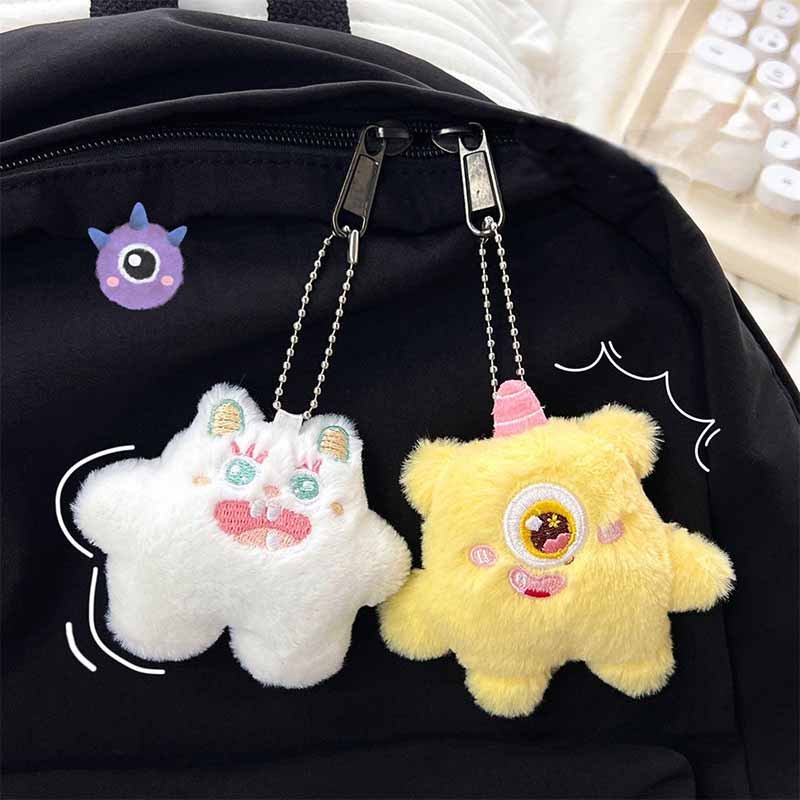
The best supplier is usually a plush product development manufacturer with proven experience in miniature hanging products. It should understand small-pattern construction, embroidery limits, hardware attachment, weight distribution, retail packaging, and bulk consistency. A general accessories factory may supply excellent metal parts, but it rarely has the complete soft-product engineering capability needed to turn artwork into a reliable plush bag charm.
Is a Plush Factory Better?
A plush bag charm may be sold as a fashion accessory, but most of its engineering challenges come from plush manufacturing. The face must remain recognizable at a small scale, narrow limbs must be sewn and turned cleanly, filling must support the intended silhouette, and the hanging loop must be secured inside a soft structure without pulling the head or body out of shape. For that reason, a specialist plush development manufacturer is usually the most suitable lead supplier for a fully custom program.
The lead factory does not need to claim that every specialist process happens inside one building. Custom plating, complex embroidery, fabric dyeing, packaging printing, and third-party testing are often completed by qualified partners. What matters is whether one accountable team controls the artwork version, material list, approved hardware, production standard, inspection method, packaging files, and delivery schedule. A transparent supply structure is more valuable than an unrealistic promise that every component is made under one roof.
When reviewing a factory portfolio, do not simply count how many plush products appear on the website. Look for evidence that the supplier has developed items with similar scale, shape, facial detail, hardware weight, and hanging orientation. A factory that makes excellent 30-centimeter stuffed animals may still struggle with an 8-centimeter character charm because miniature pattern pieces, embroidery placement, turning openings, and filling tolerances behave very differently.
| Supplier Type | Main Strength | Common Weakness | Best Role |
|---|---|---|---|
| Plush development manufacturer | Patterns, embroidery, sewing, filling, and shaping | May outsource special metal hardware | Lead project supplier |
| Accessories manufacturer | Clasps, chains, rings, and plating | Limited plush engineering | Hardware partner |
| Promotional gift supplier | Fast sourcing of standard items | Weak character development | Simple Logo programs |
| Trading company | Communication and supplier coordination | Production control varies | Use only after verification |
| General toy factory | Broad toy-production capability | May lack mini hanging-product experience | Consider with relevant samples |
OEM, ODM, or Co-Development?
OEM is appropriate when the brand already has complete artwork, target dimensions, material requirements, hardware specifications, packaging files, and quality standards. The manufacturer focuses on translating those requirements into a sewable structure and reproducing the approved result in bulk. Even a well-prepared OEM project still requires engineering input because a flat drawing does not show seam placement, panel division, pile direction, filling density, internal reinforcement, or the correct center of gravity.
ODM is more suitable when the client has a brand direction, audience, theme, retail price, or product category but has not finalized the product. The manufacturer may propose body shapes, character variations, fabric combinations, colorways, expressions, hardware options, and packaging formats. Before proceeding, confirm design ownership, exclusivity, modification rights, and whether the proposed structure has been adapted from an existing item that may also be offered to other customers.
Co-development sits between those two models and often works well for licensed characters, fashion collaborations, entertainment merchandise, collectible programs, and multi-SKU launches. The client controls the brand or character asset, while the manufacturer helps determine which details must remain unchanged, which elements need simplification, where the hanging point should sit, how hardware affects balance, and which construction can be repeated reliably in mass production. A supplier that raises practical concerns before sampling is usually more valuable than one that agrees to every request without analysis.
Match the Sales Channel
The right manufacturer must understand where the product will be sold because the sales channel changes the specification. A charm developed for an event giveaway has different requirements from one entering a fashion boutique, licensed retail program, department store, theme park, or ecommerce fulfillment network. The channel affects presentation, labeling, barcode management, durability expectations, packaging, inspection, carton configuration, delivery appointments, and the way future replenishment will be managed.
Fashion brands often care about hardware finish, tonal color matching, controlled branding, balanced proportions, and how the charm appears in campaign photography. Entertainment and IP clients usually place greater emphasis on character fidelity, style-guide approval, copyright lines, regional packaging versions, and multiple character variants. Retailers may focus on testing documentation, barcode accuracy, assortment control, warehouse requirements, and repeat-order consistency, while ecommerce programs must also consider fulfillment labels, dimensional weight, packaging damage, and return reasons.
Before selecting a supplier, explain the intended channel and ask how it affects the proposed construction. A capable manufacturer should connect the channel to practical decisions rather than simply saying it can make the item. For example, a retail-ready program may require a hangtag, woven label, copyright label, barcode sticker, backing card, individual protective packaging, and a controlled carton assortment. A direct-to-consumer launch may use simpler packaging but demand stronger photography, unboxing presentation, and visible-finish control.
Keychain or Bag Charm?
Plush keychains and plush bag charms overlap, but they are not always the same product. A keychain is commonly designed for keys, promotional distribution, souvenirs, fan merchandise, or lower-price retail. It usually prioritizes compact size, light weight, durability, and cost efficiency. A bag charm is more closely associated with fashion, lifestyle, collectible, and social-media use, so it may use larger proportions, more expressive styling, better-finished hardware, layered accessories, branded clothing, or premium packaging.
The distinction affects development decisions. A keychain may use a simple split ring or short chain, while a bag charm may require a swivel lobster clasp, snap hook, decorative chain, carabiner, or custom-shaped fitting. A keychain often needs to remain very light, whereas a fashion charm may accept more visual volume as long as it does not pull awkwardly on a bag or create discomfort during use.
During supplier discussions, define the product by its intended use rather than relying on terminology alone. Show the type of bag it will attach to, the desired visual scale, the target retail price, the expected hardware finish, and the packaging environment. This gives the manufacturer far more useful information than the words ‘bag charm’ by themselves and reduces the risk that a standard promotional keyring is quoted for a product that needs premium fashion presentation.
Where Can You Find Qualified Manufacturers?

Qualified manufacturers can be found through Google, sourcing platforms, trade shows, referrals, and existing supply-chain networks. No single channel is sufficient on its own. Build a broad longlist, then narrow it using relevant product evidence, development capability, factory transparency, communication quality, commercial fit, packaging experience, and support for the market in which the charms will actually be sold.
Search With the Right Terms
A broad search such as ‘bag charm supplier’ often returns metal pendants, acrylic charms, PVC keychains, leather accessories, finished wholesale products, and promotional gifts. To find a plush specialist, combine the product name with manufacturing, customization, customer type, and use-related terms. Useful variations include custom plush bag charm manufacturer, fashion plush charm factory, mini plush keychain manufacturer, licensed character plush keychain supplier, retail-ready plush charm producer, and plush bag charm manufacturer for fashion brands.
Search several naming variations because suppliers may describe similar products as plush pendants, mini hanging plush, stuffed keyrings, character keychains, fashion plush charms, or bag accessories. Adding the project context can make results more relevant. A search for a licensed character plush charm manufacturer will surface a different supplier group from a search for promotional plush keychains, and a request involving custom metal hardware should be reflected in the search wording from the beginning.
Search results are also useful for evaluating how a supplier explains its work. Look for pages discussing sample development, miniature embroidery, hanging-point construction, hardware, packaging, quality control, and production consistency. A page containing only product photographs and sales phrases provides less evidence than one that explains how the product is engineered. Website quality is not proof of manufacturing ability, but detailed technical content can help distinguish a specialist from a company that has created one keyword page without meaningful product experience.
Use Platforms Carefully
Sourcing platforms can help create a longlist quickly because they allow teams to compare company profiles, product categories, response information, audit badges, and basic commercial details in one place. They are particularly useful when a brand has not yet identified the strongest production region or needs to see a wide range of supplier types. Their weakness is that marketplace information often looks more standardized and complete than the underlying manufacturing reality.
Product galleries may contain old samples, customer-supplied images, standard catalog products, or items sourced through another factory. Supplier badges may verify business information without proving that the team can develop a complex mini character, control hanging orientation, or manage multi-SKU retail packaging. Review whether the portfolio contains several genuine plush charm structures, different face types, different hardware systems, and finished packaging rather than many photographs of one simple round mascot.
Initial replies can reveal a great deal. A weak response often gives a unit price immediately after receiving one picture. A stronger response asks about size, quantity, target market, material, hardware, packaging, target age, SKU count, and launch date. Do not judge suppliers by response speed alone. A quotation delivered in ten minutes may be based on assumptions that later change, while a slower response that identifies missing information and technical risks can be far more useful for a custom project.
Check Trade Shows and Referrals
Trade shows remain valuable because products can be handled directly. A sample that looks polished online may feel overfilled, poorly balanced, rough around the seams, or weak at the hanging point. Physical inspection quickly reveals details that photography hides. Bring a simple evaluation sheet and record the supplier name, booth number, product relevance, sample quality, hardware types, packaging examples, MOQ discussion, and the documents promised after the event.
Do not spend the entire meeting discussing price. Ask who develops patterns, where embroidery and sewing occur, how custom hardware is approved, what the sample process looks like, and how bulk quality is controlled. A supplier that can explain a specific displayed charm from artwork through sampling and production usually provides stronger evidence than one that can only repeat general factory claims.
Referrals can be helpful when they come from a company with comparable requirements. A supplier recommended by a promotional gift agency may not suit a licensed collectible brand, while a referral from a fashion accessories business may be useful for hardware but not for complex character development. Ask what the manufacturer actually produced, when the project happened, how many SKUs were involved, how quality problems were handled, and whether the client placed a reorder.
Build a Shortlist
For an important custom program, a practical longlist may contain roughly 10 to 15 suppliers. This range is usually broad enough to reveal different manufacturing models without creating an unmanageable evaluation process. Remove companies that clearly lack relevant product experience, cannot explain their company or factory relationship, or provide generic answers unrelated to the brief. The goal is not to collect the largest number of quotations; it is to identify a small group worth testing seriously.
A workable sequence is to reduce the initial list to five or seven suppliers after the portfolio and company review, send the same structured RFQ to each, compare three or four serious quotations, and develop physical samples with the strongest two or three candidates. These numbers are practical ranges rather than fixed industry rules, but the sequence helps prevent a team from either choosing too quickly or creating a sourcing exercise so large that no one can compare the details properly.
Create a shared supplier file rather than relying on email memory. Record the legal company name, operating brand, factory relationship, relevant examples, development team, sample terms, MOQ by SKU, price assumptions, hardware source, packaging capability, inspection system, target-market support, lead time, communication quality, and unresolved questions. Classify each supplier as proceed, hold, or reject, and do not reopen a rejected candidate merely because it later offers a lower price without explaining what changed.
How Do You Verify a Manufacturer?

Verify a manufacturer by checking its legal identity, production relationship, relevant samples, development team, quality procedures, commercial documents, and actual performance on your brief. Business licenses, audits, and test reports are useful but incomplete. The strongest evidence is a consistent connection between what the supplier claims, what its team explains, what its sample demonstrates, and how its production system is documented.
Verify the Company
Begin by identifying the company that will be responsible for the project. Some suppliers operate through a brand, export company, factory entity, or group of managed production partners. This structure is not automatically a concern, but it must be explained clearly. Request the legal company name, registered address, operating address, quotation entity, contract entity, payment beneficiary, and exporting entity, then ask who controls sampling, mass production, quality, packaging, and customer communication.
The information should make sense across the website, business registration, quotation, proforma invoice, bank details, audit report, test documentation, email domain, and video-call introduction. Small differences may have reasonable explanations, particularly when a manufacturing brand is operated by an export company or a group that manages several factories. The concern is not structural complexity itself; it is whether the supplier can describe the structure accurately and accept responsibility for the final result.
Request a focused live video call when the project value, confidentiality level, or first-order risk justifies it. Rather than asking for a general factory tour, concentrate on relevant processes such as sample development, miniature embroidery, small-component sewing, filling, hanging-loop insertion, hardware storage, packing, and inspection. Ask the presenter to show how approved samples are stored or how an embroidery file is identified. A rehearsed walk past equipment proves less than a detailed explanation of the project workflow.
Test Development Ability
The best way to verify development ability is to submit a real product brief and study the questions that come back. Provide front, side, and back views where possible, mark essential character features, identify areas that may be simplified, and include the target height, intended use, hardware preference, sales channel, quantity, and launch timing. A capable developer should identify likely risks before producing a sample rather than waiting until the first prototype is finished.
Pay attention to whether the supplier discusses three-dimensional proportions, panel division, seam placement, pile direction, embroidery size, narrow-part construction, filling density, hanging-loop position, weight balance, hardware scale, packaging pressure, and mass-production feasibility. An experienced patternmaker may explain that a tail must be widened, an eye needs to move away from a seam, or a separate accessory should become embroidery. Those comments protect the project rather than reduce creative ambition.
Ask who will handle revisions and how feedback reaches the technical team. The salesperson may coordinate communication, but design comments must reach the patternmaker, embroidery programmer, sample sewer, filling specialist, and quality team. Pufumi’s current development system includes more than 58 designers, patternmakers, and sample-development specialists, with roughly half described as having more than 15 years of relevant experience. Team size alone does not guarantee success, but the supplier should have enough experienced people to manage interpretation, revisions, and production transfer.
Review Quality Evidence
Quality evidence should cover the full production process rather than only final inspection. By the time a finished charm reaches the packing area, some cutting, embroidery, reinforcement, or filling errors may be difficult to correct. Ask the supplier how it checks incoming fabric and hardware, cutting accuracy, embroidery position, sewing strength, filling weight, shaping, hardware operation, hanging orientation, labels, barcodes, packaging, carton assortment, and final shipment records.
Request blank inspection forms, anonymized quality records, or sample checklists instead of confidential customer documents. A supplier with a real system can usually show the structure of its quality plan without revealing another brand’s designs or purchase information. Also ask which items are checked individually and which are controlled through sampling. The phrase ‘100 percent inspection’ is not meaningful unless the supplier can explain exactly what is checked on every unit and what remains subject to process inspection or AQL sampling.
A practical plush quality process normally includes incoming inspection, first-piece confirmation, embroidery checks, sewing and reinforcement checks, filling and appearance control, packaging verification, and a final release decision. Critical items such as barcodes, mixed-SKU risk, detachable accessories, required functions, or customer-specified attachment checks may receive individual verification, while overall appearance can be supported by in-process checks and final sampling. The standard should refer to an approved sample and production files, not to scattered chat messages or individual judgment.
Protect IP and Files
For unreleased characters, fashion collaborations, entertainment projects, or seasonal launches, confidentiality must be part of the operating process. An NDA is useful, but it is only one layer of protection. Ask how the supplier receives, stores, names, shares, archives, and deletes project files. Artwork should be organized under a project code rather than downloaded into personal folders or distributed casually through uncontrolled messaging groups.
The supplier should have clear rules for style guides, target prices, packaging files, launch dates, customer names, sample photography, factory displays, social media, website case studies, and retained samples. Review the NDA scope carefully and confirm whether specialist partners handling embroidery, hardware, printing, or packaging are subject to equivalent confidentiality expectations. For highly sensitive projects, access should be limited to the specific people responsible for sales, project management, design, engineering, quotation, production, quality, and packaging.
Be cautious when a supplier casually shows recognizable licensed projects from other customers. It may appear impressive, but it can also reveal weak information control. A responsible manufacturer may provide anonymous process examples, blank templates, or permitted samples instead of exposing names, exact quantities, or unreleased designs. Clients also have responsibilities: provide only necessary files at each stage, identify authorized contacts, label confidential materials, and confirm that the artwork is original or legally licensed for commercial production.
Which Production Capabilities Matter Most?

The most important capabilities are small-scale pattern development, precise embroidery, stable sewing, controlled filling, reinforced hanging-point construction, suitable hardware sourcing, weight management, and retail packaging. The charm must remain recognizable, face the correct direction when suspended, tolerate normal handling, and reproduce consistently across a bulk order, multiple character SKUs, seasonal variations, and future reorders without losing its approved proportions or finish.
Small-Scale Detail Control
Miniaturization is not simple reduction. When a 25-centimeter plush character becomes a 9-centimeter charm, seams, embroidery, fabric pile, turning openings, and accessory thickness occupy a much larger share of the design. Many commercial bag charms fall somewhere around an 8- to 15-centimeter body-height range, although fashion pieces may be larger and compact keyring styles may be smaller. At the lower end, a shift of only a few millimeters can change the expression or weaken character recognition.
Start by identifying the features that carry the character’s identity. These may include head-to-body ratio, eye spacing, ear or hairstyle silhouette, signature colors, mouth shape, costume elements, tail, prop, Logo, or one distinctive accessory. Not every line in the artwork should become a separate fabric panel. Excessive panel division can create bulky seams and inconsistent shaping, while fine details may work better as embroidery, print, simplified appliqué, or a controlled change in fabric color.
Fabric pile must be chosen with the face and camera view in mind. Long fur can create personality and softness, but it may cover small embroidery or alter the apparent outline. Short plush and minky-style materials usually reveal facial details more clearly. Review the sample from normal viewing distance and in photographs, not only during close inspection. Consumers may first see the product in an ecommerce thumbnail or social post, so the face must remain clear under ordinary visual conditions.
Hanging Point Engineering
The hanging point is a structural feature rather than a decorative afterthought. Its location affects orientation, balance, appearance, and durability. The loop should connect to a reinforced seam or internal anchor, and its insertion depth, material width, seam allowance, and surrounding structure must be appropriate for the charm’s weight. Simply stitching a narrow ribbon onto the surface may look acceptable in a sample photograph but create a weak point during repeated use.
Balance must be tested with the final hardware attached because a lightweight sample clip cannot represent a heavier production clasp. A properly engineered charm should present the intended front view, avoid excessive forward or backward tilt, return to a natural position after movement, prevent the clasp from pressing into the face, and fit the target bag attachment point. When the head is large or the body is asymmetrical, moving the loop by only a small distance can improve orientation significantly.
Hardware should be selected for both performance and proportion. A large lobster clasp may be convenient but visually overpower a small charm, while a delicate clasp may look refined but fail to fit a thick handbag handle. Check clasp opening width, rotation, plating consistency, sharp edges, connection rings, and movement. Test the complete assembly on actual bag straps and repeat opening, closing, rotating, and gentle pull actions before the hardware specification is frozen.
Materials and Decoration
Material selection should follow the intended appearance, scale, retail price, durability, embroidery needs, and market requirements. There is no single fabric that is best for every charm. Short plush provides clean visibility for embroidered features, minky-style fabrics offer a smooth and soft surface, velboa can support cost-sensitive programs, and Sherpa or longer-pile fabrics create stronger texture but may require trimming around the face and can increase variation in the finished outline.
Filling changes the final geometry as much as the pattern. Underfilling can cause a flat face, collapsing limbs, and a weak body shape, while overfilling can widen the head, distort embroidery, shorten the body visually, and make the product heavier than intended. Filling should be specified by type, approximate amount, distribution, and acceptable range. The head may need enough support to preserve facial geometry while the body remains softer and lighter.
Decoration methods must be chosen according to scale and function. Embroidery is durable and suitable for eyes, mouths, Logos, and small graphics, but dense stitching can stiffen a tiny panel. Applique creates larger color blocks but adds seam thickness. Printing can reproduce fine artwork or gradients, although rub resistance and hand feel must be reviewed. Separate accessories can add value but introduce attachment, small-part, assembly, and cost risks. Clean execution normally creates more perceived quality than unnecessary layers of complexity.
Multi-SKU and Packaging
A multi-character program creates risks that do not exist in a single-SKU order. Similar fabric colors, shared accessories, different embroidery files, character cards, barcodes, and packaging versions can be mixed during production. Each SKU should have a clear identifier that connects the character name, artwork version, materials, embroidery program, hardware, label, packaging, barcode, and carton assortment. Shared components can reduce cost, but they should not force different characters into one structure that weakens their identity.
Production should use both physical and document separation. Cutting bundles, embroidery panels, accessories, packing materials, and finished goods should be marked by SKU. Visual reference boards are especially useful when characters look similar. The packing plan should define carton quantity, assortment, barcode, inner packaging, and any retailer-specific requirements. Mixed-SKU errors are expensive because the product itself may be correct while the card, barcode, or carton allocation is wrong.
Packaging must protect the charm without crushing the face or allowing metal hardware to leave pressure marks. Depending on the channel, options may include an individual polybag, paper sleeve, hangtag, backing card, window box, gift box, display carton, blind packaging, or collector card. The hardware position inside the package matters; chains or clasps may need to be wrapped, fixed, or separated from the plush surface. Packaging should always be sampled with the actual finished charm rather than designed only from estimated dimensions.
How Do You Compare Samples, MOQs, and Quotes?
Compare suppliers by sending the same RFQ, reviewing samples against the same measurable standards, and confirming identical price boundaries. MOQ should be evaluated by SKU, color, material, hardware, and packaging version, not only by total quantity. A lower unit price is useful only when development, components, inspection, packaging, commercial terms, and production standards are genuinely comparable.
Build a Complete RFQ
A reliable quotation begins with a reliable brief. One reference image cannot define the final cost because the supplier must otherwise make assumptions about size, fabric, filling, embroidery, hardware, packaging, quantity, testing, and delivery. Include company and brand information, intended use, sales channel, artwork from all available views, target size, desired hand feel, quantity per SKU, materials, decoration details, hardware type, packaging, market, target age, testing expectations, delivery dates, destination, and confidentiality needs.
Ask every supplier to state its quotation assumptions. One price may be based on stock fabric, standard thread colors, a standard clasp, simple protective packaging, and no testing. Another may include custom-dyed material, upgraded plated hardware, a printed backing card, barcode application, and inspection. The numbers cannot be compared until those boundaries are visible. For early budgeting, request prices at realistic volume points such as 500, 1,000, 3,000, and 5,000 pieces where the project structure makes those quantities meaningful.
A structured RFQ also reveals the supplier’s working style. Experienced teams usually ask questions before confirming a final price because they understand how small changes affect pattern difficulty, embroidery time, material minimums, hardware cost, and packaging. A supplier that immediately quotes from a picture may still be useful for a rough estimate, but that figure should not be treated as a production-ready price until the assumptions have been documented and the sample direction has been reviewed.
Understand MOQ Logic
MOQ is rarely determined by sewing alone. Fabric purchasing, custom dyeing, embroidery setup, metal hardware, packaging printing, labels, and SKU changes all influence the economic minimum. A factory may accept 1,000 total pieces, but the allocation matters. Two designs at 500 pieces each are easier to manage than ten designs at 100 pieces each because every SKU can require its own pattern, embroidery file, sample, quality reference, barcode, packaging, and packing plan.
Custom fabric colors may require a separate dyeing minimum, while custom metal hardware may involve tooling or plating minimums. Printed cards and boxes can have their own production quantities, and special labels or accessories may create additional constraints. Ask for the minimum per design and color, whether several designs can share fabric or hardware, whether extra packaging can be stored for reorders, and whether a pilot run can be separated from the main production quantity.
Pufumi uses 500 pieces as an internal project-screening reference rather than a universal promise. The actual minimum is evaluated according to construction, SKU count, colors, materials, packaging, and process complexity. This approach reflects a practical industry reality: total quantity matters, but quantity per unique design and version usually determines whether materials, setup, production flow, quality control, and packing can be executed efficiently.
Evaluate Samples
The first sample should reveal engineering problems rather than merely produce an attractive photograph. Review it in a consistent order so major structural issues are not overlooked while the team discusses small color preferences. Compare the silhouette and proportions with the artwork, inspect the expression and key identity points, check fabric pile and color, measure critical dimensions, review embroidery alignment, weigh the product, test the hanging point, operate the clasp repeatedly, and photograph the charm on several real bag types.
Review all views: front, back, both sides, top, bottom, and hanging position. The bag context matters because a charm designed for a small handbag may look weak on a large tote, while an oversized piece may interfere with zippers or handles. Pack and unpack the sample several times to check whether the clasp leaves pressure marks, whether the body is crushed, and whether the product returns to its intended shape after storage.
Record every comment in one revision document using photographs, arrows, measurements, and clear instructions. Separate mandatory corrections from preferences, then number each sample version so that Prototype V1, Revision V2, PPS, and Golden Sample cannot be confused. Pufumi’s current internal reference is roughly 7 to 12 working days for ordinary samples after the brief, sample fee, materials, and task release are ready, while complex samples may require 12 to 20 working days and multi-SKU groups depend on shared structures and approval rounds.
| Inspection Area | What to Check | Practical Method |
|---|---|---|
| Character accuracy | Silhouette, face, proportions, and key features | Compare with annotated artwork |
| Dimensions | Height, width, depth, and critical ratios | Measure on a flat surface |
| Embroidery | Position, density, thread color, and distortion | Check front and reverse sides |
| Fabric and filling | Color, pile, touch, weight, and shape | Review under fixed lighting and weigh |
| Hanging point | Position, reinforcement, and orientation | Hang on several bag types |
| Hardware | Opening, rotation, plating, and edges | Operate repeatedly and inspect closely |
| Packaging | Fit, pressure marks, barcode, and display | Pack, scan, and unpack several times |
Compare Total Cost
Unit price is only one part of the commercial decision. Two quotations that appear close can produce very different landed costs and risk levels. Confirm whether the quotation includes product development, sample and revision charges, embroidery digitization, custom dyeing, hardware tooling, plating, labels, packaging, barcode application, testing support, inspection, cartons, export documents, freight, duties, warehousing, and fulfillment preparation. Also review payment terms, quotation validity, currency, trade terms, lead-time assumptions, and price-adjustment conditions.
A lower unit price may come from thinner fabric, less filling, simpler embroidery, lighter hardware, basic packaging, wider tolerances, or fewer inspection steps. These choices are not automatically wrong, but they must be visible. Compare costs at the project level. A supplier that optimizes carton dimensions, prevents barcode errors, reduces rework, and maintains stable reorders may be more economical than a cheaper factory that creates delays, inconsistent goods, or repeated corrective work.
Ask suppliers to identify the largest cost drivers and offer controlled alternatives. Replacing a custom clasp with a premium standard fitting may reduce MOQ without weakening the product. Simplifying one hidden applique may reduce sewing time while preserving the front appearance. For a fashion or licensed launch, also consider the cost of failure. Reshooting campaign photography, relabeling inventory, replacing broken hardware, missing a launch date, or recalling incorrectly packed SKUs can exceed the original manufacturing savings.
How Do You Choose the Final Manufacturer?
Choose the final manufacturer by weighing sample performance, technical understanding, production control, quality systems, communication, compliance support, packaging, delivery planning, and reorder capability. The best supplier is not always the lowest-priced one. It is the company that demonstrates a reliable, documented path from approved artwork and sample to consistent, retail-ready bulk production, accurate multi-SKU packing, and dependable future replenishment.
Use a Weighted Scorecard
A scorecard helps prevent the decision from being dominated by one attractive sample, one confident salesperson, or one low quotation. The weighting should reflect the project’s real risk. A licensed character may place more weight on fidelity and approval control, while a fashion accessory may place more weight on hardware, finish, photography, and proportion. A major retailer may give greater weight to compliance, packaging, barcode control, inspection, and delivery discipline.
Set minimum pass conditions in addition to the total score. A supplier should not win with a strong overall score if it fails a non-negotiable requirement such as IP confidentiality, hanging-point security, character approval, or target-market documentation. Every score should have evidence. Replace comments such as ‘quality looks good’ with observations such as embroidery position matches the approved reference, the clasp rotates smoothly, the hanging orientation remains stable, and the barcode scans correctly after packing.
Include representatives from product, design, sourcing, quality, compliance, and logistics when the project is significant. Each function sees different risks. Designers may notice character distortion, quality teams may identify weak reinforcement, and logistics teams may recognize packaging dimensions that make the program commercially inefficient. A cross-functional review takes longer at the beginning, but it reduces the chance that one department selects a supplier while another discovers a critical problem after the purchase order is released.
| Evaluation Area | Suggested Weight | Minimum Expectation |
|---|---|---|
| Sample accuracy | 20 | Character remains recognizable and proportionally correct |
| Mini plush engineering | 15 | Supplier explains patterns, seams, filling, and scale limits |
| Hanging point and hardware | 10 | Stable orientation and reinforced attachment |
| Production and quality control | 15 | Documented process checks and final inspection |
| Commercial clarity | 10 | Transparent assumptions, MOQ, payment, and inclusions |
| Communication and version control | 10 | Clear replies and a responsible project contact |
| Compliance support | 8 | Market-specific documentation and testing coordination |
| Packaging capability | 7 | Correct labels, barcodes, assortment, and protection |
| Delivery planning | 3 | Realistic production and shipment schedule |
| Reorder support | 2 | BOM, retained sample, material, and version records |
Confirm Compliance and QC
Quality and compliance are related but different. Quality asks whether the product matches the approved specification. Compliance asks whether the product, labeling, documentation, and testing meet the requirements of the intended market and product category. Start with the sales market, intended use, age grading, claims, materials, detachable parts, and packaging. A charm promoted as a children’s toy may face different requirements from a decorative collectible accessory even when the two products look similar.
For the United States, a project may involve ASTM F963, CPSIA, CPC, tracking-label, and laboratory considerations depending on classification. European Union projects may involve EN 71, CE documentation, technical files, and labeling, while requirements for the United Kingdom, Canada, Japan, Australia, and retailer-specific programs must be reviewed separately. The manufacturer should support the process with samples, BOM information, material details, factory information, label execution, packaging files, and corrective action, but it should not promise that every design automatically passes every standard.
The quality plan should identify incoming material checks, first-piece approval, embroidery inspection, sewing and reinforcement checks, filling and weight control, hardware inspection, hanging-orientation review, label and barcode checks, packaging checks, final sampling, critical-point individual checks, and retained production samples. Pufumi’s internal final-inspection reference for ordinary programs uses an AQL approach of Critical 0, Major 2.5, and Minor 4.0, with stricter plans or additional individual checks for higher-risk or customer-specified projects.
Watch for Red Flags
Some weaknesses can be corrected during development, while others indicate that the relationship is too risky. Important warning signs include a final price quoted from one image, company and payment identities that cannot be explained, portfolio images that cannot be discussed technically, refusal to show relevant processes, inability to explain hanging-loop reinforcement, unapproved hardware changes, unnumbered sample revisions, pressure to start production before final approval, and testing claims that rely on unrelated or expired reports.
Also watch how the supplier handles disagreement. An experienced manufacturer may challenge a detail because it is too small to sew, too heavy, unsafe, commercially inefficient, or likely to vary in mass production. That can be valuable. A weak supplier often agrees to every request during sales communication and introduces limitations only after receiving payment. The right partner should explain trade-offs before commitment and connect each proposed change to appearance, cost, MOQ, timing, durability, or compliance.
Sudden price reductions also deserve attention when they are not connected to a clear specification change. A legitimate cost reduction should have a reason, such as standard hardware, shared materials, simplified packaging, adjusted dimensions, a higher quantity, or revised embroidery. An unexplained discount may indicate that the original quotation was unreliable or that quality assumptions have changed. Pause the project whenever technical, legal, quality, or commercial evidence no longer supports the same supplier story.
Lock the PO and Reorder Plan
Before releasing the purchase order, confirm that the commercial and technical documents refer to the same product version. The final package should include approved artwork, approved sample version, product dimensions, allowed tolerances, materials, fabric colors, filling specification, embroidery and print files, hardware type and finish, hanging-loop construction, labels, packaging artwork, barcode data, quantity by SKU, carton assortment, quality plan, testing responsibilities, production schedule, inspection method, shipping terms, payment terms, and change-control process.
The Golden Sample or equivalent approved reference should be available to production and quality teams, but important specifications must also be written because a physical sample cannot show material codes, embroidery program numbers, tolerances, label data, or the approved packaging version. Any change after approval should follow a formal process. A fabric substitution, hardware change, revised warning label, new barcode, or packaging adjustment can affect cost, timing, testing, and quality and should never enter production through an informal chat instruction.
Discuss reorders before the first shipment leaves the factory. Confirm which materials may be difficult to reproduce, how long records and retained samples will be kept, whether packaging plates or hardware tooling will be stored, and how a future batch will be compared with the original. Stable replenishment depends on BOM records, approved samples, material references, production files, batch information, inspection results, and retained samples. The final supplier should be able to reproduce a successful item and extend it into new characters without rebuilding the entire development system from the beginning.
Closing Perspective
Finding a plush bag charm manufacturer is not mainly a search for sewing capacity. It is a search for a team that understands how miniature design, three-dimensional interpretation, hanging balance, hardware, filling, packaging, quality, compliance, and commercial timing affect one another. The strongest supplier will make these relationships visible before production begins, record the decisions that matter, and convert an attractive approved sample into a repeatable product rather than treating the sample and the bulk order as separate jobs.
A disciplined sourcing process may feel slower than choosing the first factory that offers an appealing price, but it usually saves time where it matters most. When the brief is complete, suppliers are compared on the same basis, samples are evaluated in real use, and the production standard is locked before the purchase order, the finished charm is more likely to photograph well, hang correctly, arrive ready for its channel, and remain stable when the product succeeds and requires new colors, new characters, or long-term replenishment.
Frequently Asked Questions
What is a typical MOQ for custom plush bag charms?
A practical MOQ for fully custom plush bag charms is often several hundred pieces per design, but there is no universal number. The real minimum depends on the number of SKUs, fabric colors, custom dyeing, embroidery files, metal hardware, packaging, and whether components can be shared across the range. A total order of 2,000 pieces may be straightforward with two designs and difficult with ten designs, several packaging languages, and custom hardware for each version.
How long does it take to make a plush bag charm sample?
A standard sample may take roughly 7 to 12 working days after the artwork, sample payment, material direction, and technical brief are ready. Complex characters, unusual fabrics, layered clothing, custom hardware, high-fidelity licensed details, or several unique SKUs can require 12 to 20 working days or longer. Shipping time and customer revision rounds should be added separately, and the schedule should begin only after the project has enough information to enter real development.
What files should I send to a plush bag charm manufacturer?
Send front, side, and back artwork where available, high-resolution Logos, color references, a target size, expected quantity per SKU, intended market, desired hardware, packaging direction, target age, sales channel, launch date, and any non-negotiable character details. AI, PDF, PSD, EPS, PNG, and high-resolution JPG files are commonly useful. A turnaround drawing and annotated detail sheet reduce interpretation errors, especially when the character has asymmetrical clothing, hair, ears, tails, or separate accessories.
How can I test the hanging point and clasp before production?
Review the complete sample with final-weight hardware attached, then hang it from the actual bag types the product is intended to fit. Check whether the charm faces forward, tilts, rotates excessively, or allows the clasp to press into the face. Open and close the clasp repeatedly, inspect sharp edges and plating, and apply controlled gentle pull and movement checks. The factory should also explain loop material, insertion depth, seam reinforcement, and how attachment points will be inspected in production.
Do plush bag charms need toy testing?
Testing depends on the intended market, product classification, target age, materials, detachable components, claims, and sales channel. A charm marketed or reasonably perceived as a children’s toy may trigger toy-safety requirements, while an adult fashion accessory or collectible may follow a different path. The brand, importer, manufacturer, retailer, and qualified laboratory should confirm the applicable rules for the exact product. A historic report for another design should never be treated as automatic coverage for a new charm.
What is the difference between a plush bag charm and a plush keychain?
A plush keychain is usually smaller, lighter, and designed for keys, souvenirs, promotions, or entry-price merchandise. A plush bag charm is more likely to function as a visible fashion or lifestyle accessory, with greater emphasis on proportion, hardware finish, hanging presentation, photography, styling, and retail packaging. The categories overlap, so the manufacturer should receive a use-based brief showing the intended bag, attachment point, visual scale, retail position, and hardware rather than relying only on the product name.
How do I keep reorders consistent with the first production run?
Approve a Golden Sample and freeze the BOM, dimensions, filling, embroidery files, hardware specification, packaging, barcode data, quality standards, and allowed tolerances before production. Ask the supplier to retain approved references and record material codes, vendors, batches, tooling, and inspection results. For each reorder, compare materials, weight, color, hardware, and finished appearance with the retained sample and previous batch. Any substitution or packaging change should be approved through a documented change process before production begins.