Skip to content

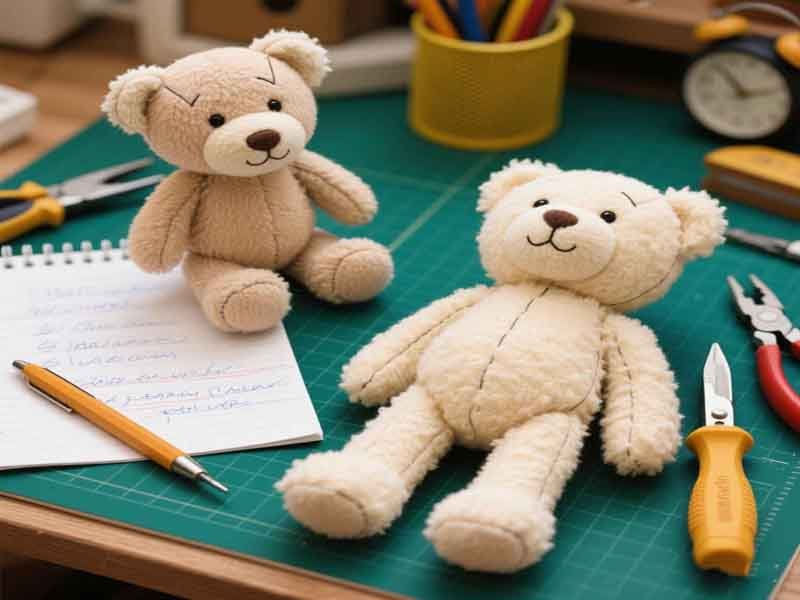
Finding a factory that can sew a plush toy is not difficult. Finding a manufacturing partner that can protect an unreleased character, interpret a two-dimensional style guide, satisfy a licensor’s approval process, maintain facial accuracy across thousands of units, prepare retail packaging, and support market-specific testing is a much more demanding task. Licensed character plush is not simply an ordinary stuffed toy with recognizable artwork added to it. It carries intellectual-property risk, launch-date pressure, consumer-safety responsibility, and the reputation of the character itself. The wrong supplier may still produce a presentable first sample, yet fail when the project expands into several characters, multiple packaging versions, retailer requirements, or repeat orders.
To find the right licensed character plush manufacturer, shortlist suppliers with verifiable character-development experience, clear IP-protection procedures, pattern and sampling capability, written approval controls, target-market compliance support, and a documented method for matching mass production to the approved golden sample. Verify the legal company, actual production resources, project team, quality records, packaging capability, capacity assumptions, and change-control process before releasing the order.
A licensing team once approved a carefully handmade sample whose expression matched the artwork almost perfectly. During production, however, the embroidery team used an older eye file, while the sewing line filled the head more firmly than the sample room had done. The finished units were technically clean, but the character looked unexpectedly alert rather than friendly. The failure did not come from one careless worker. It came from a missing link between the approved sample and the production files. The sections below explain how to identify that missing link before it becomes an expensive shipment.
What Makes Licensed Plush Manufacturing Different?
Licensed plush manufacturing combines character interpretation, intellectual-property control, formal approvals, product safety, packaging accuracy, and repeatable production. A suitable factory must do more than copy artwork. It must convert protected character assets into a manufacturable product while preserving recognizable features, recording every revision, following the approved style guide, and preventing unauthorized changes during production and future reorders.
Licensed vs. Ordinary Custom Plush
All licensed character plush is custom, but not every custom plush project is licensed. A company-owned mascot may have one internal decision-maker and a flexible design brief. A licensed entertainment character may involve an IP owner, licensing agency, regional licensee, product manager, sourcing team, retailer, compliance department, and manufacturer. Each party can control a different part of the product, which makes approval management as important as sewing quality. A supplier that is technically capable but unable to manage these overlapping responsibilities can still create expensive delays.
The manufacturer cannot freely simplify a face, change a costume color, move a logo, or replace a material simply because the change lowers cost or improves sewing efficiency. A detail that appears minor to the production team may be protected by the style guide. Eye spacing, mouth shape, head proportion, signature colors, costume emblems, copyright wording, and the way multiple characters appear together may all require written approval. The product therefore needs a controlled route from artwork review to sample approval, production release, packaging confirmation, inspection, shipment, and reorder management.
A reliable supplier separates approvals rather than treating one general confirmation as permission for everything. Character appearance, materials, safety construction, packaging artwork, labels, and final production release may require different sign-offs. When these decisions are compressed into one unclear message, factories often assume that a partial approval covers the entire product. That assumption can result in correctly sewn units using unapproved materials, outdated labels, or packaging that the licensor never reviewed.
Character Fidelity
Character fidelity is not a vague judgment about whether the plush looks cute. It is the controlled preservation of the features that make the character immediately recognizable. These may include the overall silhouette, face width, eye angle, head-to-body ratio, ear position, hair shape, costume outline, color balance, or a distinctive accessory. Fans often notice these features instantly, even when they cannot explain the exact measurement that feels wrong.
Experienced development teams identify the character’s first recognition points before they begin pattern work. For many retail plush products, the front view carries most of the identity, yet side thickness and back construction still influence how the front looks after filling. A head that is too deep may push the face forward. A fabric with excessive pile can cover the embroidery. Filling that is too firm can widen the cheeks, alter the jawline, and make a friendly expression appear tense.
Fidelity review becomes more dependable when the team converts subjective reactions into measurable checkpoints. Eye spacing can be measured from center to center. The head can be expressed as a percentage of total height. The mouth may have a defined width and distance from the nose. A costume emblem can have specified dimensions and placement tolerances. The purpose is not to turn every creative decision into a rigid engineering formula, but to protect the few visual details that carry most of the character’s identity.
Approval Responsibilities
Licensed plush projects work best when approval roles are defined before the first sample is made. Without a clear approval map, design, licensing, sourcing, compliance, and retail teams may send separate instructions directly to the factory. The sample team then receives several valid but conflicting requests. The result is often a product that reflects many opinions but has no clearly approved direction.
The licensor or IP owner usually controls character appearance, brand rules, copyright wording, and prohibited uses. The licensee or product team may control product size, materials, target price, packaging format, and launch schedule. A retailer may add barcode, carton, labeling, or display requirements. The compliance team reviews target age, test planning, warnings, traceability, and product-risk details. The manufacturer should not decide which stakeholder has the highest authority; it should request one consolidated revision list and one named person who can issue the final production release.
| Approval Area | Typical Decision-Maker | Evidence the Factory Should Keep |
|---|---|---|
| Character appearance | Licensor or IP owner | Marked artwork, comparison images, written approval |
| Product specification | Product or merchandise team | Approved size sheet and construction details |
| Materials and colors | Design and product teams | Signed swatches, Pantone references, material codes |
| Safety construction | Compliance team | Risk notes, BOM, agreed test plan |
| Packaging and labels | Licensor, retailer, compliance team | Approved artwork and print-ready files |
| Production release | Authorized project owner | Dated release and final version list |
Each approval should state exactly what has been accepted. Approving the face does not automatically approve the fabric. Approving a prototype photograph does not automatically approve hand feel. Approving the product body does not automatically approve the hangtag, retail box, or market-specific warnings. Clear approval boundaries protect both the customer and the manufacturer when a later department requests changes.
Project-Specific Risks
Licensed plush projects concentrate several risks that are less visible in basic custom merchandise. The first is unauthorized use. A factory may receive character artwork from an agency, distributor, or sourcing company without knowing whether that party holds the necessary rights. Responsible suppliers request confirmation rather than treating possession of a design file as legal authorization. A factory that is willing to reproduce famous characters without questions may later show the same casual attitude toward the customer’s confidential assets.
The second risk is confidentiality. Unreleased game characters, new costumes, film merchandise, collaboration products, launch dates, retailer information, and packaging can have commercial value months before release. An NDA is useful, but real protection depends on how folders, samples, photography, subcontractors, rejected packaging, and trade-show displays are managed. A signed document does not prevent leakage if everyone in the production chain can freely access or photograph the project.
The third risk is sample-to-production drift. A senior sample maker may manually create an excellent prototype, but the result cannot be reproduced reliably without released patterns, embroidery files, material codes, filling specifications, tolerances, and inspection standards. The fourth risk is version confusion. One character may have several costumes, sizes, territories, and packaging formats. Every SKU must be linked to the correct artwork, pattern, BOM, labels, and market version, or a technically acceptable product may still be commercially unusable.
What Files Do You Need Before Sourcing?

Before requesting firm quotations, prepare evidence of authorization, the latest character assets, a clear product brief, target-market information, estimated quantities by SKU, packaging requirements, approval contacts, and a realistic launch schedule. Complete input allows manufacturers to identify technical risks, calculate costs, plan sample stages, and compare suppliers using the same project assumptions rather than several different interpretations.
Authorization Records
The manufacturer does not usually need the customer’s complete licensing agreement, but it does need enough information to understand that the project is legitimate. The appropriate evidence depends on whether the customer is the original IP owner, a regional licensee, a licensing agency, a retailer, or a sourcing company acting for another organization. The objective is to confirm the right to develop the product without unnecessarily circulating confidential legal documents.
An original creator or IP company may provide an ownership declaration. A licensee may provide an authorization letter, product-category approval, supplier nomination, or written confirmation from the licensor. An agency should be able to show that it is acting for the authorized company and has permission to share the assets with the manufacturer. Useful records may identify the authorized company, character property, product category, territory, license period, sales channels, approval authority, publicity limits, and required copyright or trademark wording.
The factory’s role is not to grant rights or replace the customer’s legal review. Its responsibility is to avoid knowingly producing unauthorized merchandise and to follow the documented rights information supplied by the customer. If a project involves a protected sports mark, university logo, celebrity likeness, entertainment character, or major consumer brand, a professional manufacturer should ask for clarification instead of moving directly to sample production.
Style Guide Files
A style guide is the visual rulebook for the project. The most useful guides include front, side, and rear views; official proportions; approved expressions; color references; costume details; logos; trademark usage; copyright lines; packaging hierarchy; and prohibited changes. When a design contains several versions, the guide should also show which appearance belongs to each season, territory, product category, or retail program.
Many projects begin with strong front artwork but limited information about side depth, back construction, tail attachment, or costume thickness. In that situation, the factory should not quietly invent the missing areas. It should prepare an interpretation sheet showing the proposed side view, rear view, product thickness, seam positions, materials, pose, and treatment of small details. This allows the licensing and product teams to approve the manufacturer’s interpretation before the first pattern is cut.
Color information should be practical rather than screen-based. RGB, CMYK, Pantone, embroidery thread, dyed plush fabric, printed fabric, and paper packaging reflect light differently. Material swatches and approved color cards are more reliable than screenshots. Critical face colors and brand colors deserve stricter control than hidden or low-sensitivity areas. The style-guide version, effective date, market, and product scope should also be recorded so that a later update does not silently replace the files linked to an approved purchase order.
The Product Brief
A useful product brief allows several manufacturers to quote the same project. A request such as “quote a ten-inch character plush” is too broad because size definition, pile length, filling, embroidery, costume layers, quantity, packaging, target age, and market can change both the cost and production route. The brief should separate fixed character requirements from areas where the factory may suggest engineering alternatives.
| Brief Item | Information to Provide | Why It Matters |
|---|---|---|
| Character assets | Current artwork and file version | Prevents quotation from outdated designs |
| Product form | Core plush, mini plush, keychain, bag charm, or display plush | Determines structure and hardware |
| Finished size | Measurement points and acceptable tolerance | Avoids inconsistent size interpretation |
| Quantity | Units per character, color, size, and market | Determines MOQ and production efficiency |
| Target age | Intended age group and use scenario | Affects construction and test planning |
| Sales market | US, EU, UK, Canada, Japan, or other markets | Affects labels and compliance planning |
| Materials | Preferred texture, pile, filling, and restrictions | Affects appearance, hand feel, and cost |
| Decoration | Embroidery, print, applique, woven label, or molded parts | Affects detail limits and setup cost |
| Packaging | Polybag, hangtag, retail box, gift box, or display carton | Affects cost, dimensions, and lead time |
| Schedule | Sample deadline, approval date, and delivery date | Exposes approval and material risks |
| Approvers | Named roles for design, licensing, and production | Reduces conflicting feedback |
Quantity should be provided per SKU rather than only as a total. A program with 5,000 units across ten characters is very different from one with 5,000 units of a single character. Each SKU may require separate patterns, embroidery programs, materials, quality references, labels, packaging, test samples, and carton identification. The factory cannot calculate a realistic MOQ or schedule until it understands how the total quantity is divided.
NDA and File Control
An NDA is strongly recommended when the supplier will receive unreleased artwork, launch dates, target costs, retailer information, licensing terms, packaging, patterns, or confidential construction details. However, the agreement is only the legal layer. Daily file control determines whether the project is genuinely protected during development and production.
Ask who can access the files, where they are stored, whether employees use personal messaging accounts, and how access is removed when a staff member leaves the project. A sound system uses project codes, permission-controlled folders, version status, and separate areas for artwork, samples, packaging, testing, and production files. Physical samples require similar controls. Sample-room photography, visitor access, rejected prototypes, printed packaging, embroidered panels, and test pieces should not be treated as ordinary workshop waste.
Publicity permission should be separate from manufacturing permission. A factory may be authorized to make a licensed product but not to show it on its website, at an exhibition, or on social media. Suppliers that protect customer confidentiality may use anonymized process examples or share recognizable cases privately under NDA. That restraint is often a stronger trust signal than a public gallery filled with famous characters whose display permission is unclear.
Where Do You Find Qualified Manufacturers?
Qualified licensed plush manufacturers can be found through specialist search results, toy and licensing exhibitions, industry referrals, sourcing platforms, testing laboratories, retail partners, and experienced sourcing teams. The discovery channel only creates a list of candidates. Qualification depends on evidence of character development, IP controls, factory transparency, approval management, production consistency, packaging, compliance support, and delivery capability.
Search Channels
Search engines are useful when the query is specific enough to separate character specialists from general stuffed-toy suppliers. Broad phrases such as “plush toy factory” often return businesses focused on stock animals, simple promotional products, or private-label catalog items. More useful searches connect the product with the commercial requirement, such as licensed character plush manufacturer, IP plush toy factory, game character plush manufacturer, retail-ready character plush production, multi-SKU licensed plush factory, or custom plush supplier with NDA controls.
Trade shows allow customers to compare physical samples, fabrics, embroidery, packaging, and staff knowledge in a short period. Toy fairs, licensing exhibitions, collectible events, gift shows, and sourcing fairs may all produce leads. The most useful discussion is not a general question about whether the supplier can make plush. Ask the exhibitor to explain one complex character project, how the sample changed, which details were protected, what the production controls were, and how the final approval reached the sewing line.
Professional referrals can be valuable when they come from licensing agencies, laboratories, retailers, packaging companies, or product developers who have observed real performance. A referral should still be verified for the current product category and order scale. A supplier that performed well on a simple mascot may not be equipped for a twelve-character collectible series with multiple costumes, retail boxes, and territory-specific labels.
Building the Shortlist
Begin with approximately ten to fifteen candidates, then reduce the list to three to five serious options. A smaller shortlist allows deeper verification, better sample comparisons, and more useful commercial discussions. Comparing thirty suppliers in detail usually creates more documents without creating more certainty, especially when many of the suppliers do not meet the project’s basic authorization, development, or quality requirements.
Use exclusion criteria before detailed scoring. Remove suppliers that do not ask about character rights, cannot identify the legal contracting entity, refuse to explain where sampling and production occur, or provide final pricing without requesting basic product information. Also remove suppliers that promise universal compliance without reviewing the target market, cannot describe the production-release process, or rely mainly on low-price claims and public photographs of famous characters.
A suitable candidate should be able to explain how artwork becomes a pattern, who makes and approves the samples, how revisions are recorded, which operations are internal or outsourced, how materials are locked, how the golden sample reaches the production line, how multi-SKU items are separated, and how labels and packaging are verified. These explanations reveal whether the supplier thinks in terms of a controlled merchandise program or simply a one-time sewing order.
Factory, Brand, or Trading Company
The familiar question of whether a supplier is a factory or trading company is often too simple. A licensed plush project may involve a contracting and export company, a customer-facing project team, a core factory, managed production sites, specialist embroidery or printing suppliers, packaging partners, laboratories, and logistics companies. This structure can work well when the relationships are transparent and one organization remains accountable for versions, quality, confidentiality, and delivery.
The risk appears when the sales company cannot identify the production site, has no authority over technical decisions, or transfers the order to an unknown workshop after sample approval. Ask who signs the contract, receives payment, creates the pattern, holds the golden sample, purchases fabric, approves material substitutions, manages embroidery files, conducts inline inspection, and signs the final quality record. The answers should form one consistent operational map.
A transparent supplier can clearly distinguish the legal company, operating brand, owned or invested factory resources, managed capacity, and qualified subcontractors. It should also explain which processes are not performed internally. Custom dyeing, printing, molded accessories, electronic modules, testing, and international freight commonly involve specialists. The value lies in coordinated control, not in pretending that every process happens under one roof.
Platform Badges and Online Claims
Online verification badges, memberships, certificates, and factory photographs can help with initial screening, but they are not complete evidence. Every document should be checked for the legal entity, facility address, scope, issue date, expiration date, and relevance to the production site that will make the order. A social-compliance audit may address working conditions, while a quality-management certificate may confirm documented procedures. Neither one proves that the team can interpret a difficult face or control a multi-version licensed program.
Factory images can also be outdated, borrowed, staged, or unrelated to the site used for the current project. A live video walkthrough is more useful when it follows the actual flow from the sample room through pattern development, cutting, embroidery coordination, sewing, filling, inspection, packaging, and storage. Ask the presenter to show work records and process areas rather than only clean reception rooms or sample displays.
A polished website may indicate professional communication, but it does not guarantee production discipline. Conversely, a technically strong factory may have a modest website. The most reliable decision combines company documents, current audits, live observation, sample performance, written processes, capacity assumptions, and commercial references. No single badge, page, photograph, or certificate should carry the entire verification decision.
How Do You Verify the Factory?

Verify the legal company, manufacturing relationship, operating address, development team, sample room, production processes, quality controls, confidentiality practices, current audits, capacity conditions, packaging operations, and responsible project manager. Strong verification creates an evidence chain in which contracts, certificates, factory footage, sample records, production files, quality documents, and shipment details support the same explanation.
Legal and Factory Identity
Start with the company that will sign the agreement, issue the invoice, receive payment, and accept contractual responsibility. Record its English and local-language legal names, registered address, operating address, bank beneficiary, export entity, factory address, and responsible contacts. Then confirm the relationship between that company and the site or sites that will develop and manufacture the product.
Compare the names and addresses across quotations, business registration records, bank details, audit reports, certificates, email domains, and shipping documents. Small translation differences can be normal, especially when local company names are written in English. Unexplained changes are more concerning. Payment instructions should not suddenly move to an unrelated personal or corporate account without a documented commercial reason.
The supplier should state honestly which processes are internal and which are managed through qualified partners. It is normal for embroidery, printing, custom dyeing, packaging, testing, and freight to involve external specialists. What matters is whether the main supplier controls the specifications, versions, approvals, material substitutions, confidentiality, traceability, and final quality decision. A factory visit or continuous live walkthrough should confirm that the claimed sample, production, inspection, packaging, and storage areas actually exist.
Audits and Technical Evidence
No single certificate proves that a factory is suitable for licensed character plush. Different records answer different questions, so they must be reviewed together. Corporate documents confirm identity and legal existence. Factory audits may examine working conditions, security, or management systems. Material documents support composition, chemical, or recycled-content claims. Product test reports apply only to the tested design, materials, construction, age grading, and standard.
When reviewing an audit or certificate, check the named legal entity, facility address, issuing body, issue date, expiration date, scope, open corrective actions, and whether the covered site will produce the order. A valid document for another factory in the same group may not describe the actual production conditions. Similarly, a previous test report for a simple plush animal does not automatically cover a new character with different fabrics, accessories, printed coatings, magnets, electronics, or removable clothing.
The supplier should understand the limits of its evidence. A professional answer does not promise that every product is automatically compliant in every country. It identifies the target market, intended age, product function, construction, materials, labels, testing responsibilities, and information needed by the relevant laboratory or responsible economic operator. That disciplined response is more trustworthy than a broad promise that all products carry every possible certification.
Project Evidence
Customer names and recognizable character images may be confidential, so responsible factories may not provide public lists of famous projects. Useful evidence can still be shared in anonymized or controlled form. Ask for artwork-to-sample comparison formats, revision sheets, material approval cards, pattern snapshots, embroidery-position checks, golden sample identification, BOM histories, production-release forms, inline inspection sheets, packaging checklists, multi-SKU separation records, corrective-action reports, and reorder comparison records.
Ask the supplier to explain one project from inquiry to shipment. Experienced staff can usually describe where the main technical difficulties occurred, how many sample rounds were needed, which character features were treated as critical, how comments were consolidated, how materials were booked, and what was inspected during production. General statements such as “we have rich experience” are far less useful than a clear account of one difficult decision and how the team controlled it.
Capacity claims also need conditions. Output depends on size, pattern complexity, number of SKUs, embroidery area, costume construction, accessories, packaging, material timing, testing, and required delivery dates. A factory that can produce a high monthly volume of simple products may have much lower practical capacity for a detailed multi-character collection. Ask for a capacity plan linked to the actual product assumptions rather than a single marketing number.
Confidentiality and Team Control
Confidentiality should be visible in the supplier’s working habits. Look for project codes, permission-controlled folders, sample identification, photography restrictions, separated packaging files, approved external processors, and procedures for obsolete or rejected materials. One character may have standard, seasonal, retail-exclusive, and regional versions. The supplier should not rely on filenames such as “final,” “new final,” and “latest final” to control them.
One accountable project manager should coordinate business communication, design interpretation, engineering, sampling, sourcing, production, quality, packaging, testing, and logistics. This person should maintain the master schedule, open-action list, approval status, risk register, cost changes, and released-file list. When the customer asks which version is ready for production, the answer should be immediate and supported by records.
During supplier interviews, ask the project manager to explain the status of a real or anonymized sample case. A capable manager can state which items are approved, which remain open, who owns each action, and how a delayed decision affects cost or delivery. Weak project control becomes obvious when the supplier repeatedly asks the customer to resend files, cannot identify the current sample, or sends feedback to several departments without consolidating it.
How Do You Evaluate Development Capability?

Evaluate whether the manufacturer can convert two-dimensional artwork into a repeatable three-dimensional product. Review its pattern engineering, material interpretation, embroidery limits, structural decisions, measurable fidelity checks, sample stages, revision controls, and golden-sample system. A visually appealing prototype has limited value unless the factory can reproduce it consistently during mass production and future reorders.
2D-to-3D Conversion
A flat character image does not show all the decisions needed for a physical plush product. The factory must determine head depth, body thickness, limb volume, ear structure, side profile, back construction, tail attachment, costume layers, seam positions, filling distribution, and final pose. These decisions influence both the character’s appearance and whether the design can be sewn, filled, inspected, packed, and reproduced efficiently.
The first task is identifying the character’s main recognition view. For many retail plush products, the front view is most important because it is what consumers see on shelves and product pages. Side thickness must still be developed carefully because an incorrect profile can distort the front after filling. The team must also decide which features should be three-dimensional and which should be embroidered, printed, appliqued, or represented through fabric layering.
Scale changes every design decision. A four-inch keychain cannot carry the same seam count, costume layers, embroidery detail, or internal support as an eighteen-inch display plush. Small sizes require stronger simplification and clearer recognition points. Large products require tighter control of filling distribution, shape retention, transport compression, and structural stability. The supplier should document these interpretations before sampling so that the customer can approve the direction rather than discovering major assumptions in the first physical prototype.
Fidelity Measurements
Character review becomes more reliable when emotional reactions are converted into measurable observations. A comment such as “the face feels wrong” is valid, but the development team needs to determine whether the cause is eye spacing, mouth width, cheek filling, head depth, pile length, or another physical variable. Measurable checkpoints turn that reaction into an instruction that the sample room and production line can both execute.
Common checkpoints include overall height, head width, face height, head-to-body ratio, eye center distance, mouth size, ear angle, limb length, tail position, costume logo dimensions, embroidery distance from seams, and filling weight. Photographs should be taken from consistent front, side, and rear angles using similar camera distance, lens, lighting, and background. Otherwise, perspective differences can make one version appear better or worse without any physical change.
Not every feature needs the same tolerance. A small movement in a critical eye position may change the expression, while a larger difference in a hidden rear seam may have no visible effect. Quality standards should therefore distinguish character-critical measurements from ordinary workmanship limits. Material behavior must also be considered. Long pile can make features appear smaller, stretch fabric can widen after filling, and stiff applique can pull the surrounding surface even when the underlying pattern is accurate.
Sample Stages
Different samples answer different questions. Combining every decision into one prototype often creates confusion because temporary materials, incomplete packaging, or untested structures may be mistaken for final production standards. A simple character may combine several stages, while a complex product with clothing, accessories, electronics, or retail packaging may require a longer approval path.
| Sample Stage | Main Purpose | Typical Approval |
|---|---|---|
| Material swatch | Confirm texture, pile, color, thread, filling, and accessories | Material direction |
| First prototype | Evaluate general form and character interpretation | Development direction |
| Revision sample | Correct proportions, expression, materials, and details | Character fidelity |
| Engineering sample | Confirm seams, structure, strength, and repeatability | Production method |
| Packaging mockup | Check fit, artwork, labels, warnings, and presentation | Packaging direction |
| Pre-production sample | Use production-ready materials and processes | Manufacturing readiness |
| Testing sample | Represent intended production construction | Laboratory submission |
| Golden sample | Serve as the final physical standard | Production release |
| Retention sample | Preserve a shipment reference | Reorder and claim support |
Approval language must be precise. A prototype may be approved for appearance while still using temporary fabric. A packaging mockup may confirm dimensions without confirming printed colors. A test sample should accurately represent the intended construction if the results are expected to support production. Recording these limits prevents a partial approval from being treated as permission to purchase all materials or begin mass production.
Version and Golden Sample Control
Every sample should carry a unique ID, date, version number, SKU code, pattern version, BOM version, packaging version, and approval status. These identifiers connect the physical sample to the correct digital and production files. Each revision should record the customer’s original comment, the factory’s interpretation, the exact action taken, and any effect on cost, safety, packaging, or lead time.
Vague instructions should be converted into measurable actions. “Make the face friendlier” might become “move the eye centers upward by 2.5 millimeters, reduce the mouth width by 12 percent, and lower the filling weight in both cheeks.” This does not eliminate creative judgment; it makes the approved creative judgment repeatable. The golden sample is the final physical reference, but it is only effective when supported by released patterns, fabric and thread codes, embroidery files, BOM, filling requirements, dimensions, tolerances, labels, packaging artwork, and inspection criteria.
Golden sample control becomes even more important for repeat orders. Materials may be discontinued, fabric batches may vary, employees may change, and equipment may be replaced. The reorder team should compare new materials and pre-production units with the archived sample, previous BOM, color records, and quality reports. Without that reference system, a successful character can slowly drift across production seasons until it no longer matches the original approval.
Which Manufacturer Should You Choose?
Choose the manufacturer that presents the lowest total project risk while meeting the required quality, budget, schedule, and order scale. The strongest candidate should demonstrate transparent production resources, accurate character development, controlled approvals, stable manufacturing, suitable capacity, compliance coordination, retail packaging capability, clear communication, and dependable support for repeat orders rather than relying mainly on a low unit price.
Production Control
Mass-production control begins before the first piece of fabric is cut. The factory must release the correct patterns, BOM, embroidery files, material codes, filling requirements, packaging artwork, specifications, and approval status as one controlled production package. If fabric purchasing begins from one version while the sample room is modifying another, later inspection cannot repair the resulting inconsistency.
A practical control plan includes incoming material inspection, pile-direction checks, cutting-piece identification, first embroidery approval, first sewn-body review, filling-weight checks, accessory attachment tests, label verification, packaging inspection, SKU separation, final inspection, and retained samples. Character-critical processes should be reviewed during production rather than only after packing. Eye embroidery, mouth position, facial filling, costume logos, and signature colors may require first-piece approval and increased inline checks.
The quality team needs both a golden sample and measurable specifications. The sample communicates the overall expression, hand feel, and visual relationship between parts. The specification defines dimensions, tolerances, materials, process requirements, and inspection methods. For multi-SKU programs, production areas should separate characters, colors, costumes, labels, and packaging versions through clear codes. One incorrect hangtag or copyright line can make a well-sewn unit unsuitable for the intended channel.
Compliance and Packaging
The manufacturer should help organize the technical information required for the target market, but the responsibilities of the factory, brand, importer, laboratory, retailer, and other responsible parties must remain clear. The project should define intended age, sales market, use scenario, materials, small components, filling, mechanical features, electronics, magnets, batteries, labels, warnings, and traceability before the final test plan is confirmed.
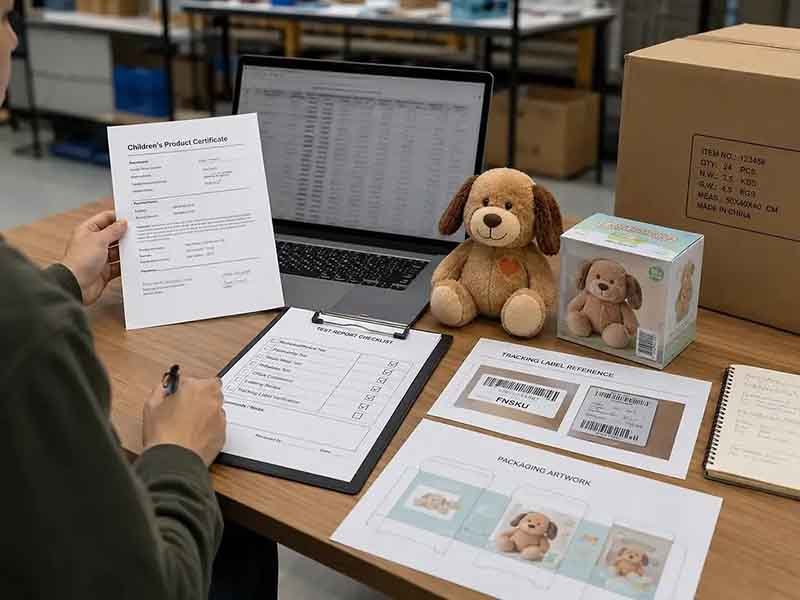
Packaging is part of compliance and retail readiness, not a decorative step added after the product is finished. Copyright lines, trademark symbols, age grading, warnings, importer details, product names, barcodes, market languages, case quantities, and warehouse labels must match the approved version. Retailers may also require FNSKU labels, display cartons, pallet markings, routing information, or specific packaging tests.
Testing samples should represent the intended production construction and materials. A specially reinforced sample or one made from substitute materials may produce results that do not reflect the final goods. Avoid suppliers that promise automatic compliance with every market before reviewing the product. A more trustworthy manufacturer explains what information is required, which risks are visible, who is responsible for each document, and how a design change may affect the testing or labeling route.
MOQ, Cost, and Schedule
MOQ should be reviewed by character, color, size, packaging, and market version. A quoted MOQ of 500 pieces may mean 500 pieces per design rather than 500 pieces divided across a collection. Clarifying that point early prevents large quotation differences. Practical minimums are influenced by fabric purchasing, dyeing, embroidery programming, printing setup, pattern development, cutting efficiency, costume complexity, packaging runs, test samples, and production-line changeovers.
A project with one character and 5,000 units is normally more efficient than a project with ten characters and 500 units each, even when the total quantity is identical. Each SKU requires separate patterns, embroidery, material allocation, quality references, labels, packaging, and carton control. The customer should therefore compare the quantity per SKU with the commercial role of each item rather than expanding the assortment simply because the total volume appears large.
Cost should be reviewed as a complete project. Development fees, samples, materials, decoration, packaging, testing, inspection, freight, duties, and destination handling may all affect the result. A lower ex-factory price can become expensive if the supplier needs repeated revisions, misses the launch date, fails testing, or ships inconsistent goods. The schedule should separately show artwork review, sampling, revision rounds, licensing approval, material booking, packaging, testing, production, inspection, freight, customs, and destination delivery.
Final Supplier Decision
Use a weighted scorecard so that price does not overpower the risks that matter most. A complex unreleased character with a fixed launch date should place greater weight on confidentiality, development skill, approval control, and delivery. A repeat order of a stable design can place more weight on cost and capacity. The exact percentages may change, but every score should be supported by evidence that the team has actually reviewed.
Useful categories include character-development capability, legal and factory transparency, quality control, confidentiality, compliance support, project management, capacity, packaging, communication, total project cost, and reorder support. A salesperson’s statement that the factory uses a golden-sample system is not equal to seeing the sample ID, approval record, linked BOM, and inspection method. Evidence should determine the score, not confidence or presentation style.
Before production, confirm the final artwork, style-guide version, approved sample, specifications, BOM, patterns, embroidery files, materials, colors, filling, labels, copyright wording, packaging, test plan, quantities by SKU, inspection criteria, schedule, change-control method, and approval authority. The best manufacturer is not the company that promises there will be no problems. It is the partner that identifies risks early, records decisions clearly, explains the consequences of changes, and keeps the approved character consistent from sample development through shipment and future reorders.
Conclusion
Finding a manufacturer for licensed character plush is ultimately an exercise in risk control. The factory must respect the rights behind the character, understand which visual details cannot drift, turn creative approvals into production data, and maintain a clear chain from artwork to sample, testing, packaging, mass production, and repeat orders. A supplier that only shows attractive samples may still be missing the systems required for a serious licensed merchandise program.
The most reliable selection process combines a complete project brief, authorization checks, factory verification, technical sampling, measurable fidelity review, written approval boundaries, golden-sample control, and a risk-weighted supplier scorecard. When these elements are in place, discussions about MOQ, cost, capacity, and lead time become far more accurate. Teams preparing a licensed character collection can also share the project files with Pufumi for a structured feasibility review covering product form, sample route, SKU allocation, materials, packaging, and production controls without turning the process into an aggressive sales conversation.
Frequently Asked Questions
Do I need a license before asking a factory to make character plush?
You should own the character, hold the relevant merchandise rights, or have written authority from the rights holder before manufacturing begins. A factory may review general feasibility under confidentiality, but it should not reproduce protected entertainment characters, logos, sports marks, university marks, celebrity likenesses, or other third-party assets without reasonable confirmation that the customer has the right to use them. The exact documentation depends on the relationship among the IP owner, licensee, agency, and manufacturer.
What is the difference between a licensed plush manufacturer and a normal custom plush factory?
A licensed plush manufacturer must manage more than pattern making and sewing. It should understand authorization boundaries, confidential asset handling, style guides, licensor approvals, copyright lines, market-specific packaging, sample version control, and the transfer of approved character details into mass production. A normal custom factory may be capable of making a simple mascot, but licensed programs often require more formal documentation, more stakeholders, and tighter controls over revisions and production release.
How can I verify that a plush factory has real licensed-project experience?
Ask for anonymized process evidence rather than only customer names. Useful records include revision sheets, material approvals, golden sample IDs, BOM histories, production-release forms, inline quality checks, packaging checklists, and multi-SKU control methods. Request a live factory walkthrough and ask the team to explain one complex project from artwork review to shipment. A supplier with genuine experience can usually describe specific technical decisions, approval challenges, and corrective actions without violating another customer’s confidentiality.
How many sample rounds are normal for licensed character plush?
There is no universal number because the result depends on artwork completeness, character complexity, size, materials, costumes, accessories, and the number of approving parties. A simple mascot may reach approval after one or two revision rounds, while a detailed licensed character may require a prototype, one or more revisions, an engineering or pre-production sample, packaging approval, and a final golden sample. The important point is that each round has a defined purpose and a recorded approval status.
What MOQ should I expect for licensed character plush?
MOQ depends on quantity per design, fabric purchasing, custom colors, embroidery setup, pattern complexity, accessories, packaging, and the number of market versions. In commercial custom plush manufacturing, several hundred units per design is a common starting range, but it is not a fixed industry rule. A total order of 5,000 units divided across ten characters may be harder to produce efficiently than 5,000 units of one character, so always confirm the minimum per SKU.
How do I keep mass production consistent with the approved sample?
Use an identified golden sample supported by released patterns, material codes, embroidery and print files, BOM, filling requirements, measurements, tolerances, labels, packaging artwork, and inspection checkpoints. Require first-piece approval for character-critical processes and conduct inline checks before most units are completed. The factory should also keep retention samples and version records so that reorders can be compared with the approved product rather than produced from memory.
How early should I contact a licensed plush manufacturer before launch?
Contact the manufacturer as early as possible, especially when the project involves several approving parties, custom materials, retail packaging, testing, or international freight. The calendar must include artwork review, pattern development, sample rounds, licensor feedback, material booking, pre-production approval, testing, manufacturing, inspection, and transportation. For a complex licensed collection, beginning several months before the required warehouse date is usually safer than planning around the factory’s sewing time alone.