Skip to content


A plush toy can look wonderfully simple: soft fabric on the outside, something fluffy on the inside, and a face that gives it personality. In manufacturing, however, that simplicity is deceptive. A commercial plush product can contain several outer fabrics, filling with different densities, embroidery thread, printed textiles, reinforcement layers, foam, weighting materials, metal hardware, labels, costume fabrics, and sometimes electronic modules. Change one of those materials and the finished toy may feel softer, look wider, sit differently, lose facial definition, cost more to produce, or behave differently after months of handling.
Most modern plush toys use polyester-based fabrics such as minky, velboa, short-pile plush, microfiber plush, fleece, or faux fur for the outer shell, combined with lightweight polyester or PP-type fiber filling. Depending on the design, manufacturers may also use embroidery thread, appliqué, printed fabrics, foam, internal support pieces, weighting pellets, plastic components, metal accessories, and electronic modules. The best combination depends on the toy’s size, target age, appearance, use, and quality requirements.
That is why asking what a plush toy is “made of” is more interesting than it first appears. Imagine producing two toys from the same approved drawing and sewing pattern. Give one a stable short-pile fabric with carefully controlled stuffing, then make the other from a stretchier long-pile fabric with heavier filling. The pattern may be identical, yet the two finished characters can look surprisingly different. Understanding that relationship between material and form is the key to understanding how professional plush products are developed.
What Materials Are Used in Plush Toys?
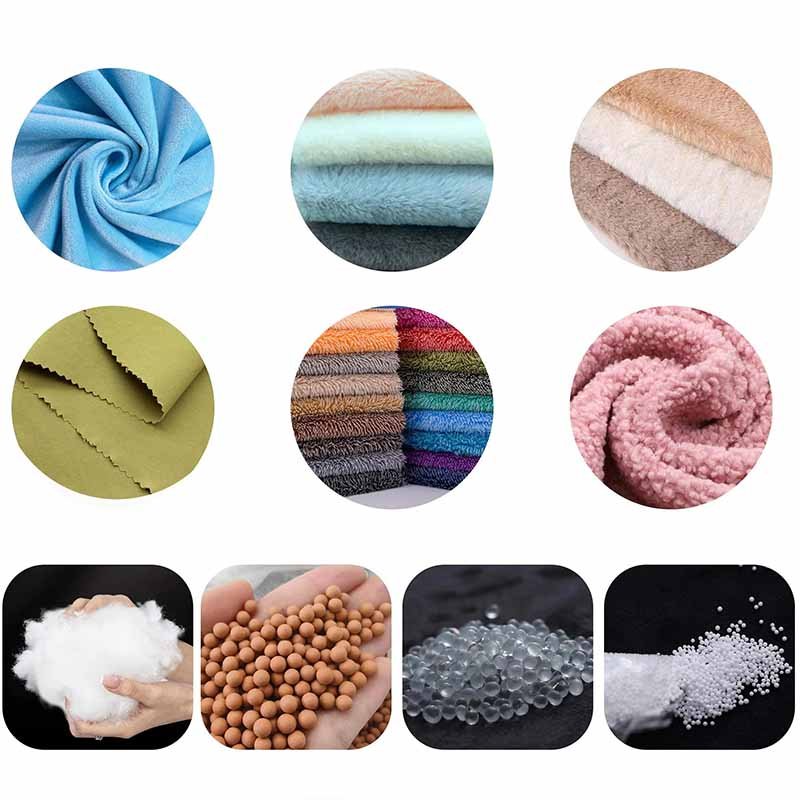
Most plush toys combine several material groups rather than one single material. The main groups are outer fabrics, fiber filling, sewing and embroidery threads, printed or appliqué details, internal support materials, accessories, labels, and sometimes weighting or electronic components. Each material influences appearance, softness, durability, weight, shape, or production consistency.
A useful way to understand plush construction is to think of the product in layers. The exterior provides color, pile, texture, and most of the tactile experience. The filling gives the body volume and determines how firm, floppy, supportive, or squeezable the toy feels. Facial details create recognition, while internal materials solve problems that cannot always be handled with fabric and fiber alone. A standing character may need localized support, a weighted plush requires contained mass, and an interactive product needs protected space for modules and wiring.
Commercial production introduces another requirement: repeatability. A material description such as “soft pink plush” may be good enough for casual conversation, but it is not detailed enough for a product expected to be reproduced across multiple production runs. Professional specifications may record fabric composition, pile length, GSM, stretch, backing, color reference, filling type, hardware dimensions, embroidery colors, internal structure, and permitted substitutions.
A structured bill of materials can therefore include the main shell fabric, secondary fabrics, clothing materials, filling, support pieces, embroidery thread, printing, eyes or noses, metal hardware, labels, electronic parts, and retail packaging. Pufumi’s documented product-development system similarly treats the BOM as a structured record connecting materials with sourcing, sampling, production, quality control, and repeat-order traceability.
| Plush Component | Common Materials | Useful Specifications | Main Function |
|---|---|---|---|
| Main shell | Minky, velboa, short plush, faux fur, fleece | Composition, pile, GSM, stretch, backing | Appearance and touch |
| Filling | PP/polyester fiber, high-rebound fiber | Type, unit weight, density, distribution | Softness and volume |
| Face | Embroidery, appliqué, printing | Thread color, stitch file, print method | Expression and identity |
| Internal support | Foam, lining, support sheet, inner bag | Thickness, shape, location | Shape and stability |
| Accessories | Rings, chains, clasps, clothing fabrics | Size, finish, attachment | Styling and function |
| Weighted parts | Pellets or specified weighting media | Type, weight, compartment | Balance and heavy feel |
| Interactive parts | Speaker, wiring, buttons, battery unit | Model, position, protection | Sound, light, interaction |
Outer Fabrics
The outer fabric determines much of what consumers immediately notice. Minky can produce a soft, smooth surface; short plush provides a clear character outline; velboa offers a relatively controlled short pile; faux fur creates depth and realism; sherpa gives a warm, curly texture; velvet brings directional sheen; and microfiber plush can create a refined, very soft finish.
The actual fiber composition does not tell the whole story. Many very different plush fabrics are polyester-based, yet their pile height, density, knit construction, stretch, backing, weight, and finishing can vary dramatically. A dense 2–3 mm short pile and a long faux fur may both contain polyester but perform almost like different material families once they are cut, sewn, embroidered, filled, and packaged.
Fabric must also support the scale of the product. Thick materials can work beautifully on a large animal but become difficult to turn through a narrow seam on a miniature hand or ear. Highly elastic fabric can make rounded forms comfortable, but it may also allow an approved face to widen after filling. Long pile can enhance a realistic animal while hiding small embroidery on an anime character.
This is why a manufacturer’s material library is more useful when it records measurable specifications rather than simply displaying attractive swatches. Pufumi’s material records, for example, cover categories such as minky, velboa, short plush, faux fur, sherpa, fleece, velvet, microfiber plush, printed and custom-dyed fabrics, while also connecting materials with sampling and production information.
Filling and Internal Structure
The inside of a plush toy usually begins with lightweight synthetic fiber, but the engineering becomes more interesting once shape and function are considered. Filling affects cheek volume, body firmness, limb thickness, sitting posture, rebound, squeeze, and total weight. The head may need more support than the torso, while ears or tails often need less filling so they remain flexible rather than stiff.
Additional internal materials may be introduced when loose fiber cannot perform a specific job. Foam can support a muzzle, shoe, wing, or structured accessory. Inner fabric compartments can separate weighted material from ordinary filling. Reinforcement can strengthen a hanging point used by a plush keychain or bag charm. Partition fabrics can stop filling from migrating between regions or create deliberately different handfeel across the body.
A well-engineered product uses these hidden materials selectively. Adding internal structure everywhere can make a plush unnecessarily hard, complicated, expensive, or difficult to clean. The better approach is to let the sewing pattern and controlled fiber filling create as much of the shape as possible, then introduce foam, reinforcement, or supporting materials only where they provide a clear functional benefit.
Even when consumers never see these materials, they should still be part of the technical record. A hidden support changed during a repeat order can alter posture or handfeel just as noticeably as changing the exterior fabric.
Faces and Decorative Materials
A plush face may use embroidery, printing, appliqué, dimensional components, or a mixture of techniques. Embroidery is especially common for character products because it can reproduce eyes, eyebrows, mouths, noses, logos, facial lines, and other identifying details without adding a separate protruding piece to the surface.
Embroidery quality is closely linked to fabric choice. Long pile can partly cover fine stitches, which means eyelashes, narrow mouths, or tiny graphic lines may disappear into the surrounding fibers. Thin or highly elastic fabric can pucker under dense embroidery, while very small products may not have enough surface area to reproduce all the details found in the original artwork. A design that looks excellent at 30 centimeters may therefore need intelligent simplification when developed as an 8-centimeter bag charm.
Printing is useful when the artwork contains complex gradients, all-over patterns, animal markings, small repeated graphics, or textures that would be inefficient to embroider. Flatter fabrics generally reproduce print detail more clearly than deep pile because the printed image remains visible instead of moving with long fibers.
Dimensional eyes, noses, badges, and other parts can also be appropriate for certain products, especially realistic animals or styles where physical depth contributes to the expression. Those components should be treated as specified product parts rather than decorative afterthoughts.
Accessories and Functional Parts
Modern plush products often extend well beyond a simple stuffed body. A mascot can wear a miniature jacket and shoes. A bag charm may include a lobster clasp, chain, reinforcement point, and decorative badge. A blind-box character may have a tiny costume made from several contrasting textiles. An interactive plush may contain a sound unit, speaker, button, wiring, or battery compartment.
These additional materials can affect durability and production as much as the main fabric does. Consider a plush keychain: the toy itself may weigh very little, but repeated hanging and movement place stress on the attachment point. The chain and clasp therefore need a reliable connection to the textile structure rather than being treated as something simply sewn onto the surface.
Character clothing creates another layer of material selection. Woven fabrics, knits, mesh, artificial leather, metallic textiles, ribbons, hook-and-loop materials, foam, and printed fabrics can all appear in a single product. Each may behave differently during sewing and handling.
The practical lesson is that a plush toy should be evaluated as one assembled product. The quality of an excellent main fabric cannot compensate for weak hardware, unstable costume parts, inappropriate internal supports, or poorly engineered decorative attachments.
Which Fabrics Are Best for Plush Toys?

There is no single best fabric for every plush toy. Minky is useful when softness and clean details matter, short plush supports precise character faces, velboa offers a controlled short surface, faux fur suits realistic animals, while fleece, sherpa, velvet, and microfiber each serve different tactile and visual purposes. The best fabric matches the product’s scale, geometry, detailing, use, and manufacturing requirements.
Fabric selection should begin with the finished product rather than the swatch book. A textile may feel wonderful in your hand and still create problems after it is transformed into a three-dimensional product. A dense long pile can make a large animal look luxurious, yet overwhelm an 8-centimeter collectible. A highly elastic fabric may produce a pleasant squeeze but expand enough during filling to alter the character’s eyes, cheeks, or body width.
Several physical variables are worth considering together. Pile length affects how much of the underlying pattern is visually visible. GSM, measured in grams per square meter, gives an indication of material weight but does not independently determine quality. Density influences coverage, backing visibility, and handfeel. Stretch influences final dimensions. Backing construction affects sewing stability. Surface texture changes how embroidery, printing, photography, and wear appear.
For commercial products, availability also matters. The perfect fabric for the first sample is not truly perfect if it cannot be obtained reliably for production or future reorders. A good material decision balances aesthetics, engineering, cost, availability, consistency, and the intended retail position.
| Fabric | Typical Surface | Common Applications | Key Development Issue |
|---|---|---|---|
| Minky | Smooth, soft, short pile | Character plush, comfort products | Stretch and backing |
| Velboa | Short, relatively flat | Animals, basic characters | Grade and density |
| Short plush | Dense, defined | Anime, game, mascot, mini plush | Detail visibility |
| Faux fur | Long, dimensional | Realistic animals, creatures | Direction and trimming |
| Fleece | Soft, flatter surface | Pillows, simple plush | Pilling and wear |
| Sherpa | Curly, textured | Cozy and seasonal products | Fine-detail visibility |
| Velvet | Directional sheen | Premium and gift plush | Nap direction |
| Microfiber plush | Fine, refined touch | Premium soft-touch products | Batch consistency |
Minky, Velboa, and Short Plush
Minky has become popular in plush development because it offers a useful balance between softness and visual control. Its relatively short surface allows facial embroidery and seam-defined shapes to remain visible, making it a practical choice for character plush, comfort-oriented products, gifts, and designs where the consumer is expected to handle the toy frequently.
Velboa typically presents an even shorter, flatter texture. It can be effective for animal plush, simpler character products, promotional styles, or projects that benefit from a relatively clean surface. The important qualification is that velboa exists in different grades. A low-density construction and a well-made dense construction may share the same fabric category name while producing noticeably different handfeel and finished appearance.
Short plush is particularly useful when character recognition depends on precise graphics. Anime eyes, game-character facial details, logos, cheek embroidery, and small costume boundaries remain clearer when the pile does not surround and cover the stitching.
For all three categories, the marketing name is less important than the real specification. When an approved product needs to be reproduced later, pile height, GSM, backing, density, elasticity, supplier reference, and color sample provide much more reliable information than simply recording “minky” or “short plush.”
Faux Fur and Sherpa
Faux fur works best when the visible hair itself contributes to the character. Realistic bears, wolves, cats, wildlife plush, fantasy creatures, long-haired mascots, and premium animal merchandise can benefit from the depth and movement that long fibers create. The fabric softens seam transitions and produces a more natural appearance under different lighting angles.
The production process becomes more demanding as pile length increases. Pattern pieces need consistent pile direction or neighboring areas may appear to grow in conflicting directions. Cutting can generate loose fibers. Hair can become trapped inside seams and needs to be brushed out. Facial regions may require trimming so the eyes, nose, mouth, or embroidery remain visible.
Sherpa provides a different kind of volume. Instead of long individual hairs, its curled or wool-like texture creates a cozy, warm appearance that works particularly well for teddy-inspired products, sheep characters, winter collections, home-oriented plush, and lifestyle merchandise.
Texture should support rather than fight the artwork. A highly detailed face with narrow embroidery lines may be easier to develop using short plush around the face while retaining faux fur or sherpa on the body. Combining materials can preserve both character accuracy and the desired tactile experience.
Fleece, Velvet, and Microfiber
Fleece is useful when the product requires a soft surface without a traditional high pile. It works well for plush pillows, simplified characters, clothing pieces, soft accessories, and products where comfort and practicality matter more than a visibly furry appearance. The specific construction should still be checked for rubbing and pilling, particularly on products that will experience repeated handling.
Velvet moves in the opposite visual direction. Its short directional nap produces changing highlights and shadows, which can create a refined, premium appearance on collector items, fashion collaborations, decorative characters, and gift products. That directional quality also means pattern pieces need to be cut consistently. Opposing nap directions may make identical fabric appear to be different colors under the same light.
Microfiber plush can deliver an exceptionally fine, smooth handfeel. It is useful when a product needs softness without the visual bulk of long fur. Premium gifts, lifestyle plush, comfort characters, and certain baby-oriented designs may benefit from this surface.
None of these fabrics is automatically premium or basic simply because of its name. Density, finishing, backing, dye quality, surface stability, sewing performance, and the way the fabric works on the finished form ultimately determine the result.
Fabric Choice for Mini Plush
Mini plush deserves special attention because making a product smaller does not make the material problem easier. As a plush shrinks, fabric thickness and seam allowance consume a larger percentage of the available space. A thick fabric that behaves comfortably on a 30-centimeter character may produce bulky fingers, rounded ears, distorted horns, or an oversized face when used on a miniature version.
Pile length becomes equally important. Imagine a 7-centimeter collectible with 10-millimeter fur around the eyes. The hair can occupy so much visual space that the face loses definition even if the embroidery is perfectly positioned. Short-pile plush, fine minky, controlled velboa, and microfiber surfaces are therefore often more practical for small products.
Embroidery also needs to scale intelligently. A facial highlight consisting of several tiny thread elements may need simplification because stitch width does not shrink infinitely. Clothing seams, appliqué edges, and tiny accessories face the same constraint.
A successful multi-size collection does not necessarily use exactly the same material specification at every size. The goal is to preserve the same character impression. Sometimes that requires changing pile length, fabric thickness, embroidery detail, or filling strategy as the product moves from a large hero plush to a mini collectible or bag charm.
What Is Plush Toy Stuffing Made Of?

Most plush toys are filled with lightweight synthetic fiber, often described as polyester fiberfill or PP-type filling. Depending on the product, manufacturers may also use high-rebound fiber, recycled filling, foam, weighted material, or several filling types in different regions. Filling controls much more than softness: it influences volume, posture, facial shape, weight, rebound, balance, and production consistency.
Stuffing is often treated casually in consumer descriptions because it is hidden once the toy is closed. In production, filling is one of the last major variables shaping the finished product. A correctly sewn head can look wrong if the cheeks receive too little fiber. A body can feel unnaturally hard if it is packed too tightly. A seated animal may tip backward if filling and weight distribution move the center of gravity.
Even total filling weight does not tell the complete story. Two pieces can contain the same number of grams yet feel and look different because the fiber is distributed differently. A product with more filling concentrated in the head may have a wider face, while another with more in the torso may feel firmer through the body.
Pufumi’s documented filling controls treat material type, weight, density, softness, regional distribution, support, and rebound as defined product characteristics. This approach also recognizes that the same pattern and fabric can produce noticeably different results when filling changes.
Standard Fiber Filling
Standard polyester or PP-type filling is the workhorse of the plush industry because it creates substantial volume without adding much weight. It can be used across stuffed animals, mascots, character plush, mini plush, bag charms, keychains, pillows, and many other product formats.
The phrase “PP cotton” appears frequently in commercial sourcing conversations, although the word “cotton” should not be interpreted automatically as natural cotton fiber. A product developer should confirm the real composition and specification rather than relying on a colloquial name.
Synthetic fiber fillings can also differ substantially from one another. Fiber fineness, shape, surface treatment, spring, bulk, and resilience influence how the material feels after compression. Some grades create a softer and more open structure; others feel denser or more supportive. Those differences become easier to notice in large cuddle products where consumers squeeze a significant volume of filling.
Repeat orders benefit from material control. Replacing a familiar filling with another material of similar appearance may change the handfeel even if the product’s overall weight remains the same. For successful long-term SKUs, the filling should therefore be considered part of the product identity rather than an interchangeable commodity.
High-Rebound and Premium Filling
High-rebound filling is considered when the desired product experience calls for greater spring, softness, or recovery after squeezing. Large comfort plush, pillows, premium gifts, and soft lifestyle products may benefit from a filling that quickly recovers its shape after compression.
The word “premium,” however, should not be confused with “softer in every area.” Character accuracy sometimes requires firmer regions. A face may need enough support to keep the eye spacing and cheek shape stable. A standing mascot requires stronger support through the legs and lower body. A bag charm needs to hold its silhouette without becoming unnecessarily heavy.
The fabric also changes the way the filling feels. A springy material inside a stretchy textile can expand the shell more noticeably, creating a softer but rounder product. The same filling contained by a dense, stable backing may feel significantly firmer.
Sample approval is therefore more useful when the desired tactile experience is defined by region. Instead of simply requesting “more premium stuffing,” a development team can specify a stable head, softer belly, structured feet, or relaxed limbs. Those observations can then be compared with the approved physical sample during production.
Foam and Mixed Filling
Foam is generally introduced to solve a local shape problem rather than replace ordinary fiber filling. A muzzle may need more definition, a shoe may need to remain flat, a hat brim might collapse without support, or a wing may need to hold a particular angle. Thin foam or other internal structure can help those areas maintain geometry.
Mixed filling goes a step further by allowing different parts of a single plush to behave differently. A character could use supportive fiber in the head, softer fiber through the body, thin foam in a hat, and a weighted insert in the base. A large animal could use more resilient filling in the torso while keeping the limbs relaxed and flexible.
This type of construction is powerful but adds production complexity. Workers need to know exactly which filling belongs in which zone, how much is required, and how the finished region should feel. Materials must remain separated during assembly, while inspectors need a reliable physical reference.
The goal should be purposeful complexity rather than complexity for its own sake. When the sewing pattern and ordinary filling can achieve the desired result, additional internal materials may be unnecessary. When they cannot, mixed filling provides a practical engineering tool for achieving shape, balance, and handfeel simultaneously.
Weighted Filling
Weighted plush requires a different design mindset because the product contains concentrated mass rather than only light fiber. Weighting materials may include specified pellets or other media selected according to product requirements, intended use, market, and target user.
Those materials should normally be contained in a dedicated internal bag or divided compartment. Allowing particles to move freely through the main body makes the weight unpredictable and can produce uncomfortable clusters. Controlled containment keeps the mass where the designer intended it and allows the product’s center of gravity to remain more consistent.
Placement is as important as quantity. Weight positioned at the bottom can improve sitting stability. Weight through the torso creates a heavier cuddle experience. Weight in the limbs changes how the product drapes or hangs when picked up.
The extra mass also places greater stress on seams and internal structures. A weighted plush dropped onto a surface generates different forces from a lightweight fiber-filled product. Material type, quantity, compartment strength, location, seam construction, and finished unit weight therefore belong in the development specification rather than being decided casually during stuffing.
How Do Materials Affect Plush Quality?

Plush quality depends on measurable material properties as much as on workmanship. Pile length influences facial detail, GSM and density affect surface feel, stretch changes finished dimensions, backing affects seam stability, and filling determines shape and rebound. The best material is therefore not simply the softest or thickest option; it is the material that performs consistently in the intended product.
When two plush toys are placed side by side, consumers often describe one as feeling “better” without identifying the reason. The difference may come from several subtle factors acting together: denser pile, a more stable backing, smoother fibers, better filling distribution, cleaner embroidery, or a surface that recovers well after packaging. None of those factors alone defines quality, but together they shape the experience.
Quality also changes according to use. A collectible displayed inside a box is exposed to relatively little friction. A bag charm can rub against clothing and bags every day. A child’s cuddle plush may be squeezed, dragged, cleaned, and compressed repeatedly. A large retail mascot needs to maintain recognizable proportions across many units.
The right question is therefore not whether one material is “higher quality” in isolation. It is whether the material specification is appropriate for the product’s visual requirements, expected handling, manufacturing process, packaging, and repeat-order needs.
Pile Length, Density, and GSM
Pile length changes the apparent geometry of a plush. Short fibers sit close to the fabric backing and allow the underlying sewn form to remain visible. This makes them useful for character faces, logos, fine embroidery, mini products, and clean graphic silhouettes. Long pile visually extends beyond the paper pattern and softens edges, making it better suited to realistic animals or deliberately fuzzy characters.
Density determines how much surface coverage the fabric provides. If fibers are sparse, bending or stretching the shell around a heavily filled area may expose the backing underneath. Higher density can create a fuller, more luxurious look, although it may also increase weight, thickness, and cost.
GSM—grams per square meter—is useful because it provides a standardized measure of fabric weight. It should not be treated as a universal quality score. A 300 GSM short dense textile and a 300 GSM longer-pile textile can have completely different structure and handfeel.
Experienced developers therefore examine pile height, GSM, density, backing, and thickness together. A material must also fit the product’s scale. Heavy, thick textiles can become difficult to sew cleanly when seam allowances are compressed inside miniature ears, hands, horns, or clothing details.
Stretch and Dimensional Control
Stretch changes what happens after a two-dimensional pattern becomes a filled three-dimensional object. Once fiber pushes against the shell, an elastic material can expand. If it stretches more across the width than the length, a nominally round head may become slightly wider, and eye spacing can appear different from the flat embroidery layout.
Some stretch is useful. It creates soft curves, improves squeeze, and allows fabric to conform comfortably around rounded shapes. The problem appears when stretch is not understood during pattern development or changes between the approved sample and production material.
Material substitution deserves particular attention. Two fabrics can match closely in color, pile, and handfeel but behave differently after stuffing because their elastic recovery or backing is different. Replacing one with the other without checking the complete product may cause size or proportion changes.
This is especially important for character faces. A few millimeters of visual change around the eyes, cheeks, mouth, or head width can affect character recognition even when the product remains within ordinary textile-manufacturing tolerances.
For repeatable production, the fabric should therefore be considered part of the pattern system rather than a decorative surface placed over an independent shape.
Embroidery and Printing Performance
Embroidery does not exist separately from the material beneath it. Dense stitches pull inward on the textile while filling pushes outward after assembly. Thin, unstable, or highly elastic fabric can therefore pucker or distort around the embroidery area. Long fibers may also bend over narrow stitched details and make them appear smaller.
This matters particularly for character plush, where a few embroidered lines can define the entire expression. Eyes that are technically positioned according to the design file may still look wrong if the surrounding pile obscures their lower edges. A narrow mouth may nearly disappear in deep fur. A small logo can lose clarity when stitch density becomes too high for the available surface.
Printing presents its own challenges. Flat short-pile materials generally reproduce fine graphics better than long or strongly textured surfaces. Stretch can change printed areas after stuffing, while dark base colors and surface texture can influence color appearance.
Testing a graphic on the actual production fabric is therefore much more informative than reviewing only the embroidery file or digital artwork. For high-detail characters, the best decision is often made after seeing the decorated fabric transformed into the filled three-dimensional face.
Filling and Shape Consistency
Filling is one of the final sculpting stages in plush manufacturing. Even when cutting and sewing are accurate, uncontrolled stuffing can produce faces that look wider or flatter, limbs with different thicknesses, bodies with inconsistent firmness, or products that sit at different angles.
Consider two pieces that each contain 250 grams of filling. One may receive more material around the cheeks and head, while the second has more concentrated in the body. Their total weights match, but their appearance and handfeel can still differ substantially.
Regional distribution is therefore as important as total filling weight. The head may need enough support to maintain facial geometry. The body may need softer compression for comfort. Feet may require firmer filling for stability. Ears and tails may need lighter treatment so they maintain a natural shape.
Production references help turn this subjective work into a controlled process. Pufumi’s documented filling method links weight and regional distribution with the BOM, approved Golden Sample, and production tolerance rather than depending exclusively on an operator’s memory.
For long-term products, this combination of measurable targets and physical comparison is one of the best ways to keep handfeel and silhouette reasonably consistent from one manufacturing run to another.
Are Plush Toy Materials Safe?
Plush toy material safety depends on the complete product rather than one fabric name. Target age, intended market, accessibility of small components, attachment strength, internal structure, weighting materials, electronics, labels, and applicable testing requirements all matter. A familiar material such as polyester cannot automatically make every finished plush suitable for every user or market.
It is tempting to divide materials into simple categories of “safe” and “unsafe,” but real product development is more nuanced. Soft exterior fabric may surround foam, metal hardware, plastic components, weighted compartments, wiring, or batteries. A material that works appropriately inside a collector item may require different evaluation when used in a product intended for a very young child.
Safety also depends on construction. A small component securely incorporated into one design may behave differently when attached using another method. Weighting material contained in a strong internal compartment presents a different situation from freely moving pellets. A removable electronic module changes cleaning instructions and access requirements.
The practical approach is to define the intended user and market before finalizing materials. Fabric, filling, facial components, internal structure, accessories, labels, cleaning expectations, and testing requirements can then be considered together instead of being treated as separate decisions late in the project.
Target Age and Intended Use
Target age changes the way a plush product is expected to be handled. An adult collector may display a limited-edition character on a shelf and touch it occasionally. A comfort plush intended for younger users may be squeezed, carried, pulled, slept with, cleaned, and handled repeatedly. Those use patterns create different priorities for fabrics, accessories, seams, internal components, and cleaning.
Material selection should therefore begin with a clear product definition. A soft textile that works visually does not answer questions about the entire construction. Facial parts, decorative accessories, cords, hard components, support sheets, weighted sections, and functional modules all need to make sense for the intended user and product category.
The intended use also affects durability expectations. A plush keychain may face continuous friction against a backpack. A theme-park souvenir might be handled by many shoppers before purchase. A boxed collectible can prioritize visual finish and shape retention.
Defining these conditions before the first prototype gives the development team a more useful basis for choosing materials. It also reduces the risk of approving an attractive sample and later discovering that major structural changes are needed for the intended age or use scenario.
Embroidery, Eyes, and Facial Parts
Embroidery is widely used for plush faces because the detail becomes integrated into the textile surface. It is especially effective for character eyes, mouths, noses, eyebrows, logos, and graphic expressions. A well-developed embroidery design can preserve the unique personality of a licensed character without adding an external dimensional component.
Plastic eyes and noses are also common in certain stuffed animals and decorative products, particularly where dimensional appearance is part of the desired style. They should not be treated as automatically suitable or unsuitable simply because they are plastic. Size, attachment method, accessibility, target age, product structure, and applicable product requirements all matter.
From a design perspective, embroidery and dimensional parts also solve different visual problems. Anime and game characters often rely on specific graphic eye shapes that are easier to control using thread. Realistic animal products may benefit from the depth and reflections of dimensional eyes.
Printing is another option when artwork contains complex gradients or fine graphic textures. The safest and most successful approach is not to choose a facial method based on one general rule, but to evaluate how the complete detail system fits the intended user, appearance, fabric, product size, and manufacturing structure.
Weighted and Internal Components
Weighted plush requires more deliberate internal engineering because concentrated mass changes the way the product behaves under handling. Weighting material should be specified and contained rather than placed loosely inside the main body. Internal bags or divided compartments help prevent migration and keep the mass in the intended region.
Containment is only part of the issue. Added weight increases the mechanical load experienced by seams and supporting structures. A weighted body landing on the floor, being lifted repeatedly, or hanging from one area produces greater forces than an ordinary lightweight plush. That makes internal placement and seam design relevant to the overall structure.
Foam, support sheets, reinforcement materials, and electronic components should receive the same attention. A rigid support can improve the appearance of a wing or shoe, but poorly positioned material can create an uncomfortable hard point. Wiring or battery units in interactive products need to remain protected from surrounding filling and manufacturing operations.
Pufumi’s internal material framework records support and weighting components by material, location, function, and containment rather than treating them as invisible parts that do not need specification.
Testing and Material Documentation
Testing requirements depend on the target market, intended age, product structure, materials, features, and customer specifications. It is therefore misleading to assume that using a familiar fabric automatically means a finished plush meets every requirement for every country or retail channel.
Planning should begin early because replacing material late in development can trigger a chain of changes. A new fabric may differ in stretch, pile, color, or embroidery behavior. A different component can affect product weight or structure. New artwork or labeling may be required when material composition changes. The approved sample itself may need to be reviewed again.
Documentation also matters when brands make composition or sustainability claims. If only one fabric contains recycled content, the statement should reflect that specific component. A supplier certificate relating to one material does not automatically certify every material in the finished plush.
Pufumi’s documented environmental-claim approach follows this principle by tying claims to the relevant material, batch, project, evidence, and defined scope rather than expanding a component-level fact into a broad unsupported product claim.
That evidence-based mindset is useful beyond sustainability. The more clearly materials, suppliers, batches, test information, and approved samples are connected, the easier it becomes to make accurate product decisions.
How Do You Choose Plush Toy Materials?
Choose plush materials by defining the finished product first: appearance, size, target user, market, handfeel, durability, detailing, function, packaging, cost, and repeat-order requirements. Then compare physical fabric and filling specifications, make prototypes, approve the actual materials, and record them in the BOM. Good selection balances visual appeal with manufacturability and consistency.
Starting with a fabric name often leads the development process in the wrong direction. “Use minky” does not tell a manufacturer whether the product needs a dense short pile, extra-soft stretch, matte appearance, specific GSM, stable backing, or precise color match. “Use faux fur” says even less about the length, density, backing, pile direction, or trimming requirements.
A better process begins with the intended product experience. Is it a 10-centimeter collectible or a 45-centimeter cuddle plush? Does the face depend on tiny embroidered details? Will the product hang from a bag? Does it need to sit independently? Is it intended mainly for display, repeated handling, or comfort? Will it be compressed during shipping? Is the product expected to remain in the assortment for several years?
Those questions narrow the material choices naturally. Once the likely fabric and filling combination has been identified, physical swatches and prototypes turn assumptions into observable results. The approved product can then become a controlled reference for production and future orders.
| Specification | Common Record | Practical Reason |
|---|---|---|
| Composition | Fiber percentage | Material identity and labeling |
| Pile length | mm | Detail visibility and texture |
| GSM | g/m² | Fabric weight and sewing bulk |
| Width | cm | Consumption and cutting efficiency |
| Stretch | Direction / measured behavior | Pattern and filling response |
| Filling | Type and unit weight | Shape and handfeel |
| Color | Swatch, Pantone reference, material code | Visual consistency |
| Hardware | Material, finish, dimensions | Function and appearance |
| Material lot | Batch reference | Traceability |
| Substitution | Approval record | Change control |
Match Materials to Product Type
Different plush categories demand different material behavior. A realistic animal needs surface depth, pile direction, grooming, and perhaps several fur lengths. A mini collectible needs compact seams, fine fabric, visible embroidery, and controlled filling. A bag charm adds hardware loading, surface abrasion, and weight limitations. A large cuddle plush needs a comfortable shell and filling that recovers well after compression.
Weighted products require contained mass and structural planning. Interactive products need protected internal space for sound or electronic modules. Plush pillows place more emphasis on body softness, filling resilience, and shipping volume. A mascot may prioritize recognizable proportions, brand color, and long-term repeatability.
Thinking in terms of product role immediately improves material selection because each option can be judged against a real requirement. Instead of asking whether faux fur is better than minky in the abstract, the team can ask which one better preserves the animal’s appearance at the intended size. Instead of deciding whether high-rebound filling is “better,” they can determine whether the product needs a soft squeeze, strong shape retention, or both in different zones.
A strong material system is therefore product-specific. Even two plush toys using the same character artwork may need different specifications when one is a small keychain and the other is a large premium display product.
Match Materials to Character and Scale
Character recognition often depends on a surprisingly small number of visual features. Eye shape, cheek volume, ears, hairstyle, color boundaries, costume, tail, wings, or a distinctive prop may be more important than the amount of decorative detail across the rest of the product.
Material selection should protect those features. Long fur may work on the body but need to be shortened around the face. A very soft stretch textile might suit the body while a more stable short fabric is used under precise embroidery. Metallic textile or artificial leather may belong only on a costume detail rather than covering a large surface.
Scale changes all of these decisions. When a 30-centimeter character becomes an 8-centimeter collectible, the fabric does not become proportionally thinner unless a new specification is selected. The same pile suddenly looks much longer relative to the head. The same seam allowance occupies more internal space. Embroidery lines take up a larger percentage of the facial area.
Experienced plush development therefore treats downsizing as reinterpretation rather than simple reduction. The goal is to preserve the character’s visual language even if the fabric pile, thickness, embroidery, accessory dimensions, and filling need to change.
Balance Cost, Performance, and Supply
Material cost should be considered in terms of the finished product rather than only the price per meter or kilogram. A lower-priced fabric can become expensive if it produces more cutting waste, slows sewing, increases rejection, or creates visible quality problems.
Fabric width affects how efficiently pattern pieces can be arranged. Directional faux fur can reduce layout efficiency because every piece must follow the correct pile direction. Custom-dyed materials may introduce additional material commitments and lead time. Thick fabrics can slow assembly or create extra work in miniature details. Accessories with many finishes and small components add their own sourcing and assembly complexity.
The opposite mistake is overengineering. A premium material does not need to appear in every hidden or secondary part simply because it costs more. Effective cost engineering preserves the features that consumers notice and value—character accuracy, key touch surfaces, durability, recognizable colors, attractive detailing—while simplifying elements that do not materially improve the finished experience.
Supply continuity matters alongside price. A successful product may need repeat orders for several seasons. A slightly more practical fabric with stable availability can sometimes be a stronger commercial choice than an unusual textile that becomes difficult to source after the initial launch.
Approve, Record, and Control Materials
Physical approval is essential because digital color and texture are unreliable. Phones, monitors, lighting, camera settings, image compression, surface gloss, and pile direction can all change the way a material appears. A fabric that seems correct in a photograph may look quite different beside an approved physical sample.
After selection, the material should be identified precisely enough to support production. Useful information can include supplier, composition, material code, color reference, pile, GSM, width, stretch, backing, approved swatch, and any specific restrictions. Filling and accessories should receive the same treatment.
The finished approved sample then provides something data alone cannot: a physical definition of how the materials are supposed to work together. Production can compare surface feel, filling, color, facial shape, hardware, clothing, and overall appearance with that reference.
Substitutions should be reviewed carefully. A fabric may match the color but stretch more. Filling can look identical but recover differently. A metal clasp can have the same dimensions yet use a visibly different finish. Pufumi’s material-management approach links physical material records with sampling, BOM, production control, substitutions, and repeat orders so approved materials do not depend solely on staff memory.
For brands developing custom plush, this is where material knowledge turns into commercial reliability. Choosing attractive materials creates a good prototype; controlling those materials creates a product that can be produced, reordered, and expanded into a consistent product line.
A good plush toy is rarely the result of choosing the softest fabric available. It comes from matching the exterior textile, filling, facial construction, internal structure, accessories, and production controls to the purpose of the product. A mini collectible needs different material logic from a realistic animal, a weighted comfort plush, or a large mascot, even when all four products could casually be described as “soft toys.”
For brands developing a new character or plush collection, the most productive material conversation usually starts with the artwork, intended size, target user, market, quantity, desired handfeel, product position, packaging, and expected use. From there, materials can be evaluated through swatches and prototypes instead of vague descriptions. Pufumi can support this type of custom plush development by reviewing the material combination together with the pattern, filling, detailing, sample, and production requirements, helping turn an attractive concept into a product that can be manufactured and reproduced consistently.
Frequently Asked Questions
What is the most common material used for plush toys?
Polyester is one of the most widely used fiber families in commercial plush manufacturing because it can be engineered into many different surface structures. Minky, velboa, short plush, microfiber plush, fleece, sherpa, and many faux-fur constructions can be primarily polyester while looking and feeling very different. Polyester-type fiber is also widely used as stuffing. The exact fabric construction, however, matters more to the finished result than the word “polyester” alone.
What is the soft fabric on plush toys called?
There is no single fabric called simply “plush toy fabric.” Soft plush products can use minky, short-pile plush, microfiber plush, velboa, fleece, sherpa, faux fur, velvet, or other textiles depending on the intended texture and design. Minky is particularly well known for its smooth, soft handfeel, while faux fur creates a deeper hairy texture and short plush is often selected where character faces and embroidery need clearer visual definition.
What are stuffed animals usually filled with?
Most conventional stuffed animals use lightweight synthetic fiber filling, commonly described as polyester fiberfill or PP-type filling. Different grades can vary in softness, resilience, bulk, and rebound. More specialized products may use high-rebound fiber, recycled filling, foam, contained weighting material, or mixed filling structures. The amount and distribution of stuffing are as important as the material itself because they control the product’s firmness, facial shape, posture, balance, and squeeze.
Is minky or fleece better for plush toys?
Neither fabric is universally better. Minky generally offers a softer, more plush-like surface and is often well suited to character products, gifts, and comfort-oriented designs. Fleece tends to have a flatter, cloth-like surface and can work well for simple shapes, pillows, apparel details, and functional products. The better choice depends on product size, desired handfeel, embroidery, surface durability, stretch, backing, cost, and the visual style the designer is trying to achieve.
What is the best fabric for making small plush toys?
Small plush products usually benefit from relatively thin, stable fabrics with short or controlled pile. Fine minky, dense short plush, microfiber plush, and some velboa constructions can work well because they do not overwhelm small facial features or create excessive bulk inside narrow seams. Material thickness becomes increasingly important as product size decreases, so a fabric that works well on a 30-centimeter plush may need to be changed for an 8-centimeter mini version.
Can plush toys be made from recycled materials?
Yes. Selected plush projects can use recycled polyester fabrics, recycled filling, or other materials with documented recycled content. The claim should remain specific to the component supported by the available evidence. If only the main fabric contains recycled material, it should not automatically be described as an entirely recycled toy. Brands should review material composition, supplier documentation, applicable certificates, production batches, handfeel, color consistency, availability, and the exact wording they intend to use in product marketing.
How do manufacturers choose materials for custom plush toys?
Manufacturers typically begin with the artwork, product size, target user, sales market, intended use, desired handfeel, detailing, quantity, cost target, packaging, and expected repeat-order needs. They then compare fabric pile, GSM, density, stretch, backing, color, printing or embroidery compatibility, filling, and structural requirements. Physical swatches and prototypes are essential because the final three-dimensional result can differ significantly from a flat fabric sample. Approved materials are then recorded with the BOM and production reference so the product can be reproduced more consistently.