Skip to content


A blind box plush may be small enough to hold in one hand, yet the commercial system behind it can involve character development, rarity planning, social storytelling, packaging engineering, licensing approval, production control, and months of launch preparation. This category is no longer simply a variation of a traditional stuffed toy. It now sits at the intersection of collectibles, fashion accessories, entertainment properties, emotional comfort, and community-driven retail.
The blind box plush trends most likely to shape 2027 are portable mini formats, emotionally expressive characters, licensed and original IP collections, tactile materials, carefully controlled rarity systems, retail-ready packaging, and multi-wave product planning. The strongest programs will combine recognizable design with fair surprise mechanics, consistent manufacturing, social visibility, and enough character depth to remain interesting after the first unboxing.
These expectations are forecasts rather than guarantees, but they are supported by clear market signals. Global toy sales across Circana’s tracked markets increased by 7% in 2025, while collectibles grew by 32% and represented almost 19% of toy spending. Adults have also become a major toy audience, accounting for roughly one-quarter of U.S. toy sales.
Picture a collector opening a sealed box during a train ride home. The plush inside is only 12 centimeters tall, yet within minutes it is photographed, added to a checklist, shown in a group chat, and compared with another collector’s pull. By the next morning, that small character has become a desk companion, fashion accessory, trading item, and reason to consider another purchase. Understanding that complete journey is more important than simply predicting the next fashionable face.
What Is Driving Blind Box Plush Growth in 2027?

Blind box plush growth in 2027 will be driven by adult collectors, emotional comfort, portable formats, licensed fandom, social sharing, and the repeat-purchase appeal of surprise. Sustainable growth will depend on more than hiding products inside sealed boxes. Brands will need meaningful characters, fair rarity systems, consistent manufacturing, and a clear reason for collectors to remain interested after the initial reveal.
Kidult Collectors
Teenagers and adults are changing how blind box plush is designed, priced, photographed, packaged, and promoted. Many purchase plush for themselves as collectibles, desk companions, fashion accessories, fandom merchandise, and affordable personal rewards. The Toy Association reports that adults represent roughly one-quarter of U.S. toy sales, while 81% of parents surveyed in 2025 said they were likely to include a toy or game for themselves during holiday shopping, compared with 72% one year earlier.
This audience evaluates products differently from a casual gift shopper. Adult collectors tend to notice facial symmetry, embroidery density, fabric texture, hardware finish, color consistency, packaging condition, character backstory, and display value. They may accept a higher retail price when the improvement is visible, but they quickly recognize when a supposedly premium edition offers little more than a larger box or metallic printing.
Collectors also expect products to reward close inspection. Details on the side and back of the character matter because the product may be photographed from several angles or displayed on an open shelf. A costume should not look complete only from the front, and a tail, hood, hairstyle, or accessory should not feel like an afterthought. Inconsistent finishing becomes particularly noticeable when several characters are displayed together.
The rise of adult collecting helps explain why character personalities are becoming more emotionally specific. A tired office creature, anxious rabbit, awkward monster, or stubborn little bear may feel more relatable than a conventional smiling mascot. These products often work because the expression reflects a mood that customers recognize in themselves, turning the character into a small emotional symbol rather than a generic toy.
Surprise and Scarcity
The blind box model combines a physical product with a moment of uncertainty. Customers are not only purchasing a plush character; they are purchasing the reveal, the chance of finding something unexpected, and a position within a larger collection. This structure encourages checklist completion, duplicate trading, community discussion, and repeat visits to stores or online platforms.
The wider collectible market supports this behavior. Circana reported that collectibles grew by 32% in 2025 and accounted for almost 19% of global toy dollar sales across its tracked markets. Licensing, pop culture, adult participation, and collection-based products all contributed to the category’s expansion.
Scarcity still requires careful judgment. A hidden edition can create excitement, but a probability that feels unreachable may damage trust. Frustration also increases when regular characters appear intentionally less attractive than the secret version or when most desirable products become accessible mainly through resellers. Short-term speculation can attract attention without creating a healthy customer relationship.
The strongest series use scarcity to increase interest rather than replace product value. Regular characters should still have distinct personalities, complete designs, and satisfying materials. Hidden editions may introduce a new costume, expression, silhouette, fabric, accessory, or finish, but they should not be the only products that feel worth owning.
Rarity must also be translated into production controls. Every ratio needs corresponding quantities, SKU codes, packing instructions, line records, reconciliation procedures, and carton-level checks. Marketing cannot responsibly promise one hidden figure in a defined number of boxes unless the manufacturing and packing system can reproduce that distribution consistently.
Emotional Value
Plush has an advantage over many hard collectibles because it offers touch as well as appearance. A vinyl or resin figure may have strong visual detail, but plush adds softness, flexibility, warmth, and physical comfort. This allows the same character to function as a display object, bag accessory, desk companion, photography prop, or item that the owner can hold.
Emotional value does not always require a sentimental story. Humor, awkwardness, imperfection, and strangeness can create equally strong connections. The popularity of “ugly-cute” characters reflects a wider interest in products that feel expressive and unconventional rather than perfectly polished. HKTDC’s 2027 toy forecast identifies plush, cute collectibles, ugly-cute aesthetics, blind boxes, and sensory products as notable sourcing directions.
A soft surface alone does not automatically create attachment. The face, body posture, fabric, stuffing firmness, color, name, accessories, and packaging should communicate a consistent personality. A sleepy character may need relaxed limbs and gentle stuffing, while a rebellious monster may require sharper embroidery, firmer posture, or contrasting textures.
Before development begins, the product team should be able to describe the intended emotional response in one clear sentence. Should the character feel comforting, mischievous, nervous, proud, clumsy, energetic, or mysterious? That decision can guide the eye direction, mouth shape, body language, hand feel, packaging artwork, collector-card text, and future character relationships.
Community Influence
Blind box plush often gains additional value after purchase because customers use it socially. Collectors post opening videos, photograph bag charms, arrange display shelves, compare small manufacturing differences, trade duplicates, customize outfits, and build fan-created stories. These activities extend the life of a collection beyond the moment when the box is opened.
Community behavior can also help a character cross language and regional boundaries. A customer does not need to know the full original story before responding to a distinctive silhouette, facial expression, costume, or accessory. Short videos, captions, collector cards, fan art, and creator explanations can add meaning after the initial visual connection.
The expansion of mystery-packaged products is no longer limited to specialist collectible companies. Major toy manufacturers and large retailers increased blind box assortments after the category gained wider attention, showing that surprise-based formats are moving further into mainstream retail.
A collection should therefore be designed for community visibility. Character differences need to remain recognizable in small phone images. Names should be easy to remember and search. Packaging should provide a clear checklist, and each product should contain at least one detail that gives collectors something to discuss, compare, photograph, or exchange.
The strongest communities are rarely created by repeatedly asking customers to post. They develop when the products naturally generate conversation. A hidden expression, connected story, unusual material, matching pair, or character relationship gives people a reason to share without making every interaction feel like a formal marketing campaign.
Which Blind Box Plush Styles Will Trend in 2027?

The strongest 2027 styles will combine portability, expressive character design, tactile materials, and carefully selected premium features. Mini plush, bag charms, unusual creatures, plush-vinyl combinations, and sensory details are likely to remain visible. Successful products will not simply contain more decoration. Their size, texture, hardware, shape, and construction will work together to reinforce the character and its intended use.
Mini Plush
Mini plush works well in blind boxes because it provides an accessible entry into a character world. It is easier to display, store, carry, ship, and combine into an assortment than a full-size stuffed toy. Customers can collect several characters without needing a large shelf, substantial storage space, or the budget required for multiple premium-size products.
The technical challenge is that small size leaves little room for error. A face that appears clear on a 30-centimeter plush may become crowded at 10 centimeters. Seam allowances consume a larger percentage of the available surface, while dense embroidery can harden the face, distort the surrounding fabric, or reduce the softness expected from a miniature collectible.
Simplification should protect identity rather than remove it. The most important features may include the eye shape, mouth position, ear silhouette, body proportion, one costume detail, and a distinctive color block. Minor gradients, decorative lines, shadows, and layered graphics may need to be reduced, enlarged, or converted into more stable embroidery, printing, or appliqué.
Short-pile fabrics such as minky or short plush usually support clearer small-scale facial embroidery than long faux fur. Long-pile materials can still work on the body, but facial areas may require trimming, a shorter insert fabric, or an alternative surface technique. Pufumi’s development records similarly note that blind box and mini formats have limited embroidery space and need controlled line width, density, thread color, and fabric compatibility.
Bag Charms
Plush bag charms are likely to remain visible because they connect collecting with fashion and everyday use. Instead of staying on a shelf, the character travels through offices, schools, airports, cafés, events, and social photographs. This repeated public exposure can make a bag charm commercially valuable even when it contains less material than a traditional plush toy.
The format also creates a bridge between toy customers and lifestyle consumers. Someone who would not purchase a conventional stuffed animal may still choose a miniature character as a handbag accessory. This makes the category relevant to fashion labels, beauty brands, entertainment properties, sports organizations, museums, tourism stores, food brands, and creator-owned characters.
A bag charm must be engineered differently from a mini display plush. The hanging point needs reinforcement because continuous swinging concentrates stress in a small area. Hardware weight affects balance, and poor loop positioning can make the character rotate, lean sideways, or face downward when attached to a bag.
The sample should be reviewed while hanging, not only while sitting on a table. Teams should observe whether the face remains visible, whether long limbs become tangled, whether the character collides with the clasp, and whether pale fabrics become dirty too easily during daily handling. Hardware finish, opening method, weight, pull strength, and attachment direction should all be included in the product specification.
| Product Format | Practical Starting Size | Main Commercial Use | Key Production Control |
|---|---|---|---|
| Mini seated plush | 8–12 cm | Blind box collection and shelf display | Facial clarity and stable sitting posture |
| Plush bag charm | 10–16 cm | Fashion accessory and portable collectible | Hanging angle and attachment strength |
| Mini standing plush | 10–15 cm | Character sets and display collections | Foot balance and body proportion |
| Plush-vinyl hybrid | 12–18 cm | Premium collectible positioning | Secure assembly and color matching |
| Core character plush | 18–25 cm | Larger extension of a successful IP | Stuffing weight and shape consistency |
These dimensions are practical starting points rather than fixed rules. The final size should reflect the character’s proportions, embroidery complexity, hardware, target price, packaging volume, target age, safety requirements, and intended retail channel.
Expressive Characters
The character styles attracting attention in 2027 will not all look conventionally cute. Some may be comforting and sweet, while others appear mischievous, tired, gloomy, awkward, proud, or deliberately strange. The common requirement is emotional readability. A customer should understand something about the character’s personality before reading a long description.
Expressions must remain clear when viewed quickly. Collectors often first discover a character through a small online image, short video, store display, or photograph attached to a handbag. Eye direction, mouth shape, eyebrow position, posture, ears, and overall silhouette need to communicate at that scale.
Unusual animals and fantasy creatures offer creative flexibility because customers do not expect strict realism. Designers can combine monster teeth, rabbit ears, bird feet, cloud-shaped bodies, plant details, or food references. Even imaginative characters need internal logic, however. Too many unrelated features may create visual noise rather than memorability.
A balanced series normally shares some visual DNA while giving each character a distinct role. The designs may use the same basic body proportion, eye language, or material family while changing expressions, ears, costumes, professions, colors, and accessories. This creates a recognizable collection without making the products feel like simple recolors.
The concept must also survive physical manufacturing. Thin horns, unsupported tails, floating ribbons, tiny printed symbols, and complicated gradients may look impressive in digital artwork but become unstable after cutting, sewing, turning, stuffing, and repeated production. Early plush interpretation prevents the digital design from promising details that the physical product cannot consistently deliver.
Hybrid and Sensory Details
Mixed-material designs can create a premium collectible appearance when each material has a clear purpose. Common combinations include plush bodies with molded faces, textile ears with plastic horns, metal logo charms, soft characters with removable garments, or fabric forms with small dimensional accessories.
The transitions between materials require careful control. A molded face may appear noticeably different from the surrounding fabric under retail lighting, even when the colors look similar on a screen. Hard components may also change the product’s balance, packaging protection, drop resistance, care instructions, age grading, and applicable testing path.
Sensory features provide another way to distinguish a product. Different pile lengths, ribbed materials, sherpa, corduroy-style fabrics, crinkle layers, scent, sound, and weighted inserts can make a character memorable. The feature should relate to the story or product experience rather than being added simply because it is technically possible.
A forest creature may benefit from moss-like texture, while a bakery character may support a carefully controlled scent concept. A sleepy comfort character might use softer stuffing or a slightly weighted body. Randomly adding several textures, sounds, and accessories to every character can weaken collection consistency and make production unnecessarily difficult.
Complex features are often most effective in one premium or hidden edition. Concentrating special materials in selected SKUs protects the cost structure, reduces quality risk across the regular assortment, and makes the special edition meaningfully different rather than rare only because of a printed label.
How Will IP and Character Strategy Change?

Character strategy in 2027 will move beyond producing isolated cute designs. Licensed properties will remain commercially important, while original IP will gain value because it gives brands greater control over storytelling, launch timing, pricing, collaborations, and expansion. Strong programs will build connected character worlds capable of supporting blind boxes, bag charms, core plush, seasonal editions, retail exclusives, and long-term product lines.
Licensed Characters
Licensed characters provide immediate recognition because fans already understand their personalities, visual codes, relationships, and cultural meaning. This familiarity can reduce the amount of explanation needed at retail and can support faster adoption when the audience, product format, launch date, price point, and distribution channel are properly aligned.
Licensing does not eliminate development risk. A recognizable character may contain proportions, colors, costumes, hairstyles, or facial details that are difficult to reproduce in a miniature plush format. Approval may involve the rights holder, licensing agency, brand team, retailer, regional operator, and manufacturing partner, creating a longer chain of decisions than an ordinary custom product.
The product team should identify non-negotiable features before sampling. These may include eye shape, head-to-body ratio, signature colors, costume marks, logos, props, hairstyle, and copyright information. Other details can sometimes be simplified for sewing or enlarged for readability, but any adjustment should preserve the character’s recognition rather than merely reduce production cost.
Version control is especially important. Approval of a two-dimensional drawing does not automatically approve the plush sample, and sample approval does not approve the packaging. Artwork, materials, embroidery, prototype, preproduction sample, copyright text, collector card, box layout, and final production reference should each have a clear version, approval status, and release date.
Licensed products continued to contribute strongly to toy-market growth during 2025, particularly when connected with established entertainment, gaming, sports, and pop-culture audiences.
Original IP
Original IP requires more effort to build recognition, but it gives the owner greater control over the commercial lifecycle. The brand can decide when a character appears, which markets receive it, how its story develops, what products are launched, and which collaborations fit its long-term identity.
This flexibility becomes valuable when one character performs better than expected. New expressions, costumes, bag charms, larger plush, gifts, and seasonal versions can be developed without renegotiating an external product category. The brand can also adjust future releases after observing sales data, customer comments, social engagement, and retailer feedback.
Originality needs more than small visual changes to an existing popular character. Changing ears, colors, teeth, or clothing may produce a different illustration, but it does not automatically create a defensible creative asset. A stronger IP has its own emotional concept, design language, personality system, setting, and recognizable features.
Ownership records should be created early. Dated sketches, commissioned-artwork agreements, design revisions, creator contracts, reference sources, and approved character sheets help clarify how the property was developed. These records become increasingly important when freelancers, agencies, outside artists, or AI-assisted tools participate in the creative process.
An original character must also work as a physical product. A beautiful illustration may have limited commercial value if its identity disappears when converted into a mini plush, bag charm, larger toy, retail box, or social-media image. Early testing across several formats can reveal whether the character has enough visual strength to support a scalable collection.
Character Worlds
A connected cast generally offers more commercial possibilities than a group of unrelated designs. Characters may share a location, activity, profession, emotional theme, visual symbol, or story conflict. The world does not need to be complicated, but it needs enough structure to make each new release feel connected to what came before.
A series based on a night market, for example, might include a shy lantern creature, a noisy snack vendor, a sleepy delivery animal, a mysterious customer, and a hidden character that appears after closing. The shared setting naturally creates accessories, packaging graphics, collector cards, seasonal stories, and opportunities for future waves.
Character worlds also help define commercial roles. One character may become the most recognizable Hero SKU, while another works better as a portable entry product. A detailed character can support a Premium SKU, and an unusual supporting figure may become a Hidden SKU or retailer-exclusive design.
Pufumi’s documented product-line approach separates Hero, Entry, Premium, Limited, Hidden, Seasonal, and Reorder SKUs rather than treating every design as commercially identical. This framework helps brands plan how different characters and formats contribute to the collection over time.
The story should remain easy to understand. Customers should be able to enjoy the product without studying pages of background information. A memorable name, one-sentence personality, visual clue, and relationship to another character may be enough to create curiosity while leaving room for future development.
AI-Assisted Design
AI tools can accelerate early exploration by producing mood directions, color combinations, costumes, environments, and rough visual variations. They can help a creative team compare several directions before investing time in finalized character sheets, packaging layouts, and physical product development.
The generated image is not a manufacturing specification. AI may change the number of fingers, reverse accessories, alter costume details, create inconsistent views, or produce a front design that cannot logically connect to the side and back. It may also create elements that resemble protected characters or artwork more closely than the user intended.
A production-ready character requires consistent front, side, and back views, defined dimensions, approved colors, material interpretations, expressions, accessories, construction notes, and a list of details that cannot change. Designers, pattern makers, product developers, licensing specialists, and legal reviewers still need to make these decisions.
Teams should also maintain records showing how each design was created and who owns the contributions. AI can assist ideation, but it should not be treated as automatic evidence of originality, legal clearance, or manufacturability.
The most reliable workflow uses AI to expand creative options, human designers to establish authorship and visual coherence, and plush engineers to determine whether the character can be cut, sewn, filled, assembled, inspected, and reproduced. A striking digital image only becomes commercially useful when it can be converted into a stable physical product.
How Are Series and Rarity Systems Evolving?

Series and rarity systems in 2027 will become more structured, transparent, and operationally controlled. Brands must balance character count, hidden-edition ratios, production efficiency, customer trust, and future release potential. A strong collection makes regular characters satisfying, keeps rarity manageable during manufacturing, and leaves enough creative room for seasonal releases, retailer exclusives, collaborations, and second-wave expansion.
Series Size
There is no universal ideal number of characters, but new programs often benefit from a focused assortment. Six to eight designs can provide enough variety for collecting while avoiding the full development burden of a twelve- or sixteen-character launch.
Every additional SKU adds artwork, pattern files, embroidery programs, fabric allocations, accessories, samples, approvals, packaging records, inspection criteria, production separation, and inventory exposure. A large collection that looks impressive in a presentation can become difficult to manage when each character uses different ears, garments, hardware, colors, and packing rules.
The correct assortment size depends on total order volume, quantity per design, level of shared construction, budget, retail space, and channel capacity. A lifestyle retailer with limited shelf space may prefer six characters, while a specialist collectible store or online release may be able to support a larger assortment.
Each proposed character should add a clear visual or emotional role. Product teams should ask whether the design remains recognizable at the target size, whether it contributes a distinct personality, whether it can share selected materials or structures, and whether customers would still want it as a regular character.
The final question is important because a weak design should not be protected by artificial rarity. Hidden status may produce short-term interest, but collectors eventually evaluate the physical character. A smaller series of memorable designs usually has more long-term value than a large assortment containing several filler products.
Hidden Editions
Hidden editions work best when they are meaningfully different while remaining part of the same world. A secret character may use a unique expression, costume, texture, silhouette, material, accessory, or story reveal. A minor color change may not create enough perceived value unless the color has a strong connection to the series narrative.
The intended ratio should be decided before purchasing and production planning. It affects material orders, manufacturing quantities, packing instructions, carton composition, inventory reconciliation, and customer communication. Creating a ratio after production has begun can produce waste, shortages, or inconsistent distribution.
Brands must also decide whether rarity applies globally or by channel. A convention edition, retailer exclusive, regional character, super-secret design, and general hidden edition require separate codes, allocation rules, and distribution records. Too many overlapping rarity categories may confuse both collectors and warehouse teams.
Regular products should remain the commercial foundation. A customer receiving a standard character should feel pleased rather than unsuccessful. When regular figures are treated as filler, the experience becomes closer to an unsatisfying lottery than an enjoyable collection.
| Series Role | Illustrative 8-SKU Structure | Commercial Purpose | Main Operational Control |
|---|---|---|---|
| Regular characters | 6 SKUs | Build the core collection | Balanced quantities and assortment checks |
| Hidden character | 1 SKU | Create surprise and trading interest | Controlled ratio and packing reconciliation |
| Channel exclusive | 1 SKU | Support a retailer or launch partner | Separate code and distribution rule |
| Seasonal extension | Separate release | Refresh attention after launch | New material and approval plan |
| Reorder SKU | Selected bestsellers | Maintain retail availability | Version, BOM, and material continuity |
An eight-character structure containing six regular designs, one hidden design, and one channel-exclusive product appears in Pufumi’s documented multi-SKU project framework. It is an operational example rather than a formula that every collection must follow.
Packing Control
Rarity becomes credible only when the packing system can reproduce it. The production line must control the relationship between the physical plush, inner bag, collector card, outer box, barcode, carton number, market version, and intended rarity ratio.
Identical outer packaging creates risk because packing teams cannot rely on box artwork to identify the enclosed character. Internal codes, controlled labels, separated work areas, or scanning procedures may be required during production, even when those codes are removed or concealed before the product reaches consumers.
A reliable workflow separates each character before packing, verifies matching cards and accessories, records the intended carton assortment, and checks barcodes or fulfillment labels where applicable. Hidden editions may require dedicated quantities, restricted line entry, additional counting, and final reconciliation after all cartons have been sealed.
Differences in product weight should be managed cautiously. Accessories, hardware, fabric, and stuffing can make some characters heavier than others, but deliberately changing stuffing solely to conceal identity may create inconsistent product quality. Stable specifications should remain more important than making every sealed box weigh exactly the same.
Documented multi-SKU controls within Pufumi’s manufacturing framework include SKU coding, separated components, packaging labels, carton numbers, barcodes, FNSKU, carton marks, and packing-ratio verification.
Seasonal Drops
Seasonal editions can extend a collection without replacing its original cast. Costumes, accessories, expressions, textures, packaging, and color stories can connect established characters with holidays, anniversaries, travel periods, entertainment releases, retail events, or brand collaborations.
The strongest seasonal products add meaning rather than applying a superficial color change. A winter edition might introduce a new story setting, scarf system, soft textured fabric, and gift-oriented packaging. An anniversary version may use an archive-inspired costume, numbered card, or carefully selected premium detail.
Shared body patterns can improve efficiency, but repeated use requires version discipline. A small change to ear placement, stuffing, neck width, or attachment points may make older clothing incompatible. Product records should clearly identify which accessories and garments fit each approved body version.
Release frequency also matters. Constant launches can create fatigue, particularly when collectors feel that completion is impossible. Customers need time to discover, trade, photograph, and enjoy one series before attention is redirected to another.
A practical release calendar may include one core blind box series, one meaningful seasonal wave, and one related format such as a bag charm or larger plush. This allows the character world to grow without turning every month into another nearly identical mystery-box launch.
Which Materials and Packaging Trends Matter?
Materials and packaging will carry greater weight in 2027 because collectors evaluate the complete ownership experience. Fabric texture, embroidery clarity, hardware, inner bags, cards, box condition, sustainability evidence, and SKU accuracy all influence perceived value. Materials should express the character, while packaging must maintain secrecy, protect the product, carry required information, support retail handling, and prevent assortment mistakes.
Fabric Selection
Fabric should be selected according to the character’s scale, facial detail, intended hand feel, photography requirements, durability, and production consistency. The softest or most expensive option is not automatically the most suitable material.
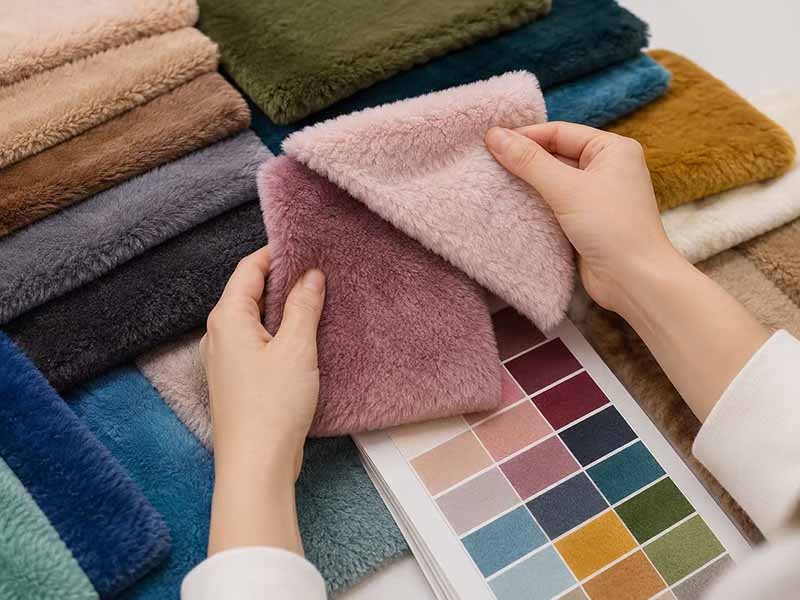
Short plush and minky generally provide controlled surfaces for small faces, precise embroidery, and clean seams. Longer faux fur creates volume and personality but may cover eye edges, mouth lines, appliqué borders, and body shapes. Sherpa and boucle-style textures offer visual warmth but can make a small product look heavier or less defined.
Pile direction also changes appearance. Panels cut in opposite directions may reflect light differently even when they come from the same fabric roll. The effect is particularly visible in dark colors, product photography, and side-by-side displays. Cutting markers should therefore control direction whenever surface appearance is important.
Physical swatches provide more reliable information than screen images. The same color can look different depending on yarn type, pile length, dye lot, surrounding embroidery, and lighting. Thread colors should be evaluated on the selected fabric because texture affects how an embroidered line appears.
Multi-character series should avoid unnecessary material proliferation. A practical fabric architecture may use one core body material, one shared face material, a controlled embroidery palette, and selected special textures for premium or hidden characters. This creates variety while reducing purchasing risk, shade variation, and small-quantity material waste.
Surface Details
Small blind box plush often uses embroidery because embroidered eyes, mouths, and logos can be durable, repeatable, and suitable for many product structures. The challenge is achieving clarity without making the surrounding fabric stiff or distorted.
Line width, stitch density, needle count, underlay, thread direction, fabric stability, and color contrast all affect the result. High density may create a rich appearance, but excessive density can shrink, wrinkle, or harden the material. Low density may expose the base fabric and create uneven edges.
Appliqué is useful for larger color blocks, ear details, bellies, clothing symbols, and areas that benefit from a different material. On a small character, however, several layered appliqués can create thick seam areas, uneven edges, and unnecessary visual congestion.
Printing can reproduce gradients, repeated patterns, and complex graphics that embroidery cannot. It still requires controls for alignment, color variation, rub resistance, and how the print changes when fabric is stretched or curved during stuffing.
Long-pile fabric may need trimming around facial embroidery or a shorter-pile insert panel. Otherwise, fibers can cover the eyes and change the expression. Pufumi’s technical records note that dense graphics, fine lines, excessive colors, and thick appliqués may become unstable in mini, keychain, and blind box formats.
Sustainable Claims
Recycled polyester fabrics, recycled filling, reduced-plastic packaging, paper-based inserts, and more efficient carton sizing can support a more responsible product program. Any environmental statement should match the available evidence.
A supplier’s claim that a fabric contains recycled material does not automatically mean the final plush can display a certification label. Textile Exchange explains that the Recycled Claim Standard and Global Recycled Standard establish requirements for recycled-material verification and chain of custody. The GRS also includes processing-related social, environmental, and chemical requirements.
Brands should distinguish among three separate statements: a material contains recycled fiber, the fabric supplier is certified, and the final product or supply chain is eligible for a specific certified claim. These statements are related but not interchangeable.
Environmental improvements also require performance testing. Recycled fabric may differ in pile recovery, color availability, softness, dye consistency, minimum quantities, or production lead time. Replacing a plastic inner bag with paper may reduce one material while creating moisture, abrasion, or secrecy problems.
Credible communication is specific. A supported statement such as “the outer fabric contains certified recycled polyester” is clearer than describing the entire product as sustainable without qualification. Claims should identify the relevant component, percentage where applicable, documentation, and certification scope.
The objective is not to add a green message to an unchanged product. It is to make measurable improvements while maintaining durability, safety, appearance, packaging protection, manufacturing consistency, and practical transportation efficiency.
Retail Packaging
Blind box packaging performs several functions simultaneously. It hides the character, protects the plush, communicates the character world, carries legal and commercial information, supports scanning, fits store displays, and helps ensure the correct assortment reaches the intended market.
A complete retail-ready system may include a sealed inner bag, collector card, checklist, outer blind box, copyright line, barcode, product label, display carton, master carton, and market-specific tracking information. E-commerce and warehouse programs may add FNSKU, carton labels, pallet requirements, or delivery-appointment information.
For children’s products sold in the United States, CPSC guidance states that tracking information generally needs to identify the manufacturer, importer, or private labeler, production location and date, and batch or run information on the product and packaging where practicable.
Packaging size should not be finalized before a packed prototype is reviewed. Long ears, molded faces, metal accessories, and high-pile materials behave differently under compression. The team should store, transport, open, and inspect a trial-packed sample before mass packaging starts.
Collector cards must match the enclosed characters, copyright information must use the approved version, and barcodes need to scan reliably. Display cartons should contain the intended assortment, while shipping cartons should meet warehouse size, weight, labeling, and handling requirements.
These details may appear less creative than character design, but a packaging error can affect thousands of sealed units. Once boxes are mixed, incorrectly labeled, or delivered to the wrong channel, correction becomes slow, expensive, and potentially disruptive to the launch.
How Should Brands Plan a 2027 Plush Program?
Brands should plan a 2027 blind box plush program by separating durable market shifts from short-lived aesthetics, defining a realistic SKU and cost structure, testing the complete product and packaging system, and documenting approved production standards. The objective is not merely to produce attractive samples. It is to build a collection that can be manufactured, inspected, distributed, reordered, and extended consistently.
Durable Trends
Not every visible trend has the same lifespan. Adult collecting, fandom, portable accessories, emotional character design, social sharing, and series-based purchasing are supported by broader consumer behavior. A particular facial style, celebrity association, color palette, or viral character may change much more quickly.
Circana’s 2025 data provides a useful distinction. Global toy growth was supported by licensing, collectibles, pop culture, and adult participation rather than one single property. Collectibles grew by 32%, while products appealing to teenagers and adults remained important growth drivers.
Before copying a successful product, teams should identify the need underneath its appearance. Customers may be responding to portability, emotional comfort, affordable self-reward, fashion personalization, surprise, community participation, or familiar IP. The visible style is only one way of meeting that need.
A durable program should own a clear character idea while allowing the product expression to evolve. The same character can move from blind box plush into bag charms, core plush, seasonal clothing, cushions, gift sets, and retail exclusives without losing its identity.
Trend analysis should include negative signals as well as positive ones. Social views, resale prices, long queues, and celebrity exposure demonstrate excitement, but they do not always prove repeatable retail demand. Duplicate complaints, quality issues, canceled orders, declining engagement, and retailer discounting may reveal whether attention is becoming fragile.
Cost Architecture
Blind box plush cost is influenced by more than size. SKU count, fabric variety, embroidery density, accessories, hardware, packing complexity, testing, assembly time, packaging, and order quantity can make a small product surprisingly expensive.
Cost planning should begin before the first sample. The brand needs a target retail price, wholesale structure, expected margin, launch quantity, channel, target market, and packaging direction. Without those inputs, the development team may create an impressive sample that cannot fit the intended commercial model.
Features can be divided into character-defining, value-enhancing, and decorative elements. Character-defining details deserve protection because removing them weakens recognition. Value-enhancing features should be compared against their cost. Decorative features with limited customer impact are generally the first candidates for simplification.
Shared construction can improve efficiency. Several characters may use the same basic body pattern while changing ears, facial embroidery, color, clothing, or accessories. This reduces unnecessary pattern and sewing variation without turning the series into simple recolors.
Cost reduction should not compromise attachment strength, facial balance, required labeling, internal containment, fabric stability, or critical packaging controls. A cheaper product that fails inspection, arrives misshapen, produces poor reviews, or cannot be reordered consistently is not commercially efficient.
The most productive discussion is not simply about making the product cheaper. It is about identifying which features create recognition, perceived value, collectibility, and repeat sales, then allocating the available budget to those areas.
Preproduction Testing
Every character needs to be tested individually and as part of the complete collection. A program can contain six attractive samples and still fail because colors conflict, packaging sizes vary, collector cards become mixed, barcodes do not scan, or the intended hidden-edition ratio cannot be controlled.
The approved production package should include the physical sample, bill of materials, pattern files, embroidery versions, color references, hardware specifications, stuffing targets, labels, packaging artwork, packing rules, and inspection criteria.
A trial packing run is particularly useful. It reveals whether the plush fits without excessive compression, whether collector cards bend, whether hard accessories damage the box, and whether workers can maintain the intended assortment at normal production speed.
| Control Area | Practical Approval Record | Main Failure Prevented |
|---|---|---|
| Character appearance | Golden sample and approved views | Facial, proportion, and shape drift |
| Fabric and color | Swatch, supplier code, and color reference | Material or dye-lot mismatch |
| Embroidery | Released file, thread code, and position | Expression and logo inconsistency |
| Accessories | Dimensions and attachment specification | Missing, weak, or incorrect components |
| Packaging | Approved artwork and packed reference | Compression and incorrect information |
| SKU identity | Code map and card-matching record | Plush, card, and box mixing |
| Rarity | Ratio and carton-packing instruction | Incorrect hidden-edition distribution |
| Barcode | Verified scanning record | Retail or warehouse rejection |
| Reorder control | Retained sample, BOM, and history | Batch-to-batch variation |
Applicable testing and labeling requirements should be confirmed according to the target country, target age, material system, product function, accessories, and packaging. The brand owner, importer, laboratory, and manufacturer may hold different responsibilities, so those boundaries should be agreed before production begins.
Pufumi’s documented service model covers character interpretation, sample development, multi-SKU planning, production control, retail-ready packaging, version management, anti-mixing procedures, and long-term replenishment.
Long-Term Releases
A blind box collection becomes more commercially valuable when the first release creates options for future products. This does not require finalizing every design several years in advance. It requires a basic architecture that allows the character world to expand without losing consistency.
The brand should identify which character carries the main IP recognition, which designs are suitable for replenishment, which can become premium formats, and which may support seasonal or retailer-exclusive editions. Strong-performing mini characters can later become bag charms, larger plush, cushions, accessories, or gift sets.
Development records make this expansion easier. Retained samples, approved patterns, fabric codes, embroidery programs, bills of materials, packaging versions, and inspection histories reduce the risk of recreating a product from old photographs or memory.
Material continuity also needs planning. A custom fabric color may not remain available forever. Hardware finishes can change between suppliers, and paper or printing conditions may create packaging differences. Teams should decide which variations are acceptable and which require renewed approval.
The useful capability of a long-term manufacturing partner is not simply producing a successful first order. It is maintaining character fidelity, assortment consistency, packaging accuracy, SKU separation, document control, and quality expectations across new releases and repeat production.
The strongest 2027 blind box plush programs will not necessarily be the ones with the largest number of characters or the most complicated rarity systems. They will be the collections that turn a clear creative idea into a controlled product experience—one that customers enjoy opening, carrying, displaying, trading, and returning to when the next meaningful release arrives.
Is blind box plush expected to remain popular in 2027?
Blind box plush is likely to remain commercially relevant in 2027 because it combines several durable behaviors: collecting, surprise, emotional attachment, portable accessories, fandom, and social sharing. HKTDC’s 2027 forecast identifies cute collectibles, blind boxes, plush, ugly-cute figures, and kidult demand as important sourcing directions. However, interest will not be distributed equally across every brand. Products without distinctive characters, reliable quality, fair rarity, or a clear release strategy may struggle after the novelty of the first launch fades.
Which blind box plush formats will be most popular in 2027?
Mini seated plush and bag charms are likely to remain strong because they are easy to collect, display, carry, photograph, and purchase across several price levels. Plush-vinyl hybrids, textured characters, and selected sensory products may support premium or hidden editions. The best format depends on the character design, audience, channel, target price, and manufacturing complexity. A product should not adopt a bag-charm or hybrid structure simply because the format is popular; the construction needs to improve how the character is used and experienced.
How many characters should a blind box plush series include?
Many first-time collections can be managed effectively with approximately six to eight designs, although there is no universal standard. The appropriate number depends on total volume, quantity per SKU, shared construction, development budget, retailer capacity, and the strength of the character world. Each additional design adds patterns, embroidery files, materials, samples, packaging records, production separation, and inventory risk. A focused collection of six memorable characters may create more value than a larger range containing several products that collectors see as filler.
What is a hidden edition in a blind box plush series?
A hidden edition is a less frequently packed character or variant that creates an additional level of surprise. It may use a unique costume, expression, silhouette, color, material, accessory, or story element. The design should still belong to the same collection and should provide more than a minor visual change. Its ratio must be planned before production because rarity affects purchasing quantities, manufacturing records, carton composition, packing instructions, and customer communication. Regular editions should remain desirable even when customers do not receive the hidden product.
Are plush bag charms still likely to trend in 2027?
Plush bag charms are likely to remain visible because they combine collectible products with fashion personalization and everyday display. They allow customers to carry characters on handbags, backpacks, luggage, and accessories instead of keeping them only on shelves. Their continued success will depend on more than visual appeal. Hanging angle, clasp quality, attachment strength, weight, durability, dirt resistance, and recognizable facial details must all be tested. A poorly balanced charm may look attractive in a product photograph but disappointing when attached to a real bag.
Can recycled materials be used for blind box plush?
Recycled polyester fabrics and filling can be used in many plush applications, but material claims require documentation and performance review. Brands should verify recycled-content records, certification scope, chain-of-custody requirements, color consistency, softness, pile recovery, availability, and minimum order conditions. A certified fabric supplier does not automatically make the complete plush eligible for a final-product certification claim. Packaging, trims, accessories, and other materials may have separate requirements, so environmental statements should identify exactly which component and standard they cover.
What should brands prepare before contacting a blind box plush manufacturer?
A useful initial brief should include character artwork, intended size, expected quantity, number of SKUs, target market, target age, launch date, packaging concept, retail channel, estimated cost range, rarity idea, and any licensed-IP requirements. Front, side, and back views are especially helpful for complex characters. Complete information is not always available at the first discussion, but a clear commercial direction allows the development team to identify feasibility issues, cost drivers, sampling requirements, packaging risks, safety considerations, and the most practical route toward production.