Skip to content


Fabric is one of the first things people notice when they pick up a plush toy, but softness is only a small part of the decision. The fabric also affects how clearly a character’s face can be reproduced, whether a small embroidered logo remains visible, how a paper pattern changes after filling, how consistently the color looks from one production run to another, and even how efficiently the product can be cut and sewn. A beautiful swatch can still be a poor manufacturing choice if its stretch, pile, density or backing creates problems once the material becomes a three-dimensional product.
Plush toys are commonly made from polyester-based materials such as minky, velboa, short-pile plush, faux fur, sherpa, fleece, velvet and microfiber plush. The right choice depends on pile length, GSM, density, stretch, backing, texture, color, decoration method, product size, intended use and production requirements. There is no single plush fabric that performs best for every toy, character or retail program.
That distinction becomes obvious during sampling. Imagine a character with carefully spaced embroidered eyes and a small curved mouth. A long, luxurious fur may feel impressive in the hand, but once the sample is sewn, the fibers can cover half the expression. The better result may come from using short plush on the face, longer fur on the body and a third fabric for the clothing. Good plush fabric selection is less about finding the “softest” option and more about finding the material combination that lets the design survive real manufacturing.
What Fabrics Are Used in Plush Toys?
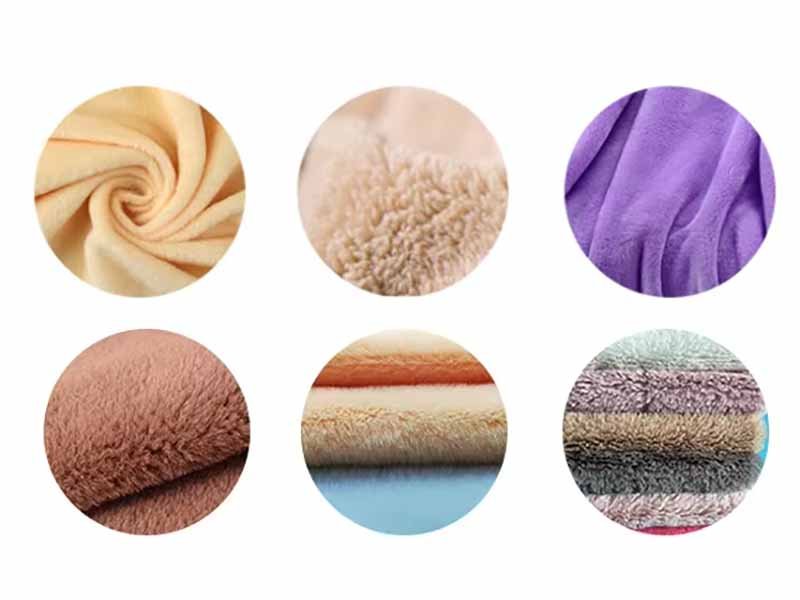
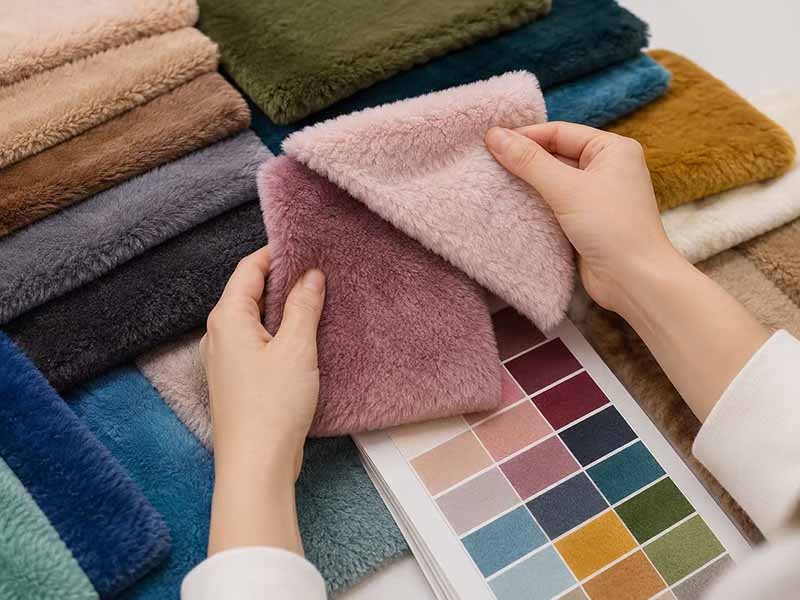
Commercial plush products are commonly made from minky, velboa, short-pile plush, faux fur, sherpa, fleece, velvet, microfiber plush, printed fabric and custom-dyed fabric. Polyester is the most common fiber base because it can be produced in many colors, textures and pile structures while remaining practical for repeat manufacturing. Recycled polyester, cotton-based options and specialty materials are also used when the product has specific appearance, performance or material-positioning requirements.
Minky, Velboa and Short Plush
Minky is widely used when a plush product needs a noticeably soft surface without the visual bulk of long fur. It works well for character plush, gift products, soft-touch collections and products where handfeel is part of the consumer experience. What matters, however, is that “minky” describes a material family rather than one universal construction. Two minky fabrics can differ substantially in pile, weight, stretch, density and backing, and those differences can change the shape of a finished toy after filling.
Velboa usually has a shorter and flatter surface. It can be a practical choice when the design depends on clean outlines and clear decoration rather than a deep, fluffy texture. Animal plush, simplified character products and many cost-sensitive commercial programs can use velboa successfully when the intended appearance matches the material. Its flatter surface does not automatically make it lower quality; it simply creates a different visual and tactile result from dense minky or microfiber plush.
Short-pile plush is especially valuable for products with recognition-critical details. Anime characters, game characters, mascots, mini plush and keychains often contain embroidered eyes, narrow mouths, small logos or tiny color blocks. A shorter pile lets these elements remain visible instead of disappearing into the surface. This makes short plush an important engineering choice, not merely an aesthetic preference.
| Fabric Type | Surface Character | Typical Strength | Common Applications | Main Control Point |
|---|---|---|---|---|
| Minky | Soft, smooth, plush | Handfeel and color variety | Character plush, soft-touch gifts | Stretch and filled shape |
| Velboa | Short, flat, even | Detail clarity and stability | Animals, basic characters | Density and handfeel |
| Short Plush | Clean, controlled pile | Embroidery visibility | Mascots, anime, mini plush | Nap consistency |
| Faux Fur | Deep, dimensional | Realistic texture | Animals, premium plush | Direction and trimming |
| Sherpa | Curled, wool-like | Warm visual texture | Lifestyle and seasonal plush | Fine-detail visibility |
| Fleece | Flat, soft surface | Simple construction | Pillows, clothing, basic forms | Surface appearance |
| Velvet | Fine, directional sheen | Refined presentation | Premium and decorative plush | Nap and pressure marks |
| Microfiber Plush | Fine, dense handfeel | Premium soft touch | Collectibles and gifts | Batch consistency |
Faux Fur and Sherpa
Faux fur becomes useful when surface depth is part of the design rather than an optional finish. Realistic animal plush, fantasy creatures, long-haired characters and destination merchandise may need a stronger fur effect than short-pile fabrics can provide. Longer fibers soften the visible pattern lines and give the product more movement, but they also affect the face, seam appearance, cutting layout, finishing labor and how the product recovers after being compressed in packaging.
The face is usually the most sensitive area. Long fibers around an embroidered eye or mouth can reduce apparent detail even when the embroidery file itself is correct. Some projects therefore use strategic trimming, while others use a shorter material on the face and reserve long fur for the head sides, body, chest or tail. This mixed-material approach often produces a cleaner expression while preserving the realistic texture that made faux fur desirable in the first place.
Sherpa communicates something different. Its curled, wool-like surface feels warm and casual, making it suitable for selected lifestyle plush, winter themes, home-related products and certain animal styles. The texture is visually active, so it is less suitable for every facial area or for designs that rely on extremely precise embroidery. A good material plan uses sherpa where its texture adds character rather than applying it automatically across every panel.
Fleece, Velvet and Microfiber
Fleece has a relatively controlled surface and can be useful for plush pillows, simple geometric shapes, clothing components and products where a strong fur effect is unnecessary. Because it is flatter than most pile fabrics, printed elements, appliqué and larger decorative shapes can often remain easy to read. Its appearance is more restrained, so it works best when the product concept benefits from simplicity rather than a luxurious or realistic coat.
Velvet provides a more polished visual effect. Its sheen can make premium gifts, fashion-related plush and decorative products look refined, particularly under controlled lighting. The same sheen also creates a production challenge because the surface changes appearance according to nap direction. Two pieces cut from the same roll can look like different shades when one panel faces upward and another downward, which makes directional cutting essential.
Microfiber plush is often selected when the target is a smooth, fine and dense handfeel. It can work particularly well for premium small products, collectible plush and products where tactile quality is noticeable immediately. For commercial programs, the most important question is not whether the first swatch feels excellent, but whether the same color, density and surface character can be sourced reliably for the next production run.
Printed, Custom-Dyed and Specialty Fabrics
Solid fabrics cannot reproduce every character. Printed plush can be used for animal markings, gradients, clothing graphics, fantasy textures, patterns and complex surface effects that would otherwise require many separate fabric pieces. The print process must be considered together with pile height and stretch because a highly textured or elastic surface can distort fine graphics after the panel is filled.
Custom-dyed fabric becomes relevant when a stocked color cannot reproduce a signature character or brand color closely enough. This gives the development team more control over color direction, but it also introduces additional considerations such as dye-lot variation, color approval, minimum material requirements and replenishment timing. For products expected to remain in a catalog for several seasons, repeatability can matter as much as the first color match.
Specialty fabrics may include metallic textiles, mesh, faux leather, glitter fabrics, apparel textiles and other decorative materials used on wings, clothing, accessories, ears, shoes or small accents. Recycled polyester and organic-material options may also be considered when the project has documented material requirements. Marketing descriptions should reflect the actual fiber composition and supplier documentation rather than assuming that a wool-like, cotton-like or natural-looking surface is made from the fiber it visually resembles.
Which Fabric Is Best for Each Plush Toy?

The best plush fabric depends on what the finished product needs to communicate. Character plush generally benefits from shorter pile that protects facial clarity, realistic animals may require faux fur or mixed pile lengths, mini plush need controlled thickness and surface depth, and collectible products place more emphasis on repeatable color and handfeel. Many commercially successful toys combine several materials instead of expecting one fabric to solve every visual and structural requirement.
Character and Mascot Plush
Character plush should start with recognizability. Licensed characters, mascots, game characters and creator-owned designs often depend on a small group of features that people notice immediately: eye spacing, mouth shape, head width, color blocks, hairstyle, ears, clothing and distinctive logos. The fabric has to support those features instead of obscuring them.
Short plush and minky are common choices because they provide enough softness while keeping the underlying pattern readable. Long fibers can make embroidery appear smaller and can blur the boundary between facial features and surrounding areas. When the original character is intentionally furry, a long-pile fabric can still work, but the facial area may require trimming, shorter pile or a separate material.
Stretch is equally important. A very elastic surface can make a filled head wider or rounder than the paper pattern suggests. If the character has strict proportions, the sample maker may need to adjust the pattern specifically for the selected fabric. The correct material therefore has to be evaluated together with the pattern, embroidery and filling rather than approved independently.
Animal Plush
Animal plush covers everything from simple cartoon bears to highly realistic wildlife products, so material choices vary widely. A stylized animal with clean graphic features may work perfectly in short plush or minky, while a lion, husky, alpaca or long-haired cat can require several surface textures and pile lengths to look believable.
One useful approach is to think of the product as a fur map. The muzzle, forehead, chest, back, legs and tail do not necessarily need the same pile. A long material can create depth on the body while a shorter fabric keeps the face readable. This also reduces the amount of trimming required around eyes and embroidered details.
Pile direction becomes particularly important on realistic products. Natural fur rarely lies in one direction across an entire animal, so different panels may intentionally use different directions. Those decisions should be planned during sample development and transferred into production instructions. If the direction changes by design, the result can look natural. If it changes because different operators interpreted the fabric differently, the same product can look inconsistent across a production batch.
Mini Plush and Bag Charms
Small plush products make material proportions more sensitive. A pile that looks moderate on a 35 cm plush can overwhelm a 10 cm bag charm. Tiny ears may lose definition, narrow limbs can appear too thick, and embroidered features can become visually crowded by surrounding fibers.
This is why mini plush, keychains, blind-box plush and bag charms often use shorter pile and relatively stable backing. The material can still feel soft, but the surface needs to remain controlled enough to preserve the intended silhouette. Fabric thickness matters as well because small products contain tighter curves, narrower seam allowances and smaller openings for turning and filling.
When one character is produced in several sizes, the best solution may not be to use exactly the same fabric specification. A large core plush and a mini keychain can share the same color family while using different pile heights or fabric weights. This approach keeps the product family visually connected while allowing each size to be engineered appropriately.
Collectible and Premium Plush
Collectible products are frequently displayed side by side, which makes variation easier to see. Color differences, sheen direction, pile density and handfeel may be less noticeable on one isolated product but become obvious when six characters are placed on the same shelf.
For this reason, repeatability should be treated as part of premium quality. A rare specialty fabric may create an impressive prototype, but it can become a weakness if it cannot be sourced again when the next series launches. Shared colors and materials across a multi-SKU program are often easier to control when they are assigned consistent specifications and material codes.
Premium appearance is also not created by maximum fabric weight. A dense short-pile material with stable color, precise embroidery, accurate pattern shaping and controlled finishing can look more refined than a heavier fabric with inconsistent direction or weak surface coverage. Fabric, filling, pattern engineering, facial execution and packaging work together to create the final perception of quality.
How Do Fabric Specs Affect Plush Toys?

Fabric names describe a category, but physical specifications determine how the material behaves. Pile length, GSM, density, stretch, backing, width, thickness, texture, sheen and nap direction can affect appearance, handfeel, pattern behavior, cutting efficiency, sewing and repeatability. Two materials both sold as minky or short plush can produce noticeably different results if their weight, stretch or backing construction is not the same.
Pile, GSM and Density
Pile length changes how much of the underlying product geometry remains visible. A short pile preserves seam definition, facial embroidery and small design elements. Medium pile softens the silhouette and increases tactile richness. Long pile creates a stronger fur effect but can conceal embroidery, reduce the apparent size of eyes and make small components look less precise.
GSM, or grams per square meter, describes the weight of a fabric over a defined area. It is useful when comparing materials, but it should not be treated as a universal quality score. A higher GSM may contribute to a fuller and denser handfeel, yet the final result also depends on fiber type, pile structure and backing. Heavy materials can also increase seam bulk and material cost.
Density determines how effectively the pile covers the backing when the fabric is stretched over a stuffed form. A fabric can look dense while lying flat and reveal the backing around a rounded head or belly after filling. Testing the material on a three-dimensional sample is therefore much more useful than judging coverage only from a flat swatch.
| Specification | What It Influences | If Too Low or Weak | If Excessive or Poorly Controlled |
|---|---|---|---|
| Pile Length | Detail visibility and texture | Product may look flat | Features can become hidden |
| GSM | Fullness and material mass | Surface may feel thin | Cost and seam bulk can rise |
| Density | Coverage and handfeel | Backing may become visible | Sewing difficulty can increase |
| Stretch | Filled dimensions | Curves may feel rigid | Shape can drift after stuffing |
| Backing | Structural stability | Seam distortion can increase | Handfeel may become stiff |
| Fabric Width | Cutting efficiency | Material yield may fall | Requires compatible cutting plan |
| Sheen | Visual character | Surface can appear plain | Direction differences become obvious |
| Nap Direction | Color and fur flow | Uneven appearance | Cutting flexibility is reduced |
Stretch and Backing
Stretch changes the relationship between a two-dimensional pattern and the final three-dimensional product. A highly elastic material can expand around filling, making the head, body or limbs wider than the same pattern sewn in a more stable fabric. This behavior may be useful for a deliberately rounded, squishy character, but it can reduce accuracy when a licensed design depends on strict proportions.
Stretch also has direction. Many plush fabrics behave differently lengthwise and crosswise. When pattern pieces are rotated inconsistently, one side of a body or face can expand differently from the other after filling. Grain direction should therefore be considered during pattern layout rather than left entirely to cutting-room convenience.
Backing forms the structural foundation of the surface. A weak base can distort around seams or heavily filled areas, while an overly rigid backing can reduce softness. Keychains and bag charms create additional stress because the attachment point carries repeated pulling force. In those products, surface fabric, backing, internal reinforcement and hardware need to function as a single structural system.
Pile Direction and Sheen
Nap direction is one of the most underestimated causes of apparent color variation. Fibers reflect light differently depending on the direction they lie, which means two panels from the same roll can appear lighter or darker even when the dye color is identical.
The effect is especially visible on velvet, faux fur, microfiber and certain minky constructions. On a character face, opposite nap directions can create the impression that the left and right sides are different colors. On an animal body, direction changes how the fur flows and how the product looks after brushing.
Direction therefore needs to be treated as a design and production parameter. Head panels, bodies, ears, limbs and tails should follow intentional rules. Realistic animal designs may deliberately use several directions to simulate natural fur flow, while graphic characters usually need greater uniformity. The key is that the chosen direction should be documented so the bulk production team can reproduce what was approved during sampling.
Width, Yield and Consumption
Fabric width directly affects cutting efficiency. Wider materials generally give more flexibility when pattern pieces are nested, while narrow or strongly directional materials can create more unused space between parts.
This becomes especially important for large plush, oversized ears, long tails and multi-SKU collections. A directional fabric cannot always be rotated freely because reversing a pattern piece can change the appearance of the pile. The theoretical surface area of all pieces therefore does not equal the actual amount of fabric that must be purchased.
Printed materials can add another limitation when certain graphics need to align with a specific body panel. Long-pile fabrics may also require additional handling around cut edges. For this reason, reliable consumption estimates are best made after the pattern, product size and nap rules are reasonably stable rather than during the earliest concept stage.
How Does Fabric Affect Decoration and Sewing?
Fabric has a direct effect on embroidery, printing, appliqué, cutting and sewing. Short and stable surfaces usually reproduce fine details more clearly, while long pile, heavy texture or strong stretch can affect placement, stitch visibility and shape. Decoration should be tested on the actual intended production material because a digital embroidery file or print sample does not show how the design will behave once the textile is stretched over a filled plush form.
Embroidery and Facial Details
Embroidery is one of the most important processes in character plush because it creates eyes, mouths, eyebrows, logos and other recognition-critical details without using hard components. The final appearance depends not only on the embroidery file but also on pile length, density and the way the fabric behaves under the stitches.
Short surfaces usually keep stitch edges clean and visible. Long fibers can partially cover narrow lines and make embroidered features appear smaller than expected. Increasing stitch density is not always the best correction because dense embroidery can compress soft material and create a hard or puckered area around the design.
Scale matters as well. A face that works on a 30 cm plush may be too detailed when reduced to a 10 cm keychain. Thin lettering, small eye highlights and narrow curves often need simplification rather than simple proportional scaling. The most reliable approval comes from embroidery applied to the actual material and assembled into the real sample rather than from a flat embroidery test alone.
Printing and Color Graphics
Printing is useful for gradients, animal markings, clothing graphics, scales, fantasy textures and complex patterns that would otherwise require many separate panels. A smooth short-pile surface generally produces clearer graphics than a very deep or irregular pile.
Stretch can distort printed artwork when the panel is filled. A circle can become oval, a straight line can curve, and a printed face can change proportion around a rounded head. Printed graphics should therefore be assessed in their final three-dimensional form.
Handfeel also matters. Some printing processes can make large areas feel firmer than the untreated textile. That may be acceptable on a decorative patch but undesirable across the main body of a plush intended to feel soft. Production approval should therefore review color, registration, detail, surface handfeel and durability together rather than treating color matching as the only success criterion.
Appliqué and Mixed Construction
Appliqué is commonly used for large color blocks, belly panels, ear interiors, clothing details, patches, badges and logo backgrounds. It also makes it possible to combine materials with very different textures in a controlled way.
Different textiles need different edge treatments. Felt can retain a relatively stable cut edge, woven materials may fray, minky and fleece can stretch, and faux leather can become difficult to fold around tight curves. Mesh and very light fabrics may need reinforcement so the stitching does not distort the panel.
Large appliqué areas can also alter handfeel because several layers may make the product stiffer. This is not always undesirable; a structured collectible may benefit from it. A cuddle-focused product usually does not. The process needs to reproduce the artwork without unintentionally turning a soft plush surface into a rigid decorative panel.
Cutting and Sewing
Plush cutting is more complex than cutting a flat, non-directional fabric. Long fibers can be cut through rather than separated at the backing, creating loose fluff around the edges. Directional materials limit how pieces can be rotated, while stretchy fabrics require controlled orientation.
Pile can become trapped inside seams during sewing. If long fibers are not released during finishing, the seam may look narrow and unnatural compared with the surrounding surface. Thick materials can create bulky intersections where several panels meet, while a weak backing may stretch around heavily filled curves.
Small product parts are particularly sensitive. Narrow ears, fingers, horns and tails can twist when the fabric stretches unevenly or when seam allowances become too bulky for the available space. A commercially suitable fabric should allow trained production teams to reproduce the approved shape consistently rather than requiring extensive manual correction on every individual unit.
How Do You Choose Plush Fabric?
Plush fabric should be selected by balancing appearance, handfeel, character accuracy, decoration, durability, intended use, target market, cost and future availability. The softest or most expensive material is not automatically the best choice. A successful fabric has to reproduce the design, work with the planned manufacturing process, fit the commercial target and remain sufficiently consistent when the product moves from sampling into mass production and later repeat orders.
Start With the Product Experience
The process should begin with what the finished product needs to communicate. “Soft” is not a precise material brief. Silky, dense, fluffy, smooth, wool-like, velvety, natural and squishy describe very different surfaces and lead toward different material families.
The visual priority should be defined at the same time. A licensed character may depend on a precise facial shape, while a realistic animal depends more heavily on fur texture. A fashion bag charm may need a clean, refined surface that photographs well, and a comfort-oriented product may place more emphasis on tactile softness and compression recovery.
It is useful to rank the important attributes before choosing a fabric. If character recognition is the highest priority, a controlled short pile may be a better choice than a luxurious long fur. If tactile experience is central to the product concept, density and handfeel may deserve more weight. A flat swatch can help narrow the options, but the real decision should be made after the material has been sewn and filled.
Match Fabric to Use and Market
A display collectible, an everyday children’s plush and a bag charm experience very different conditions. Collectibles may prioritize photographic appearance and series consistency. Frequently handled products may need greater attention to abrasion and surface recovery. Bag charms place repeated force around the hanging structure, while large plush have more filling weight and may experience significant compression during transport.
Packaging must also be considered. Long fur can be flattened inside a small polybag or retail box, and certain velvet surfaces can show pressure marks. A fabric that looks excellent immediately after sampling should also be observed after realistic packing and unpacking.
The destination market and intended age can affect documentation, labeling and testing preparation. A fabric is not automatically suitable for a particular toy standard simply because it feels soft or has been used in another product. The complete construction, components, age grading and applicable regulations determine the compliance path for the finished toy.
Balance Quality and Cost
Fabric cost should be evaluated as part of the complete product rather than by comparing price per meter alone. GSM, usable width, cutting efficiency, nap direction, dyeing, printing, sewing difficulty, finishing labor and minimum purchasing requirements can all affect the real cost.
A more expensive textile can sometimes reduce overall production risk if it provides stable color, reliable density and easier sewing. A cheaper fabric can become expensive when it creates excessive waste, exposes the backing after filling or produces inconsistent shapes because of uncontrolled stretch.
A useful cost strategy is to identify high-value zones. Premium material can be used on the face or primary body area where consumers see and touch it most, while a more economical fabric may be suitable for hidden or secondary components. This allows the product team to protect the visual and tactile identity of the item without using the highest-cost textile on every panel.
Check Supply Continuity
Material availability matters most after a product becomes successful. A rare seasonal textile may be acceptable for a one-time event, but it can create serious difficulties for an evergreen SKU, collectible series or product expected to be reordered for several years.
The development team should consider whether the supplier can reproduce the same color, pile, density and backing later. Standard constructions are usually easier to replenish than highly specialized seasonal materials. Retaining an approved physical reference also makes later comparisons more meaningful.
A structured material record should include fabric type, composition, pile, GSM, width, stretch, backing, color, supplier, bulk availability and possible alternatives. If the original textile becomes unavailable, the team can then compare replacements against known specifications instead of relying on a vague description such as “soft grey plush.” This turns material selection into a reusable product-development asset rather than a one-time sourcing decision.
How Is Fabric Controlled in Mass Production?

Fabric control in mass production relies on approved swatches, material specifications, BOM records, lot identification, directional cutting rules, incoming inspection and comparison against approved samples. The objective is to ensure that the textile used in production is traceable to the approved type, color and physical specification, so that unexpected differences can be identified before they create visible inconsistencies across hundreds or thousands of finished units.
Swatches, Samples and BOM
Material approval usually progresses from flat swatches to an actual sewn sample. The swatch helps compare color, texture and handfeel, but it does not reveal everything that will happen when the fabric is stretched, embroidered, sewn and filled.
Many problems only become visible in three dimensions. A fabric can stretch enough to widen the head, reveal the backing around a rounded belly or hide an embroidered mouth after the pile changes direction. Velvet can look uniform on a swatch but show obvious light and dark panels after several directional pieces are assembled.
Once approved, the material should be recorded in the product BOM rather than described informally. Material type, composition, color, pile, GSM, width, supplier reference and critical directional rules provide a much stronger production reference than phrases such as “soft pink fabric.” The finished approved sample or Golden Sample then provides a physical comparison point for the production and quality teams.
Material Lot Control
Bulk fabric arrives in rolls, lots and dye batches rather than as one abstract material specification. Even when every shipment is nominally the same product, small differences can appear in color, pile, surface character or handfeel.
Lot control makes those differences traceable. Useful records can include material code, color, pile specification, GSM, width, supplier, dye lot, roll number, arrival date, incoming inspection result and the SKU for which the material is approved.
| Lot-Control Field | Practical Purpose |
|---|---|
| Material Code | Identifies the approved fabric specification |
| Color / Dye Lot | Helps trace shade variation |
| Pile Specification | Confirms surface appearance |
| GSM | Checks material-weight consistency |
| Supplier | Links material to its approved source |
| Roll Number | Identifies the physical material roll |
| Arrival Date | Connects the receipt to production timing |
| Incoming QC Status | Shows whether the lot was accepted |
| Applicable SKU | Prevents incorrect material allocation |
| Production Lot Link | Supports later defect investigation |
When practical, using the same dye lot within one visible SKU reduces the chance of obvious color differences between units displayed together. Lot records do not eliminate variation, but they provide enough information to isolate and investigate it instead of treating the entire production run as one undifferentiated batch.
Direction and Cutting Rules
Pile direction needs to survive the transition from sample development to the production floor. An approved sample is only useful if the cutting team understands how each directional piece should be placed.
Faces are especially sensitive because opposite nap directions can create apparent shade differences or alter the way fibers frame the eyes. Long-haired animals may deliberately use several directions to mimic natural fur flow, while graphic characters usually need greater consistency across the head and body.
Directional cutting can reduce material efficiency because pieces cannot always be rotated to fill empty areas in the layout. That trade-off should be recognized during costing rather than discovered after the material has already been purchased. Saving a small amount of fabric by reversing critical pieces can create a visible inconsistency that is much more expensive to correct after sewing.
Repeat Orders and Traceability
Repeat production is where documentation proves its value. Several months after the original order, the dye lot will be different, material availability may have changed, and the people handling the project may not be exactly the same.
A reliable repeat-order process returns to approved samples, material records, BOM specifications and earlier production information. New fabric can be compared with retained references before large quantities are cut. If the original textile is no longer available, a replacement can be tested against the known product rather than selected solely because a supplier calls it “similar.”
Traceability also becomes important when a defect appears. If one fabric roll develops unexpected shedding, shade variation or surface damage, lot-to-production records help identify which finished products used that material. This narrows the investigation and makes corrective action more practical.
For established plush programs, this is the difference between making a good sample once and manufacturing a commercial product repeatedly. Consumers experience softness first, but specifications, records and controlled production are what make that softness reproducible.
Choosing the right plush fabric is not a contest between minky, velboa, faux fur and fleece. Each material solves a different combination of visual, tactile and manufacturing problems. A successful fabric is one that protects the product’s most important features while remaining practical to cut, decorate, sew, fill, inspect, pack and reproduce.
For a character product, that may mean reducing pile length around the face so the expression stays clear. For a realistic animal, it may mean combining long and short surfaces. For a collectible series, color repeatability and future availability may matter more than choosing the softest fabric in the sample room. For a mini keychain, a controlled surface may preserve details that would disappear under longer fibers.
The strongest material decisions are usually made before bulk production begins. When appearance, handfeel, specifications, decoration, cutting direction, supply continuity and repeat-order requirements are considered together, fabric stops being a last-minute sourcing choice and becomes part of the product engineering process. That is what allows an attractive prototype to become a plush product that can be approved, manufactured, replenished and extended into a broader product line.
Frequently Asked Questions
What is the most common fabric used for plush toys?
Polyester-based plush fabrics are the most common choice in commercial toy manufacturing because polyester can be engineered into many different surfaces, including minky, velboa, short plush, faux fur, sherpa, fleece and microfiber plush. The material offers a broad range of colors and textures and can be sourced in constructions suitable for many product types. The exact fabric should still be selected according to pile, density, stretch, backing and the design requirements of the finished toy.
Is minky the best fabric for plush toys?
Minky is an excellent option for many plush products because it can provide a soft handfeel, a relatively clean surface and good compatibility with character designs. It is not automatically the best material for every application. A realistic animal may benefit from longer faux fur, a highly detailed mini plush may need a shorter surface, and a decorative product may suit velvet or another specialty material. The correct choice depends on the design rather than the fabric name alone.
What fabric is best for character plush toys?
Character plush usually benefits from short-pile materials such as short plush, selected minky or velboa because these surfaces help embroidered eyes, mouths, logos and other small features remain visible. The best choice also depends on fabric stretch because an elastic material can change the final head or body proportions after filling. When a character includes furry hair, ears or tails, combining short facial fabric with longer secondary materials often gives a better result.
What is the difference between minky and velboa?
Minky generally has a softer and often richer surface, while velboa typically has a shorter, flatter pile that keeps shapes and decorative details easy to read. The two materials can also differ in GSM, stretch, density and backing, so the exact manufacturing behavior depends on the specification rather than the category name alone. Minky is often chosen for tactile appeal, while velboa can be useful for stable, clean-surface character and animal products.
How does GSM affect plush toy fabric?
GSM describes the weight of fabric per square meter and can influence fullness, density, material consumption and sewing thickness. A higher GSM can contribute to a richer handfeel, but it does not automatically mean better quality because pile construction, density, backing and fiber structure also matter. A material should be evaluated after sewing and filling because a flat fabric sample does not show how the surface will stretch over a three-dimensional plush shape.
Can different fabrics be used on one plush toy?
Yes. Mixed-material construction is common and can improve both appearance and manufacturability. A realistic animal might use long fur on the body and short plush on the face so the eyes and muzzle remain clear. A character plush may combine minky for the body, fleece or woven fabric for clothing and specialty materials for accessories. The key is to control thickness, stretch, edge treatment and color so the materials work together rather than looking like unrelated components.
How do manufacturers keep plush fabric consistent in repeat orders?
Repeat-order consistency depends on material specifications, approved samples, BOM records, fabric codes, dye-lot information and traceable production records. New fabric should be compared against the approved reference for color, pile, handfeel and physical characteristics before large quantities are cut. When the original fabric is unavailable, alternatives should be evaluated against the actual approved product instead of relying only on supplier descriptions. This reduces the risk of visible changes between production runs.