Skip to content

The most expensive custom plush project does not always begin with a high quotation. It often begins with a supplier whose quotation appears simple, competitive, and easy to approve. The sample may even look good at first. Problems appear later, when nobody has clearly taken responsibility for interpreting missing artwork, controlling revisions, approving materials, translating sample details into production instructions, coordinating packaging, or preparing the order for testing and retail delivery.
A custom plush factory is usually the right choice when your company already controls the design, technical specifications, materials, packaging, quality standards, approvals, and supply chain. A full-service plush development partner is more suitable when the supplier must help interpret artwork, engineer the product, manage revisions, control bulk consistency, coordinate packaging and testing, and preserve the project for future production.
The distinction is not about choosing a factory or avoiding one. A credible development partner still needs direct access to skilled sample makers, pattern engineers, manufacturing resources, quality personnel, and specialist suppliers. The real question is who manages the difficult space between an attractive drawing and a repeatable commercial product. That space is where characters lose their expression, materials change without proper approval, packaging versions become mixed, and launch schedules quietly begin to slip.
What Is a Custom Plush Factory?
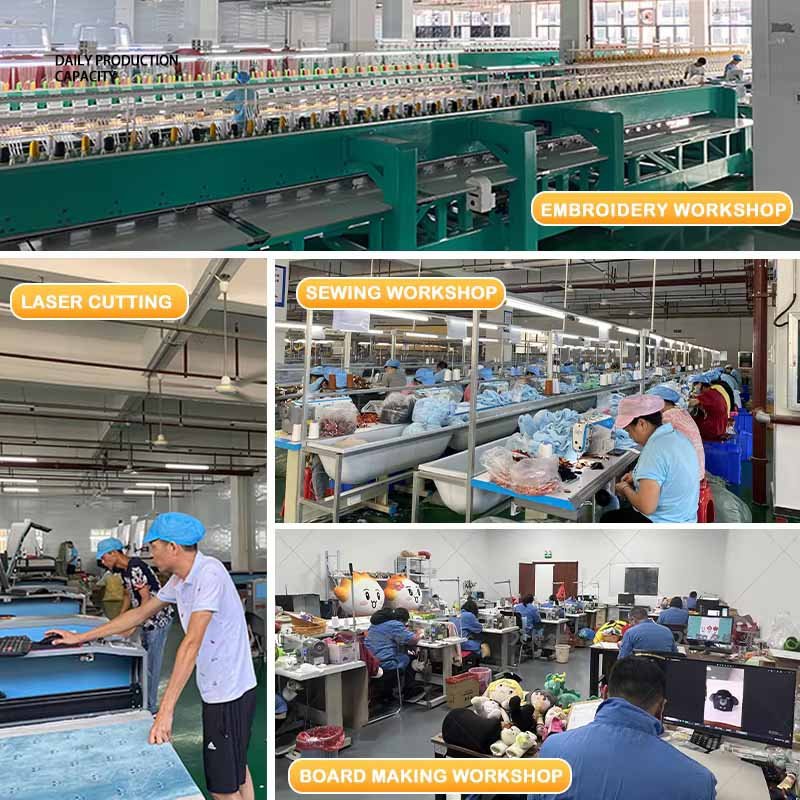
A custom plush factory primarily converts approved product information into finished goods. Its work may include pattern making, material purchasing, cutting, embroidery, printing, sewing, filling, shaping, inspection, packing, and bulk production. This model is most effective when the client already has complete specifications and experienced people managing development, approvals, packaging, compliance, quality, and delivery.
What Does a Factory Handle?
A capable custom plush factory is responsible for turning controlled production information into physical products. For a standard character plush, this may involve checking incoming fabric, preparing paper patterns, cutting components, completing embroidery or printing, sewing the body, turning the shell, inserting filling, closing openings, attaching accessories, shaping the face and body, grooming the fabric, applying labels, inspecting the finished item, and preparing retail or transport packaging.
More complex products may require additional operations. A dressed character may involve miniature garment patterns, layered fabrics, printed clothing, buttons, belts, hats, footwear, or fixed accessories. A weighted plush may require an internal pouch and controlled weight distribution. An interactive plush may include a sound module, light component, switch, battery compartment, or sensor. A keychain or bag charm may require metal fittings, reinforced hanging points, and alignment checks when the product is suspended.
The word “factory” does not describe the full depth of these capabilities. One factory may have experienced character designers, pattern engineers, sample technicians, embroidery programmers, and dedicated project managers. Another may be a highly efficient production unit that performs best when it receives an approved sample, complete bill of materials, released embroidery files, and detailed packing instructions. Both may appear under the same search term, yet they are not interchangeable.
Before comparing prices, clarify whether the supplier is expected to manufacture an already-defined product or help define the product. This affects the quotation basis, sample schedule, number of revision rounds, internal workload, and the likelihood of changes appearing after production has already started.
What Must the Client Provide?
A production-focused factory depends on the client to provide enough information to avoid uncontrolled interpretation. Basic project information normally includes artwork, product dimensions, expected quantity, target market, intended age group, target cost, material preferences, packaging requirements, and a realistic date by which the products must be ready to ship or enter a warehouse.
Character products usually require more than one front-facing image. A useful artwork package may include front, rear, side, and three-quarter views; close-up facial details; clothing and accessory references; approved logo files; color information; target posture; and a clear list of features that must not be altered. If these details are missing, the sample team must make assumptions about thickness, seam positions, profile shape, rear construction, clothing attachment, and dimensional balance.
The client must also own information that a factory cannot responsibly invent. Copyright statements, licensed-property approvals, importer details, retail warnings, barcodes, FNSKU labels, packaging claims, customer service information, and market-specific legal text must be provided or approved by the responsible party. A factory may help format or position this information, but it should not create legally sensitive claims without authorization.
A supplier can recommend how to support a tail, simplify a small accessory, or adjust embroidery so that it remains legible. It cannot decide whether a licensor permits a different facial expression, whether a retailer accepts a new box format, or whether a product claim is legally suitable for every intended market.
| Client Input | Practical Purpose | Common Risk When Missing |
|---|---|---|
| Front, side, and rear artwork | Defines the complete three-dimensional form | Incorrect thickness, profile, or rear construction |
| Target size and posture | Guides patterns, filling, and balance | Unstable sitting, standing, or hanging position |
| Color and material references | Connects artwork to fabric and thread | Visible color mismatch or inconsistent handfeel |
| Target market and age group | Supports material, label, and testing decisions | Late compliance or packaging changes |
| Approved packaging files | Controls retail presentation and warehouse acceptance | Repacking, barcode errors, or rejected cartons |
| Named approval contacts | Defines who can authorize changes | Conflicting feedback and repeated revisions |
| Launch and delivery dates | Creates realistic approval and production gates | Compressed inspection or expensive shipping |
Is OEM Production Enough?
OEM production is often the best option when the client already operates a mature product-development system. Established toy companies, major retailers, licensing businesses, and experienced consumer brands may have internal designers, product engineers, sourcing managers, packaging specialists, compliance personnel, quality teams, and nominated inspection companies. In this situation, the supplier does not need to redefine the product. It needs to execute approved requirements accurately and consistently.
The OEM model is especially efficient for stable repeat orders. When the approved pattern, bill of materials, embroidery file, fabric specification, Golden Sample, packaging artwork, inspection standard, and shipping method are already established, additional design services may create little practical value. Material continuity, production discipline, version control, line planning, and repeat-order consistency become more important than another round of product interpretation.
The model becomes less effective when a company has only a character image, an AI-generated concept, a rough sketch, or a product it wants to improve without knowing exactly what should change. It also becomes risky when development responsibilities are scattered across a freelance illustrator, packaging agency, trading company, factory, laboratory, inspector, freight forwarder, and internal procurement team.
Each party may perform its individual task correctly while the overall project still fails. The factory may follow the approved drawing, the packaging company may print the approved box, and the laboratory may test the submitted sample, yet the finished order can still contain mismatched versions if nobody controls the complete system.
What Should You Verify?
A supplier assessment should examine more than sewing capacity and production equipment. The most useful questions relate to how the factory controls information, samples, materials, first pieces, process deviations, final packing, and repeat orders. A clean production floor is valuable, but it does not prove that the approved version will reach every department correctly.
Look for physical and documentary evidence. Approved samples should be identified with project and SKU information. Fabric cards should record material codes, colors, and approval status. Patterns, embroidery files, packing instructions, and quality standards should have clear versions. Materials, work in progress, finished products, abnormal goods, packaging, and retained samples should be separated rather than mixed in one uncontrolled area.
A reliable factory should be able to explain which sample is used as the production reference, how obsolete files are removed, what happens when an approved material becomes unavailable, who checks the first production pieces, which details receive full inspection, and how issues are documented. The answers should describe actual procedures rather than rely on broad phrases such as “strict quality control.”
What Is a Full-Service Plush Development Partner?

A full-service plush development partner helps turn a character, product concept, or commercial idea into a manufacturable and repeatable plush program. Its work can cover artwork interpretation, pattern engineering, materials, sampling, revisions, production documents, quality planning, packaging, testing coordination, delivery, and repeat orders. The purpose is to connect these stages so information is not lost between teams.
How Does It Turn Artwork Into Plush?
A flat drawing does not contain all the information required to create a three-dimensional soft product. It may communicate the front of the character clearly while leaving the side profile, rear form, physical thickness, seam structure, fabric direction, filling distribution, balance, and production tolerances undefined. These missing elements must be interpreted before the design can become a stable product.
The development process usually begins by identifying the character’s strongest recognition points. These may include face shape, eye position, mouth angle, head-to-body ratio, ear form, hairstyle, tail, costume, color combination, posture, or a distinctive accessory. These details do not all carry equal value. A slight difference in an internal seam may have little effect, while a three-millimeter change in eye position can noticeably alter the character’s expression.
The team then decides which features should become dimensional components and which are better represented through embroidery, printing, appliqué, or fabric layering. Wings, hats, shoes, horns, bags, bows, and tails may need separate sewn structures. Eyes, mouths, blush, stripes, and logos may be more stable when applied as flat processes, especially on smaller products.
Product size changes the engineering solution. A four-inch keychain cannot hold the same seam count, clothing construction, or accessory detail as an eighteen-inch display plush. Smaller products usually require simplified forms, enlarged recognition features, flatter components, and reduced embroidery complexity. Larger products can support layered garments, deeper shaping, internal supports, and more detailed accessories.
For complex projects, a written interpretation record should describe the front, side, rear, thickness, posture, materials, construction, and non-negotiable details before the first pattern is cut. This prevents the first sample from becoming an expensive guessing exercise.
Which Teams Support the Project?
A full-service development partner requires coordinated technical and operational roles. A salesperson can collect requirements and communicate updates, but cannot personally replace character designers, pattern makers, sample technicians, embroidery programmers, material specialists, production planners, quality inspectors, packaging coordinators, testing contacts, and logistics personnel.
The project manager connects these functions. This person translates quantity, product size, target market, target cost, packaging direction, approval structure, launch date, and shipping destination into a workable plan. When a change is requested, the project manager should establish whether it affects the pattern, material consumption, sample timing, testing, packaging dimensions, production schedule, or final price.
Technical teams translate subjective reactions into practical instructions. “Make the character younger” may require a wider head, shorter torso, larger eye spacing, softer filling, and a different mouth curve. “Make the product feel more premium” may involve denser fabric, improved embroidery, cleaner garment construction, controlled stuffing, or better packaging rather than simply adding decorative features.
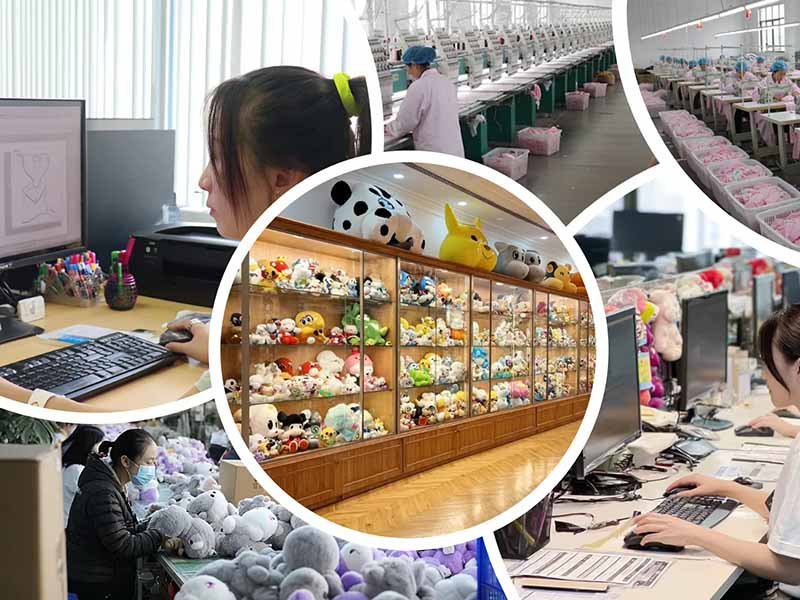
Pufumi’s documented operating structure includes design, engineering, sampling, purchasing, production, quality, logistics, and project-management functions. Its core Dongguan operation includes more than 58 designers, pattern makers, sample technicians, and related development personnel, with approximately half having more than 15 years of relevant experience.
Experienced people are valuable only when their knowledge is organized. A skilled sample maker can improve one prototype, but a complete development system must convert that improvement into documents and controls that the production team can follow repeatedly.
How Far Does the Service Extend?
Full-service support should continue until the product is commercially usable, not end when the first attractive sample has been photographed. A complete scope may include early project review, artwork interpretation, development notes, pattern engineering, material comparison, sample making, revision control, pre-production approval, production-file release, manufacturing, process inspection, final quality control, packaging coordination, testing support, shipment preparation, and reorder management.
This does not mean the supplier replaces the client, licensor, importer, laboratory, or retailer. The client remains responsible for legal authorization, business decisions, final approvals, target-market information, approved packaging text, and purchase authorization. The testing laboratory remains responsible for its test methods and reports, while importers retain the obligations assigned to them in the destination market.
The value lies in continuity. Information discovered during artwork review should appear in the sample brief. Approved sample details should appear in the bill of materials and production package. Identified risks should become inspection checkpoints. Packaging requirements should appear in packing instructions. Final approved records should remain available when the client expands the series or places another order.
A structured sample system may include:
- Concept prototype
- First physical sample
- Revision sample
- Engineering sample
- Material sample
- Packaging mock-up
- Pre-production sample
- Golden Sample
Pufumi’s documented sample structure includes prototypes, revision samples, engineering samples, material samples, packaging mock-ups, pre-production samples, and Golden Samples. The stated purpose is to produce a reference that the client can approve, manufacturing teams can execute, quality teams can inspect, and future orders can trace.
What Does Full Service Not Mean?
“Full service” should not mean unlimited responsibility or unconditional promises. A responsible supplier should not claim that every design can meet every target price, that all materials are suitable for all age groups, that every product will pass every standard, or that customs and transportation will never cause delays.
The supplier may help prepare a bill of materials and testing samples, but it does not issue the laboratory’s independent report. It may coordinate shipping, but it cannot guarantee that a shipment will never face port congestion, customs inspection, severe weather, or warehouse appointment changes. It may suggest materials commonly used for a market, but product-specific compliance decisions still require the correct documentation, testing, and responsible-party review.
The client must remain involved in artwork approval, budget, quantity, age grading, market selection, licensing approval, packaging claims, and production authorization. Important decisions should be confirmed in writing rather than assumed from conversations or sample photographs.
Full service should therefore mean coordinated development, disciplined project management, documented advice, and transparent responsibility. Suppliers that explain their boundaries clearly are often more dependable than those that promise to handle everything without asking difficult questions.
How Do Their Responsibilities Differ?
A factory generally executes approved manufacturing instructions, while a development partner helps create, test, document, and control those instructions. The difference affects artwork interpretation, sample revisions, material decisions, production files, quality standards, packaging, testing support, delivery, and repeat orders. As unresolved decisions increase, the value of structured development support usually increases as well.
Who Owns Design Interpretation?
In a factory-led model, the client usually owns the creative and technical interpretation. The factory may identify obvious production problems, such as an accessory that is too small to sew or a fabric that hides embroidery, but it normally expects the client to define the intended result and approve the acceptable compromise.
In a development-partner model, interpretation is shared. The client protects the identity of the character and brand, while the supplier explains how that identity can be translated into fabric, seams, patterns, filling, embroidery, printing, clothing, and stable construction. The supplier should not change the design freely, but it should identify missing information and propose workable solutions.
This work includes detecting incomplete views, conflicting artwork, unstable postures, weak attachment points, oversized details, inappropriate material choices, and design elements that cannot be reproduced consistently at the intended size. It should also make trade-offs visible. Long-pile fabric may feel luxurious but hide a small mouth. A thicker body may feel softer but change the silhouette. Metal hardware may improve perceived value while adding weight, testing considerations, and packaging risks.
The client retains final creative authority. The supplier owns the quality of the technical questions, development options, and written interpretation that support that decision.
Who Controls Samples and Revisions?
Informal revision handling may work for a basic stuffed animal, but it becomes unreliable when a project involves licensed characters, several approvers, multiple sizes, special materials, or more than one SKU. Comments may be scattered across email, shared documents, messaging applications, spreadsheets, video calls, and annotated photographs.
A structured revision system separates comments into practical categories such as expression, proportion, material, filling, construction, clothing, accessories, function, and packaging. Each requested change should show the original feedback, the supplier’s interpretation, the exact action, any cost or schedule effect, and the approval status.
Approval scope must be clear. A photograph can confirm visual direction but cannot fully confirm handfeel. Approval of a fabric color does not automatically approve fabric quality or pile length. Approval of the plush body does not approve the retail box. Approval of a first prototype does not automatically authorize mass production.
The Golden Sample becomes the primary physical reference, but it must be supported by documents. A physical sample cannot show the file name of the approved embroidery program, exact fabric code, filling target, barcode information, carton quantity, or permitted manufacturing tolerance.
Pufumi’s documented revision approach separates changes involving expression, proportion, materials, filling, structure, accessories, and packaging. It also records revisions and approval scope so that partial approval is not mistaken for full production authorization.
Who Manages Production Quality?
A factory is responsible for producing goods according to the agreed specification. A full-service partner must also help create that specification and convert sample-making knowledge into repeatable production controls.
This is where many projects become unstable. A highly experienced sample maker may manually reshape the face, distribute filling by feel, trim the pile carefully, or adjust feature positions until one prototype looks excellent. If those actions are not documented, bulk-production operators may not reproduce the same result consistently.
Production controls can include material approval, embroidery positioning, first-piece inspection, filling guidance, critical dimensions, attachment methods, clothing alignment, barcode checks, function testing, packaging verification, and final grooming. Certain items may need full inspection, especially electronic functions, barcodes, detachable hardware, or high-risk accessories. Other features can be checked through an agreed inspection sample, depending on product complexity and risk.
Quality must be controlled during the process rather than discovered only when the order is complete. Pufumi’s documented quality responsibilities include incoming-material checks, first-piece checks, process inspections, finished-product inspections, packaging checks, barcode scanning, function testing, abnormal-product isolation, and corrective action.
Who Coordinates Final Delivery?
A production factory may consider its work complete once approved products are packed and handed to the nominated freight provider. A development partner takes a broader view and asks whether the order is ready for the actual sales channel, destination warehouse, retailer, marketplace, or distribution system.
Retail-ready plush products may require hangtags, woven labels, care labels, copyright information, polybag warnings, barcodes, FNSKU labels, retail boxes, assortment ratios, carton marks, pallet labels, packing lists, and warehouse-specific instructions. A plush product can be well sewn and still fail commercially because a barcode does not scan or the wrong packaging version has been applied.
Multi-SKU projects require additional control. Similar characters may share body shapes, fabrics, clothing, or packaging dimensions while using different facial embroidery, accessories, copyright information, or barcodes. Each SKU should connect to the correct pattern, bill of materials, sample, embroidery file, packaging artwork, inner pack, carton quantity, and shipping document.
| Responsibility | Custom Plush Factory | Full-Service Development Partner |
|---|---|---|
| Product definition | Mainly provided by the client | Reviewed and developed jointly |
| Artwork interpretation | Limited or optional | Documented before sampling |
| Pattern development | Creates patterns for production | Connects patterns to appearance, function, and scale |
| Material decisions | Sources specified materials | Compares handfeel, cost, risk, and continuity |
| Sample diagnosis | Executes clear client instructions | Helps identify causes and translate feedback |
| Production documents | Often provided or led by the client | Built and controlled through development |
| Quality plan | Factory checklist and approved reference | Project-specific risks become inspection points |
| Packaging | Uses approved files and components | Coordinates fit, labels, versions, and packing |
| Testing support | Provides requested samples | Helps organize samples, BOM, and corrections |
| Repeat orders | Uses available historical records | Preserves versions, materials, and change history |
The service scope should always be confirmed before sampling. A factory may provide strong development support without using the word “partner,” while another company may advertise full service but outsource most technical decisions without clear control.
Which Risks Does Each Model Leave With You?

Every supplier model leaves some responsibility with the client. A factory-only arrangement can leave design diagnosis, specifications, packaging, testing coordination, file control, and launch management with the client. A development partner reduces those gaps but still depends on accurate information, legal authorization, timely approvals, commercial decisions, and final acceptance from the client.
How Can Character Fidelity Be Lost?
Character fidelity is often lost through several small changes rather than one dramatic mistake. The eyes may be slightly too low, the head slightly too narrow, the body too long, the ears too upright, the mouth too curved, or the filling too firm. Each difference may appear acceptable when reviewed alone, yet the complete product no longer feels like the original character.
Soft materials make this work unusually sensitive. Fabric stretch changes a face after filling. Pile direction affects the apparent width and shadow of a feature. Long fur can hide embroidery. Smooth material exposes seam placement and asymmetry. Thick clothing can make a small character look bulky, while very thin fabric may lose the visual quality expected from a premium product.
The most important recognition features should be identified before sampling and controlled more tightly than less visible details. For many character products, these include head-to-body ratio, face width, eye size and spacing, mouth expression, signature colors, ear or hair shape, costume details, recognizable accessories, and the intended posture.
Approval should include front, rear, side, and three-quarter views. The sample should also be checked in its intended use. A keychain may look correct on a table but rotate incorrectly when hanging. A sitting plush may appear balanced in a photograph but tip forward when placed on a shelf.
Why Do Samples and Bulk Orders Differ?
A sample and a bulk order are produced under different working conditions. One experienced technician may spend several hours adjusting a prototype, redistributing filling, trimming fibers, shaping the face, and correcting clothing. Bulk production usually involves multiple operators completing separate processes under defined production schedules.
Differences appear when material lots change, embroidery moves to another machine, filling is not standardized, or the approved sample was made with temporary materials. Clothing may shift when body dimensions vary. Accessories may rotate if attachment marks are unclear. Packaging compression may change the product’s presentation if recovery and grooming are not considered.
The gap is reduced when sample knowledge becomes production data. Useful controls include:
- Approved fabric code and color reference
- Released embroidery and printing files
- Pattern version and SKU identification
- Filling target or controlled handfeel reference
- Critical measurements and tolerances
- Approved attachment methods
- First-piece inspection
- In-process comparison with the Golden Sample
- Grooming and packaging instructions
- Retained production samples
A Golden Sample is essential, but it cannot replace the bill of materials, process instructions, component references, and inspection criteria. The physical sample and the written system must support each other.
How Are Multi-SKU Errors Prevented?
Multi-SKU programs create risks that are not visible from the total order quantity. A six-character series may share the same body pattern and base fabric while using different facial embroidery, clothing, accessories, barcodes, and packaging artwork. One mixed component can make the affected products commercially unusable even when sewing quality is acceptable.
Each SKU needs a unique identity throughout the project. The code should appear on patterns, bills of materials, embroidery files, sample records, component containers, packaging artwork, carton labels, inspection reports, and shipping documents. Similar-looking components should not rely on memory or visual recognition alone.
Separation should begin before production. Cut pieces, embroidered panels, clothing components, hardware, labels, and retail boxes should be stored and identified in ways that reduce mixing. Visual reference cards, controlled bins, batch records, and dedicated packing instructions may be needed when several products share similar colors or shapes.
Assortment cartons add another layer of risk. The total carton quantity can be correct while the character ratio is wrong. Final packing checks should confirm product identity, unit quantity, inner-pack quantity, barcode, assortment ratio, carton mark, and shipping document together rather than as separate tasks.
What Causes Launch Delays?
Most launch delays do not begin at the sewing line. They begin with incomplete artwork, slow approvals, repeated creative changes, unavailable materials, packaging revisions, testing failures, or uncertainty about who can make the final decision.
A realistic project schedule separates the work into visible stages:
- Requirement and artwork review
- Pattern and first-sample development
- Client or licensor feedback
- Revision and sample approval
- Material and packaging confirmation
- Pre-production sample
- Testing preparation or laboratory testing
- Bulk-material readiness
- Production and in-process inspection
- Final inspection and shipment
Changes to size, fabric, structure, accessory, function, packaging, or target market should be evaluated before approval. A small request can affect patterns, material use, product cost, test requirements, carton dimensions, and the date production can begin.
A development partner cannot prevent every delay caused by clients, licensors, laboratories, retailers, shipping companies, customs authorities, or external events. Its role is to make dependencies visible, maintain current files, and warn the client when a decision threatens the schedule.
How Do Cost, Speed, and Control Compare?

A custom plush factory may show a lower visible unit price because the client retains more development and coordination work. A full-service partner may charge for engineering, sampling, project management, packaging support, and quality planning. The meaningful comparison is total project cost, including internal labor, revisions, testing, delays, rework, rejected goods, and expedited shipping.
Is the Lowest Unit Price the Lowest Total Cost?
The lowest unit price can be the best commercial choice when the product is fully defined and the client already has strong internal controls. It becomes misleading when quotations do not cover the same materials, construction, filling, accessories, packaging, inspection level, testing assumptions, delivery terms, or development scope.
Consider a hypothetical order of 5,000 pieces. A price difference of $0.20 per unit creates a visible saving of $1,000. That saving can disappear after one extra sample round, external technical assistance, repacking, additional inspection, or a limited amount of expedited freight. For a product tied to a holiday, entertainment release, retail promotion, exhibition, or event, missing the sales window may cost considerably more than the original price difference.
Sample fees should also be understood correctly. A custom sample is not priced like one bulk-production unit. It may require artwork review, pattern development, material preparation, embroidery tests, printing tests, sewing, filling, shaping, internal inspection, photography, revision management, and project communication.
A higher quotation does not automatically prove that the supplier provides better service. The useful question is whether the supplier explains what is included and whether the proposed work creates a clearer route to an approved, sellable, and repeatable product.
Which Model Reduces Internal Work?
A factory-only arrangement requires more coordination from the client. Someone must review the artwork, consolidate feedback, compare materials, approve samples, control versions, communicate with the laboratory, check packaging, follow production, organize inspection, arrange shipping, and preserve information for future orders.
Large organizations may prefer this model because they already employ specialized teams. Product developers, licensing managers, compliance staff, packaging engineers, sourcing managers, quality personnel, and logistics specialists can each own their area directly. Adding another management layer at the supplier may not be necessary.
A leaner organization may benefit from one development partner coordinating technical functions. The supplier does not replace the client’s approvers, but it reduces the need for the client to translate every request between designers, factories, material suppliers, packaging companies, laboratories, inspectors, and freight providers.
The right answer depends on internal capacity. A company with one product manager coordinating several launches has different needs from a global toy business with dedicated technical departments. The most efficient model places each responsibility with the team that can control it best.
How Does Each Model Affect Lead Time?
A factory can move quickly when it receives complete and approved production information. Stable repeat orders may proceed directly into material confirmation, pre-production checks, and manufacturing without repeating the full development process.
A new custom product is different. Time is needed to interpret artwork, create patterns, compare materials, make samples, gather feedback, complete revisions, approve packaging, prepare testing, and release production files. Skipping these stages may create the appearance of speed while moving unresolved questions into bulk production.
The supplier’s quoted production lead time should not be confused with the total project timeline. A statement such as “production takes 30 days” may begin only after the sample, deposit, materials, packaging, and production files have been approved. The client should ask which conditions officially start the production period.
Neither model is automatically faster. A factory is faster when the client supplies complete and stable information. A development partner may spend more time resolving uncertainty before production, but that work can prevent costly changes after materials are ordered or products are already being assembled.
Who Controls Changes and Approvals?
Change control is one of the clearest signs of project maturity. A new image sent through a messaging application should not automatically replace an approved production file. Every change should identify what has changed, who requested it, which SKU is affected, whether the old version is cancelled, and whether the change affects cost, schedule, packaging, or testing.
Approval authority should also be assigned. The designer may approve visual appearance, purchasing may approve cost, licensing may approve character details, compliance may approve labels, and logistics may approve carton information. A supplier should not assume that a comment from one person automatically overrides another department’s approved decision.
For complex projects, approval may include:
- Artwork interpretation approval
- Material approval
- First-sample review
- Revision approval
- Pre-production sample approval
- Packaging artwork approval
- Testing-sample approval
- Production authorization
- Final inspection release
- Shipment approval
Formal control can feel slower at the beginning, but it protects the project from expensive reversals after fabric, packaging, or production capacity has been committed.
How Can You Choose the Right Partner?
Choose the supplier model by comparing the work your project still needs with the capabilities your own team already has. A factory is suitable when the product is fully defined and internally controlled. Full-service support is more valuable when the supplier must help interpret, engineer, document, coordinate, or scale the product before it can be manufactured reliably.
When Is a Factory the Better Choice?
A custom plush factory may be the better choice when your company already has a complete and approved production package. You should know the dimensions, construction, materials, fabric codes, colors, embroidery files, filling specifications, accessories, packaging, inspection requirements, testing plan, and delivery conditions.
The model is particularly suitable for stable reorders. When the Golden Sample, bill of materials, material sources, packaging files, carton dimensions, and inspection criteria remain valid, the main need may be production capacity and process consistency rather than further development.
A factory model may also suit companies that prefer to appoint their own specialists. They may work directly with an independent design agency, laboratory, inspection company, packaging supplier, and nominated freight forwarder. This arrangement can work well when the internal sourcing team has enough experience, time, and authority to coordinate every participant.
The key test is whether every responsibility has an owner. If nobody on the client side can diagnose an inaccurate sample, approve a material substitution, control packaging versions, coordinate testing, or release the final production files, the apparent simplicity of the factory model can become a serious risk.
When Is Full-Service Support Necessary?
Full-service support becomes more valuable as creative, technical, operational, and approval complexity increases. Licensed characters may require controlled interpretation and formal approvals. Collectible series require consistent visual language across several SKUs. Blind-box projects add assortment and packaging risks. Retail programs add barcodes, carton labels, warnings, testing files, and warehouse requirements.
It is also useful when the client begins with incomplete information. A company may have strong artwork and a clear commercial goal but no plush pattern, fabric specification, filling standard, seam plan, packaging dimensions, or inspection criteria. The supplier must then help convert the concept into an executable product.
Projects that commonly benefit from broader support include:
- Licensed animation, game, film, and creator-IP plush
- Character collections with several sizes or versions
- Blind-box, collectible, and limited-edition series
- Retail-ready products with custom packaging
- Plush keychains and bag charms with custom hardware
- Electronic, weighted, or internally supported products
- Programs serving several markets or sales channels
- Projects connected to fixed launch dates
- Long-term collections requiring replenishment
- Companies without dedicated plush-development personnel
Pufumi’s documented role combines product development, manufacturing, project management, and supply-chain coordination rather than treating every project as a basic sewing order.
What Evidence Should You Request?
Supplier selection should be based on evidence rather than company descriptions. Factory photographs can show that production exists, but they do not prove artwork interpretation, sample diagnosis, revision control, quality planning, packaging management, or repeat-order stability.
Request practical examples with confidential information removed:
- Artwork-to-sample comparisons
- Front, rear, side, and detail sample photographs
- Revision records and change summaries
- Fabric and material approval cards
- Golden Sample procedures
- Bills of materials
- Production-file structures
- First-piece inspection records
- In-process quality checkpoints
- Barcode and packaging verification
- Multi-SKU separation methods
- Corrective-action records
- Reorder version controls
A development partner should be able to demonstrate how an incomplete or difficult idea became an approved commercial product. A production factory should be able to demonstrate how an approved standard was maintained throughout bulk production.
Pufumi’s documented infrastructure includes a core factory established in 2007, an in-factory sample room supporting first samples, revision samples, engineering samples, pre-production samples, and Golden Samples, as well as controlled material, storage, inspection, and packaging functions. These are examples of connected capabilities that should be examined rather than assumed.
Which Questions Should You Ask?
Direct questions reveal more than general statements such as “We provide one-stop service.” Ask who performs each task, what record is created, how approval is obtained, and what happens when the planned method cannot be followed.
| Project Condition | Factory May Be Enough | Full-Service Support Is Usually Safer |
|---|---|---|
| Complete production files | Yes | Optional |
| Approved reference sample | Yes | Optional |
| Stable repeat order | Usually | Useful for version changes |
| First custom plush project | Possible with an experienced internal team | Often |
| Character artwork only | Risky | Yes |
| Licensed-property approval | Possible with strong client management | Often |
| Four or more related SKUs | Possible with mature controls | Often |
| Custom retail packaging | Yes when files are complete | Helpful |
| Electronics or weighted structures | Requires specialist production | Usually |
| Fixed entertainment or seasonal launch | Possible with mature planning | Often |
| No internal plush engineer | Risky | Yes |
| Internal technical and quality teams | Usually | Depends on complexity |
Useful supplier questions include:
- Who reviews the artwork before sampling?
- Who creates and approves the patterns?
- How are unclear character details documented?
- How are sample revisions recorded?
- Which materials are used for the pre-production sample?
- What happens if an approved material becomes unavailable?
- Who releases production files?
- How is the Golden Sample used during production?
- Which product features receive full inspection?
- How are multiple SKUs separated?
- Who checks barcodes and packaging versions?
- What testing support is included?
- What remains the client’s responsibility?
- Which records are retained for future orders?
Conclusion
The difference between a custom plush factory and a full-service plush development partner is not determined by the company name printed on a quotation. It is determined by how much of the product has already been defined, which responsibilities your team can manage internally, and how much commercial risk remains between artwork and final delivery.
A production-focused factory can be the most efficient choice when your company already controls the specifications, materials, samples, packaging, testing plan, quality standards, and approvals. A full-service development partner becomes more valuable when the supplier must help interpret the character, engineer the product, manage revisions, build production files, coordinate packaging, control quality, and preserve records for future orders.
The best decision begins with an honest review of responsibility. Before comparing unit prices, identify who will own artwork interpretation, sample diagnosis, material approval, change control, production release, quality planning, barcode verification, testing support, and reorder documentation. Once every critical task has a clear owner, the supplier comparison becomes much easier—and the risk of discovering hidden gaps after production begins becomes much lower.
Frequently Asked Questions
Is a full-service plush development partner always more expensive?
A full-service partner may charge more for sampling, engineering, project management, materials research, packaging coordination, and quality planning. However, the visible supplier price is only one part of the total project cost. Extra sample rounds, internal labor, technical consultants, repacking, failed inspections, delayed launches, and expedited shipping can easily outweigh an initially lower manufacturing quotation.
Can a custom plush factory also provide product development?
Yes. Some factories have experienced designers, pattern makers, sample technicians, material specialists, project managers, and quality teams. They may provide many services associated with a development partner even if they describe themselves primarily as a factory. The important step is to verify who performs the work, how decisions are documented, and whether the supplier controls both development and production.
What information should I prepare before contacting a plush supplier?
Prepare clear artwork, desired dimensions, estimated quantity, target market, intended age group, product use, packaging direction, required delivery date, and any cost targets. Character projects benefit from front, side, rear, and detail views, approved colors, logo files, accessories, posture requirements, and a list of features that cannot be altered during plush interpretation.
How many sample rounds does a custom plush project usually need?
The number varies according to artwork quality, character complexity, materials, structure, client feedback, and approval requirements. A simple design with complete specifications may be approved quickly, while licensed characters, detailed clothing, unusual postures, multiple SKUs, electronics, or weighted structures may require several controlled stages. It is more useful to define sample stages and approval criteria than promise one universal number.
What is the role of a Golden Sample?
A Golden Sample is the approved physical reference used to guide bulk production and inspection. It represents the accepted appearance, proportions, materials, construction, filling, accessories, clothing, and finishing. It should be supported by a bill of materials, approved files, measurements, packaging instructions, and quality standards because the physical sample alone cannot record every production detail.
Which supplier model is better for a multi-SKU plush collection?
A full-service development model is often safer when several characters, sizes, expressions, accessories, or packaging versions must be managed together. Multi-SKU projects require controlled coding, sample versions, component separation, bills of materials, barcodes, carton ratios, and packing records. A production factory can also manage this successfully when the client provides complete files and maintains strong internal project control.
Should I request an NDA before sharing character artwork?
An NDA is appropriate when the project involves unreleased characters, licensed properties, confidential product plans, packaging, pricing, or launch information. It should clarify which information is confidential, who may access it, how long the obligation lasts, and what exceptions apply. An NDA supports confidentiality, but practical controls such as restricted file access, project coding, staff permissions, and controlled sample handling remain equally important.