Skip to content


A plush supplier can look excellent during the first video call and still become expensive six months later. The real trouble usually does not begin with a dramatic factory failure. It begins with smaller things: the production face is slightly different from the approved sample, a fabric changes without a clear record, the wrong language packaging reaches the wrong market, or a previous test report turns out not to cover the actual SKU being shipped. For European brands, these details sit directly between a promising product concept and a reliable retail program.
The best custom plush manufacturers for European brands are suppliers that can convert artwork into repeatable production while supporting product-specific safety documentation, controlled materials, sample approval, batch consistency, traceability, retail packaging and scalable supply. A practical 2026 shortlist includes Pufumi, Plush Factory, PlushCraft, Toy Gift Supply, Mavo Toys, CJL Plush, Plush Creation, KINWIN Toys, CudoraToy, StarDream Toys, The Plush Maker and Maris Plush.
That list is more useful as a shortlist than as a beauty contest. Some companies are stronger for complex character development, some publish lower entry quantities, some make European-facing compliance support easy to understand, and others are built for larger OEM programs. The right choice depends on what can go wrong in your project. Put two nearly identical plush toys on a desk, and one may be backed by a locked BOM, Golden Sample, packaging matrix and traceable batch history while the other is backed mainly by a good-looking prototype. They may look equal on day one; they will not feel equal when the first major reorder arrives.
What Should European Brands Look for in a Plush Manufacturer?
European brands should look beyond unit price and MOQ. A dependable plush manufacturer combines real production control, strong character development, product-specific EU documentation support, disciplined sample-to-production transfer, multi-SKU management, traceable materials and responsible IP handling. The best fit is the supplier that can preserve the approved product through bulk production, packaging, shipment and later reorders without creating avoidable compliance or quality surprises.
Manufacturing Control
The useful question is not simply whether a company calls itself a factory. The more important question is who controls pattern development, sample making, material approval, production, inspection, packaging and corrective action. Plush programs often involve specialist partners for embroidery, custom dyeing, printing, metal hardware, electronics, retail cartons or third-party laboratories. That is normal. Risk appears when subcontracting is hidden, responsibilities are vague, or the supplier cannot explain which facility will actually produce the order.
During qualification, ask for a clear production map. Confirm where patterns are made, where the physical prototype is sewn, which facility is planned for bulk production, which processes use outside specialists and who can stop production when specifications are not being followed. Pufumi documents a model that combines a core owned plush factory, additional managed production resources and qualified specialist partners, while keeping development, project execution, quality control and supply-chain coordination under one management system. This kind of transparency is more useful than an unrealistic claim that every component is made under one roof.
Character Development
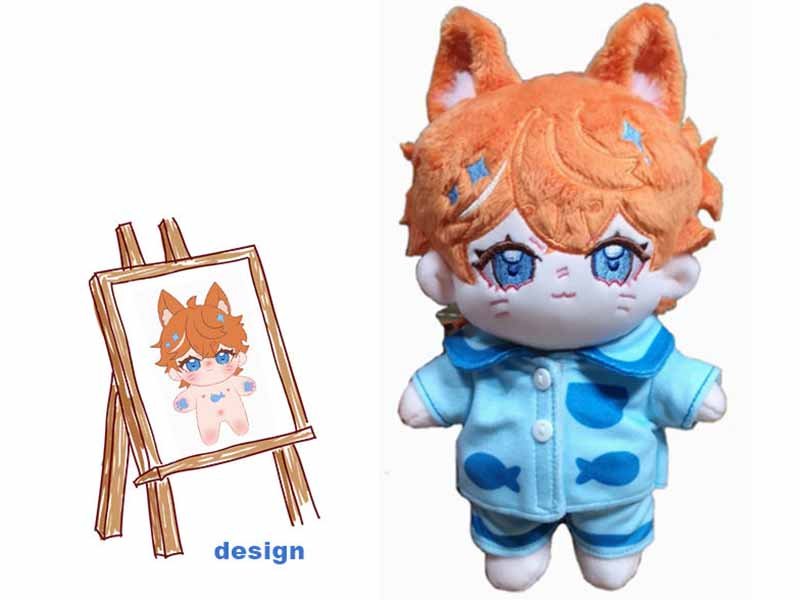
Custom plush development is a three-dimensional engineering problem hidden inside a soft product. A flat illustration does not tell a pattern maker how deep the head should be, how stuffing pressure will change cheek shape, whether a curved mouth will move after sewing, or how a costume will sit after the body is filled. European brands working with recognizable IP, mascots or collectible characters should therefore evaluate the sample room with the same seriousness they apply to the production floor.
Look for teams that can explain face shape, eye spacing, silhouette, pile direction, embroidery placement, clothing construction, balance and attachment methods before the first sample is finished. Pufumi’s documented workflow accepts inputs such as 2D artwork, AI images, sketches, 3D models, photographs and physical references, then converts them into cuttable, sewable and production-ready structures. Its sample process can include Prototype, first sample, Revision Sample, Engineering Sample, Pre-Production Sample and Golden Sample stages, allowing creative feedback to become controlled production information rather than a series of informal visual edits.
Compliance and Traceability
European-market support should be product-specific rather than certificate-driven. A previous EN71 report from a different plush item does not automatically prove that a new character using new fabric, hardware, printed elements or electronic parts follows the same requirements. The production system should be able to connect the approved item to its BOM, material information, test samples, labels, packaging version and production records so that changes can be identified rather than disappearing inside everyday factory substitutions.
A useful supplier should also understand responsibility boundaries. Manufacturing teams can prepare BOMs, samples, product information, labels, packaging files and technical records, but the final legal obligations may sit with different economic operators depending on the project and market. Pufumi’s EU framework, for example, provides manufacturing-side Technical File inputs, test-sample support, label execution and batch-traceability information while distinguishing these tasks from the responsibilities of the customer, importer, laboratory or relevant EU economic operator. Clear boundaries are a sign of maturity, not an attempt to avoid accountability.
Commercial Fit
A technically capable supplier can still be the wrong commercial partner if its operating model does not fit the program. A factory designed for small promotional jobs may struggle with a 40-SKU collectible launch, while a development-heavy manufacturer can be inefficient for a simple one-time giveaway. Compare MOQ per SKU, material minimums, packaging minimums, sample workload, production capacity for the actual construction, seasonal availability and reorder support rather than relying on one headline quantity.
For example, Pufumi internally assesses conventional core plush projects from around 500 pieces per SKU, while mini plush, keychains, bag charms and complex packaging programs tend to become more stable around 1,000 pieces per SKU depending on structure, materials and packaging. Other manufacturers in this article publish starting quantities from roughly 50 pieces upward for selected products. Neither model is automatically better. A low entry quantity may suit a pilot, while a higher production threshold may align better with a repeat retail program that needs stable material purchasing and line efficiency.
Which 12 Custom Plush Manufacturers Stand Out?

The twelve manufacturers below stand out because their current public positioning or documented capabilities address major parts of European custom-plush sourcing, including development, OEM/ODM production, sampling, packaging, safety-document support, quality control or scalable manufacturing. Treat the list as a research shortlist rather than an absolute ranking, and verify every third-party claim against current certificates, factory records, samples and project-specific documents before supplier approval.
| Manufacturer | Publicly Stated or Documented Indicators | Practical Fit to Evaluate |
|---|---|---|
| Pufumi | Core factory established in 2007; 58+ design, pattern and sample-development specialists; core plush generally assessed from about 500 pcs/SKU | Licensed characters, collectibles, retail-ready and multi-SKU programs |
| Plush Factory | 15+ years; MOQ from 50 pcs; 7-business-day sampling publicly promoted | Pilot quantities, mascots, keychains and flexible custom programs |
| PlushCraft | 10+ years; 3,000+ sample projects; typical 45-day bulk lead time stated | Character-focused development and retail-grade plush |
| Toy Gift Supply | Standard MOQ from 500 pcs/design; private-label packaging and retail-oriented development | Museums, gift retail, branded merchandise and private label |
| Mavo Toys | 15+ years; 10 production lines; 15+ designers/pattern makers; MOQ from 500; 10-15 business-day sampling | European-facing OEM/ODM and IP projects |
| CJL Plush | OEM, ODM, licensed-character and bulk-production positioning | General commercial custom plush programs |
| Plush Creation | Minimum 500 pcs; prototype process and CE/EN71-focused European positioning | European promotional, association and brand merchandise |
| KINWIN Toys | 17+ years; 30+ pattern makers; 15 production lines; MOQ from 500 stated | Larger OEM, private-label and character programs |
| CudoraToy | 22 years; 120+ skilled workers; 2,000+ m² stated | Broad OEM/ODM manufacturing |
| StarDream Toys | 3,000 m²; 50+ workers; 3 production lines; 1M+ pieces/year stated | Flexible export programs and custom character production |
| The Plush Maker | Manufacturing since 1998; selected MOQ from 500; about 300,000 pcs/month stated | Established bulk and repeat-production programs |
| Maris Plush | 18 years; typical 300-500 pcs for standard custom plush; 7-10 business-day sampling stated | General OEM/ODM and specialty plush formats |
The third-party figures above are current public website claims rather than independent audit findings, so they should be reconfirmed during an RFQ, factory audit or document review.
Development-Led Suppliers
Pufumi, PlushCraft and KINWIN are worth closer attention when development work is a large part of the commercial risk. Pufumi is structured around character fidelity, sample engineering, multi-SKU programs, approval control and repeat production rather than stock wholesale. Its core factory records more than 58 design, pattern and sample-development specialists, with roughly half having more than 15 years of relevant development, sampling or production experience. This becomes useful when a project begins with character assets rather than a complete production specification.
PlushCraft publicly emphasizes high character accuracy, more than 3,000 sample projects, retail-grade product development and a typical 45-day mass-production lead time. KINWIN publicly states 17+ years of experience, 30+ senior pattern makers, 15 production lines and a standard MOQ around 500 pieces. Those numbers should be verified in a live sourcing process, but they provide a useful starting signal. When comparing these suppliers, give each the same difficult artwork and ask them to identify the three biggest manufacturing risks before quoting. The quality of their questions often reveals more than their sample galleries.
European-Facing Suppliers
Mavo Toys and Plush Creation make European-market requirements especially visible in their public communication. Mavo states 15+ years of OEM/ODM experience, 10 production lines, 15+ designers and pattern makers, a 500-piece starting MOQ and 10-15 business-day sampling, while also highlighting CE/EN71 and international audit information. Plush Creation presents a European-facing development process with a 500-piece minimum, prototype development, CE/EN71 positioning and a straightforward route from illustration to physical sample and production.
These front-end advantages can make early communication easier, but a European-facing sales process should not be confused with product-specific compliance. Procurement teams still need to verify which legal entity signs the contract, which plant makes the goods, which audit covers that plant, which laboratory performs testing and how the tested version is connected to the final production BOM. Local communication can reduce friction; it cannot replace the evidence chain behind the product. For straightforward promotional or mascot programs, that service structure may be very convenient, while complex licensed projects may demand deeper version and traceability controls.
Flexible OEM Suppliers
Plush Factory, Toy Gift Supply, CudoraToy, StarDream Toys and Maris Plush cover useful parts of the flexible OEM market. Plush Factory publicly promotes an unusually accessible MOQ from 50 pieces and approximately seven business days for sampling. Toy Gift Supply starts standard custom projects around 500 pieces per design and gives noticeable attention to private-label packaging and retail contexts. CudoraToy states 22 years of experience and more than 120 skilled workers, while StarDream publishes a 3,000-square-metre factory, 50+ workers, three production lines and annual output above one million pieces.
Maris Plush states 18 years of custom plush experience, standard project MOQs commonly around 300-500 pieces and sample development around 7-10 business days. These figures are helpful for narrowing a sourcing list, but the more important test is how each system behaves when volume grows. A 100-piece pilot and a 25,000-piece European retail order create very different needs for material lots, line balancing, packaging versions, inspection records and replenishment. A supplier can be excellent at one scale and average at another, so qualify against the size of the program you hope to have after the product succeeds.
Established Bulk Producers
The Plush Maker and other larger-capacity suppliers become more interesting when repeat orders, seasonal demand or multiple launches have to be supported at the same time. The Plush Maker states that it has manufactured custom plush since 1998, operates an owned Dongguan facility, can begin selected projects around 500 pieces and has approximate capacity around 300,000 units per month depending on product type and current loading. Those details suggest a bulk-oriented operating model, although capacity must always be checked against the actual construction being ordered.
The same caution applies to every factory in this list. A plant capable of producing hundreds of thousands of simple animals may have much less throughput for dressed characters with dense embroidery, detachable accessories, long-pile fabric or retail boxes. Pufumi’s own internal capacity system illustrates this point: conventional monthly capacity is recorded around 150,000-300,000 pieces, while higher seasonal and flexible output depends on SKU count, product size, complexity, embroidery, accessories, packaging, materials, testing and schedule. Capacity is therefore most useful when expressed as output for a defined product mix, not as a single impressive factory-wide number.
How Do These Plush Manufacturers Compare?

Plush manufacturers should be compared against the real risk profile of a project rather than a generic number-one ranking. Character complexity, EU-market requirements, annual volume, number of SKUs, packaging, retail channel and reorder plans all change which supplier creates the most value. A simple event mascot and a 30-SKU licensed collectible program should not use the same scoring model, even if both are technically custom plush.
| Selection Factor | Simple Mascot | Licensed Character | Multi-SKU Retail |
|---|---|---|---|
| Character development | 15% | 25% | 20% |
| Quality control | 20% | 20% | 20% |
| EU-market support | 20% | 20% | 20% |
| Manufacturing control | 15% | 10% | 15% |
| Multi-SKU management | 5% | 10% | 15% |
| Packaging control | 10% | 5% | 10% |
| Commercial fit and scale | 15% | 10% | 0-10% |
Compare by Project Type
A simple corporate mascot often places more weight on schedule, dependable workmanship and commercially sensible pricing. A licensed entertainment character raises the importance of face accuracy, controlled revisions, confidentiality, style-guide interpretation and formal approvals. A multi-SKU retail collection adds another operating layer because the factory must keep fabrics, labels, barcodes, packaging versions and carton assortments correctly separated across many similar-looking products. Those differences should determine how each manufacturer is scored.
The percentages in the table are not an industry standard; they are a practical way to stop one attractive number from controlling the entire decision. A low MOQ can look decisive until a collection requires eight packaging versions. A fast sample can look decisive until the first production run drifts from the approved face. A large monthly capacity can look decisive until only a small part of that capacity is suitable for detailed character sewing. Define the project archetype first, then compare factories against the risks that actually matter to that archetype.
Compare Sample Systems
Sampling is one of the clearest places to see differences between manufacturers. Some factories optimize for speed and publicly quote prototypes in roughly five to ten working days. Others use longer development cycles for complex characters because pattern changes, custom materials, accessory sourcing and internal engineering reviews take time. Pufumi’s documented internal benchmark is around 7-12 working days for standard samples and 12-20 working days for complex samples after required information, fees and key materials are in place.
The number of days is less important than what happens inside those days. A useful sampling system records pattern versions, material choices, changes, approval status and production feasibility rather than treating every revision as a new handmade object. Compare first-sample accuracy, the quality of revision notes and the way the final sample becomes a Golden Sample. A five-day prototype that needs four poorly controlled revisions can consume more calendar time and create more production risk than a twelve-day sample built through a disciplined engineering process. Speed matters, but controlled learning matters more.
Compare MOQ and Scale
MOQ is partly a sales policy and partly a production-economic reality. Public starting quantities among the suppliers in this article range from approximately 50 pieces for selected programs to around 500 pieces for more conventional custom manufacturing. Material suppliers may impose different thresholds again. A factory may accept 300 finished pieces while a custom-dyed fabric mill, specialty hardware supplier or printed packaging vendor requires enough material for a much larger run.
Ask for four numbers instead of one: factory MOQ per SKU, material MOQ, packaging MOQ and commercially efficient quantity. This gives a clearer view of how costs will behave as a product scales. A low-MOQ supplier can be excellent for a test order, while a factory optimized around several hundred or more pieces per SKU may be better for stable replenishment. The goal is not to drive the minimum as low as possible. It is to find the quantity at which the exact specification can be produced reliably without unnecessary inventory or hidden setup pressure.
Compare Quality Evidence
Phrases such as “strict QC” and “100% inspection” are too broad to compare factories by themselves. Ask what is inspected, when it is inspected and what happens when a repeated defect is found. A credible plush quality plan can include incoming material checks, cutting inspection, embroidery positioning, first-piece sewing review, in-process checks, stuffing and shaping inspection, final appearance review, functional tests where relevant, barcode verification, packaging inspection and shipment checks.
Pufumi’s documented checkpoints cover incoming materials, cutting, embroidery, sewing, filling, shaping, packaging and shipment, while its internal wording avoids promising absolute zero defects. Instead, critical appearance, labeling, packaging, SKU and shipping points can receive full or targeted full inspection alongside process inspection, final inspection and AQL-style sampling where appropriate. Use that level of specificity as a benchmark with any supplier. If a character’s expression depends on eye position within a few millimetres, the QC plan should contain a measurable reference rather than a generic instruction to “check the face.”
What EU Compliance Should Brands Verify?

European brands should verify product classification, applicable toy-safety requirements, product-specific EN71 testing where relevant, CE-related responsibilities, chemical restrictions, Technical File records, labeling, language versions, traceability and the transition to Regulation (EU) 2025/2509. Compliance evidence needs to match the actual SKU, materials, intended user and production version; a general factory certificate is not a substitute for product-level control.
| Document or Record | Main Purpose | Typical Source |
|---|---|---|
| Final BOM | Identifies materials and components | Manufacturer |
| Approved Golden Sample | Physical production reference | Brand + manufacturer |
| Product drawings/specifications | Defines construction and critical details | Brand + manufacturer |
| Relevant test reports | Supports safety assessment | Accredited third-party laboratory |
| Material information | Supports chemical and material review | Manufacturer + material suppliers |
| Label and packaging files | Controls warnings and market information | Brand + manufacturer |
| Production and batch records | Supports traceability | Manufacturer |
| Change records | Shows post-approval modifications | Brand + manufacturer |
| Technical File inputs | Supports conformity documentation | Multiple responsible parties |
Product Classification
The compliance discussion should begin by deciding what the product actually is. A soft product can be marketed and used as a children’s toy, adult collectible, decorative item, promotional product, electronic plush, weighted plush or another type of consumer product. Classification affects the regulatory pathway, risk assessment, labeling and testing that may apply. Simply printing the word “collectible” on packaging does not automatically change how a product is assessed if its design, marketing and expected use point toward children’s play.
This question should be resolved before the final sample because construction choices can alter the risk profile. A detachable plastic accessory, magnet, sound module, weighted insert or battery compartment can create different considerations from a conventional embroidered-face plush. Pufumi’s EU project framework explicitly begins by identifying categories such as Toy, Collector Item, Gift, Decorative Item, Electronic Plush and Weighted Plush before the testing and documentation path is confirmed. A safer development sequence is concept, intended user, classification, risk review, engineering, sample, testing and then production release, rather than discovering the classification question after bulk materials have already been purchased.
Testing and Documents
For conventional toy plush, EN71 Parts 1, 2 and 3 are common reference points covering mechanical and physical properties, flammability and migration of certain elements. The exact testing plan still depends on the product, intended age, materials and functions. CE marking is different from a factory quality certificate; it sits within the broader conformity framework for the specific product, so a supplier’s old report or general statement cannot automatically be transferred to every future design.
Manufacturers should be able to contribute accurate manufacturing evidence such as the final BOM, product drawings, approved sample information, material data, labels, packaging files, production records and test samples. Pufumi’s documented EU support includes manufacturing-side Technical File information, test-sample preparation, label execution and batch-traceability support while keeping final responsibilities with the relevant economic operators. This is a useful model because it replaces vague promises with a defined evidence chain. When another supplier says “EN71 ready,” ask what documents they can actually provide for your exact SKU and which parts of the process they expect your compliance team or laboratory to handle.
Labels and Market Versions
A European launch can become surprisingly complex at the packaging stage. Products sold across several countries may need different warning or instruction languages depending on the applicable requirements and sales destination. Retailers may add their own barcode, carton, pallet or receiving specifications. The compliance risk is therefore not only whether the right translation exists, but whether the right packaging version reaches the right SKU and the correct warehouse.
A ten-character collection sold in four language versions can create forty packaging combinations before size or channel variants are added. Pufumi’s EU documentation framework explicitly does not assume that English packaging covers every EU destination. Brands should maintain a packaging matrix connecting SKU code, character, target country, language version, barcode, copyright line, responsible-party information, warning version, artwork version and carton quantity. The manufacturer should check this matrix during packaging preparation and final inspection. Many expensive European retail problems are version-control failures rather than sewing failures, which is exactly why packaging deserves the same approval discipline as the physical plush.
Regulation and Traceability
Regulation (EU) 2025/2509 entered into force on January 1, 2026. Most of its provisions apply from August 1, 2030, while specific articles became applicable from January 1, 2026. That transition matters for brands developing evergreen products today because a character launched in 2027 can still be on sale when the new framework is fully applicable. The practical response is not panic; it is stronger product data, clearer traceability and better control of changes.
Useful traceability information can include SKU, BOM version, material code, supplier information, production batch, manufacturing date, test-report reference, packaging version, approval status, QC records and retention-sample references. Pufumi’s sample archive connects identifiers such as Sample ID, Project Code, SKU Code, Sample Type, Version Number, BOM Version, Pattern Version, Packaging Version and Approval Status. This level of structure already helps with retailer questions, quality investigations, reorders and potential recalls, even before future digital-product requirements fully apply. In practice, a manufacturer’s ability to retrieve clean records is becoming part of product quality rather than an administrative extra.
How Do You Verify a Plush Manufacturer Before Ordering?
Verify a plush manufacturer through legal-company information, factory evidence, sample development, BOM and change-control records, quality procedures, product-specific testing support, IP handling and packaging execution. A polished website can identify possible suppliers, but approval should depend on evidence connected to the facility, materials and product version that will actually serve your program. Verification depth should increase with product risk, annual value and brand exposure.
Factory and Team Verification
Start with the legal company, production site and people responsible for your project. Ask which entity signs the contract, which factory will make the goods, where sampling occurs, which major operations are subcontracted and who owns the final quality decision. For significant programs, a live video audit, factory visit or independent audit can confirm that the proposed site and equipment match the supplier’s description. The goal is not to eliminate every external specialist; it is to understand accountability from design through shipment.
Team depth also deserves attention. A large sewing workforce with a thin sample department can be less suitable for a complex character than a smaller operation with experienced pattern engineers. Pufumi’s core factory records more than 58 design, pattern and sample-development specialists, with roughly half having more than 15 years of relevant experience. During supplier interviews, ask who interprets artwork, who makes the pattern, who approves substitutions, who releases production files, who investigates quality problems and who controls packaging. Clear named functions usually indicate a real project organization rather than a sales team relaying instructions into an opaque factory.
Sample and BOM Verification
The sample stage is the first practical stress test of the relationship. Give every finalist the same artwork, dimensions, target market, quantity, intended age or use, packaging direction and critical visual details. Strong teams normally ask for missing information before locking price because they understand how these variables affect construction, testing and cost. Weak teams often answer with a fast quotation before they know enough to produce the item responsibly.
Once a prototype exists, review proportions, face symmetry, dimensions, material color, pile length, filling density, seams, embroidery, accessories, clothing, labels and the way the product sits inside its intended packaging. Then request the BOM and change history. Pufumi defines its BOM as a structured file covering fabrics, filling, embroidery thread, printed elements, hardware, electronics, labels, hangtags, retail packaging and cartons, with fields such as material code, color, specification, supplier, usage and substitution status where relevant. If a factory cannot produce a usable BOM before mass production, later testing, traceability and repeat orders become much harder to control.
Production and QC Verification
Before placing the first significant order, ask how the approved sample becomes a production standard. A professional system should release production through controlled files rather than relying on the memory of a sample maker or line supervisor. Pufumi’s Production File Package includes pattern information, BOM, workmanship instructions, embroidery and print files, color references, label information, packaging information and QC standards. The Golden Sample then becomes the physical reference against which production and inspection can be judged.
Ask every finalist for an anonymized QC plan for a comparable product. Important checkpoints can include incoming fabric, cutting dimensions and pile direction, embroidery placement, seam quality, attachment strength where relevant, stuffing density, final shape, labels, barcodes, packaging configuration and SKU accuracy. Independent pre-shipment inspection can add another layer for higher-value programs, but it should confirm an already controlled internal process. One revealing question is: “What happens when the same cosmetic defect appears repeatedly during in-line inspection?” A mature answer should include containment, root-cause analysis, rework or rejection and corrective action rather than a promise that workers will simply “be more careful.”
Testing and IP Verification
When a supplier provides an EN71 or other test report, verify the product description, model or SKU, materials represented, test date, laboratory and scope. A report containing a similar teddy bear is not automatically evidence for a new character with different fabric, accessories, printed coatings or electronic components. Pufumi’s internal evidence rules state that reports should correspond to the specific product, material and version and should not automatically be extended across every SKU, market or order. Apply the same standard to all twelve companies.
IP protection deserves equally practical verification. An NDA is useful, but it should be backed by rules about who can access artwork, how unreleased samples are photographed, how obsolete files are withdrawn, whether outside partners receive full character information and whether a supplier can publish project images. Pufumi’s documented policy limits customer IP to authorized project use and separates manufacturing permission from permission to publicize a case. European licensors, entertainment companies and fashion collaborations should ask every factory to explain those controls before high-resolution artwork, style guides or unreleased product plans are transferred.
Which Plush Manufacturer Is Right for Your Brand?
The right plush manufacturer is the supplier whose operating model matches your development complexity, annual volume, EU-market requirements, SKU structure, quality target, packaging system and reorder plan. Reduce the twelve-company market list to three to five serious candidates, issue the same detailed RFQ, compare both their answers and the questions they ask, then confirm the strongest options through samples and documentary verification before committing to scale.
Match the Supplier to the Product
First decide whether the project is mainly a manufacturing job or a development job. If your team already controls the physical sample, patterns, BOM, approved materials and packaging files, a capable production-focused factory may be sufficient. If you start with artwork or a character concept, the manufacturer’s pattern engineering, interpretation and revision process will influence the product itself. In that situation, sample-room capability deserves much more weight than the opening unit price.
The most difficult feature should guide the decision. A 25 cm mascot with embroidered facial features can be simpler than a 10 cm bag charm containing small clothing pieces, dense embroidery and metal hardware. Weighted plush introduces internal containment and weight distribution. Interactive plush can add batteries, sound modules and extra documentation. The best supplier is not the one that says yes to every feature; it is the one that identifies which features affect cost, safety, repeatability or testing before the design is locked. Ask each factory what it considers the highest-risk manufacturing feature in your concept and compare the quality of the explanation.
Match the Supplier to the SKU Plan
Tell shortlisted manufacturers what the collection may become, not only what the first sample looks like. One character can expand into multiple sizes, keychains, bag charms, blind-box variants, seasonal colors, retailer exclusives and several language packs. That growth creates more than additional sewing work; it creates coding, material segregation, packaging, approval and carton-management complexity. A factory capable of making 50,000 pieces of one simple animal may not be equally capable of managing 50,000 pieces divided across sixty different SKUs.
Pufumi explicitly treats SKU count and complexity as capacity variables and uses different production arrangements for standard plush, complex character products, small hanging items, apparel-style plush, finishing, retail packaging and sample development. That logic is useful regardless of supplier. Ask every finalist to explain how it would manage a hypothetical matrix of twelve characters, two sizes and three packaging versions. If the answer focuses only on total pieces and ignores version control, the supplier may be optimized for volume rather than assortment complexity.
Match the Supplier to the Market
“Europe” is too broad for a serious production brief. Specify whether the item will be sold in EU member states, the United Kingdom, Switzerland, Norway or a wider regional mix, and identify the intended channels such as toy retail, fashion retail, museum stores, theme parks, Amazon, direct e-commerce or department stores. Market and channel choices can affect classification, labels, language versions, responsible-party information, packaging, barcodes, carton specifications and technical documentation.
Pufumi’s global compliance matrix treats Target Market as a dedicated project field and recognizes that the same plush item sold in different regions may require different testing, labels, documents or responsible parties. That principle should be applied with every supplier. The cheapest FOB quotation is not necessarily the lowest total project cost if the brand later has to repeat testing, rebuild packaging, correct warehouse labels or chase missing records. Compare the cost of a correctly manufactured, documented, packed and deliverable product rather than comparing factory unit price in isolation.
Build the Final Shortlist
Once requirements are clear, send the same RFQ to three to five candidates. Include artwork, target dimensions, quantity by SKU, destination markets, intended user or age group, material preferences, critical visual details, packaging, launch timing and any known testing or retailer requirements. Good suppliers usually ask meaningful follow-up questions because they understand that those inputs affect manufacturability and cost. A quotation that arrives suspiciously fast without technical questions may be less complete than it appears.
Score the finalists across development, QC, EU-market support, factory control, traceability, commercial fit, packaging and confidentiality, then develop physical samples with the strongest two or three. Evaluate not only the final toy but the process: Were revisions documented? Were material changes explained? Could the team provide a BOM? Was the approved version clearly identified? Did the supplier understand the market and packaging requirements? For complex characters, licensed assets, multi-SKU collections and repeat retail programs, Pufumi can be one candidate worth evaluating because its documented model is built around product development, Golden Sample control, production files, EU manufacturing documentation, packaging and longer-term program management rather than simple stock supply.
A manufacturer selection decision should still feel practical when the excitement of the first prototype has passed. The supplier needs to perform when the second order uses a new fabric lot, when three new characters are added, when a retailer changes a barcode specification and when the product returns for another season. That is where disciplined factories separate themselves from suppliers that are excellent only at winning the first order. The best long-term partner is the one that can explain the product, reproduce it and show the records behind it after the project has become routine.
Frequently Asked Questions
Which custom plush manufacturer is best for European brands?
There is no universal best manufacturer because project risk varies. European brands developing licensed characters, collectibles or multi-SKU retail programs usually need stronger pattern engineering, version control, traceability and packaging systems, while a straightforward mascot campaign may place more weight on lead time and commercial flexibility. A useful shortlist should therefore compare manufacturers against the exact product, destination markets, annual volume and approval complexity rather than relying on one overall ranking.
What certifications should a plush manufacturer have for Europe?
European toy projects commonly involve EN71 testing and CE-related conformity obligations, but the correct requirements depend on product classification, intended age, materials and functions. Factory certificates are not a substitute for product-specific evidence. Brands should confirm which tests apply to the actual SKU, who arranges laboratory work, how the tested sample connects to the final BOM and which party is responsible for the relevant declarations and market documentation.
What is a typical MOQ for custom plush manufacturing?
MOQ varies widely by factory model, product size, material and packaging. Suppliers in this shortlist publicly state entry quantities ranging from about 50 pieces for selected flexible programs to roughly 500 pieces for many conventional OEM projects, while specialty items and custom materials can require different minimums. Established brands should ask separately for factory MOQ, material MOQ, packaging MOQ and commercially efficient quantity instead of assuming one published number covers the entire product.
How long does a custom plush sample usually take?
Standard custom plush samples are often quoted in roughly 5-15 business days across the market, while complex characters, custom materials, electronics, special clothing or multi-SKU programs can take longer. The useful metric is not speed alone. Brands should compare first-sample accuracy, revision discipline and whether the final approved sample is linked to controlled patterns, materials and production files. A slower but well-controlled sample can shorten the total development calendar if it prevents repeated revisions.
Do European brands need EN71 testing for every custom plush SKU?
Not every SKU automatically requires a completely separate test program, but brands should never assume one report covers all products. The answer depends on differences in construction, materials, colors, accessories, age grading and how a laboratory or compliance specialist groups representative samples. The important control is that the tested version can be linked to the production BOM and that any later material or component change is reviewed before the existing evidence is reused.
How can a brand check whether a plush factory is reliable?
Verify the legal company, production site, sample room, manufacturing flow, quality responsibilities and any key subcontracted processes, then test the system with your own sample project. Request a BOM, revision record, Golden Sample process, QC plan and relevant compliance documents rather than relying on factory photos alone. For larger programs, a video audit, site visit, independent factory audit or pre-shipment inspection can add valuable evidence before significant production capital is committed.
Is a Chinese plush manufacturer suitable for EU retail programs?
Yes, provided the manufacturer can support the product-development, quality, documentation, packaging and traceability requirements of the target market. Factory location does not determine compliance by itself. European brands should confirm how the supplier manages EN71 testing support, BOM control, product changes, multilingual packaging, production records and retail delivery. A well-controlled Chinese manufacturing system can support sophisticated EU programs, while a poorly documented supplier in any country can create avoidable risk.