Skip to content


A blind box plush may occupy only a few inches of shelf space, but the manufacturing job behind it can be far more complicated than producing a conventional stuffed animal. A collection of eight characters can require eight facial embroidery programs, several paper-pattern sets, different fabric combinations, unique accessories, collector cards, hidden-edition controls, packaging versions, barcodes, and carefully planned case assortments. If even one of those systems breaks down, a perfectly sewn plush can still become a commercial problem because it is packed with the wrong card, placed in the wrong market box, or mixed into the wrong assortment.
That is why the strongest manufacturers are not necessarily the companies with the largest factory floor or the lowest quoted unit price. They are the ones that can keep character appearance, product identity, packaging, approvals, quality standards, and production records aligned from the first prototype through a later reorder.
The best blind box plush manufacturers for brands and IP owners are suppliers that combine strong character development with reliable multi-SKU production, hidden-edition control, retail packaging, quality inspection, compliance support, and repeat-order management. The 25 manufacturers below offer different strengths, so the right choice depends on product structure, SKU count, target market, order volume, packaging complexity, IP requirements, and launch schedule.
The real test often comes several months after the first sample is approved. Imagine a product team placing eight beautiful prototypes on a conference table, signing them off, and then discovering during the first bulk shipment that two embroidery files were switched, one secret character was packed too frequently, and a regional carton received the wrong barcode. None of those failures comes from not knowing how to sew. They come from weak project control. That is the lens worth using when comparing the manufacturers below.
What Makes a Blind Box Plush Manufacturer Different?
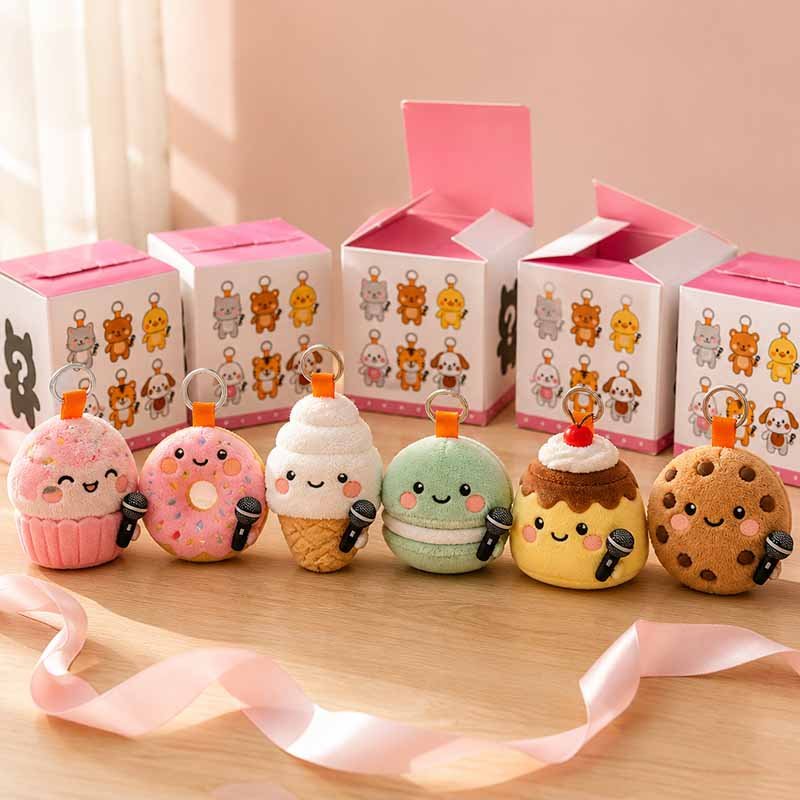
A blind box plush manufacturer must manage an entire collectible system rather than one stuffed toy. Character fidelity, multiple SKUs, hidden variants, packaging, version control, assortment ratios, quality inspection, and repeat production all need to work together. A strong sample is important, but the real manufacturing test is whether that approved result can be reproduced correctly across thousands of units.
Character Fidelity
Character fidelity becomes increasingly difficult as product size decreases. On a 30 cm plush, a small change in eye position may be visible but not devastating. On an 8–12 cm collectible, moving both eyes only a few millimeters can noticeably alter expression, while slightly increasing stuffing pressure can widen the face enough to make the approved embroidery look misplaced. Smaller products leave less physical room for seams, embroidery, ears, clothing, hardware, and filling, so apparently minor decisions interact with each other.
An experienced development team therefore starts with the elements that make the character recognizable from a distance: head shape, silhouette, head-to-body ratio, eye spacing, mouth position, ear angle, posture, and signature details. Decorative elements come after those fundamentals are stable. A beautifully embroidered mouth does not fix a head pattern that is too narrow, just as a perfectly matched fabric color cannot compensate for ears positioned at the wrong angle.
Material selection also changes visual geometry. Long-pile faux fur can partly hide embroidery and soften edges. Short minky exposes placement differences more clearly. A miniature hood may pull on the head shape, while a heavy accessory can change posture or hanging balance. These interactions are especially important when a collection contains several characters intended to look like members of the same visual family.
For multi-character projects, samples should therefore be reviewed side by side rather than only one at a time. The development process used by Pufumi, for example, converts drawings, AI images, sketches, photographs, 3D references, or physical samples into manufacturable structures involving paper patterns, seam positions, pile direction, filling areas, balance, and accessory fixation before production.
Multi-SKU Control
Multi-SKU control is one of the clearest differences between ordinary plush manufacturing and a serious blind box program. A typical collection may contain six standard characters, one secret design, and one retailer-exclusive version. Although all eight products may appear similar on a planning spreadsheet, the factory could be handling eight embroidery files, multiple accessory sets, different colors, unique collector cards, special packaging codes, and several production revisions at the same time.
The risk is not limited to obvious mistakes such as putting the wrong head on the wrong body. More subtle problems include using an obsolete embroidery file, packing Character 03 with Character 04’s card, attaching the correct barcode to the wrong market version, or allowing an accessory left at a workstation to move into the next SKU after a production changeover.
Reliable factories create product identity before production begins. Materials and cut pieces can be grouped by SKU, embroidery programs should carry controlled names or version numbers, accessory sets can be pre-kitted, and packing stations should verify the relationship between the product, card, label, box, and carton. The system does not have to be complicated software. Labeled bins, work cards, controlled folders, physical separation, and disciplined line clearance can be highly effective when consistently used.
Pufumi’s documented approach divides multi-SKU programs into shared-platform, partly shared, and fully independent structures. Shared-platform characters can often use common bodies, materials, hardware, and packaging, while completely independent designs require separate assessment because their patterns, materials, operations, and packaging differ materially.
Hidden Editions
Hidden editions create an unusual manufacturing problem because the factory requires precise information that should not become obvious outside the controlled production process. The team must know how many secret units to produce, how they are coded, and how they enter cartons, while consumers should not be able to identify the secret product from the outside of the package.
The first requirement is a written ratio. Instructions such as “put a few secrets in the shipment” are not sufficiently precise for commercial production. A collection may use a ratio such as one hidden unit within a defined number of retail units, but the brand and manufacturer must also agree whether that ratio is controlled across the full order, individual displays, master cartons, or another packing unit. The chosen method should match the way products will actually reach retail.
Physical clues also deserve attention. A secret character with a large metal accessory may weigh noticeably more than regular characters. An unusual insert can change the feel of the box. Even tiny differences in package thickness or internal movement may eventually be noticed by collectors. Product engineering and packaging therefore have to support the commercial rarity concept together.
Confidentiality is equally important. Unreleased characters, retailer-exclusive versions, launch dates, and rarity structures should not be casually displayed around the facility or used for marketing without approval. Pufumi’s documented blind box controls separately manage hidden quantities, internal codes, packing confidentiality, carton ratios, and approved project rules.
Packaging and Repeat Production
For blind box products, packaging is part of the product architecture. The factory may need to manage an inner bag, collector card, printed retail box, display carton, barcode, copyright line, age marking, warning information, retailer labels, and master carton in addition to the plush itself. When several markets are involved, the same physical character may require multiple packaging or labeling versions.
A good packaging check therefore covers three areas. Physical fit confirms that the plush can be packed without unwanted compression or permanent deformation. Visual verification checks artwork, colors, printing, and brand information. Data verification confirms that barcodes, product codes, copyright information, market labels, carton marks, and quantities correspond to the correct product.
Packaging errors can be commercially more disruptive than a small cosmetic sewing defect. A minor stitch variation may still produce a saleable item, while an incorrect barcode can prevent warehouse receiving or place the wrong inventory information into a retailer’s system.
Repeat production adds another layer of risk. New fabric lots may vary slightly in color or hand feel, operators may change, and old production files can accidentally return. A strong manufacturer retains the Golden Sample, BOM, paper patterns, embroidery files, approved materials, packaging records, QC requirements, and revision history so the next order is reproduced against an approved reference rather than reconstructed from memory. Pufumi explicitly connects these records with repeat-order control.
Which Are the 25 Best Blind Box Plush Manufacturers?

There is no universal manufacturer that is best for every blind box plush project. Some factories are particularly strong in collectible plush, some in licensed characters, some in traditional stuffed-toy production, and others in hybrid vinyl-plush or electronic products. The following 25-company shortlist is intended as a sourcing comparison, not a mathematical ranking or certification of every supplier.
Blind Box Specialists
Pufumi is particularly relevant where a project involves blind box plush, hidden editions, licensed characters, mini collectibles, keychains, bag charms, multi-SKU control, and retail-ready packaging. Its internal product system treats Blind Box Plush, Mini Collectible Plush, Hidden Edition Plush, numbered or limited designs, collector-card products, and multi-character programs as product-line work rather than isolated sewing orders.
Kinwin also stands out because blind box plush is explicitly presented as part of its private-label manufacturing offering. Its public information describes complete collections, character development, series planning, and custom blind box packaging alongside broader OEM and ODM plush production. The company currently states more than 17 years of manufacturing experience, 30+ senior pattern makers, 15 production lines, and a standard MOQ around 500 pieces for its general plush programs. Those figures should still be reconfirmed against a specific RFQ.
Nianbeast publishes a dedicated plush blind box category covering customized plush blind boxes, animal collections, seasonal concepts, and plush-vinyl combinations. Weijun Toys approaches the market more broadly, combining plush with PVC, vinyl, ABS figures, and blind box collectibles. That makes it particularly interesting when the product line may eventually cross from soft collectibles into hard or mixed-material designs.
Mr Plushie also explicitly lists Blind Box Plushies among its services, while its public company information describes a Malaysia-based commercial organization supported by manufacturing in China. For companies that value a regional commercial interface combined with China manufacturing, that structure may be worth evaluating more closely.
Plush OEM and IP Factories
Many strong blind box projects can be produced by experienced custom-plush factories even when “blind box” is not their main website category. The important question is whether their pattern making, character development, SKU controls, packaging management, and inspection systems can support the extra complexity.
Mavo Toys publicly positions itself around custom plush for brands, IP owners, licensors, retailers, and overseas commercial programs. It currently states more than 15 years of OEM/ODM experience, ten production lines, 15+ in-house designers and pattern makers, MOQ from 500 pieces per design, and typical sampling around 10–15 business days. These numbers are useful for initial comparison, although every program should receive a project-specific quotation.
JianChuang has a particularly relevant background in cotton dolls, IP merchandise, fan merchandise, trendy collectibles, plush products, and blind box figures. Its public profile says the company was founded in 2018 and operates under an ISO 9001:2015 quality-management certification. The combination can be attractive for anime, creator-IP, and detailed character merchandise where facial embroidery and small-scale costume details matter.
KJIN markets itself around licensed-IP plush manufacturing and publicly displays ISO 9001, Disney FAMA, Sedex, and NBCU-related credentials. That profile can be useful for projects where licensor approval and controlled character assets matter as much as basic sewing ability. As always, the scope and current status of relevant documents should be verified during qualification rather than assumed from a website logo.
Other conventional plush candidates include CJL Plush, Toy Gift Supply, DreamPlush, Bella Plush, Miyan Toys, Misail Toys, Dongguan Yikang, Yangzhou Tongyue, Yancheng Geeme, Dongguan Dingman, Dongguan Mayachi, and Dongguan Lokwell. Their public positioning spans custom stuffed animals, character plush, keychains, cotton dolls, retail packaging, baby products, OEM/ODM production, and international export programs. Several publish useful manufacturing or capacity information, but blind-box-specific controls should be confirmed through samples and project documentation rather than assumed.
Hybrid and Specialty Manufacturers
The category becomes more interesting when a blind box product is no longer entirely soft. Some collectible characters combine a fabric body with a vinyl face, injection-molded accessories, ABS parts, electronic functions, sound modules, LEDs, NFC components, or interactive technology.
Meida Toys is relevant in this area because it publicly describes an integrated plastic and plush manufacturing operation founded in 1997, covering plastic, electronic, plush, cartoon, and educational toys. Its current company information describes an 18,500-square-meter factory and more than 600 employees, alongside a larger intelligent-industrial-park investment. These capabilities may be useful where soft and hard components need to be engineered together.
KingDa is primarily a collectible and hard-toy manufacturer, but its public offering covers blind box development, plush toys, electronic toys, and custom figures. Its dedicated blind box page focuses mainly on PVC, soft vinyl, ABS, and resin rather than traditional all-fabric plush, so it is better viewed as a candidate for hybrid programs rather than a default choice for a simple mini stuffed character.
Kidult Tech is another specialist case. Its current website focuses on AI and interactive plush and lists blind box series and limited editions within its wider product scope. The company publicly states a 10,000-square-meter facility, more than 500 workers, and monthly capacity above one million pieces. Those capabilities are most relevant when an interactive, electronic, or premium secret edition requires technology beyond ordinary sewing.
25-Manufacturer Shortlist
The table below is best used as an initial qualification map. “Best fit” describes the type of project each supplier appears most relevant to based on publicly visible capabilities and the manufacturing categories reviewed for this article. It should not replace current factory audits, sample evaluation, compliance review, or commercial due diligence.
| # | Manufacturer | Relevant Strength | Practical Best Fit |
|---|---|---|---|
| 1 | Pufumi | Blind box plush, hidden editions, multi-SKU control, retail packaging | IP and collectible plush programs |
| 2 | Kinwin | Blind box collections, private label, character development | Character-led mystery collections |
| 3 | Weijun Toys | Plush plus figures and blind box collectibles | Multi-material collectible programs |
| 4 | Nianbeast | Dedicated plush blind box products | Mystery plush and seasonal series |
| 5 | JianChuang | Cotton dolls, IP merchandise, trendy collectibles | Anime and detailed character collections |
| 6 | MSX Toys | Custom plush OEM/ODM and collectible-oriented development | Brand-led plush collections |
| 7 | Bella Plush | Mini plush, keychains, custom characters | Compact pendant and keychain series |
| 8 | DreamPlush | Cotton dolls, character plush, in-factory plush processes | Small character collections |
| 9 | Mavo Toys | IP-focused OEM/ODM, sampling, retail packaging | Licensed and brand character plush |
| 10 | CJL Plush | Custom and licensed plush production | Conventional plush series |
| 11 | Toy Gift Supply | Retail-oriented plush and private-label packaging | Gift and retail collections |
| 12 | Misail Toys | Larger-scale plush manufacturing | Higher-volume programs |
| 13 | FunEnjoy Toys | Custom plush and related brand merchandise | Mixed retail plush programs |
| 14 | KJIN | Licensed-IP plush manufacturing | Licensor-controlled projects |
| 15 | Miyan Toys | Traditional custom plush and prototype development | Structurally straightforward collections |
| 16 | Mr Plushie | Dedicated blind box plush category | Mystery plush and branded collections |
| 17 | Meida Toys | Plastic, electronic, and plush integration | Hybrid plush collectibles |
| 18 | KingDa | Blind box figures and multi-material toy development | Vinyl-plush or hard/soft hybrids |
| 19 | Kidult Tech | AI and interactive plush | Electronic or interactive collectibles |
| 20 | Dongguan Yikang | Plush keychains, stuffed toys, mystery-box category | Small hanging plush products |
| 21 | Yangzhou Tongyue | Broad plush, dolls, keychains, OEM/ODM | Conventional sewn collections |
| 22 | Yancheng Geeme | Traditional stuffed-toy manufacturing | Established plush constructions |
| 23 | Dongguan Dingman | Plush, infant products, QC and testing equipment | Safety-sensitive soft products |
| 24 | Dongguan Mayachi | Plush dolls, keychains, mascots | General collectible plush |
| 25 | Dongguan Lokwell | OEM/ODM custom plush and established production process | Character-led conventional plush |
The list becomes far more useful once a brand narrows it according to its actual problem. A six-character 10 cm minky collection is not the same manufacturing job as a twelve-character licensed series containing retailer exclusives, different regional packaging, and a vinyl-faced secret edition. The manufacturer with the best match to the product architecture usually deserves more attention than the company with the most impressive general factory statistics.
How Should You Compare Blind Box Plush Manufacturers?

Compare manufacturers against the failures that would actually hurt the project: character drift, SKU mixing, uncontrolled revisions, packaging mismatches, hidden-edition errors, weak compliance planning, and inconsistent reorders. Factory size and price remain important, but they should be viewed alongside sample quality, production documentation, SKU control, packaging capability, QC records, and the supplier’s ability to reproduce the same product later.
Development Capability
The sample room often reveals more about a blind box manufacturer than the main sewing floor. Industrial sewing capacity is necessary for production, but it is the pattern-making and development team that converts a flat character image into a stable physical form that can later be repeated by production workers.
Ask who creates paper patterns, who digitizes facial embroidery, who decides seam placement, and how sample feedback is recorded. A serious development process normally separates the first prototype from later production references because the first sample is intended to expose questions rather than finalize everything immediately.
For a complex character, the team may need to adjust head volume, eye position, fabric pile, stuffing pressure, accessory attachment, and clothing simultaneously. Each revision should move the project toward a form that is not only visually appealing but reproducible. The sample maker may be able to manually pull and reshape one prototype until it looks perfect; production workers cannot depend on that kind of artistic correction across thousands of pieces.
The most useful supplier conversation is therefore not “How fast can you make a sample?” but “How do you decide when a sample is actually ready for production?” Pufumi’s documented sample process distinguishes first samples, revision samples, engineering samples, pre-production samples, and Golden Samples, while its internal benchmark places ordinary samples around 7–12 working days and complex samples around 12–20 working days once required information, sample fees, and key materials are ready.
Production and SKU Control
Once samples are approved, the project changes from product development into information control. Every production station needs the correct version of the product without receiving contradictory or outdated instructions.
A good factory should be able to explain what documents are released before bulk work starts. Depending on the product, this may include the Golden Sample, BOM, paper pattern, embroidery program, fabric information, accessory specification, stuffing target, artwork files, packaging data, and critical quality points.
Blind box projects need additional separation because several similar characters often travel through the same production area. Materials, cut panels, embroidered pieces, accessories, semi-finished products, finished products, and packaging can all look surprisingly similar when workers are handling thousands of units. Clear identification at each stage is more reliable than assuming employees will remember the difference.
Version control is equally important. If the approved face is Revision 5, Revision 3 should no longer be available for normal production use. If the packaging artwork changes after a licensing review, the old file should be archived rather than sitting next to the current version.
A practical comparison scorecard can keep supplier evaluation focused on evidence rather than sales claims.
| Area | Evidence Worth Requesting | Typical Warning Sign |
|---|---|---|
| Character Development | Revision samples, pattern explanation, sample records | Immediate promise of “perfect copying” |
| SKU Management | SKU master, work cards, separation method | Workers identify products from memory |
| Hidden Editions | Written ratio and confidentiality process | No defined packing rule |
| Production Release | Golden Sample, BOM, released files | Bulk starts before approvals close |
| Packaging | Box mock-up, barcode and card checks | Packaging considered only after sewing |
| Quality | Incoming, in-line, final and packing records | Only final visual inspection |
| Reorders | Retained sample and revision archive | Reproduction based mainly on photos |
| Compliance | Product-specific testing plan | Generic certificate claims without scope |
Packaging Capability
A manufacturer that makes excellent plush but handles packaging poorly can still create a serious retail problem. Blind-box projects frequently involve several packaging layers that must correspond to each other without revealing product identity inappropriately.
Ask the manufacturer when packaging development begins. Ideally, the box structure and packing method are evaluated while the physical sample is still being refined. Waiting until thousands of finished characters are sitting in a warehouse creates unnecessary risk because the final plush may compress badly, hardware may damage printed surfaces, or the box may be larger than needed.
Printed components also have independent production realities. Retail boxes, collector cards, foil processes, labels, and display cartons may each carry their own setup requirements and production minimums. A project can therefore have an economical plush quantity but an inefficient packaging quantity for a small regional version.
Data accuracy deserves as much attention as appearance. The right barcode on the wrong character is still wrong. So is the right plush inside the wrong language version. Pufumi’s quality-control matrix includes checks for hangtags, barcodes, boxes, polybags, outer cartons, carton marks, SKU identity, quantity, and outgoing shipment requirements.
Long-Term Reliability
A successful collectible rarely remains a one-order project. Strong characters may return in a second wave, seasonal color, bag charm, larger format, retailer exclusive, or another regional launch. That is when recordkeeping becomes commercially valuable.
Ask what the supplier retains after shipment. The ideal archive contains approved Golden Samples, patterns, embroidery programs, BOM versions, material references, packaging artwork, QC standards, production photographs, carton specifications, and retained finished samples. If a claim arises six months later, the factory should be able to compare the returned product against a known reference.
Material continuity deserves particular attention. Fabric suppliers may change dye lots, pile characteristics, backing density, or hand feel. Even when a material is nominally the same, it should be checked against the approved reference for a reorder.
Revision history should remain visible as the product evolves. Pufumi’s SKU framework uses statuses such as Draft, Sample, Approved, Released, Revised, Archived, and Obsolete, with the intent that only a Released version enters formal production.
Long-term consistency rarely comes from trying harder on the second order. It comes from retaining enough information from the first one.
How Do Blind Box Plush Projects Move From Art to Production?

A well-managed blind box plush project moves through controlled gates: artwork review, engineering, sampling, revision, Golden Sample approval, SKU release, material preparation, bulk production, packaging verification, final inspection, and shipment. Each stage should resolve the decisions needed by the next stage because late changes can affect cost, materials, packaging dimensions, compliance, production efficiency, and launch timing.
Artwork and Engineering
Brands rarely begin with perfect factory specifications. They may provide turnaround sheets, flat illustrations, game assets, AI renderings, a 3D model, photographs, sketches, or an existing character reference. The manufacturer’s first job is not simply to copy what it sees but to determine how that design behaves when converted into fabric, seams, stuffing, embroidery, and physical volume.
Some features translate directly. Others require interpretation. A thin illustrated arm may become impossible to turn after sewing at miniature scale. A dramatic hairstyle may need to be simplified into layered fabric pieces or longer-pile material. A large accessory can disturb the center of gravity. A face that works perfectly in a front-view drawing may need subtle adjustment after the head becomes three-dimensional.
Engineering should also identify the parts that can be shared across the collection. Eight characters using one common body can reduce patterns, material variation, and production changeovers while maintaining unique faces, colors, clothing, and accessories. That approach can improve consistency without making the collection feel repetitive.
The manufacturer should also separate flexible design details from identity-critical features. A licensing team may tolerate a slight seam change but reject a different eye shape, signature color, or emblem position. Those boundaries are easier to manage when established before samples start.
Sampling and Approval
The first sample should be treated as a physical question rather than a miniature final product. It reveals whether the proposed pattern, material, embroidery, stuffing, and construction actually create the intended character.
Feedback becomes much more useful when it is measurable. “The face looks strange” forces the sample maker to guess. “Reduce the head width by approximately 5 mm and move the eyes 2 mm inward” creates a clear action. Brands should consolidate comments where possible so the factory receives one revision brief rather than conflicting instructions from product, design, licensing, procurement, and management.
Photography should show more than the front. Side, rear, 45-degree, top, bottom, and close-up images reveal volume and symmetry. Hanging products should be shown suspended from their clasp because gravity can alter posture. Sitting products should be tested without hand support.
Multi-character collections should also be reviewed together. Eye size, stuffing density, embroidery style, material sheen, and overall proportion can feel inconsistent when every character has been developed in isolation.
Once the product reaches a production-ready state, the Golden Sample becomes the main physical reference. It should match the released BOM and production information and should not be silently superseded by later verbal changes.
SKU Release and Bulk Production
Bulk production should start from a controlled definition of the product. An attractive approved sample alone is not enough if the factory has not released the correct files, materials, packaging information, and inspection criteria.
A practical release package often includes approved physical references, patterns, embroidery programs, BOM data, confirmed fabrics, accessory information, labels, packaging requirements, and critical quality points. Blind box programs also need a master SKU structure that distinguishes regular characters, secret editions, retailer versions, market versions, and later revisions.
Once materials arrive, SKU identity should continue through cutting, embroidery or printing, sewing, stuffing, shaping, accessory installation, finishing, inspection, and packing. It is safer to verify several times than to hope a final inspector can discover everything at the end.
Pufumi’s documented system requires materials, cut parts, embroidery pieces, accessories, semi-finished products, finished goods, and packaging for different SKUs to be separated physically or through clear identification. It also describes line-clearance practices during SKU changes so leftover components from one version do not enter the next.
Packaging, Inspection, and Shipment
Packaging should be verified using production-equivalent products before the entire order is packed. The actual plush should fit correctly, collector cards and inserts should match the project logic, retail boxes should close without excessive pressure, and display cartons should hold the correct assortment.
The last stages are where product quality and commercial identity finally meet. Inspectors should not only ask whether the face is symmetrical and the seams are secure; they should also confirm whether the correct item is associated with the correct label, card, barcode, package, market version, carton, and shipping documentation.
A pre-shipment inspection for a multi-SKU program should include carton-level checks rather than examining only loose samples. The factory may produce excellent individual characters but still create a distribution problem if carton ratios are wrong.
A useful planning model separates the project into distinct gates rather than treating “sampling” and “production” as two large blocks.
| Project Gate | Main Output | Typical Release Condition |
|---|---|---|
| Artwork Review | Character brief and open-question list | Critical design ambiguities resolved |
| Engineering | Pattern and construction direction | Main manufacturability risks accepted |
| Prototype | First physical sample | Core shape can be evaluated |
| Revision | Corrected samples | Visual and structural issues closed |
| Golden Sample | Approved physical reference | Approval is recorded |
| Production Release | BOM, files, packaging, QC plan | Correct versions are released |
| Bulk Production | Finished products by SKU | In-process issues contained |
| Pack-Out | Correct product/package relationships | Assortment and labels verified |
| Shipment | Approved cartons and documents | Final inspection completed |
This gate-based approach also makes launch planning more realistic because delays become visible where they actually occur. A late licensor comment affects sample approval. A custom fabric delay affects production release. A packaging artwork change affects print lead time. Managing each dependency explicitly is much safer than promising one simple factory completion date.
What Should You Ask About MOQ, Cost, and Lead Time?
MOQ, cost, and lead time should be discussed at the SKU, material, and packaging level rather than as one headline number for the entire collection. Blind box economics depend heavily on how many components are shared, how many unique designs require separate setup, whether custom materials are used, and how many packaging versions must be produced and controlled.
MOQ Per SKU
MOQ is one of the most misunderstood parts of blind box sourcing because brands often want one simple number while a factory is dealing with several different minimums.
A supplier may state a 500-piece MOQ, but that can mean 500 pieces per character rather than 500 pieces for an entire eight-character series. The difference changes a program from 500 total units to 4,000. A common outer box does not necessarily make all other components shareable.
The most useful quantity discussion separates finished-product MOQ from material and packaging constraints. Custom-dyed fabric may carry a minimum independent of sewing quantity. Special hardware can require its own production batch. Printed boxes or collector cards may become inefficient when one regional version needs only a few hundred pieces.
Shared-platform designs can improve the situation. If eight characters use one body shape, one base fabric, one filling, one clasp, and one box size, the factory can often combine material purchasing more efficiently. Fully independent characters behave more like eight separate products.
Pufumi’s internal planning guidance illustrates this difference rather than presenting one universal quantity. Suitable ordinary Core Plush projects can begin evaluation around 500 pieces per SKU, while Mini Plush, Keychain, Bag Charm, and complex-packaging programs are generally more stable around 1,000 pieces per SKU, depending on construction, material, and packaging requirements.
Cost Structure
The smallest character is not automatically the cheapest. A compact 10 cm plush may contain several fabrics, three embroidery areas, miniature clothing, a metal clasp, tiny accessories, hand trimming, an inner bag, collector card, premium printed box, and display carton. Labor and component complexity can outweigh the raw value of the fabric.
Important cost drivers include pattern complexity, number of fabric colors, custom dyeing, pile type, embroidery stitch count, printed details, clothing layers, accessories, hardware, stuffing, assembly time, hand finishing, product inspection, individual packaging, collector cards, special printing, display packaging, and testing requirements.
A well-designed collection can reduce cost without losing its character. Sharing a body platform, standardizing clasps, reusing approved fabrics, reducing unnecessary internal parts, or using one packaging structure across several characters can simplify manufacturing while leaving the visible identity intact.
Cost engineering is most effective before Golden Sample approval. Once the product team, licensing team, and brand have approved every detail, meaningful price reduction usually requires reopening decisions that have already been closed.
A professional quotation should therefore be read as an engineering result, not simply compared line by line against another number. Two factories may appear to quote the same plush while making different assumptions about materials, inspection, packaging, testing, or assortment work.
Sampling and Packaging Costs
A sample fee represents development work rather than the retail value of one plush. The factory may need to create paper patterns, source fabrics, program embroidery, test different materials, cut one-off components, sew miniature garments, assemble hardware, adjust stuffing, photograph the sample, review it internally, and repeat several steps after feedback.
Complex characters cost more to develop because the team is solving more engineering questions. A basic rounded mascot built from one short-pile fabric behaves differently from a humanoid character with layered clothing, hair, footwear, accessories, and several embroidery positions.
A multi-SKU collection can reduce some development work when characters share a common platform, but each unique head, face, accessory, color, or garment still needs controlled approval.
Packaging development may create separate costs as well. A blind box can require structural mock-ups, print proofs, collector cards, inserts, foil or specialty printing, and display-carton testing. Printed packaging also has its own production economics.
Pufumi’s commercial fact library treats sample fees as compensation for real development tasks including pattern making, material preparation, sample labor, trial embroidery or printing, internal review, revisions, and pre-shipment sample checking.
When comparing sample quotes, ask what is included rather than assuming every supplier uses the same definition.
Realistic Lead Time
Lead time should be separated into development, material preparation, manufacturing, packaging, inspection, and transportation. A statement such as “30-day production” can be misleading when it excludes sample approval, custom-dyed fabrics, printed packaging, testing, or shipping.
A straightforward product made from available materials can move faster than a licensed multi-SKU collection. The latter may require artwork review, several sample revisions, licensor approval, packaging approval, materials, third-party testing, bulk production, assortment checks, pre-shipment inspection, and delivery into a retailer or 3PL.
Multi-SKU work also requires more changeovers than one large single-design run. Machines and workstations may need to switch embroidery programs, fabrics, accessories, and labels. Components must be cleared before the next SKU enters. Packaging and carton ratios require additional checking.
Pufumi’s internal records explicitly note that multi-SKU production generally takes longer than an equivalent single-SKU run because SKU switching, line clearance, verification, packaging, and QC add real workload.
For launch-driven collections, work backward from the required warehouse or retail date rather than the factory’s finished-production date. Freight, customs, destination receiving, retailer booking, and local distribution can consume meaningful time after the last carton leaves the production floor.
How Do You Verify a Blind Box Plush Manufacturer?
Verify a blind box plush manufacturer through evidence rather than presentation: legal identity, real factory access, relevant samples, sample-development capability, multi-SKU controls, IP practices, quality records, packaging procedures, and product-specific compliance planning. A professional supplier should be able to explain exactly how your collection moves from artwork to controlled production instead of relying on broad claims about experience or capacity.
Factory and Team
Begin with a simple question: who are you actually contracting with? The entity shown on the website, the company issuing the quotation, the bank beneficiary, the factory registration, the audit report, and the export documentation may not always be identical.
That does not automatically indicate a problem. Many legitimate manufacturing organizations use a commercial company together with owned, invested, or managed factories and specialist partners. The problem appears when responsibility is unclear or the supplier deliberately creates the impression that unrelated operations are all one facility.
Ask where product development takes place, where samples are made, where cutting and sewing occur, where packing is completed, and which processes are handled by outside specialists. Custom dyeing, printing, packaging, metal accessories, electronic modules, testing, and logistics are commonly supported by external specialists even in strong manufacturing systems.
A live video walkthrough can be useful before an on-site audit. Ask to see the current sample room, material storage, cutting, embroidery, sewing, stuffing, finishing, QC, packing, and warehouse rather than relying solely on edited promotional footage.
Pufumi, for example, documents its brand and operating relationship explicitly: the brand operates under Shenzhen Oneier Technology Co., Ltd. and uses Oneier-invested plush manufacturing resources, including a core Dongguan factory established in 2007. Its fact library deliberately distinguishes the different entities rather than presenting all resources as one undefined factory.
Relevant Samples and Production Evidence
Ask for samples that resemble the manufacturing challenge you intend to purchase. A 40 cm teddy bear does not demonstrate the same skills required for a 9 cm anime-style blind box pendant with detailed embroidery, miniature clothing, and a metal clasp.
Relevant evidence can include mini character plush, keychains, bag charms, cotton dolls, multi-character collections, licensed products, boxed retail merchandise, or comparable structural details. If customer confidentiality prevents the supplier from showing recognizable commercial projects, internally developed demonstration samples can still show engineering capability.
Inspect multiple pieces where possible. One perfect showroom sample mainly proves what a sample maker can achieve. Five or ten pieces of the same design begin to show repeatability. Several characters from one program reveal whether the factory can maintain consistent stuffing, embroidery style, material quality, and finishing across a series.
Development samples can be even more revealing than final products. A sequence showing Version 1, Version 2, and the approved sample demonstrates how the team solves problems and responds to comments.
Pufumi’s sample-room documentation covers character plush, anime and game characters, mascots, keychains, bag charms, blind box plush, interactive products, and retail packaging samples. It also records internal sample reviews for appearance, dimension, face shape, materials, hand feel, construction, accessories, and presentation before customer submission.
IP, Quality, and Compliance
A professional supplier should be willing to ask whether the customer has the right to use a character. A factory that casually offers to reproduce any famous IP without checking authorization may display the same lack of discipline when handling a customer’s unreleased original assets.
Confidentiality should extend beyond signing an NDA. Ask how customer files are stored, whether secret-edition artwork is access-controlled, whether prototype photography is restricted, and whether product samples can appear on the factory’s website or social channels without explicit permission.
Pufumi’s documented policy accepts original, customer-owned, or properly authorized assets and restricts project files to activities such as evaluation, quotation, sampling, production, testing, packaging, delivery, and reorder management. Projects that are clearly unauthorized are outside its stated service scope.
Quality systems should produce records rather than slogans. Relevant checkpoints can include incoming fabric, color, pile, cut dimensions, embroidery position, seam integrity, stuffing level, symmetry, accessory attachment, labels, barcodes, packaging, cartons, and outgoing quantity. Pufumi’s documented matrix uses incoming, cutting, embroidery, sewing, stuffing, shaping, packaging, and shipment checks, combined with focused inspection rather than claiming an unrealistic guarantee of absolute zero defects.
Compliance should likewise be project-specific. ASTM F963, CPSIA-related requirements, EN71, CE obligations, or other market requirements depend on the target country, age grade, materials, components, and product design. A generic certificate page is not a substitute for a testing plan connected to the actual SKU being purchased.
Start With a Controlled Sample
Sampling is not merely a preliminary purchasing formality; it is one of the most useful supplier-verification tools available.
Give shortlisted factories enough information to reveal how they think: artwork, dimensions, intended quantity, number of SKUs, target market, packaging direction, target launch date, and any critical character features. Pay attention to the questions they ask. A supplier that identifies unclear dimensions, difficult accessories, unusual material minimums, packaging conflicts, or compliance concerns early may be demonstrating more competence than a factory that immediately promises everything.
Choose a technically representative character for the first evaluation. The easiest character may hide important problems. If one SKU contains complex ears, layered clothing, a heavy accessory, or an unusual face structure, it can expose engineering and communication quality more quickly.
When several factories produce samples from the same brief, compare more than appearance. Review how clearly they document revisions, how materials are identified, whether measurements are consistent, whether the supplier explains manufacturing trade-offs, and how confidently it describes the transition into bulk production.
For a high-value collection, it can also be useful to test a small production-equivalent set before committing the whole launch. The goal is not necessarily to place a tiny commercial order, but to confirm that released patterns, embroidery programs, actual materials, packaging, SKU identification, and QC criteria work together outside the sample room.
A reliable supplier should make the path from artwork to repeat production easier to understand, not more mysterious.
Conclusion
Choosing among the best blind box plush manufacturers is ultimately less about finding the factory with the loudest marketing claim and more about finding the organization whose operating system matches the collection. A simple six-character minky series may perform well with an experienced conventional plush factory, while a licensed twelve-character launch containing hidden editions, multiple market packages, retailer exclusives, and hybrid components requires a much deeper level of development and project control.
The strongest manufacturing relationship becomes visible through small practical details: clear sample revisions, controlled embroidery files, labeled materials, clean SKU changeovers, approved Golden Samples, accurate packing ratios, barcode checks, retained references, and honest discussions about MOQ, timing, compliance, and manufacturing limits. Those details may not look exciting in a promotional video, but they are what protect an expensive product launch after the excitement of the first prototype has passed.
For brands, licensors, collectible companies, and retail teams considering a new blind box plush line, the most useful next step is to narrow the 25 manufacturers to a handful that match the actual product architecture, then send the same structured project brief to each one. Comparing how those suppliers question, sample, document, and plan the project will usually reveal far more than comparing homepage claims or headline prices. A manufacturer that can explain exactly how your character becomes a controlled, retail-ready, repeatable product is the one worth continuing the conversation with.
Frequently Asked Questions
What is a blind box plush manufacturer?
A blind box plush manufacturer develops and produces small collectible plush characters that are sold in sealed mystery packaging. Unlike a conventional plush supplier, the manufacturer may need to manage several character SKUs, secret editions, controlled assortment ratios, collector cards, identical-looking retail boxes, barcodes, display cartons, and retailer-specific packaging at the same time. The manufacturing process normally includes artwork conversion, paper-pattern development, sampling, material confirmation, embroidery or printing, sewing, stuffing, finishing, SKU separation, packaging verification, inspection, and bulk shipment.
How do I choose a blind box plush manufacturer?
Start by matching the supplier to the actual complexity of the collection rather than choosing solely by price or factory size. Review character-development samples, ask how multiple SKUs are separated during production, examine the process for hidden editions, request packaging and QC examples, and confirm how approved versions are retained for reorders. For licensed or confidential projects, also review IP handling and NDA procedures. The most useful qualification method is usually a controlled sample project based on the same artwork and requirements that will eventually enter commercial production.
What is the typical MOQ for custom blind box plush?
There is no universal MOQ because quantity depends on character structure, number of SKUs, materials, custom colors, hardware, packaging, and the manufacturer’s production model. A collection may have one total purchase quantity but several separate minimums for each design, fabric, printed box, collector card, or custom accessory. Pufumi’s internal planning framework, for example, evaluates suitable standard Core Plush projects from around 500 pieces per SKU, while Mini Plush, Keychain, Bag Charm, and complex packaging projects are generally more stable around 1,000 pieces per SKU depending on the specification.
How long does it take to make a blind box plush sample?
Sampling time depends heavily on design complexity and whether materials are readily available. A simple character using standard fabrics can usually move faster than a licensed character with custom colors, elaborate clothing, multiple accessories, or several approval stages. As one real manufacturing reference, Pufumi’s internal sample-room benchmark is approximately 7–12 working days for ordinary projects and around 12–20 working days for complex samples after required information, fees, and key material conditions are ready; multi-SKU sample groups are evaluated individually.
How are hidden editions controlled during manufacturing?
Hidden editions should be managed through a written production and packing rule rather than informal instructions. The project normally defines the secret SKU’s production quantity, internal identity, approved rarity or assortment ratio, confidentiality level, packing method, and carton relationship. During manufacturing, the secret product still needs accurate pattern, embroidery, accessory, and QC control, while information visible to consumers should not reveal its identity. Strong factories also consider whether weight, insert shape, package feel, or another physical clue could make the secret version easy to identify before opening.
What safety standards apply to blind box plush toys?
Applicable standards depend on the target market, intended age, product materials, and components rather than the blind-box format itself. US projects may involve ASTM F963 and CPSIA-related requirements, while European projects commonly involve EN71 and CE-related conformity obligations. Other destinations have their own regulations and labeling requirements. Hard accessories, magnets, batteries, electronics, or detachable small parts can introduce additional considerations. Brands should ask the manufacturer and an appropriate testing laboratory to create a product-specific compliance plan instead of relying on a generic certificate from another plush product.
Should I sign an NDA before sending my blind box character designs?
An NDA is sensible when a project involves unreleased characters, licensed assets, secret editions, collaboration information, launch dates, packaging artwork, or other commercially sensitive material. The agreement is only one part of protection, however. Ask the manufacturer how project files are stored, which employees can access them, whether prototype photography is restricted, how external suppliers receive necessary information, and whether customer products can appear in marketing without approval. Practical access control and clear internal rules usually matter just as much as the NDA itself.