Skip to content

Plush AQL Inspection for Controlled Bulk Quality
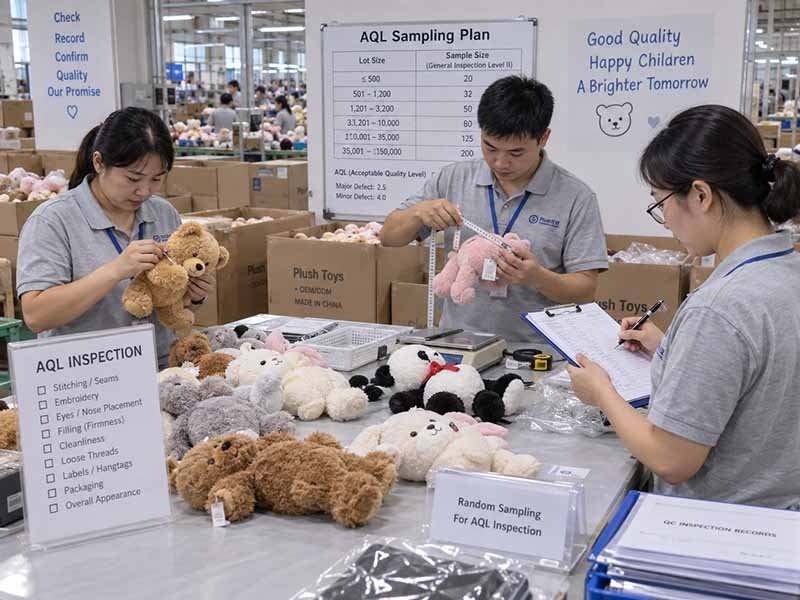
Pre-shipment plush inspection with Pufumi’s standard AQL criteria of Critical 0, Major 2.5, and Minor 4.0—supported by multi-stage production checks and stricter controls for higher-risk projects.
Pufumi combines AQL sampling with incoming inspection, in-process checks, finished-product inspection, packaging verification, and defined 100% checks for critical functions or SKU risks. Inspection decisions are measured against the approved Golden Sample and Production File Package, helping identify workmanship, appearance, labeling, packaging, and batch-quality issues before shipment. Higher-risk children’s, licensed, electronic, retail, or client-specified projects can use stricter AQL levels or additional 100% inspection requirements.
What AQL Actually Means for Bulk Plush Production
Acceptance Sampling
Not a Defect Allowance
Not a Replacement for Process QC
How a Plush Production Lot Reaches Release

Define the Lot

Confirm the Sampling Plan

Select Units Across the Lot

Inspect Against Approved Standards

Classify and Count Defects

Release, Hold or Correct
Build the Inspection Plan Around the Product
Different Plush Programs Need Different Critical Quality Characteristics
A generic finished-toy checklist cannot control every plush program effectively. Licensed character plush may depend heavily on facial landmarks, eye spacing, head-to-body proportion, brand colors, embroidery position and approved costume details. A bag charm has another risk profile: attachment reinforcement, hardware orientation, hanging balance, compact sewing accuracy and small-scale appearance become more important. Blind box collections introduce SKU separation, card matching, hidden-edition controls, sealed packaging and case-ratio accuracy. Interactive plush adds module identification, switch position, battery access, sound or light performance and checks after the body is closed.
Pufumi therefore develops quality controls around the actual product configuration rather than applying equal inspection effort to every characteristic. A project quality plan can identify the approved standard, inspection stage, method, checking frequency, sample size, acceptance criteria, responsible function and required record for each important characteristic. A facial embroidery position might require first-piece confirmation plus process checks. A barcode can require final packaged-state scanning. An electronic function may require unit-level checking where specified. Final workmanship can then be assessed through the agreed AQL sampling plan.
The quality plan is reviewed again when an approved design, material, packaging version, target market or functional configuration changes. A revised product cannot safely inherit every old inspection condition without checking whether the changed element affects appearance, performance, compliance or packing.
Inspection Frequency Must Match Risk, Not Convenience
Quality planning also separates three controls often incorrectly treated as interchangeable: key-point or 100% checking, process sampling, and final lot acceptance sampling. Pufumi’s internal quality approach allows important appearance, label, packaging, SKU-separation and shipment items to receive full or focused full checking while process inspections and final AQL sampling provide additional control.
The inspection method should answer a specific failure mode. Repeated embroidery offset is best detected before hundreds of embroidered panels enter sewing. Incorrect filling distribution cannot be solved by confirming total weight alone. A keychain attachment needs checks that reflect actual loading direction. Multi-SKU packing needs reconciliation before cartons are sealed. A wrong copyright line or barcode may make otherwise acceptable products commercially unusable even when sewing and appearance are excellent.
Pufumi records quality requirements through project files rather than leaving the production team to remember verbal instructions. Core quality documents can include the Project Brief, Golden Sample, released BOM, released pattern, seam map, embroidery file, printing file, packaging file, QC checklist, production tolerance, inspection records and nonconformance records. The result is a control system where the standard, checking point and evidence can be identified when a question appears during production or after shipment.
AQL Levels Used for Pufumi Plush Programs
Pufumi uses a routine internal AQL reference while allowing stricter project requirements. Final criteria depend on product risk, approved specifications, market requirements and the agreed inspection plan.
Defect Class | Routine Internal Reference | Typical Meaning in Plush Inspection | Project Treatment |
Critical | AQL 0 | Safety, regulatory, serious functional, wrong critical labeling, wrong SKU or another issue capable of preventing lawful or intended sale | No Critical defects accepted under the routine internal reference; project-specific rules may be stricter |
Major | AQL 2.5 | Significant appearance, construction, function, packaging or brand-standard failure that materially affects sale or use | Counted against the agreed Major acceptance criteria |
Minor | AQL 4.0 | Limited workmanship or cosmetic variation that does not normally prevent intended sale or use | Counted against the agreed Minor acceptance criteria |
Client-Specified | As agreed | Retailer, licensor, brand or program requirements outside Pufumi’s routine internal reference | Written project requirement takes precedence |
Pufumi’s recorded internal reference is Critical 0, Major 2.5 and Minor 4.0, with stricter standards available when defined for the project.
AQL values should be read together with the selected sampling plan rather than as percentages that can be applied directly to an entire order. ISO 2859-1:2026 defines AQL-indexed acceptance-sampling schemes for lot-by-lot inspection, while ANSI/ASQ Z1.4 remains an attributes acceptance-sampling reference frequently specified in North American quality programs. A Pufumi project can align the sampling basis with the agreed requirement rather than assuming one universal plan for every plush order.
Classify Plush Defects by Their Real Consequences
Critical Defects: When the Risk Goes Beyond Appearance
Critical classification is reserved for defects whose consequence can extend far beyond ordinary cosmetic workmanship. Within Pufumi’s quality framework, Critical issues can include safety or regulatory failures, serious functional conditions, wrong critical labeling, incorrect SKU identification, severe contamination or another major problem capable of making the goods unfit for intended sale.
For plush products, context matters. A loose component on a decorative adult collectible and the same component on a product intended for young children cannot automatically receive identical treatment because use pattern and safety implications differ. Needle or sharp-metal contamination, an exposed internal component, leakage from a weighted insert, an incorrect safety warning, a dangerous battery condition or a prohibited small-part condition can demand immediate escalation rather than routine cosmetic sorting. Pufumi maintains a separate safety-escalation logic for potential metal, broken-needle, small-part, battery, weighted-particle, chemical, flammability, age-labeling and related safety issues.
Wrong-market labels and major SKU errors can also create severe commercial consequences even when the plush body itself looks correct. Severity therefore follows the approved project definition, intended user, target market and actual consequence—not simply the department where the defect originated.
Major Defects: Failures That Materially Damage Sale, Function or Brand Presentation
Major defects are the most common source of serious shipment disputes because the product may still exist as a usable object while failing the approved commercial standard. Typical examples can include an open seam, obvious facial distortion, materially incorrect eye or mouth placement, wrong embroidery color, inconsistent character proportion, significant fabric staining, incorrect filling that changes the approved shape, weak accessory attachment, missing components, wrong retail packaging, incorrect barcode, wrong copyright information, or a functional feature that does not perform as approved.
Pufumi’s own quality-risk library identifies recurring plush concerns such as unequal ears or limbs, unstable sitting or standing posture, insufficient or excessive filling, inconsistent pile direction, shifted costume parts, embroidery color differences, print-position deviation, weak small-accessory fixing, wrong care-label position, mixed market labels, barcode or SKU label errors, deformation caused by packaging, and carton marks inconsistent with the PO.
Major classification should remain tied to written criteria. One millimeter of variation on a hidden seam and the same variation in a character’s eye position do not have equal visual impact. Character-critical features, retail information and functional components often require tighter boundaries because small deviations can change recognition, approval status or sellability.
Minor Defects: Controlled Variation Without Hiding Systemic Problems
Minor defects generally involve limited workmanship or cosmetic variation that does not materially impair normal use, safety or retail presentation under the agreed standard. Examples may include small non-prominent thread tails, slight local surface variation, limited non-critical asymmetry or other approved cosmetic variation within the project’s Minor definition.
Minor classification does not mean “ignore the problem.” Repetition changes the interpretation. A single small cosmetic issue may be Minor, but the same issue appearing across many sampled units can signal a process problem requiring investigation. The frequency, location and pattern of defects matter alongside the defect count.
Soft products also contain natural manufacturing variation. Filling, pile direction and hand-shaped contours cannot be managed as if every surface were rigid-machined. Pufumi therefore focuses tolerances on features that influence character identity, safety, structure, function, packaging and retail presentation while defining acceptable variation for less critical soft areas. Filling, for example, is managed against the Golden Sample and specified handfeel, contour and weight expectations rather than demanding physically identical fiber distribution in every unit.
Use Full Checks, Process Sampling and AQL Correctly
Different quality questions need different inspection frequencies. Pufumi combines focused full checking, process control and final lot sampling rather than presenting any single method as universal.
| Inspection Approach | Best Used For | Plush Examples | Main Purpose |
|---|---|---|---|
| Key-Point / Full Checking | Characteristics where every applicable unit or a defined critical population needs verification | SKU identity, selected labels, packaging points, final shipment information, specified functions | Prevent known high-impact errors from passing unnoticed |
| First-Piece Confirmation | New setup, new file, new SKU, new production stage | Facial embroidery, cutting orientation, seam construction, label placement | Stop a setup error before it becomes a batch problem |
| Process Sampling | Production stability during active manufacturing | Sewing workmanship, filling, appearance, dimensions, embroidery position | Detect drift early enough to correct the process |
| Final AQL Sampling | Lot-level acceptance decision | Finished plush workmanship and other agreed attributes | Decide whether the finished lot meets the agreed sampling criteria |
| Third-Party Inspection | Independent verification where required | Pre-shipment inspection, retailer or licensor review | Add independent evidence before release |
Pufumi’s internal quality approach specifically combines key-point checking or full checking for important appearance, label, packaging, SKU and shipment items with AQL sampling, process patrol inspection and final inspection. It does not use “zero defects” as a blanket marketing claim.
A high-risk feature can also receive a different control frequency from general workmanship. An interactive plush function, for example, may be specified for unit-level verification while other finished appearance characteristics follow a statistical sample. Quality frequency is therefore established by product risk and agreement rather than by one factory-wide slogan.
Golden Sample Defines What the Inspector Must Protect
The Inspection Baseline Starts Before Mass Production
AQL cannot tell an inspector whether a character’s eyes are correctly placed, whether the body feels appropriately filled, whether a costume hem sits at the approved height, or whether a retail box uses the right copyright version. Those decisions require an approved product baseline.
Pufumi defines the Golden Sample as the approved sample used as the mass-production and QC reference. Once approved, its corresponding BOM, pattern and production files become part of the manufacturing baseline. The quality system can also draw from a released pattern, seam map, embroidery file, printing file, packaging file, production tolerance and QC checklist. Each document controls a different source of variation.
Visual approval is particularly important for character plush because small production changes can alter recognition. A correct embroidery program can still create the wrong expression after sewing and filling if the panel position, elasticity or facial shape shifts. Filling weight can be numerically close while the distribution leaves the face flat or limbs uneven. A label can contain correct artwork but be attached to the wrong SKU. Final inspection therefore compares the assembled product with the approved result, not isolated production parameters.
A strong baseline removes arguments such as “the operator has always done it this way.” Production and QC can point to the current approved file and physical reference instead.
Version Control Prevents an Old Approval From Becoming a New Defect
Large plush programs often accumulate many revisions: V1 prototype, revised facial embroidery, changed fabric shade, updated accessory, revised packaging artwork, new barcode, country-specific warning or a second production wave. Quality control fails quickly when an obsolete file remains active beside the current version.
Pufumi uses project, SKU, sample, production-batch and shipment identifiers to connect inspection records with the relevant production state. Inspection records are expected to associate with the project and production batch so an issue can be traced to the affected SKU, material batch, QC evidence and shipment.
Sample archives also support repeat production. Before a reorder, Pufumi can compare the Golden Sample, prior retention sample, photographs, BOM and approval history against current materials and production preparation. Golden Samples and Retention Samples serve different purposes: the Golden Sample defines the approved target; a Retention Sample records what a real production batch actually looked like.
Version control becomes especially important in licensed and multi-market programs. A visually identical plush body can still have different copyright lines, warnings, languages, UPCs or packaging files. The inspection baseline must therefore include both product and retail information.
Control Quality Before the Final AQL Inspection

Incoming Materials

Cut Panels

Embroidery and Printing

Sewing

Filling and Shaping

Labels and Packing Preparation
What Pufumi Checks in a Finished Plush Lot
Character Appearance, Shape and Construction
Finished plush inspection begins with the elements most visible to the consumer and brand team: face, expression, overall silhouette, proportions, left-right balance, ear and limb position, tail orientation, clothing placement, sitting or standing posture and other product-specific landmarks. Soft construction allows reasonable variation, but the features that define character identity need controlled boundaries.
Surface inspection covers stains, holes, pile disturbance, wrong pile direction, visible cutting errors, printing problems and embroidery finish. Sewing checks include open seams, skipped stitches, exposed filling, poor closing, misassembled parts and unacceptable asymmetry. Accessories are examined for correct type, location, orientation and attachment condition. Where a component carries load—such as a keychain loop, hanging strap, tail, wing or wearable accessory—the inspection requirement should reflect its real use rather than only static appearance.
Dimensions and weight are interpreted together with the approved product structure. Filling affects circumference, posture, facial shape and handfeel. Pufumi therefore relates filling control to the Golden Sample and product tolerance rather than judging weight in isolation.
Inspection findings are recorded against defined standards so a pattern can be recognized. Five units with the same eye-position shift are more informative than five unrelated comments saying the toys “look slightly different.”
Function, Components and Safety-Related Inspection Points
Interactive or mechanically complex plush requires additional checkpoints. Sound, light, recording, sensors, buttons, switches, battery compartments, internal modules and wiring can be checked at the stages appropriate to the project. A module working before installation does not prove it works after filling, closing and packaging. Pufumi’s quality experience includes electronic projects where filling affected sound output, leading to module-position adjustment and an added post-packaging unit-level function check.
Needle and foreign-metal risks are managed separately from ordinary cosmetic AQL. Needle control covers issue, return, breakage, fragment reconciliation, affected-product isolation and release. Metal detection may be used where the product construction and project requirements make it appropriate. Products intentionally containing metal hardware or electronics need a risk-based detection arrangement rather than pretending one detector setting suits every configuration.
Accessory checks also depend on intended use. A decorative bow, plastic eye, hanging ring and battery compartment are not evaluated through the same loading direction or failure criteria. Internal production checks can support process control, but they do not automatically substitute for formal regulatory laboratory testing where such testing is required.
Retail, Packaging and Shipment Accuracy
Final inspection extends beyond the plush body. Pufumi’s inspection points include hangtags, care labels, barcodes, retail boxes, polybags, cartons, carton marks, quantity, SKU, carton specifications, documentation and other agreed shipment requirements.
For a multi-SKU collection, inspectors need to know whether each character is inside the right package, whether cards match the SKU, whether barcodes belong to the correct version, whether pack ratios match the order and whether carton marks correspond with the PO. A product can pass every sewing criterion but still create a costly warehouse problem when its barcode, warning, copyright line or carton identity is wrong.
Retail packaging is also inspected in its real assembled state. A window can press against the face, a tight insert can deform ears, a polybag can obscure a barcode, and compression can change the product’s presentation after opening. The final quality decision therefore considers how the item will actually leave the production site, not only how it looks before packaging.
Read an AQL Decision Without Guessing
An AQL result depends on the agreed lot, inspection level, sampling scheme and defect thresholds. The figures below show the decision logic, not a universal standard for every plush program.
| Decision Element | Representative Plush Program Example | What It Controls |
|---|---|---|
| Production Lot | 3,600 finished units across an approved production batch | Defines the population being considered for acceptance |
| SKU Structure | 4 SKUs with controlled packaging identity | Ensures sampling and findings remain representative across the assortment |
| Defect Classes | Critical / Major / Minor | Separates defects by consequence |
| Pufumi Routine AQL Reference | Critical 0 / Major 2.5 / Minor 4.0 | Provides the internal starting point before project overrides |
| Inspection Level | Defined by the agreed sampling standard or brand requirement | Determines how the lot maps to a sampling plan |
| Sample Size | Taken from the agreed sampling scheme | Defines how many finished units are inspected |
| Ac / Re Limits | Taken from the selected AQL sampling plan | Determines the numerical pass/reject boundary for each class |
| Final Result | Pass, Hold, Correct/Rework or Reinspect | Converts findings into a controlled release decision |
For a real order, Pufumi confirms the applicable plan before inspection rather than choosing the sample after seeing the finished goods. A stricter brand, retailer or licensor specification can replace the routine internal reference. Critical characteristics or defined high-risk points may also receive tighter or full checking outside ordinary final AQL sampling.
ISO 2859-1:2026 provides AQL-indexed acceptance-sampling schemes for lot-by-lot attributes inspection, including single, double and multiple sampling approaches. ANSI/ASQ Z1.4 provides normal, tightened and reduced attributes sampling plans where specified.
Packaging, Barcode and SKU Control Belong in AQL
Packaging Must Protect the Approved Product and Carry the Correct Version
Retail packaging can fail even when the plush inside is manufactured correctly. Pufumi checks applicable packaging material, dimensions, artwork, product fit, accessory completeness, sealing, barcode, warning information, carton packing and protection. The visual file and physical structure are considered separately: attractive artwork does not prove the box protects the plush, while a strong box does not prove the copyright line, warning or SKU information is correct.
Product fit deserves particular attention. Tight inserts can flatten facial features, bend ears or compress accessories. A window can hide the strongest character feature. A box sized before the final filling tolerance is confirmed may fit one unit while stressing another. Changes to box dimensions, internal supports, compression method or units per carton can therefore trigger a fresh review of product deformation, protection, barcode position and carton data.
Multi-market projects introduce another layer. Similar products may carry different languages, warnings, importer information, copyright lines or retailer-specific data. Pufumi uses approved packaging files and version identification to reduce the chance of producing a correct plush with the wrong market information.
Barcode and SKU Accuracy Must Be Verified in the Final Configuration
Barcode inspection goes beyond checking whether black bars are printed on the package. Pufumi quality planning can cover SKU-to-barcode mapping, check digits, symbol type, size, quiet zone, contrast, placement and scan result. Scanning is preferably performed in the final packaging state because transparent film, reflections, curved surfaces, folds or incorrect label placement can affect readability.
SKU control is equally important. A project code links the broader program, while SKU and batch identification distinguish product form, character, size, color, packaging, market or version. Inspection records are linked to production batches so a label or packing error can be traced to its affected scope.
Pufumi’s quality-risk library specifically recognizes mixed market labels, incorrect barcode or SKU labels, packaging deformation and carton marks inconsistent with the PO as recurring plush-production risks. Preventing these errors requires line clearance, controlled label issue, first-piece verification, final scan checks and packing reconciliation—not only visual inspection after cartons are closed.
A Failed Lot Must Trigger More Than Sorting
Contain the Affected Batch Before Deciding How Far the Problem Reaches
When final inspection identifies a failure, the first responsibility is containment. Affected products, cartons or batches should not move forward simply because the shipping date is close. Pufumi uses status identification and abnormal-product isolation so incoming-material problems, work-in-process defects, finished-goods defects, packaging errors and reworked units remain separated from released goods.
Containment then asks a harder question: is the finding isolated or systemic? A single stained item may have a narrow scope. Repeated eye displacement across sampled units can point to embroidery positioning, panel cutting, sewing alignment or filling. Wrong FNSKU labels may affect an entire packing run. Weak attachment strength can come from one operator, one line, one reinforcement method or a design problem. The inspection team therefore traces the defect back through the relevant SKU, production batch, materials, process records and packing information before deciding the corrective scope.
Sorting is useful only when the characteristic can be reliably identified and the underlying process is understood. It cannot replace root-cause analysis. A shipment with repeated open seams, wrong labels or unstable function needs a controlled investigation before anyone decides that removing the defects found in the initial sample is enough.
Correct the Cause, Verify the Work and Reinspect Where Required
Pufumi’s corrective workflow covers problem identification, isolation, root-cause analysis, responsible-process confirmation, correction, reinspection, record retention and preventive action. Repeated problems are escalated to production, quality and project leadership.
Corrective actions are tied to the failure mode. Pufumi’s fact library records examples such as strengthening an attachment and increasing pull-check frequency after unstable attachment performance; adding two-person scan verification after an FNSKU labeling error; increasing weighing frequency after filling-weight instability; and redesigning carton dimensions after packaging compression damage. CAPA status can remain Open, In Progress, Evidence Submitted, Verified, Closed, Rejected or Reopened, allowing unresolved or repeated problems to stay visible.
Verification comes after the corrective work. Reworked goods are checked against the approved standard, and the lot is reinspected when required by the agreed procedure. A release decision is made only after the corrected scope and supporting evidence have been reviewed. The lesson is then carried into repeat production so the same defect does not restart as a “new” problem on the next order.
Independent Inspection Can Fit the Release Plan
Brand or Retail QA Review
- Agreed inspection criteria prepared in advance.
- Current Golden Sample and files available.
- Lot and carton status clearly identified.
Independent Pre-Shipment Inspection
- Project and lot identification supplied.
- Inspection findings recorded independently.
- Failed findings enter corrective action.
Inspection Evidence After Closure
- Inspection status tied to shipment batch.
- Corrective evidence retained where relevant.
- Restricted IP information protected during disclosure.
Trace Each Inspection Back to the Real Batch
Project and SKU Identity
Production Batch Traceability
Shipment Batch Control
Retention Sample
AQL Inspection Does Not Replace Safety Compliance
Factory Inspection and Regulatory Testing Answer Different Questions
AQL inspection evaluates an agreed set of attributes across a defined production lot. It can identify open seams, incorrect dimensions, facial distortion, packaging mistakes, wrong labels, malfunction, surface defects, SKU mix-ups and many other production problems. The result helps determine whether a finished batch meets the agreed acceptance criteria.
Formal toy safety and compliance work answers another set of questions. Depending on the product, intended age, target market, materials, function and supply-chain role, the program may involve requirements associated with ASTM F963, CPSIA, EN 71 or other applicable regulations and standards. Laboratory testing may evaluate mechanical, physical, chemical, flammability or other regulated characteristics using prescribed methods. A production inspector looking at an AQL sample cannot substitute for a laboratory analysis required by law or the agreed compliance plan.
The reverse is equally important. A laboratory report covering the applicable safety tests does not prove that a later production batch has correct eye placement, the right SKU in each box, an accurate barcode, correct carton marks or an undamaged retail package. Production conformity still requires manufacturing controls and batch-level verification.
Pufumi therefore treats internal quality checks and formal compliance testing as connected but distinct activities. The correct path begins with intended use, target age, target market and complete product configuration rather than applying the same testing statement to every plush program.
Safety-Critical Findings Require Escalation Beyond Normal Cosmetic Defect Handling
Certain findings demand a stronger response than ordinary Major or Minor sorting. Pufumi’s safety-escalation framework covers potential metal or broken-needle contamination, sharp objects, small-part release, battery risk, weighted-particle leakage, chemical concerns, flammability risk, incorrect safety warnings, incorrect age information and other potential regulatory or recall situations.
A suspected safety issue can require shipment hold, expanded batch review, retained-sample examination, document review, laboratory coordination or communication with the responsible brand and compliance teams. The correct action depends on evidence and legal responsibility; it should not be reduced to “remove the failed pieces and ship the rest.”
Internal pull checks, metal detection, functional verification and workmanship inspection remain useful controls, but Pufumi does not present them as automatic substitutes for required third-party testing. Likewise, passing AQL is not promoted as a universal declaration that a product is compliant in every country.
The purpose of a disciplined boundary is simple: quality records should say exactly what was inspected, how it was inspected and what the result proves—without claiming more than the evidence supports.
Inspection Evidence Prepared for Serious Quality Reviews

QC Checklist

Inspection Record

Barcode Scan Record

Nonconformance Record

Corrective Action Record

Golden and Retention Samples
AQL Case: 3,600-Piece Four-SKU Program
Project Setup and Inspection Baseline
The representative program contains 3,600 finished plush units across four related SKUs. Each SKU shares a common product family but carries its own character appearance, embroidery details and retail identification. The project begins with an approved Golden Sample for each relevant configuration, released BOM and production files, approved packaging artwork, SKU mapping, barcode information and a project QC checklist.
The quality plan separates common checks from SKU-specific checks. Common construction points cover fabric condition, open seams, filling, overall workmanship and packaging integrity. Character-specific inspection covers facial expression, eye and mouth placement, proportion and approved color details. Retail checks cover the correct SKU inside the correct packaging, barcode mapping, hangtag or label version and carton identification.
Pufumi’s routine internal reference of Critical 0 / Major 2.5 / Minor 4.0 is used as the starting AQL framework for the scenario, while the exact inspection level, sample size and Ac/Re thresholds are set by the agreed sampling plan. Key retail identifiers can receive focused full checking independently of the final workmanship sample.
The important point is that the AQL inspection does not begin with random finished toys and no context. The inspection team knows which files, samples, versions and defect criteria define an acceptable product before opening the first carton.
Finding, Containment and Corrective Action
During final preparation, suppose the inspection identifies repeated packaging-version errors on one SKU while the plush bodies themselves meet their visual and construction requirements. The problem is treated as a packaging and SKU-control issue rather than being hidden inside a general “quality” score.
The affected SKU and packing range are placed on hold. Packing records and label issue records are reviewed to determine whether the error is confined to several cartons or linked to a broader packaging run. Correctly packed inventory is kept physically and administratively separate from goods requiring correction.
A root-cause review finds that two visually similar label files remained available during a packaging-version transition. Corrective action removes the obsolete file from active issue, reissues the released label package, adds a second verification step to SKU-to-label matching and expands scan or visual checking across the affected packing population. Pufumi’s established CAPA library already recognizes double scan verification as an appropriate control following FNSKU-type labeling errors.
Reworked units are then verified again. The corrective record, packing evidence and inspection status remain linked with the affected batch so the shipment cannot quietly return to released status without documented closure.
Reinspection, Release and Reorder Protection
After correction, the affected lot is reinspected according to the agreed release procedure. Product appearance, construction and retail packaging are reviewed against the same approved baseline used during the initial inspection. Any unresolved Critical, Major or Minor findings remain subject to the agreed acceptance criteria rather than being automatically waived because rework has already taken place.
The final record includes the inspection result, affected SKU, correction performed, verification evidence and shipment disposition. A retained production sample and packaging reference can be stored under project identification to support later comparison. When the program returns for replenishment, the project team can review the Golden Sample, prior retention sample, released packaging files and previous corrective action before the next production run begins.
The value of the case is not the absence of defects. Mature production systems assume that variation can occur and build a controlled response around it. The stronger result is a defect discovered before shipment, isolated to its scope, corrected with evidence, reinspected and converted into a preventive control for the next batch.
Plush AQL Inspection Frequently Asked Questions

Trust, Compliance & Production Assurance
Confidence for global brands and complex plush programs
Pufumi evaluates each project according to its target market, age grade, materials, construction, labeling, and packaging requirements. Depending on the assigned production site and project scope, our team can support ISO 9001 quality-management documentation and coordinate testing to EN71, ASTM F963, CPSIA, REACH, and other applicable standards. Factory audits, certifications, and test reports are verified by issuing body, validity period, facility, and product scope, giving brands greater transparency from sample development through controlled production and delivery.















Send Your Plush Inspection Requirements for Review
A strong inspection plan starts before production, not when finished cartons are already waiting for shipment. Pufumi can review the product configuration, SKU structure, approved quality baseline, packaging requirements and proposed AQL criteria before the production release stage.
For an efficient review, provide the information already available for the program:
- Product type and intended use
- Number of SKUs
- Order quantity by SKU
- Target market and intended age
- Approved sample or reference standard
- Critical appearance and functional points
- Required AQL levels
- Preferred inspection level or sampling standard
- Label and barcode requirements
- Retail packaging configuration
- Third-party inspection requirement
- Planned shipment release date