Skip to content


A baby plush toy can look deceptively simple when it reaches a retail shelf. There may be only a soft body, embroidered face, polyester filling, a care label, and a small hangtag. Behind that finished appearance, however, are decisions involving intended age, fabric pile, seam construction, filling containment, facial features, washing behavior, product testing, traceability, packaging, and production consistency. A manufacturer that performs well on ordinary promotional stuffed animals does not automatically have the same depth of experience with products intended for infants or toddlers.
The best baby plush manufacturers combine relevant infant-product experience, low-risk construction, suitable materials, controlled sampling, market-specific compliance support, repeatable production, and traceable quality management. The right manufacturer depends on the product being developed, intended age, destination market, order volume, testing requirements, packaging format, retail channel, and the level of engineering support required before mass production begins.
That difference usually becomes visible before the first sample is completed. Imagine sending the same rabbit design to three factories. One immediately quotes a price. Another asks only about size and quantity. The third asks where the product will be sold, what age group it targets, whether plastic eyes are acceptable, how it will be washed, what packaging is planned, and whether the materials must remain unchanged after testing. Those questions reveal far more about the likely manufacturing relationship than a polished factory photograph ever will.
What Makes a Baby Plush Manufacturer Reliable?
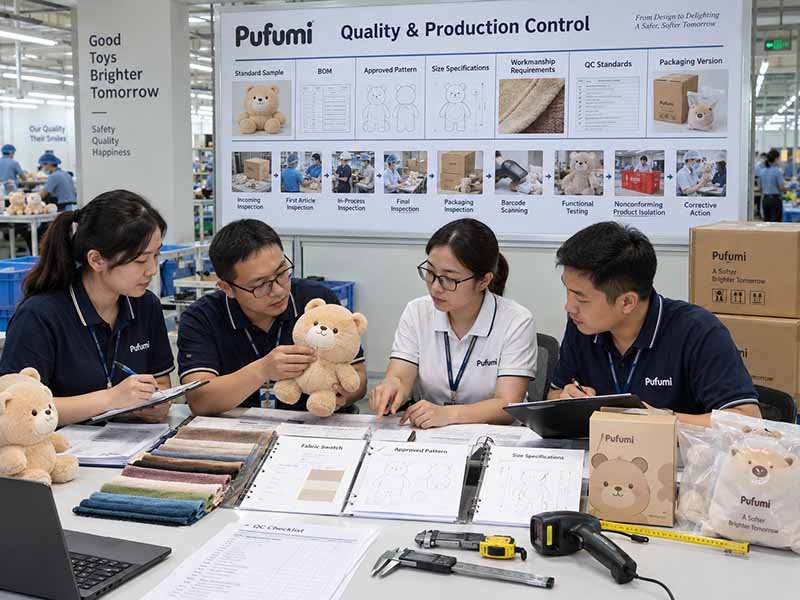
A reliable baby plush manufacturer understands how intended age, construction, materials, testing, sampling, quality control, and traceability work together. The strongest manufacturers identify risks before production, document approved specifications, control changes after testing, and maintain enough production records to reproduce a successful product consistently. For baby plush, reliability is less about making one attractive sample and more about repeating that approved result safely across an entire production run.
Relevant Baby Plush Experience
Years in business are useful, but relevant experience matters more. A factory may have produced stuffed animals for two decades while spending most of that time on promotional mascots, arcade prizes, holiday decorations, or inexpensive gift toys. Baby plush requires a different development mindset because intended age can influence facial construction, decorative accessories, seam locations, filling containment, material selection, washing instructions, labeling, and the eventual testing route.
A capable manufacturer should ask about intended age before recommending construction. For infant-oriented products, embroidered facial features are often evaluated before separate plastic eyes and noses. Decorative bows, cords, bells, beads, buttons, chains, detachable clothing, or other components should not simply be copied from an adult collectible plush design without reviewing how they affect the finished product. Softness matters, but softness alone does not make a material suitable for every baby application.
Pufumi’s internal product framework treats Baby Plush as a distinct product category serving baby-oriented brands, family brands, gift companies, and retailers. Its development priorities include soft fabrics, embroidered facial features, lower-risk construction, care labeling, and intended-age control rather than simply adapting a standard stuffed animal and calling it a baby product.
When qualifying a supplier, a more revealing question is therefore, “Which baby or infant plush structures have you developed, and what did you control differently because of the intended user?” A supplier that can discuss lovey attachments, face embroidery, closing seams, washing behavior, fabric shedding, internal components, and age classification in practical terms is usually providing more useful evidence than one repeating broad claims such as “safe for all children.”
Materials and Construction Control
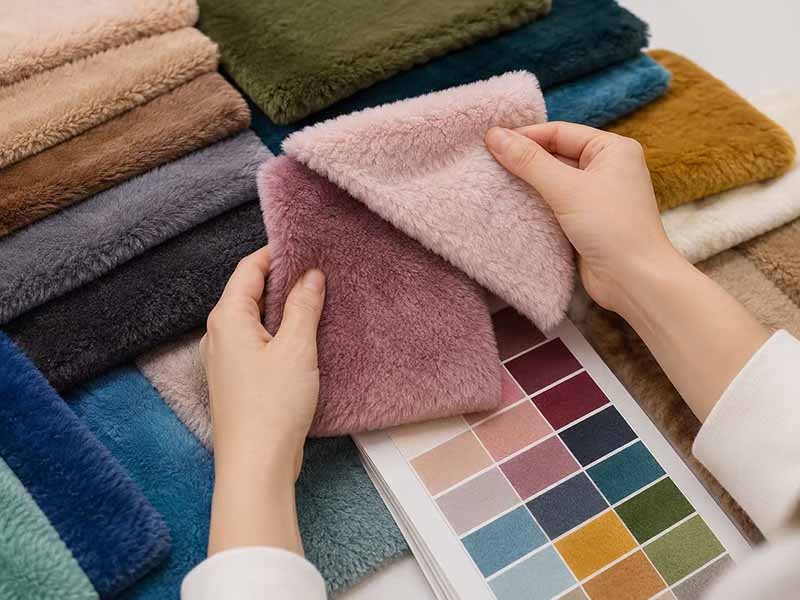
The word “minky” does not describe everything a product developer needs to know about a fabric. Two short-pile fabrics may look similar in a photograph while behaving differently in stretch, backing strength, pile stability, embroidery performance, colorfastness, or washing. Similar considerations apply to fleece, velboa, terry fabrics, embroidery thread, woven labels, printed textiles, filling, crinkle materials, rattle inserts, and decorative components.
A professionally managed project connects the approved material to a product specification or BOM rather than relying on a vague description such as “soft pink plush.” If the original fabric later becomes unavailable, a replacement should not enter mass production merely because the color appears close. Changes in supplier, fiber composition, backing, coating, pile, dye process, or functional components may affect appearance, production behavior, and the relevance of earlier testing.
Construction deserves the same discipline. Baby/Infant projects in Pufumi’s internal age-classification system receive particular attention for small components, plastic eyes and noses, cords, filling leakage, shedding, sharp elements, detachable accessories, cleaning method, labeling, and material-safety boundaries. The documented preference is to evaluate embroidered facial features, softer materials, lower-risk structures, and stricter inspection when the intended age demands greater control.
| Product Area | Practical Control Point | Useful Supplier Evidence |
|---|---|---|
| Facial features | Embroidery, appliqué, or engineered components | Approved artwork and face sample |
| Main fabric | Pile, backing, stretch, shedding, washing | Material specification and supplier record |
| Filling | Type, density, distribution, containment | BOM and approved weight or feel reference |
| Seams | Stress areas, seam allowance, closing seam | Seam map or documented QC criteria |
| Accessories | Accessibility and attachment method | Component list and risk review |
| Care label | Fiber content and cleaning instructions | Approved label artwork |
| Material changes | Replacement after sample or testing | Written change-control procedure |
The practical objective is not to make every baby plush identical in construction. A simple embroidered bear, a lovey, and a plush rattle have different structures. The objective is to make each material and construction decision deliberate, documented, and connected to the intended use instead of allowing the product to evolve through informal substitutions during sampling and production.
Sampling Discipline
The sample room often reveals more about a custom plush manufacturer than the sales presentation. Plush products are highly dependent on pattern interpretation, fabric behavior, embroidery positioning, stuffing, shaping, and manual sewing. A first prototype may therefore look noticeably different from the original artwork even when all requested colors and materials are technically present. The important question is how the manufacturer responds to those differences.
A useful revision process converts subjective feedback into measurable actions. Instead of writing “the face needs to look sweeter,” the team may adjust eye spacing, head width, cheek volume, mouth height, ear angle, embroidery scale, or stuffing density. The next prototype can then be compared with specific revision points rather than judged from memory. This becomes particularly important when several people from design, merchandising, sourcing, licensing, and quality teams participate in approval.
For projects requiring greater control, development may move through an initial sample, revision samples, engineering or material samples, a pre-production sample, and a final Golden Sample. Pufumi documents this staged development approach and uses the approved version together with the BOM, production documents, packaging files, and quality criteria as a basis for mass-production consistency.
The real value of sampling is therefore not simply obtaining one attractive handmade toy. Sampling should gradually remove uncertainty until the factory knows exactly which materials, dimensions, embroidery files, patterns, filling levels, labels, and packaging must be reproduced during mass production. A beautiful sample without a corresponding production specification remains difficult to scale reliably.
Compliance and Traceability
A manufacturer should be careful when discussing compliance because a factory audit, management certification, material document, and finished-product test report are not interchangeable. A test report for one plush design should not automatically be presented as proof that another SKU, fabric combination, accessory configuration, or target market has the same compliance status.
For products sold in the United States and intended for children under three, CPSC rules address small parts that can create choking, aspiration, or ingestion hazards, including parts that may separate during use-and-abuse testing. Market requirements should therefore be considered while the product is being engineered, rather than after thousands of units have already been manufactured.
Pufumi’s internal compliance matrix connects target market, product category, intended age, applicable standards, testing items, responsible party, labeling, certificate requirements, technical documentation, laboratory requirements, and manufacturing support. The same framework recognizes that one product sold in different markets may require different documents, labels, and compliance decisions.
Traceability completes the evidence chain. A useful manufacturing record allows a shipment to be connected to an approved sample, product version, BOM, material batch, production batch, QC information, labels, and packaging. Pufumi’s retention-sample system is designed to compare shipped products with later complaints, production records, Golden Samples, and future reorders, helping identify whether a problem relates to production, transportation, an individual unit, or another cause.
Which Are the 20 Best Baby Plush Manufacturers?

There is no credible universal ranking in which one baby plush factory is automatically better than every other supplier. Product structure, order scale, intended age, destination market, development difficulty, documentation requirements, and retail channel all change the answer. The following 20 manufacturers are better treated as a research shortlist: companies with publicly visible baby-plush, soft-toy, OEM/ODM, development, compliance, or related manufacturing capabilities worth evaluating further.
| Manufacturer | Publicly Visible Strength | Suitable Projects to Evaluate |
|---|---|---|
| Pufumi | Structured development, intended-age review, sample and production control | Brand, retail, multi-SKU baby plush programs |
| Gaodenbao Toys | Baby comforters, rattles, sensory toys, plush and infant products | Infant ranges and mixed soft-product collections |
| Yangzhou Better Toys | Custom baby comforters, OEM manufacturing, published sample and production information | Comforters and conventional baby plush |
| Kinwin Toys | Dedicated baby plush category and OEM/ODM manufacturing | Custom baby stuffed animals |
| Woodfield | Baby soft toys, infant products, substantial sample and production resources | Larger infant-product programs |
| Ken Wang Toys | Baby plushies within broad international OEM/ODM offering | Brand and retail plush programs |
| Mavo Toys | Transparent sampling, development and production information | Development-led custom projects |
| Rayiwell | Plush toys, baby toys and related soft baby products | Plush plus adjacent baby textile ranges |
| Nanjing Babytop | Plush, baby blankets, puppets and customized soft products | Coordinated gift and nursery ranges |
| Zestful World Toys | Public focus on baby plush, comforters and related products | Baby comfort and soft-product projects |
| LovelyJoy | Large OEM/ODM platform and international retail manufacturing | Scaled retail and repeat-order programs |
| CudoraToy | Broad OEM/ODM custom plush manufacturing | General custom baby plush evaluation |
| Bella Plush | Fast custom development and in-house factory positioning | Prototype-driven custom projects |
| DreamPlush | Pattern, embroidery, sewing, stuffing and closing shown in-house | General custom stuffed animals |
| CJL Plush | Structured OEM/ODM workflow with in-line QC | Commercial custom plush programs |
| Plushies4u | Long custom manufacturing history and sizable design resources | Artwork-to-plush development |
| CustomPlushMaker | Custom plush, stuffed animals and cloth baby toys | Custom soft toys and cloth baby products |
| Delsney | Public baby-plush materials and larger custom plush manufacturing system | Retail and brand-level custom plush |
| Plush Factory | OEM/ODM custom plush development and production | General custom stuffed-toy programs |
| PlushCraft | Development, sampling, QC, packaging and delivery support | Character and retail-ready plush projects |
Infant-Focused Manufacturers
Gaodenbao Toys is one of the most visibly infant-oriented companies in this group. Its public product range includes baby comforters, rattles, teethers, stroller toys, sensory products, fabric books, play mats, and plush toys, while the company describes design, sampling, and production resources supporting OEM/ODM programs. That range is particularly relevant to companies developing a coordinated infant assortment rather than a single stuffed bear.
Yangzhou Better Toys publicly provides practical information for customized baby comforters, including customizable materials and packaging, sample development stated at approximately 3–7 days depending on complexity, and typical production information around 45 days on the referenced product pages. Those numbers should be reconfirmed for each live project, but their publication gives sourcing teams a useful starting point for comparing development assumptions.
Woodfield presents an even broader infant-product operation. Its current information references baby soft toys, baby night-light products, bedding accessories, roughly 300 skilled workers, a 30-person sample team, around 19 production lines, and several quality or social-audit systems. The company’s positioning is useful for larger programs that may extend beyond basic stuffed animals into a broader infant product family.
Kinwin, Rayiwell, Nanjing Babytop, Zestful World Toys, and STTY-related product searches also illustrate an important sourcing reality: “baby plush manufacturer” can describe very different businesses. Some focus on conventional stuffed animals, while others combine plush with blankets, educational products, rattles, sensory elements, or nursery accessories. Matching the manufacturer’s existing product language to the planned collection can reduce development friction.
Larger OEM and ODM Operations
Larger manufacturing organizations become more relevant when a program includes many SKUs, multiple seasonal drops, retailer replenishment, strict packaging requirements, or a substantial sampling workload. Capacity should not be judged by a single headline number, however. A company with many sewing lines can still struggle if the sample room, material purchasing, production floor, and QC team are not working from the same approved specification.
LovelyJoy publicly presents more than 20 years of industry experience and a large in-house operation, including references to a 20,000-square-meter facility, more than 300 workers, over 50 designers, and monthly output above 800,000 pieces on its manufacturer page. These are company-published figures and should be verified during qualification, but they make the company relevant when comparing higher-capacity retail suppliers.
Ken Wang Toys similarly positions itself around international OEM/ODM work, custom stuffed animals, baby plushies, and a broad range of factory, product, and material certifications or audit references. For a sourcing team, the important next step is not simply collecting those logos. It is confirming which certificates belong to the actual production facility, whether they remain valid, and whether the exact materials and product version being ordered are covered by the relevant documentation.
Large operations can be highly effective when repeat production and capacity planning matter, but the practical question remains the same: who owns the project internally? The strongest factory should be able to explain which team handles sampling, which production line is assigned, who approves material changes, how first production units are checked, and how information from the Golden Sample reaches the operators building thousands of pieces.
Development-Led Suppliers
Some factories deserve attention because their public information reveals more about sampling and engineering than about headline production scale. Mavo Toys, for example, currently publishes a standard MOQ starting around 500 pieces per design, approximately 10–15 business days for sampling, 10 production lines, and more than 15 designers and pattern makers. These are supplier-published figures rather than industry standards, but they help customers compare the operating model before requesting detailed quotations.
Plushies4u emphasizes its development resources even more strongly. The company says it has operated since 1999 and currently references two factories, 28 designers, more than 300 workers, and capacity of up to 600,000 plush toys per month. Its positioning around artwork-to-prototype development may be useful for projects where shape interpretation and repeated sample revisions are more demanding than the sewing operation itself.
Bella Plush and DreamPlush are examples of factories presenting relatively direct, easy-to-understand development workflows. Bella publicly references more than ten years in plush manufacturing, more than 2,000 custom designs, and seven-day sample positioning, while DreamPlush shows pattern work, laser cutting, sewing, embroidery, stuffing, and closing operations as part of its internal process. These claims still require project-level verification, but they provide useful questions for a supplier audit or video factory review.
Development ability becomes especially important for baby products because many problems are cheapest to solve at the pattern and prototype stage. A hard component can be redesigned, a seam can be relocated, pile height can be reduced, or a facial feature can be converted to embroidery before bulk materials are purchased. Once thousands of units are cut and sewn, the same decision becomes much more expensive.
How to Use the List
The purpose of a 20-company comparison is not to send the same vague message to twenty salespeople and choose the lowest price. A more effective process gradually reduces the shortlist while increasing the quality of information requested. Public websites can establish whether a factory appears relevant, but project qualification should rely on current documents, comparable product experience, actual samples, production discussions, and clear written specifications.
An established product team might begin by reviewing 15–20 possible manufacturers, request structured capability information from perhaps 6–10, develop detailed quotations with 3–5, and proceed to paid prototypes with the suppliers that demonstrate the strongest fit. Those figures are not an industry rule, but the funnel illustrates an important point: deeper due diligence should be concentrated on a smaller group rather than spread thinly across dozens of companies.
Pufumi fits this list differently from a generic wholesale supplier because its internal positioning centers on enterprise-level plush development, manufacturing coordination, project management, and supply-chain integration. Its objective fact library explicitly states that the brand is intended for companies with product plans, quality requirements, distribution channels, and longer-term commercial potential rather than single-piece or ready-stock purchasing.
Whichever supplier reaches the final shortlist, request evidence that matches the actual project. A certificate from an unrelated factory, a test report for a different material, or a photograph of a product made years ago is weaker evidence than a current prototype, traceable BOM, relevant laboratory plan, written QC criteria, and clearly identified production facility.
Which Baby Plush Products Can Be Customized?

Baby plush manufacturing covers much more than teddy bears. Common custom formats include stuffed animals, loveys, comforters, plush rattles, sensory toys, soft dolls, nursery characters, and coordinated gift sets. Each format creates different material and structural questions. As components, fabrics, functions, and packaging become more complex, the development process should become more detailed rather than relying on one generic plush-toy specification.
Baby Stuffed Animals
The classic baby stuffed animal remains one of the most versatile formats because it can support animals, original characters, licensed designs, nursery themes, and gift collections. Despite the familiar appearance, dimensions and proportions have significant manufacturing effects. A small rabbit may require simplified facial embroidery and shorter limbs, while a larger bear provides more space for detail but consumes more fabric, filling, packaging volume, and shipping capacity.
Small products can actually be more difficult to engineer consistently. Fine embroidered details may become crowded, narrow limbs can be difficult to turn and fill, short seam curves may distort, and long-pile fabric may visually swallow features that looked clear on the original drawing. A good pattern maker understands when a two-dimensional design must be simplified slightly so that the physical product remains recognizable after sewing and stuffing.
Stuffing is another design variable rather than a generic production step. A very soft fill may create the intended cuddly hand feel but allow the face or body to collapse. Excessive fill may preserve shape but create a product that feels harder than expected and places more tension on seams. The approved sample should therefore establish both appearance and an appropriate filling reference for production.
Traditional teddy-bear styling also requires careful interpretation for baby-oriented products. Decorative plastic eyes, bows, buttons, attached garments, or accessories that are common on older-child or collectible plush should not automatically carry over into an infant design. Product style should be adapted to the intended-age strategy instead of forcing a familiar decorative formula onto every teddy bear.
Comforters and Loveys
Baby loveys and comforters generally combine a small plush character or head with a flat, lightly structured textile body. Their simplicity makes them commercially attractive, but the transition between the stuffed portion and blanket section creates an important stress area that should be engineered deliberately. Repeated holding, pulling, washing, and twisting can place pressure on precisely the point where the two structures meet.
Material combinations also need careful consideration. The character head may use short-pile minky or another plush surface, while the blanket body may use a lighter textile with a different stretch rate and washing behavior. When two fabrics shrink, stretch, or dry differently, the finished item can distort over repeated cleaning cycles. Evaluating materials together is therefore more useful than approving each swatch independently.
Labels deserve early planning because a lovey is designed around softness and hand feel. A poorly positioned care label or thick branding label can become one of the stiffest parts of the product. Integrating the label location into the pattern before the sample is finalized generally produces a more intentional result than deciding where to sew it after the design has already been approved.
Public baby-product manufacturers demonstrate the range of possible formats. Gaodenbao includes comforters and rattles among its core infant categories, while Yangzhou Better Toys publishes customizable baby-comforter specifications involving plush fabrics, cloth, filling options, embroidery or labels, and several packaging formats.
Rattles and Sensory Plush
Adding sound, crinkle material, textured panels, teething elements, squeakers, loops, or other sensory features transforms a simple stuffed product into a more complicated assembly. Every additional component should appear in the BOM with its approved supplier or specification, intended position, attachment or enclosure method, and any relevant testing consideration. Hidden components matter precisely because they cannot be inspected easily by a consumer once the toy has been closed.
A plush rattle illustrates the issue clearly. The sound element needs to remain enclosed while still producing a useful acoustic result. Its position can affect balance and hand feel, and its size can influence the surrounding pattern. If the component changes after sampling, the new version should not be treated as interchangeable merely because it makes a similar sound.
Sensory products require a similar discipline. Different textures may improve tactile interest, but every fabric introduces another material source and another seam interface. Crinkle film adds a hidden layer. Loops or ribbons create additional attachment areas. A squeaker introduces an internal component. A good product-development team evaluates whether each feature delivers enough consumer value to justify its added manufacturing and quality-control complexity.
Gaodenbao’s public range includes activity and sensory toys with fabric books, crinkle details, contrasting patterns, and other infant-oriented features, illustrating how far a baby soft-product program can extend beyond a conventional stuffed animal. For brands planning similar products, the key is to assess each added feature as an engineered component rather than a decorative afterthought.
Nursery Products and Gift Sets
A baby gift set may combine a stuffed animal, lovey, blanket, soft book, rattle, printed card, and retail box into one coordinated presentation. From a merchandising perspective, it looks like a single product. From a manufacturing and compliance perspective, it can contain several different products with separate materials, labels, component lists, and test considerations.
Packaging should therefore begin early. A box designed before final product dimensions are stable can become too tight after filling density changes or too loose after a sample is softened. Windows, paper inserts, ribbon closures, product restraints, barcode labels, language versions, warning information, and shipping cartons all interact with the physical dimensions of the finished products.
Product classification also deserves attention. A nursery decoration is not automatically equivalent to a toy intended for direct infant use, yet simply describing an obviously child-oriented plush as “decorative” does not necessarily remove applicable obligations. Intended use, marketing, appearance, packaging, and sales channel can all contribute to how the product is evaluated.
Nanjing Babytop’s public range combines plush products with baby blankets and other soft goods, while Rayiwell also presents baby toys alongside blankets and related baby textile accessories. These supplier structures can be useful when a brand wants coordinated soft products from fewer manufacturing partners, provided the technical and compliance requirements of each individual item remain clearly separated.
How Do Manufacturers Make Baby Plush Safer?

Baby plush safety is created through product decisions long before final inspection. Manufacturers reduce risk by reviewing small and detachable parts, choosing appropriate facial construction, controlling seams and filling, evaluating fabric behavior, documenting internal components, and preparing market-specific testing before mass production. Laboratory testing is important where applicable, but it should confirm a carefully engineered product rather than expose basic design problems after production has already begun.
Small Parts and Hard Components
Small-part control starts with identifying every component rather than assuming that a mostly textile product is automatically low risk. Plastic eyes, noses, buttons, bells, beads, charms, snaps, zipper pulls, metal accessories, decorative pieces, and some internal components can alter the product’s risk profile. Even when a component begins securely attached, the surrounding structure and its behavior during use also matter.
The U.S. CPSC explains that products intended for children under three can be prohibited when small parts create choking, aspiration, or ingestion hazards. Its guidance also notes that a small part can be an entire object, a separate component, or a piece that breaks away during testing intended to simulate use and abuse.
For this reason, a technical review should ask more than whether a plastic eye has a secure backing. The development team should ask whether the feature is necessary, what happens if the surrounding fabric tears, whether a lower-risk construction can produce the same expression, and whether the final structure matches the intended-age strategy.
Pufumi’s internal Baby/Infant guidance gives particular attention to small components, plastic eyes and noses, cords, detachable elements, exposed filling, and other structural risks. In practice, simplifying an unnecessary component before sampling is usually easier than trying to engineer around a questionable feature after the aesthetic design has already been approved.
Embroidered Facial Features
Embroidery is especially useful for baby plush because it can create eyes, noses, mouths, eyebrows, cheeks, facial patterns, logos, and character details without requiring many separate hard components. It also gives designers more control over expression than standard plastic eyes, which is important when a brand needs a recognizable character face rather than a generic teddy-bear appearance.
The manufacturing challenge is precision. On a small plush face, a few millimeters of movement in eye spacing, eye height, pupil direction, or mouth position can change the character noticeably. The approved embroidery file and placement therefore need to become part of the production specification instead of being recreated informally by the embroidery department when bulk manufacturing begins.
Thread density also deserves attention. Very dense embroidery can stiffen a small fabric panel or cause puckering, while insufficient density can make the design look weak. Fabric pile length affects visibility, and backing materials can change hand feel. Those variables should be resolved during sampling and then locked for production.
Pufumi’s embroidery framework specifically identifies Baby Plush as a category where embroidered facial features are frequently preferable when hard eyes and noses are less suitable for the intended age or safety boundary. The benefit is therefore both visual and structural: embroidery can preserve character expression while reducing the number of separate facial components.
Seams, Filling, and Fabric
The most important seam on a plush toy is often the one consumers never notice. Pattern panels are sewn together, the body is turned, filled, shaped, and then the stuffing opening is closed. That final closure needs to be accessible enough for efficient manufacturing while remaining strong, visually discreet, and suitable for the expected handling and cleaning of the product.
Other high-stress areas can include the neck, ear bases, tails, narrow limbs, blanket-to-head connections, and any area attached to a secondary element. Pufumi’s internal seam-management guidance gives Baby Plush additional attention for seams that could open, hidden hard components, loose parts, and exposure of filling.
Filling should also be treated as a controlled specification. Too little filling can make the head collapse, shift embroidery visually, or create an underfilled appearance. Too much can make the product unexpectedly firm and increase tension on seams. A target filling weight, approved feel reference, or another practical production standard helps reduce variation across the order.
Fabric safety discussions should extend beyond the phrase “soft material.” Pile shedding, fiber behavior, backing strength, stretch, colorfastness, embroidery performance, chemical documentation, and washing should all be considered where relevant. A visually similar replacement fabric can behave differently after repeated cleaning or during sewing, which is why material substitutions require structured review.
| Risk Area | Common Manufacturing Concern | Practical Control |
|---|---|---|
| Stuffing opening | Seam opens after handling | Defined closing method and inspection |
| Ear, limb, or tail base | Repeated pulling stresses joint | Appropriate seam reinforcement |
| Filling | Leakage or inconsistent firmness | Approved filling type and target |
| Long-pile fabric | Shedding or hidden embroidery | Material and wash evaluation |
| Facial embroidery | Puckering or position drift | Locked program and placement reference |
| Internal rattle or insert | Movement or accessibility | Defined position and enclosure |
| Material replacement | Different behavior or test relevance | Formal change review before use |
The main lesson is that quality control cannot repair poor engineering efficiently. An inspector may identify an open seam, but that does not solve a seam placement that repeatedly fails. The safer and more economical approach is to understand where the product will be stressed and design the pattern, seam, filling, and material system accordingly.
Testing and Change Control
Testing is meaningful only when the tested sample represents the product that will actually be produced and sold. A brand can spend time and money testing one configuration, then unintentionally weaken the value of that work by approving a different fabric, print, accessory, coating, filling, or internal component before production without reconsidering whether the earlier results remain relevant.
Pufumi’s compliance rules explicitly state that material changes should trigger a new review of testing applicability and that one report should not automatically be assumed to cover all SKUs, markets, and orders. This is a useful principle for any baby plush program because seemingly small production substitutions can affect the technical basis of a product.
Market differences add another layer. In the United States, applicable children’s products can require third-party testing and certification pathways tied to CPSC requirements, while U.S. small-parts rules are particularly relevant to products intended for children under three. EU-market projects follow their own toy-safety, technical-documentation, labeling, and conformity-assessment framework, so a responsible manufacturer should avoid presenting one generic “international certificate” as a universal solution.
Change control therefore belongs beside testing rather than inside a separate administrative process. If production proposes a new thread, fabric, accessory, supplier, or packaging component, the project team should determine whether appearance, quality, compliance documentation, or testing needs to be reviewed before the substitution is accepted.
What Should You Compare Before Choosing?
Compare manufacturers on relevant baby-product experience, engineering, sampling, material control, compliance support, bulk consistency, traceability, packaging, communication, and commercial fit. Price comparisons become meaningful only when suppliers are quoting essentially the same product and responsibilities. A lower quote may simply exclude stronger materials, testing coordination, packaging requirements, inspection work, or other elements included by a more comprehensive manufacturer.
Supplier Qualification
One of the simplest ways to evaluate a manufacturer is to pay attention to the questions it asks before quoting. An experienced supplier should want enough information to understand the product, including artwork, size, estimated quantity, SKU structure, intended age, destination market, material direction, functional features, packaging, and launch timing. A precise quotation is difficult when those variables are unknown.
If a product is clearly intended for infants and the supplier never asks about intended age or destination market, further qualification is reasonable. Similarly, a statement such as “we have all certificates” should lead to more specific questions about the facility, document validity, product version, and materials involved. Strong suppliers are usually comfortable explaining the limits of a document instead of suggesting that one certificate automatically covers every future project.
Factory audits also need context. Confirm the legal company name, production location, audit date, applicable facility, and scope. When a supplier operates more than one factory or uses partner facilities, identify where the actual product will be sampled, embroidered, sewn, filled, inspected, and packed.
Pufumi’s objective fact library deliberately separates the Shenzhen Oneier operating entity, the Pufumi brand, invested manufacturing resources, core factory resources, and specialist supply partners instead of claiming that every production step happens inside one undifferentiated facility. That kind of clarity is useful when comparing any manufacturing organization because it tells the customer which party controls each part of the project.
Sampling to Bulk Production
The transition from sample room to mass production is one of the most important control points in custom plush manufacturing. A skilled sample maker may manually adjust seam shapes, stuffing, facial positioning, or fabric direction until one prototype looks excellent. Bulk production cannot depend on that person making thousands of individual judgment calls. Those decisions need to be translated into repeatable production information.
A useful production package can include the Golden Sample, BOM, pattern version, dimensions, embroidery file, printing file, material references, filling specification, accessory details, care label, hangtag, retail packaging, carton information, and quality criteria. The exact documentation depends on product complexity, but the principle is consistent: the factory floor should not be guessing what the customer approved.
Pufumi documents production-ready master data that is updated throughout sampling and frozen after Golden Sample approval, with later specification changes managed rather than casually entering production. That approach is especially useful for baby plush because the product can involve safety-sensitive details that should not drift after the sample has been reviewed.
First-piece and in-line inspection can catch problems while correction is still manageable. If an embroidery position begins drifting three millimeters after production setup, discovering the problem during the first dozens of pieces is far better than identifying it during final inspection after several thousand units have already been completed.
Quality and Traceability
A practical quality system follows the product through manufacturing rather than waiting for finished cartons. Incoming materials, embroidery, printed parts, cutting, sewing, filling, closing seams, labels, accessories, functional components, finished appearance, retail packaging, and carton information can all create defects that are easier to correct at different stages of production.
The exact checkpoints should match the product. A simple baby rabbit with embroidered eyes does not require the same functional checks as a plush rattle, sensory cube, electronic night-light plush, or multi-item gift set. The QC plan should therefore emerge from the product’s construction and intended use rather than being copied from a generic factory checklist.
Traceability becomes critical when something changes after shipment. If a customer reports a color difference, open seam, incorrect label, or unusual hand feel, the manufacturer should be able to identify the relevant production batch and compare it with the approved specification. Retention samples can be particularly useful because they represent what was actually shipped rather than what was approved months earlier in the sample room.
Pufumi uses retention samples together with customer photographs, Golden Samples, production records, QC information, and shipment batches when investigating complaints and comparing repeat orders. This kind of record keeping becomes increasingly valuable as a brand moves from one successful launch to repeated replenishment across several seasons.
Commercial Fit
The technically strongest factory is not automatically the right commercial partner if its operating model does not fit the order. MOQ should be discussed at the level of design, color, size, fabric, and packaging version rather than looking only at the total number of pieces across a collection.
Pufumi’s internal commercial framework uses approximately 500 pieces per SKU as an important evaluation reference for many core plush projects, while some mini plush, keychain, bag charm, or complex packaging programs may operate more efficiently around 1,000 pieces per SKU depending on product structure and material requirements. These are internal project guidelines rather than universal industry rules.
Other manufacturers publish different commercial structures. Kinwin currently states a standard MOQ around 500 pieces, Mavo publishes MOQ positioning from 500 pieces per design, Yangzhou Better Toys lists 3,000 pieces on referenced baby-comforter pages, and Plushies4u publicly presents a lower 100-piece MOQ. These differences illustrate why there is no single “industry MOQ” for baby plush.
Lead time should also be separated into development, material sourcing, testing, packaging, mass production, inspection, and transportation. A statement such as “30-day lead time” has little value unless everyone agrees when the count begins and which stages are included. The most suitable supplier is the one whose development system, production economics, capacity, and communication rhythm match the project—not simply the factory displaying the smallest MOQ or fastest headline date.
How Do You Start a Baby Plush Project?
A baby plush project should begin with a practical brief covering artwork, dimensions, intended age, destination market, estimated quantity, materials, functions, packaging, and launch timing. The manufacturer can then review feasibility, build and revise prototypes, approve materials, establish the Golden Sample and production documents, coordinate applicable testing and labels, and release mass production only after the specification is sufficiently stable.
Project Brief and Feasibility
A useful project brief does not need to be an elaborate technical pack at the beginning, but it should answer the questions that materially affect development. Front, side, and back artwork are valuable when available. If only one view exists, clearly identify the features that cannot change and allow the sample team to propose reasonable construction for the unseen areas.
Dimensions should be defined using a clear measurement method. “Twenty centimeters” could refer to seated height, total head-to-foot height, body length, or another dimension depending on the design. Quantity should also include SKU distribution because 6,000 pieces of one bear is a different manufacturing problem from 6,000 pieces divided among twelve characters, each using separate fabrics or embroidery programs.
Intended age and destination market belong in the first project conversation rather than being added when testing begins. Packaging should also be mentioned early, particularly when the item will enter major retail, Amazon fulfillment, a premium gift box, or a multi-product set. Those requirements can affect labels, finished dimensions, carton quantity, and total project cost.
Pufumi’s Feasibility Review is documented as a cross-functional evaluation of design, structure, materials, process, cost, lead time, packaging, and compliance before formal production development advances. More complex projects, including Baby Plush, receive broader cross-department review because decisions in one area can create problems elsewhere.
Prototype and Revision
The first prototype is not a pass-or-fail exam for the manufacturer. It is a physical interpretation of the available information and should expose where the design needs refinement. A flat illustration does not reveal exactly how the cheeks should project, how much the head should compress when filled, where a seam should turn around an ear, or how a chosen pile height will affect the apparent size of an embroidered eye.
Useful feedback is specific. “Make the face cuter” can mean many things. “Increase cheek width by approximately 5 mm on each side, lower the eyes slightly, reduce mouth width, and soften the head filling” gives the sample team a more reproducible direction. Photographs marked with arrows, measurement notes, and side-by-side comparisons are far more effective than scattered comments across several chat messages.
Each sample should have a version identifier, especially when multiple departments are commenting. A licensing manager may approve the character expression while a compliance specialist asks for a component change and a packaging team adjusts the product restraint. Without version control, an old instruction can easily reappear in a later prototype.
Pufumi’s documented sampling path can include initial samples, Revision Samples, Engineering Samples, Pre-Production Samples, and Golden Samples, with each stage helping confirm appearance, proportion, materials, process, packaging, and production feasibility. The number of iterations should depend on complexity rather than an arbitrary target.
Production Release and Quality Control
Once the approved version is stable, the information that made the sample successful needs to move into production. This may include the final pattern, material BOM, embroidery program, printing artwork, product dimensions, filling target, accessory specification, care label, hangtag, packaging file, carton details, and QC criteria.
The Golden Sample is particularly useful because it provides a physical reference for shape and hand feel that cannot always be captured perfectly in numbers. However, a physical sample without documentation is not enough for complex repeat production. Materials may become unavailable, embroidery files may be updated, or packaging can change between seasons. Written data allows the team to understand what the sample represents.
Production should begin with early verification against those references. Incoming materials can be checked before cutting, embroidery can be reviewed before thousands of panels are produced, and first sewn units can be compared with the approved shape. Filling consistency, closing seams, labels, and packaging should then be monitored at the appropriate stages rather than postponed until final inspection.
Pufumi’s quality framework ties mass production to approved samples, BOMs, process files, packaging files, quality standards, and inspection records. This reduces the familiar problem where a customer approves an excellent sample but receives bulk goods that have gradually shifted in material, face position, stuffing, or packaging.
Testing, Packaging, and Reorders
Testing should be coordinated with the actual product version rather than treated as a final administrative step. Once the specification is sufficiently stable, the responsible parties should determine the applicable market requirements, laboratory, sample quantity, labeling information, and technical documents. The test samples should represent the materials and components planned for commercial production.
Packaging development should proceed on the same controlled timeline. Care labels, fiber information, country-of-origin information, importer or responsible-party details, warnings where applicable, copyright text, barcode data, hangtags, retail boxes, and master-carton markings should have their own approval status. Product approval does not automatically mean every piece of packaging text is correct.
Multi-market programs benefit even more from version control because the physical plush may remain almost identical while languages, warnings, labels, barcodes, importer details, or documents differ between regions. Pufumi’s compliance framework recognizes that the same product sold into different target markets can require different testing, labeling, certificate, and responsible-party information.
Reorders should begin by comparing the new production plan with the last approved and shipped version. Materials, colors, filling, embroidery, labels, packaging, and carton specifications should be checked rather than assumed. Successful plush products often remain in a retailer or brand assortment for several years, so the manufacturer’s ability to retrieve accurate records can become more important than how quickly the original sample was produced.
A good baby plush manufacturing relationship ultimately becomes quieter over time. The first project may involve many questions, material decisions, revisions, tests, and packaging discussions. When the technical records are strong, the second and third orders should require less explanation because both sides already have an approved product language. That is one of the clearest signs that the manufacturer is functioning as a long-term production partner rather than simply repeating individual purchase orders.
Choosing among the best baby plush manufacturers therefore comes down to evidence. Attractive samples matter, and competitive pricing matters, but neither should stand alone. The more durable signals are relevant infant-product experience, sensible questions during feasibility review, controlled materials, clear sample revisions, disciplined production transfer, appropriate testing support, traceable QC records, and a reliable process for reproducing the same product months later. A manufacturer that can demonstrate that chain is much easier to trust with a baby-oriented retail program.
For companies developing a custom baby stuffed animal, lovey, comforter, rattle, sensory product, or coordinated collection, it is useful to send shortlisted manufacturers the same structured brief and compare their responses before comparing final prices. The suppliers that identify real design, material, testing, packaging, and production questions early are often the ones most capable of preventing those same questions from becoming expensive problems after mass production begins.
What materials are commonly used for baby plush toys?
Baby plush products commonly use short-pile plush, minky, velboa, fleece, terry-type fabrics, cotton-based textiles, polyester fiberfill, embroidery thread, woven or printed care labels, and other soft materials selected according to the product design. The correct choice depends on intended age, destination market, washing requirements, desired hand feel, embroidery compatibility, shedding behavior, and applicable material documentation rather than on fabric softness alone.
Are embroidered eyes better for baby plush toys?
Embroidered eyes are often preferred for infant-oriented plush because they can create detailed facial expressions without adding separate hard eye components. They still require controlled thread density, backing, placement, and finishing, so embroidery should not be treated as automatically risk-free. Pufumi’s internal Baby Plush framework specifically favors evaluating embroidered facial features when hard eyes or noses are less appropriate for the intended age or safety boundary.
Which safety standards apply to baby plush toys?
The applicable requirements depend on the destination market, intended age, product classification, materials, and construction. U.S. children’s toys can involve ASTM F963-related requirements, CPSIA requirements, third-party testing, certification, and small-parts rules, while EU projects follow their own toy-safety, EN-standard, conformity, labeling, and technical-documentation pathways. A manufacturer should therefore ask where the product will be sold before describing the required testing plan.
What information should I send a baby plush manufacturer?
A useful initial brief should include character artwork or reference images, finished dimensions, intended age, target countries, estimated quantity, number of SKUs, material preferences, special functions, embroidery or branding requirements, packaging format, target launch date, and any retailer-specific standards. Providing this information allows the manufacturer to evaluate feasibility and cost drivers rather than preparing a quotation based on assumptions that may change during sampling.
How long does custom baby plush sampling usually take?
There is no single industry-wide sample time because complexity, material availability, embroidery, accessories, revisions, and packaging can significantly change development. Current manufacturers publicly advertise ranges from approximately 3–7 days for certain Yangzhou Better Toys baby-comforter projects to around 10–15 business days at Mavo Toys, while other suppliers use different timelines. These published figures should be treated as supplier-specific references and reconfirmed against the exact design.
How should I compare baby plush manufacturer quotations?
Compare quotations only after confirming that the suppliers are pricing substantially the same product. Check the finished size, fabric specification, filling, embroidery, accessories, labels, packaging, inspection scope, testing assumptions, sample charges, MOQ basis, production lead time, Incoterm, and any excluded costs. A quotation can appear significantly cheaper because it assumes a different material, simpler packaging, fewer quality-control steps, or excludes testing and development work rather than because the factory is inherently more efficient.
Can a tested baby plush product change materials before production?
Material changes can sometimes be made, but they should not happen automatically after testing. A replacement fabric, thread, filling, print, coating, accessory, or internal component may alter product behavior or affect whether previous documentation remains applicable. Pufumi’s internal compliance rules require material changes to trigger a review of test applicability and explicitly avoid assuming that one existing report automatically covers every product version, SKU, market, or future order.